EMRIs, Kicks & Tails from Black Hole Perturbation Theory (using - - PowerPoint PPT Presentation

emris kicks tails from black hole perturbation theory
SMART_READER_LITE
LIVE PREVIEW

EMRIs, Kicks & Tails from Black Hole Perturbation Theory (using - - PowerPoint PPT Presentation

EMRIs, Kicks & Tails from Black Hole Perturbation Theory (using GPUs) Gaurav Khanna Associate Professor, UMass Dartmouth 7/29/15 AEI Golm 1 Collaborators & Support Alessandra Buonanno, AEI Golm Lior Burko, Georgia G. College


slide-1
SLIDE 1

7/29/15 AEI Golm 1
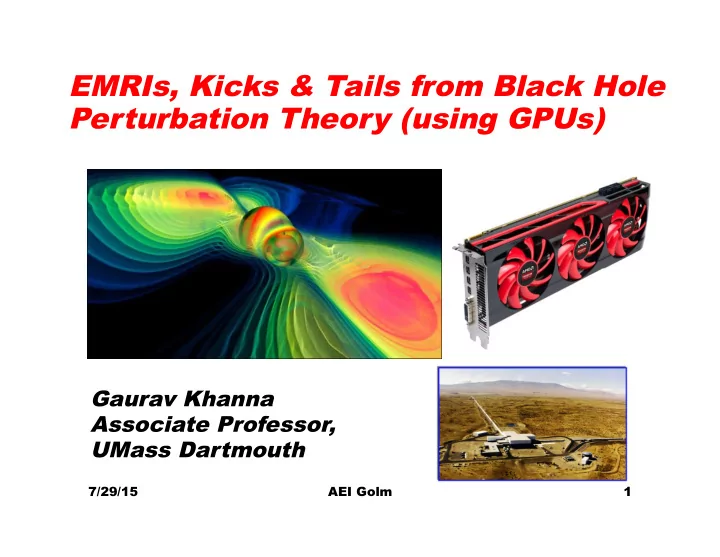
EMRIs, Kicks & Tails from Black Hole Perturbation Theory (using GPUs)

Gaurav Khanna Associate Professor, UMass Dartmouth

slide-2
SLIDE 2

Collaborators & Support

  • Alessandra Buonanno, AEI Golm
  • Lior Burko, Georgia G. College
  • Scott Hughes, MIT
  • Richard Price, UTexas / UMassD
  • P. Sundararajan, MIT, Morgan-Stanley
  • Andrea Taracchini, AEI Golm
  • Anil Zenginoglu, UMaryland

Funding: National Science Foundation

7/29/15 2 AEI Golm

slide-3
SLIDE 3

7/29/15 AEI Golm 3

Talk Outline

  • EMRIs using BH perturbation theory
  • Teukolsky equation solver with

particle-source in the time-domain

  • Waveforms and kicks & anti-kicks
  • Scalar-field “tails” in BH spacetimes
  • Kerr BH “tails” controversy
  • Computing with gaming devices
  • OpenCL / GPU computing
  • Summary and Future Outlook
slide-4
SLIDE 4

Kerr (rotating) black hole perturbation theory

  • Write Einstein’s GR field equations to linear
  • rder expanding about a BH solution
  • Teukolsky equation -- a wave-equation like

PDE that describes how generic fields (scalar, vector, tensor) in the space-time of a Kerr BH behave (propagate/evolve)

  • In the gravitational field context --

describes the behavior of GWs emitted from Kerr black holes

  • Relatively simple: linear, hyperbolic, (3+1)D

PDE .. (can be reduced down to (2+1)D)

7/29/15 4 AEI Golm

slide-5
SLIDE 5

Teukolsky equation

Here -- a: spin of the Kerr black hole M: mass of the Kerr black hole s: spin-weight of the field considered (s is -2 for outgoing GWs)

7/29/15 5 AEI Golm

slide-6
SLIDE 6

EMRI

7/29/15 6 AEI Golm

EMRI: Extreme-Mass Ratio (binary) Inspiral

slide-7
SLIDE 7

Point-like compact

  • bject ..
  • Source of the GWs (perturbation) in EMRI

is the inspiraling compact object

  • How to model a point-like compact object

(technically a Dirac-delta function) on a numerical (finite-difference) grid?

  • Obvious approach would be to take a

narrow Gaussian distribution; do several runs with successively narrower profiles; take some sort of a limit ..

  • Decent results, but very expensive

7/29/15 7 AEI Golm

slide-8
SLIDE 8

Discrete Dirac-delta

  • Alternative approach to representing Dirac-

delta on numerical finite-difference grid

  • Particularly well suited for numerical

computation (time-domain, finite-difference)

  • Work done in collaboration with Pranesh

Sundararajan & Scott Hughes (MIT)

  • Excellent (highly accurate) results
  • Extremely efficient (by over an order-of-

magnitude)

7/29/15 8 AEI Golm

slide-9
SLIDE 9

7/29/15 9 AEI Golm

slide-10
SLIDE 10

Teukolsky Equation

7/29/15 10 AEI Golm

slide-11
SLIDE 11

7/29/15 11 AEI Golm

slide-12
SLIDE 12

“source-term” T4

s4 = 1.D0/2.D0 s6 = 1/(r**2+a**2*ctheta**2) s9 = r**2+a**2 s12 = (r+cmplx(0.D0,1.D0)*a*ctheta)/(r**2+a**2*ctheta**2)*sqrt(2.D #0)*(a*stheta*nmu/rp**5*sqrt(2.D0)/dtdT*(E*(a**2+rp**2)-a*lz)*(a*E- #lz)/pie**2/wr*exp(-(r-rp)**2/wr**2/2)/wt*exp(-ctheta**2/wt**2/2)*m #m**2*dphidt**2*exp(cmplx(0.D0,-1.D0)*mm*phip)/16-nmu/rp**5*sqrt(2. #D0)/dtdT*(E*(a**2+rp**2)-a*lz)*(a*E-lz)/pie**2/wr*exp(-(r-rp)**2/w #r**2/2)/wt**3*ctheta*stheta*exp(-ctheta**2/wt**2/2)*mm*dphidt*exp( #cmplx(0.D0,-1.D0)*mm*phip)/16-1/stheta*nmu/rp**5*sqrt(2.D0)/dtdT*( #E*(a**2+rp**2)-a*lz)*(a*E-lz)/pie**2/wr*exp(-(r-rp)**2/wr**2/2)/wt #*exp(-ctheta**2/wt**2/2)*mm**2*dphidt*exp(cmplx(0.D0,-1.D0)*mm*phi #p)/16)/2 s13 = cmplx(0.D0,1.D0/8.D0)*a*(r+cmplx(0.D0,1.D0)*a*ctheta)/(r**2+ #a**2*ctheta**2)**2*(r+cmplx(0.D0,-1.D0)*a*ctheta)*stheta*nmu/rp**5 #/dtdT*(E*(a**2+rp**2)-a*lz)*(a*E-lz)/pie**2/wr*exp(-(r-rp)**2/wr** #2/2)/wt*exp(-ctheta**2/wt**2/2)*mm*dphidt*exp(cmplx(0.D0,-1.D0)*mm #*phip)-(cmplx(0.D0,1.D0/2.D0)*a*(r+cmplx(0.D0,1.D0)*a*ctheta)**2/( #r**2+a**2*ctheta**2)**2*stheta*sqrt(2.D0)-(r+cmplx(0.D0,1.D0)*a*ct #heta)/(r**2+a**2*ctheta**2)/tan(th)*sqrt(2.D0)/4)*nmu/rp**5*sqrt(2 #.D0)/dtdT*(E*(a**2+rp**2)-a*lz)*(a*E-lz)/pie**2/wr*exp(-(r-rp)**2/ #wr**2/2)/wt*exp(-ctheta**2/wt**2/2)*mm*dphidt*exp(cmplx(0.D0,-1.D0 #)*mm*phip)/8 s11 = s12+s13 s12 = s11-1/(r**2+a**2*ctheta**2)*((r**2+a**2)*nmu/rp**4/dtdT*(a*E #-lz)**2/pie**2/wr*exp(-(r-rp)**2/wr**2/2)/wt*exp(-ctheta**2/wt**2/ #2)*mm**2*dphidt**2*exp(cmplx(0.D0,-1.D0)*mm*phip)/8+cmplx(0.D0,1.D #0/8.D0)*(r**2+a**2-2*M*r)*nmu/rp**4/dtdT*(a*E-lz)**2/pie**2/wr**3* #(r-rp)*exp(-(r-rp)**2/wr**2/2)/wt*exp(-ctheta**2/wt**2/2)*mm*dphid #t*exp(cmplx(0.D0,-1.D0)*mm*phip)-a*nmu/rp**4/dtdT*(a*E-lz)**2/pie* #*2/wr*exp(-(r-rp)**2/wr**2/2)/wt*exp(-ctheta**2/wt**2/2)*mm**2*dph #idt*exp(cmplx(0.D0,-1.D0)*mm*phip)/8)/2 s13 = s12+cmplx(0.D0,-1.D0/4.D0)*(-(r+cmplx(0.D0,1.D0)*a*ctheta)** #2/(r**2+a**2*ctheta**2)**3*(r+cmplx(0.D0,-1.D0)*a*ctheta)*(r**2+a* #*2-2*M*r)/2+(r+cmplx(0.D0,1.D0)*a*ctheta)/(r**2+a**2*ctheta**2)**2 #*(r+cmplx(0.D0,-1.D0)*a*ctheta)*(r-M)/2)*nmu/rp**4/dtdT*(a*E-lz)** #2/pie**2/wr*exp(-(r-rp)**2/wr**2/2)/wt*exp(-ctheta**2/wt**2/2)*mm* #dphidt*exp(cmplx(0.D0,-1.D0)*mm*phip)

7/29/15 12 AEI Golm

s15 = -(r+cmplx(0.D0,1.D0)*a*ctheta)/(r**2+a**2*ctheta**2)*sqrt(2. #D0)*(-a*stheta*nmu*(E*(a**2+rp**2)-a*lz)**2/dtdT/rp**6/pie**2/wr*e #xp(-(r-rp)**2/wr**2/2)/wt*exp(-ctheta**2/wt**2/2)*mm*dphidt*exp(cm #plx(0.D0,-1.D0)*mm*phip)/16+nmu*(E*(a**2+rp**2)-a*lz)**2/dtdT/rp** #6/pie**2/wr*exp(-(r-rp)**2/wr**2/2)/wt**3*ctheta*stheta*exp(-cthet #a**2/wt**2/2)*exp(cmplx(0.D0,-1.D0)*mm*phip)/16+1/stheta*nmu*(E*(a #**2+rp**2)-a*lz)**2/dtdT/rp**6/pie**2/wr*exp(-(r-rp)**2/wr**2/2)/w #t*exp(-ctheta**2/wt**2/2)*mm*exp(cmplx(0.D0,-1.D0)*mm*phip)/16)/2 s16 = -(cmplx(0.D0,-1.D0/2.D0)*a*(r+cmplx(0.D0,1.D0)*a*ctheta)/(r* #*2+a**2*ctheta**2)**2*(r+cmplx(0.D0,-1.D0)*a*ctheta)*stheta*sqrt(2 #.D0)+cmplx(0.D0,1.D0)*a*(r+cmplx(0.D0,1.D0)*a*ctheta)**2/(r**2+a** #2*ctheta**2)**2*stheta*sqrt(2.D0))*nmu*(E*(a**2+rp**2)-a*lz)**2/dt #dT/rp**6/pie**2/wr*exp(-(r-rp)**2/wr**2/2)/wt*exp(-ctheta**2/wt**2 #/2)*exp(cmplx(0.D0,-1.D0)*mm*phip)/16 s14 = s15+s16 s10 = s13+s14 s8 = s9*s10 s6 = s7*s8 s8 = cmplx(0.D0,2.D0)*a*(r+cmplx(0.D0,1.D0)*a*ctheta)**2 s10 = 1/((r**2+a**2*ctheta**2)**2)*stheta s12 = sqrt(2.D0) s15 = 1/(r**2+a**2*ctheta**2)*(-(r**2+a**2)*nmu/rp**5*sqrt(2.D0)/d #tdT*(E*(a**2+rp**2)-a*lz)*(a*E-lz)/pie**2/wr*exp(-(r-rp)**2/wr**2/ #2)/wt*exp(-ctheta**2/wt**2/2)*mm*dphidt*exp(cmplx(0.D0,-1.D0)*mm*p #hip)/16+cmplx(0.D0,-1.D0/16.D0)*(r**2+a**2-2*M*r)*nmu/rp**5*sqrt(2 #.D0)/dtdT*(E*(a**2+rp**2)-a*lz)*(a*E-lz)/pie**2/wr**3*(r-rp)*exp(- #(r-rp)**2/wr**2/2)/wt*exp(-ctheta**2/wt**2/2)*exp(cmplx(0.D0,-1.D0 #)*mm*phip)+a*nmu/rp**5*sqrt(2.D0)/dtdT*(E*(a**2+rp**2)-a*lz)*(a*E- #lz)/pie**2/wr*exp(-(r-rp)**2/wr**2/2)/wt*exp(-ctheta**2/wt**2/2)*m #m*exp(cmplx(0.D0,-1.D0)*mm*phip)/16)/2 s16 = cmplx(0.D0,-1.D0/8.D0)*(-(r+cmplx(0.D0,1.D0)*a*ctheta)**2/(r #**2+a**2*ctheta**2)**3*(r+cmplx(0.D0,-1.D0)*a*ctheta)*(r**2+a**2-2 #*M*r)/2+(r+cmplx(0.D0,1.D0)*a*ctheta)/(r**2+a**2*ctheta**2)**2*(r+ #cmplx(0.D0,-1.D0)*a*ctheta)*(r-M)/2)*nmu/rp**5*sqrt(2.D0)/dtdT*(E* #(a**2+rp**2)-a*lz)*(a*E-lz)/pie**2/wr*exp(-(r-rp)**2/wr**2/2)/wt*e #xp(-ctheta**2/wt**2/2)*exp(cmplx(0.D0,-1.D0)*mm*phip) s14 = s15+s16

slide-13
SLIDE 13

continues ..

7/29/15 13 AEI Golm

s15 = -(r+cmplx(0.D0,1.D0)*a*ctheta)/(r**2+a**2*ctheta**2)*sqrt(2. #D0)*(-a*stheta*nmu*(E*(a**2+rp**2)-a*lz)**2/dtdT/rp**6/pie**2/wr*e #xp(-(r-rp)**2/wr**2/2)/wt*exp(-ctheta**2/wt**2/2)*mm*dphidt*exp(cm #plx(0.D0,-1.D0)*mm*phip)/16+nmu*(E*(a**2+rp**2)-a*lz)**2/dtdT/rp** #6/pie**2/wr*exp(-(r-rp)**2/wr**2/2)/wt**3*ctheta*stheta*exp(-cthet #a**2/wt**2/2)*exp(cmplx(0.D0,-1.D0)*mm*phip)/16+1/stheta*nmu*(E*(a #**2+rp**2)-a*lz)**2/dtdT/rp**6/pie**2/wr*exp(-(r-rp)**2/wr**2/2)/w #t*exp(-ctheta**2/wt**2/2)*mm*exp(cmplx(0.D0,-1.D0)*mm*phip)/16)/2 s16 = -(cmplx(0.D0,-1.D0/2.D0)*a*(r+cmplx(0.D0,1.D0)*a*ctheta)/(r* #*2+a**2*ctheta**2)**2*(r+cmplx(0.D0,-1.D0)*a*ctheta)*stheta*sqrt(2 #.D0)+cmplx(0.D0,1.D0)*a*(r+cmplx(0.D0,1.D0)*a*ctheta)**2/(r**2+a** #2*ctheta**2)**2*stheta*sqrt(2.D0))*nmu*(E*(a**2+rp**2)-a*lz)**2/dt #dT/rp**6/pie**2/wr*exp(-(r-rp)**2/wr**2/2)/wt*exp(-ctheta**2/wt**2 #/2)*exp(cmplx(0.D0,-1.D0)*mm*phip)/16 s14 = s15+s16 s10 = s13+s14 s8 = s9*s10 s6 = s7*s8 s8 = cmplx(0.D0,2.D0)*a*(r+cmplx(0.D0,1.D0)*a*ctheta)**2 s10 = 1/((r**2+a**2*ctheta**2)**2)*stheta s12 = sqrt(2.D0) s15 = 1/(r**2+a**2*ctheta**2)*(-(r**2+a**2)*nmu/rp**5*sqrt(2.D0)/d #tdT*(E*(a**2+rp**2)-a*lz)*(a*E-lz)/pie**2/wr*exp(-(r-rp)**2/wr**2/ #2)/wt*exp(-ctheta**2/wt**2/2)*mm*dphidt*exp(cmplx(0.D0,-1.D0)*mm*p #hip)/16+cmplx(0.D0,-1.D0/16.D0)*(r**2+a**2-2*M*r)*nmu/rp**5*sqrt(2 #.D0)/dtdT*(E*(a**2+rp**2)-a*lz)*(a*E-lz)/pie**2/wr**3*(r-rp)*exp(- #(r-rp)**2/wr**2/2)/wt*exp(-ctheta**2/wt**2/2)*exp(cmplx(0.D0,-1.D0 #)*mm*phip)+a*nmu/rp**5*sqrt(2.D0)/dtdT*(E*(a**2+rp**2)-a*lz)*(a*E- #lz)/pie**2/wr*exp(-(r-rp)**2/wr**2/2)/wt*exp(-ctheta**2/wt**2/2)*m #m*exp(cmplx(0.D0,-1.D0)*mm*phip)/16)/2 s16 = cmplx(0.D0,-1.D0/8.D0)*(-(r+cmplx(0.D0,1.D0)*a*ctheta)**2/(r #**2+a**2*ctheta**2)**3*(r+cmplx(0.D0,-1.D0)*a*ctheta)*(r**2+a**2-2 #*M*r)/2+(r+cmplx(0.D0,1.D0)*a*ctheta)/(r**2+a**2*ctheta**2)**2*(r+ #cmplx(0.D0,-1.D0)*a*ctheta)*(r-M)/2)*nmu/rp**5*sqrt(2.D0)/dtdT*(E* #(a**2+rp**2)-a*lz)*(a*E-lz)/pie**2/wr*exp(-(r-rp)**2/wr**2/2)/wt*e #xp(-ctheta**2/wt**2/2)*exp(cmplx(0.D0,-1.D0)*mm*phip) s14 = s15+s16 s4 = 1.D0/2.D0 s6 = 1/(r**2+a**2*ctheta**2) s9 = r**2+a**2 s12 = (r+cmplx(0.D0,1.D0)*a*ctheta)/(r**2+a**2*ctheta**2)*sqrt(2.D #0)*(a*stheta*nmu/rp**5*sqrt(2.D0)/dtdT*(E*(a**2+rp**2)-a*lz)*(a*E- #lz)/pie**2/wr*exp(-(r-rp)**2/wr**2/2)/wt*exp(-ctheta**2/wt**2/2)*m #m**2*dphidt**2*exp(cmplx(0.D0,-1.D0)*mm*phip)/16-nmu/rp**5*sqrt(2. #D0)/dtdT*(E*(a**2+rp**2)-a*lz)*(a*E-lz)/pie**2/wr*exp(-(r-rp)**2/w #r**2/2)/wt**3*ctheta*stheta*exp(-ctheta**2/wt**2/2)*mm*dphidt*exp( #cmplx(0.D0,-1.D0)*mm*phip)/16-1/stheta*nmu/rp**5*sqrt(2.D0)/dtdT*( #E*(a**2+rp**2)-a*lz)*(a*E-lz)/pie**2/wr*exp(-(r-rp)**2/wr**2/2)/wt #*exp(-ctheta**2/wt**2/2)*mm**2*dphidt*exp(cmplx(0.D0,-1.D0)*mm*phi #p)/16)/2 s13 = cmplx(0.D0,1.D0/8.D0)*a*(r+cmplx(0.D0,1.D0)*a*ctheta)/(r**2+ #a**2*ctheta**2)**2*(r+cmplx(0.D0,-1.D0)*a*ctheta)*stheta*nmu/rp**5 #/dtdT*(E*(a**2+rp**2)-a*lz)*(a*E-lz)/pie**2/wr*exp(-(r-rp)**2/wr** #2/2)/wt*exp(-ctheta**2/wt**2/2)*mm*dphidt*exp(cmplx(0.D0,-1.D0)*mm #*phip)-(cmplx(0.D0,1.D0/2.D0)*a*(r+cmplx(0.D0,1.D0)*a*ctheta)**2/( #r**2+a**2*ctheta**2)**2*stheta*sqrt(2.D0)-(r+cmplx(0.D0,1.D0)*a*ct #heta)/(r**2+a**2*ctheta**2)/tan(th)*sqrt(2.D0)/4)*nmu/rp**5*sqrt(2 #.D0)/dtdT*(E*(a**2+rp**2)-a*lz)*(a*E-lz)/pie**2/wr*exp(-(r-rp)**2/ #wr**2/2)/wt*exp(-ctheta**2/wt**2/2)*mm*dphidt*exp(cmplx(0.D0,-1.D0 #)*mm*phip)/8 s11 = s12+s13 s12 = s11-1/(r**2+a**2*ctheta**2)*((r**2+a**2)*nmu/rp**4/dtdT*(a*E #-lz)**2/pie**2/wr*exp(-(r-rp)**2/wr**2/2)/wt*exp(-ctheta**2/wt**2/ #2)*mm**2*dphidt**2*exp(cmplx(0.D0,-1.D0)*mm*phip)/8+cmplx(0.D0,1.D #0/8.D0)*(r**2+a**2-2*M*r)*nmu/rp**4/dtdT*(a*E-lz)**2/pie**2/wr**3* #(r-rp)*exp(-(r-rp)**2/wr**2/2)/wt*exp(-ctheta**2/wt**2/2)*mm*dphid #t*exp(cmplx(0.D0,-1.D0)*mm*phip)-a*nmu/rp**4/dtdT*(a*E-lz)**2/pie* #*2/wr*exp(-(r-rp)**2/wr**2/2)/wt*exp(-ctheta**2/wt**2/2)*mm**2*dph #idt*exp(cmplx(0.D0,-1.D0)*mm*phip)/8)/2 s13 = s12+cmplx(0.D0,-1.D0/4.D0)*(-(r+cmplx(0.D0,1.D0)*a*ctheta)** #2/(r**2+a**2*ctheta**2)**3*(r+cmplx(0.D0,-1.D0)*a*ctheta)*(r**2+a* #*2-2*M*r)/2+(r+cmplx(0.D0,1.D0)*a*ctheta)/(r**2+a**2*ctheta**2)**2 #*(r+cmplx(0.D0,-1.D0)*a*ctheta)*(r-M)/2)*nmu/rp**4/dtdT*(a*E-lz)** #2/pie**2/wr*exp(-(r-rp)**2/wr**2/2)/wt*exp(-ctheta**2/wt**2/2)*mm* #dphidt*exp(cmplx(0.D0,-1.D0)*mm*phip)

slide-14
SLIDE 14

… and many more slides!

7/29/15 14 AEI Golm

slide-15
SLIDE 15

Discrete-delta: Results

  • For a “static” delta (say, circular-equatorial

particle geodesics) excellent results (Sundararajan, GK, Hughes; Phys. Rev. D 2007)

  • Improvement (modest) in accuracy over the

Gaussian delta approach (~1% or better energy and angular momentum fluxes)

  • Dramatic improvement (20x) in performance

(speed) compared with Gaussian delta approach due to need to compute T4 on much fewer grid points!

7/29/15 15 AEI Golm

slide-16
SLIDE 16

Discrete-delta: Results 2

  • For a “dynamical” delta (say, eccentric-inclined

particle geodesics) good results (Sundararajan, GK, Hughes, Drasco; Phys. Rev. D 2008)

  • Movement of the discrete-delta across the grid

points generates numerical noise

  • Make use of “filtering” on the source-term to

reduce these noise levels

  • Some loss in accuracy and performance, but

still major improvement over Gaussian-delta approach

7/29/15 16 AEI Golm

slide-17
SLIDE 17

EMRI waveforms for elliptic-inclined orbit

7/29/15 17 AEI Golm

slide-18
SLIDE 18

Aside: Frequency- Domain Methods

  • Teukolsky equation can be solved in frequency-

domain too (its separable -- 3 ODEs!)

  • Yields extremely accurate results for periodic
  • rbits
  • In particular, does very well with computation
  • f gravitational wave fluxes (energy, angular-

momentum, etc.)

  • Does relatively very poorly for computation of

waveforms, especially for non-periodic cases (inspiral!)

7/29/15 18 AEI Golm

slide-19
SLIDE 19

How about a genuine inspiral waveform?

  • So far we’ve talked about non-decaying

geodesics i.e. without “radiation-reaction”

  • For an inspiral orbit, we need to include the

effects of radiation reaction (“self-force” will cause decay of the orbit)

  • This is a difficult problem (CAPRA community)
  • Partial results are available (mostly for

“dissipative” part of the self-force)

7/29/15 19 AEI Golm

slide-20
SLIDE 20

How to generate a complete inspiral orbit

  • There are 3 phases to an orbital decay process
  • Slow inspiral -- “Slow” decay of the orbit at large

separations (use frequency-domain radiative fluxes to compute the decay in the physical quantities -- E - energy, Lz - ang. mom. & Q - Carter const.)

  • Plunge geodesic after the ISCO has been crossed
  • Transition orbit between the above plunge and

inspiral (see work done by Ori & Thorne; Phys.

  • Rev. D 2000)
  • For complete details see: Sundararajan; Phys.
  • Rev. D (2008)

7/29/15 20 AEI Golm

slide-21
SLIDE 21

EMRI Inspiral Results

Mass-ratio: 0.016 Initial orbit -- p = 10M e = 0.5 θ = 0.5 rad BH spin (a/M) = 0.5 Hybrid approach: time-domain for waveforms & frequency-domain for

  • rbital decay details

7/29/15 21 AEI Golm

slide-22
SLIDE 22

Hybrid approach: time-domain for waveforms & frequency-domain for

  • rbital decay details

7/29/15 22 AEI Golm

slide-23
SLIDE 23

Other enhancements

  • Hyperboloidal compactification of

the computational domain

  • Zenginoglu, GK; Phys. Rev. X

(2011)

  • Adds a hyperboloidal layer to the
  • uter domain smoothly
  • Null infinity on the computational

grid (~50M); solves “outer boundary problem” beautifully; allows for ultra high grid resolutions (~M/500!)

  • GPU-cluster parallelism (later)

7/29/15 23 AEI Golm

slide-24
SLIDE 24

a/M = 0.9 r_0 = 5M ~300,000 cycles! (24 hrs, 150 GPUs)

7/29/15 AEI Golm 24

0.01% accuracy!

slide-25
SLIDE 25

Recoil velocity or “kick”

  • GWs also carry away linear-momentum flux

from the system

  • This results in the system experiencing “kick”
  • r “recoil”
  • Kicks have been the subject of several NR

papers (may provide a mechanism for the ejection of such binaries from a galaxy)

  • Our EMRI approach allows us to compute these

recoil velocities too: Sundararajan, GK, Hughes; Phys. Rev. D (2010)

7/29/15 25 AEI Golm

slide-26
SLIDE 26

7/29/15 AEI Golm 26

Kick Results

Blu a/M= -0.9 Mag a/M= -0.6 Cyn a/M= -0.3 Blk a/M= 0.0 Red a/M= 0.3 Grn a/M= 0.6 Ylw a/M= 0.9 “anti-kick”

slide-27
SLIDE 27

7/29/15 AEI Golm 27

Why an “anti-kick” ?

  • Some subtle interaction/

cancellation with the plunge phase GWs?

  • Uncovered a “simple”

explanation with Richard Price

  • Nothing subtle going on;

simply due to “slowly” evolving envelope & the high frequency

  • scillations
slide-28
SLIDE 28

7/29/15 AEI Golm 28

Trajectory Dominance

  • The origin of the behavior can

be traced back to the spin- dependence of the plunging trajectories

  • Prograde case is a slow,

smooth decay – right conditions for “anti-kick”

  • Retrograde case has abrupt

change in motion resulting in little or no kick cancellation

  • Price, GK, Hughes; Phys. Rev.

D (2011, 2013)

slide-29
SLIDE 29

7/29/15 AEI Golm 29

Trajectory Dominance: QNR

  • Led to the question: perhaps the

trajectory is indeed the dominant feature throughout (to understand the physics)?

  • BH spacetime is not important for waves;

BH only provides the QNR frequencies

  • Can we understand plunge and ringdown

waveform in detail using trajectory dominance idea?

  • Key question: What feature of the

trajectory relates to the QNR amplitude?

slide-30
SLIDE 30

7/29/15 AEI Golm 30

Trajectory Dominance: QNR 2

  • Work with Price & Nampalliwar (in progress)
  • Main insight: the velocity of the particle at

the light-ring determines QNR signal Toss objects into hole on different “cubic” trajectories (but fix velocity at light-ring)

slide-31
SLIDE 31

7/29/15 AEI Golm 31

Trajectory Dominance: QNR Kerr space-time

  • Why does that happen? What is special

about the light ring? Is this useful?

  • There may be an explanation in the context
  • f behavior of “characteristics” near light

ring (they are almost trapped there ..)

  • What about Kerr BH? No unique light ring!
  • Our early tests suggest that only the inner-

most ring (prograde, equatorial) seems to play a role for QNR ..

  • The next phase of this research ..
slide-32
SLIDE 32

7/29/15 AEI Golm 32

EOB & Teukolsky Code

  • Work with AT, AB, Hughes and others ..
  • Use EOB model to supply inspiral +

plunge trajectories and do Teukolsky evolutions for waveforms

  • Analyze waveforms, extract important

features and improve EOB model (especially for spin-dependent behavior)

  • Uncovered a number of interesting

features (time-lag between peaks, QNR mode mixing in retrograde cases)

  • Phys. Rev. D (2014, 2013, 2012)
slide-33
SLIDE 33

7/29/15 AEI Golm 33

Kerr BH “Tails”

  • Late-time decay of

fields in BH space- time is a power-law ~ 1/tn

  • Richard Price (1972):

Schwarzschild BH the power law index n = 2L+3 (L is the multi pole moment of the field here)

slide-34
SLIDE 34

7/29/15 AEI Golm 34

“Tails” Controversy

  • Late-time decay of fields in Kerr space-

time is a power-law ~ 1/tn

  • Confusion in literature about index n;

various formulae proposed (Hod, Burko) (see for example Burko, GK; CQG 2009) Involve complex analytic approximations and other intuitive arguments (involving mode-mixing and the expectation that Price’s Law should still apply to each multipole mode).

slide-35
SLIDE 35

7/29/15 AEI Golm 35

Accurate Simulations

  • Most common numerically studied case:

L=4, m=0 (spin-weight zero; source-free Teukolsky equation is being evolved here!)

  • Hod’s prediction was n = 5; while the

“common sense” prediction would be n = 3

  • Now established by several independent

numerical simulations (spectral collocation method Tiglio et al; CQG 2008), higher-

  • rder finite-difference (Burko, GK; CQG

2009) etc.) that the correct answer is indeed n = 5 (!) i.e. not “common sense” ..

  • Computations require very high accuracy

and also high precision numerics! Very challenging to attempt ..

slide-36
SLIDE 36

7/29/15 AEI Golm 36

Sample Results

  • Study other (higher)

multi-pole modes

  • Require dramatic

reduction in truncation and round-off errors

  • Use quadruple and
  • ctal precision

numerics!

  • See quality and wide

range of results in preprint: Spilhaus, GK; arXiv:1312.5210 arXiv:1312.5210

slide-37
SLIDE 37

7/29/15 AEI Golm 37

Splitting?

  • Why is the “common sense” expectation wrong?
  • Add more confusion: Racz & Toth; CQG (2011)

noted that near field tails (for some modes) are different than in the far field (!) We were able to show that this “splitting” is intermediate behavior; asymptotically the tail behavior is identical everywhere Zenginoglu, GK, Burko;

  • Gen. Rel. Grav. (2014)

n

slide-38
SLIDE 38

7/29/15 AEI Golm 38

Ongoing Work

  • Why is the “common sense”

expectation wrong?

  • It has entirely to do with mode

coupling in Kerr space-time

  • Modes may get excited via

different channels and these may result in different power law rates!

  • The slowest decay rate

channel dominates in the end,

  • f course (details matter!)
  • We have now a “simple”

modified Price law for Kerr

  • Burko, GK; Phys. Rev. D (2014)
slide-39
SLIDE 39

7/29/15 AEI Golm 39

NY Times Dec 2014

slide-40
SLIDE 40

7/29/15 AEI Golm 40

slide-41
SLIDE 41

7/29/15 AEI Golm 41

Accelerators -- GPUs

  • There are now “many-core” compute

architectures that have continued to rapidly increase in performance and are designed to do so in the future: Graphics Processing Units (GPUs)

  • Significantly more power efficient
  • Much higher performance –

parallelization / vectorization ops

  • Considered the future of

supercomputing for many years

slide-42
SLIDE 42

7/29/15 AEI Golm 42

Some Metrics

  • 2nd top (and 20 petaflop/s) system in the

top500.org list is GPU based

  • 9 / 10 top systems in the Green500.org list

are totally GPU based

  • GPU based systems have an extremely

high power and cost efficiency

  • Our interest as researchers is simply to get
  • ur codes to run as fast as possible!
slide-43
SLIDE 43

7/29/15 AEI Golm 43

Performance Metrics

McKennon, Forrester, GK; XSEDE12 (2012)

(16-core 2.2 GHz Intel Xeon CPU baseline)

Name Name Archit hitect ectur ure e No No. . of

  • f Cor
  • res

es Speed peed up up Intel Xeon E5 - 2600

CPU 16 1x

Nvidia Fermi M2050

GPU 500 6x

AMD Radeon Fury X

GPU 4000 18x

slide-44
SLIDE 44

7/29/15 AEI Golm 44

Coding with OpenCL

  • OpenCL is a new industry standard (similar to

OpenGL) led by Apple and adopted by all major processor vendors (IBM, Nvidia, AMD/ATI, Intel)

  • Based on data-parallel model and queues
  • OpenCL code runs UNCHANGED on CPUs,

GPUs, FPGAs and will do so on future hardware

  • Tremendous savings on development efforts!
  • EMRI Teukolsky OpenCL code is the current

version in use for research productivity

slide-45
SLIDE 45

7/29/15 AEI Golm 45

Summary & Future

  • BH perturbation theory continues to be

very rich both for mathematical and physical inquiry

  • Continues to be of potentially great

value to GW astronomy & astrophysics

  • Even in the present era of full NR, the

computational efficiency and simplicity

  • f the approach is likely to continue to

yield important and interesting results

  • Lots of interesting problems to tackle!
slide-46
SLIDE 46

7/29/15 AEI Golm 46

Questions?

http://gravity.phy.umassd.edu/ gkhanna@umassd.edu