Employee Benefit Plan Audit Peer Reviews Employee Benefit Plan Audit - - PowerPoint PPT Presentation

employee benefit plan audit peer reviews employee benefit
SMART_READER_LITE
LIVE PREVIEW

Employee Benefit Plan Audit Peer Reviews Employee Benefit Plan Audit - - PowerPoint PPT Presentation

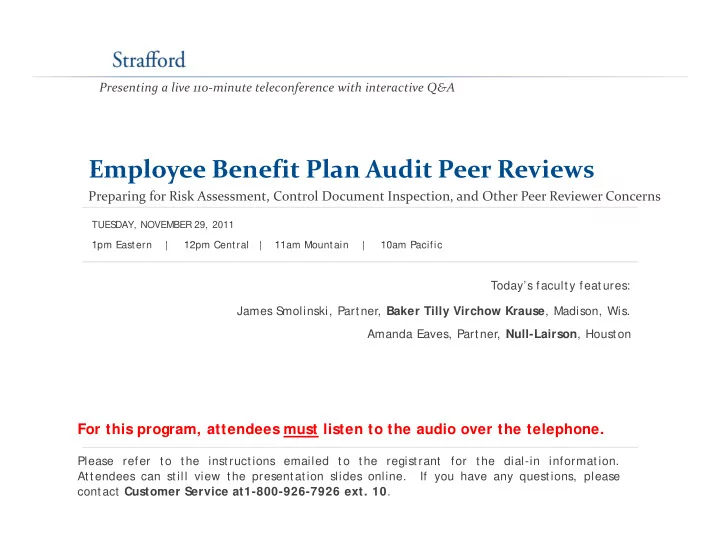
Presenting a live 110 minute teleconference with interactive Q&A Employee Benefit Plan Audit Peer Reviews Employee Benefit Plan Audit Peer Reviews Preparing for Risk Assessment, Control Document Inspection, and Other Peer Reviewer Concerns


slide-1
SLIDE 1

Presenting a live 110‐minute teleconference with interactive Q&A

Employee Benefit Plan Audit Peer Reviews Employee Benefit Plan Audit Peer Reviews

Preparing for Risk Assessment, Control Document Inspection, and Other Peer Reviewer Concerns

1pm Eastern | 12pm Central | 11am Mountain | 10am Pacific TUESDAY, NOVEMBER 29, 2011

Today’s faculty features:

1pm Eastern | 12pm Central | 11am Mountain | 10am Pacific

James S molinski Partner Baker Tilly Virchow Krause Madison Wis James S molinski, Partner, Baker Tilly Virchow Krause, Madison, Wis. Amanda Eaves, Partner, Null-Lairson, Houston

For this program, attendees must listen to the audio over the telephone.

Please refer to the instructions emailed to the registrant for the dial-in information. Attendees can still view the presentation slides online. If you have any questions, please contact Customer Service at1-800-926-7926 ext. 10.

slide-2
SLIDE 2

Conference Materials

If you have not printed the conference materials for this program, please complete the following steps:

  • Click on the + sign next to “ Conference Materials” in the middle of the left-

hand column on your screen hand column on your screen.

  • Click on the tab labeled “ Handouts” that appears, and there you will see a

PDF of the slides for today's program.

  • Double click on the PDF and a separate page will open.

Double click on the PDF and a separate page will open.

  • Print the slides by clicking on the printer icon.
slide-3
SLIDE 3

Continuing Education Credits

FOR LIVE EVENT ONLY

Attendees must listen to the audio over the telephone. Attendees can still view the presentation slides online but there is no online audio for this program. Please refer to the instructions emailed to the registrant for additional

  • information. If you have any questions, please contact Customer Service

at 1-800-926-7926 ext. 10. at 1 800 926 7926 ext. 10.

slide-4
SLIDE 4

Tips for Optimal Quality

S d Q lit S

  • und Qualit y

For this program, you must listen via the telephone by dialing 1-866-873-1442 and entering your PIN when prompted. There will be no sound over the web connection. co ect o . If you dialed in and have any difficulties during the call, press *0 for assistance. Y

  • u may also send us a chat or e-mail sound@

straffordpub.com immediately so we can address the problem. Viewing Qualit y To maximize your screen, press the F11 key on your keyboard. To exit full screen, press the F11 key again press the F11 key again.

slide-5
SLIDE 5

E l B fit Pl A dit P Employee Benefit Plan Audit Peer Reviews Seminar

  • Nov. 29, 2011

Amanda Eaves, Null-Lairson @ ll l i James S molinski, Baker Tilly Virchow Krause j li ki@ b k till aeaves@ null-lairson.com james.smolinski@ bakertilly.com

slide-6
SLIDE 6

Today’s Program

Rules Governing Benefit Plan Peer Reviews [James S molinski] S lide 7 – S lide 13 Recent Peer Review Experiences [Amanda Eaves] S lide 14 – S lide 23 Documentation Issues [James S molinski] S lide 24 – S lide 31 Preparing For The Next Peer Review [Amanda Eaves and James S molinski] S lide 32 – S lide 41

slide-7
SLIDE 7

RULES GOVERNING BENEFIT

James Smolinski, Baker Tilly Virchow Krause

RULES GOVERNING BENEFIT PLAN PEER REVIEWS

slide-8
SLIDE 8

General Comments Related To Peer Review I. General – licensed firms have peer review requirement A. The report acceptance body (RAB) is either: p p y ( ) 1. State peer review committee 2. AICPA Peer Review Board’s National Peer Review Committee Committee B. SEC registrant’s plans are not subject to peer review.

  • C. All engagements subject to GAAS, SSARS, SSAE, GAGAS

and non SEC issuers are subject to peer review and non-SEC issuers are subject to peer review. II. Fiscal year-ends Peer review is due six months after FYE; this affects plans being reviewed.

8

slide-9
SLIDE 9

General Comments Related To Peer Review (Cont.) ( )

  • III. AICPA Audit Quality Center: Peer review practice monitoring

task force for employee benefit plans A. Formed to focus specifically on enhancing the peer review quality for EBP audits, as these are considered high risk engagements. B. Recent activities 1. Revised PRP Sect. 20,700 EBP audit engagement checklist (discussed later) 2. Approved 403(b) specific questions added to the pp ( ) p q engagements checklists 3. Additional CPE trainings and webinars offered C AICPA staff meet with DOL representives on a quarterly

  • C. AICPA staff meet with DOL representives on a quarterly

basis.

9

slide-10
SLIDE 10

Applicable Guidance Related To Peer Review I. Peer review guidance A. AICPA Revised Interpretation 59-1 C p 59 1. PR Sect. 9100: Standards for performing and reporting

  • n peer reviews

2 Interpretations of Sect 100 2. Interpretations of Sect. 100 3. Systems review and engagement peer reviews B. Peer Review Alert 11-03 - Enhanced peer review guidance for the review of employee benefit plan audit engagements for the review of employee benefit plan audit engagements II. AICPA Employee Benefit Plan Audit Quality Center A. Audit checklist B. Q&A

10

slide-11
SLIDE 11

Applicable Guidance Related To Peer Review (Cont.) ( )

  • III. AICPA Revised Interpretation 59-1

Consideration for selection C A. Reasonable cross-section of the reviewed firm’s accounting and auditing practice B Emphasis on higher-risk practice areas B. Emphasis on higher-risk practice areas 1. Risk of engagements and types of benefit plans as part of the selection criteria 2 Limited vs full scope 2. Limited vs. full scope 3. Types of plans (DC, DB, H&W and 403(b) plans)

  • C. Firm’s length of experience and number of audits performed,

C / member’s experience and CPE/specialized training

11

slide-12
SLIDE 12

Applicable Guidance Related To Peer Review (Cont.) ( )

  • IV. Peer Review Alert 11-03

03 Unique risk associated with each type of plan A. Defined contribution B Defined benefit B. Defined benefit C. Health and welfare

12

slide-13
SLIDE 13

Applicable Guidance Related To Peer Review (Cont.) ( ) V. AICPA Employee Benefits Plan Audit Quality Center A. History 1. 1989 DOL Office of Inspector General report finds 23% 989 O O p G p 3%

  • f audits fail to meet professional standards.

2. 1997 – 2004: Seemed that audit quality was getting worse and spreading to the largest CPA firms p g g 3. EBPAQC established 2004 B. Resource for EBP auditors as well as clients C Checklists for peer review

  • C. Checklists for peer review

1. Tool used to evaluate engagements 2. Detail review for each section of the audit

13

slide-14
SLIDE 14

RECENT PEER REVIEW

Amanda Eaves, Null‐Lairson

RECENT PEER REVIEW EXPERIENCES

slide-15
SLIDE 15

 Planning  Investments  Contributions  Benefit payments  Participant data and allocations

p

 Parties in interest  Other

15

slide-16
SLIDE 16

Planning documentation Planning documentation 1. Audit scope 2. Communication with those charged with governance Risk assessment 1. Documented 2 Fl th h t k 2. Flow through to workpapers Risk of material misstatement due to fraud 1. Brainstorming 2. Client inquiries

16

slide-17
SLIDE 17

Understanding of internal controls 1. Inquiries of management q g 2. Analytical procedures 3. Observation and inspection Initial audits Initial audits 1. Tests of beginning net assets 2. Individual account balances SAS 70 t SAS 70 report 1. Proper use 2. Documentation of review Benefit obligation 1. Calculation 2. Use of actuary

17

slide-18
SLIDE 18

Limited-scope audits

  • 1. Certification
  • 1. Certification

2. Qualifying institution 3. Comparison to the financial statements Full-scope audit 1. Tests of year-end market values 2 A h i i 2. Authorization 3. Realized and unrealized gains (losses) Disclosures 1. GAAP 2. DOL rules and regulations g

18

slide-19
SLIDE 19

Internal controls over payroll 1. System understanding and documentation 2 T ti 2. Testing 3. Deferral authorizations 4. Payroll register Testing of elective deferrals 1. Participant confirmations 2. Alternatives to confirmation 3. Definition of compensation 3 e t o

  • co

pe sat o 4. Testing of contribution 5. Authorization of deferrals Timeliness of contributions Timeliness of contributions 1. Controls 2. Schedule 3. Testing

19

slide-20
SLIDE 20

Eligibility testing 1 Participant data 1. Participant data 2. Timing 3. When are distributions allowed? Review and approval Review of benefit calculations Confirmations Confirmations

20

slide-21
SLIDE 21

Payroll testing 1 Relevant dates (birth hire etc )

  • 1. Relevant dates (birth, hire, etc.)
  • 2. Hourly rate or salary
  • 3. Hours worked

Eligibility test

  • 1. Eligibility requirements
  • 2. Related data

Investment income allocation testing g Total net assets = Total of participant accounts

21

slide-22
SLIDE 22

D t ti f k f d Documentation of work performed 1. Related parties 2. Transactions d f f l ff 3. Consideration of financial statement effect  Disclosure  Supplemental schedules

22

slide-23
SLIDE 23

Management representation 1 Proper representations 1. Proper representations 2. Use of an attorney 3. Late contributions Staffing 1. Supervision 2. Training 3. Experience

23

slide-24
SLIDE 24

DOCUMENTATION ISSUES

James Smolinski, Baker Tilly Virchow Krause

slide-25
SLIDE 25

Documentation Emphasis I. Written audit programs A. No written audit programs = “kiss of death” = modified opinion B. Important to note that “one size does not fit all” p 1. Tailor for specific types of plans > Definied contribution > Health and welfare > Health and welfare > Defined benefit 2. Tailor for specific scope of plan > Limited-scope > Full-scope

25

slide-26
SLIDE 26

Documentation Emphasis (Cont.) II. System of quality controls A. How does the firm ensure quality of engagement meets q y g g professional standards? 1. Do you have an internal inspection program? 2 CPE requirements 2. CPE requirements 3. Technical review 4. AICPA quality control standards QC Sect. 10A: A firm’s system of quality control system of quality control > Lays out requirements for quality control > Independence checks > Client acceptance and re-acceptance procedures

26

slide-27
SLIDE 27

Documentation Emphasis (Cont.) II. System of quality controls (Cont.) B. How does the firm measure that quality of engagement q y g g meets professional standards? 1. Are inspection results disseminated to improve quality? 2 Are CPE requirements tracked and compliance 2. Are CPE requirements tracked and compliance ensured? 3. Is there a second partner or reviewer who does an independent review? independent review?

27

slide-28
SLIDE 28

Documentation Emphasis (Cont.)

  • III. Tools and templates

A. Audit progams B. Standardized testing templates S g p Examples: Sampling Sampling Participant data testing Eligibility Loans Distribution Full-scope investment Full scope investment

28

slide-29
SLIDE 29

Documentation Emphasis (Cont.)

  • IV. EBPAQC membership requirements

A. Designated audit partner g p B. Partners are members of AICPA

  • C. System of QC (CPE compliance)

D Monitoring program (Inspection)

  • D. Monitoring program (Inspection)

E. Peer review report made public F. EBPs selected for peer review

  • G. Periodically file info
  • H. Pay dues

29

slide-30
SLIDE 30

Documentation Emphasis (Cont.) V. Inspection requirements A. Review of specific engagements p g g B. Review of CPE records C. Review of training program (if applicable) D Summarize and evaluate the findings D. Summarize and evaluate the findings E. Communicate inspection results F. Remediate issues as needed

30

slide-31
SLIDE 31

Documentation Emphasis (Cont.) VI. Inspection considerations A. Internal inspections are required in the year of the firm’s p q y peer review. B. Can be modified to avoid duplication C Sole practitioners can satisfy the inspection requirement C. Sole practitioners can satisfy the inspection requirement following the AICPA quality control standards in QC Sect. 10. D Certain information is already in the EIPA’s public files D. Certain information is already in the EIPA s public files. E. If not avaiable, you can send in your peer review report, and the EBP AQC will coordinated publishing in the peer review public file public file.

31

slide-32
SLIDE 32

Amanda Eaves, Null‐Lairson

PREPARING FOR THE NEXT

Amanda Eaves, Null Lairson James Smolinski, Baker Tilly Virchow Krause

PEER REVIEW

slide-33
SLIDE 33

1. Ongoing monitoring A. File reviews B R t i B. Report reviews C. Staff reviews 2. Identify issues as they occur 3. Modify and correct procedures as needed y p

33

slide-34
SLIDE 34

1.

Review prior-year comments

2.

Take action A. Change in audit programs B Ed ff B. Educate staff C. Monitor for correction

34

slide-35
SLIDE 35

1. Experienced in EBP audits 2. EBPAQC member (it is a requirement if you are a member)

35

slide-36
SLIDE 36

1. Plan type A Defined contribution A. Defined contribution B. Defined benefit C. Health and welfare

36

slide-37
SLIDE 37

2. Audit type A Limited scope A. Limited scope B. Full scope C. Initial audit

37

slide-38
SLIDE 38

3. Engagement Hours 4. Partner 5 Manager 5. Manager

38

slide-39
SLIDE 39

 Compile a listing of persons managing EBP audits and

p g p g g their related experience and training

39

slide-40
SLIDE 40

Practical Steps To Prepare For Peer Review I. Review the Audit Quality Center requirements and checklists A. Know what the reviewers will be focusing on, so you can prepare to answer any questions related to specific engagements selected (20,700 EBP audit engagement). B. Alert your EBP group early on regarding the peer review process. C. Review the AQC requirements and checklists, if they haven’t Q q , y already been reviewed through your internal inspection process.

40

slide-41
SLIDE 41

Practical Steps To Prepare for Peer Review (Cont.) ( ) II. Accumulate list of plans and types of engagements

  • III. Document how firm addressed quality control procedures

laid out in your QA document - review files for adherence to your firm’s QA procedures y Q p

  • IV. Review CPE compliance for all of your EBP engagement

teams teams V. Ensure appropriate documentation of review and adherence to QA document to QA document

41