SLIDE 1 Embperl - How to Build Large Scale Websites/Webapplications With Perl Seite 1 von 19 file://C:\Daten\Perl\ApacheCon2002\APC2002-Embperl-Slides.htm 10.10.2002
Embperl - How to Build Large Scale Websites/Webapplications With Perl
ApacheCon 2002 Gerald Richter ecos gmbh http://www.ecos.de
The Embperl Website
Documentation are written in POD, Output should be HTML and PDF Database for storing new, articles, sites useing Embperl and
Inclusion of various document formats (HTML, binary etc.) Multilanguage (german, english)
The Layout
The starting page...
http://perl.apache.org/embperl/ or http://www.ecos.de/embperl/
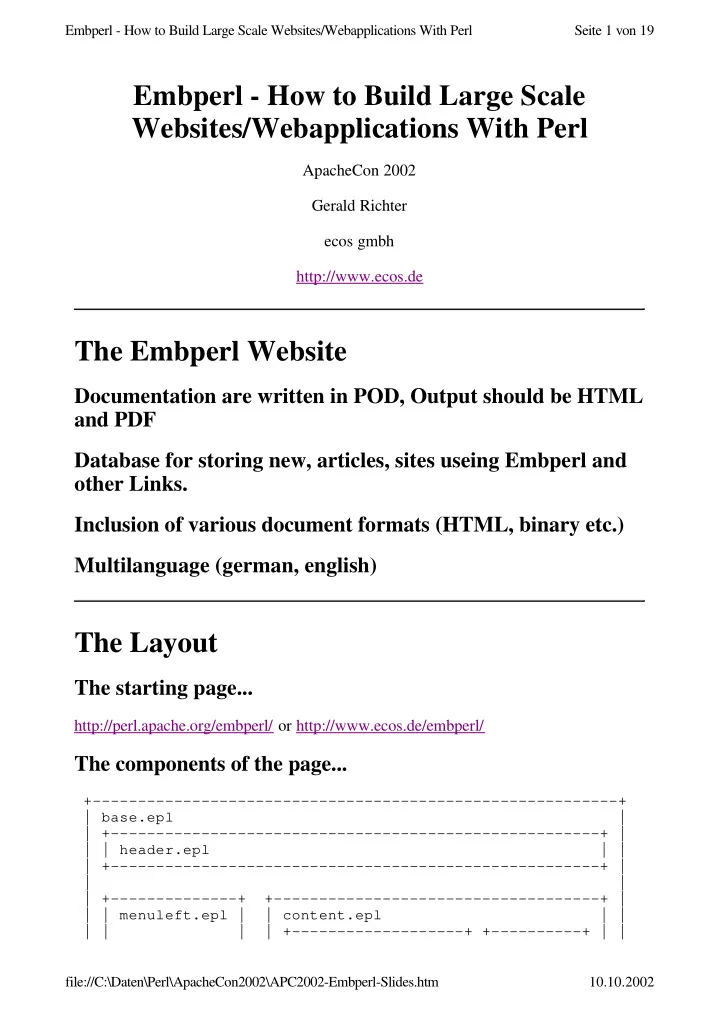
The components of the page...
+----------------------------------------------------------+ | base.epl | | +------------------------------------------------------+ | | | header.epl | | | +------------------------------------------------------+ | | | | +--------------+ +------------------------------------+ | | | menuleft.epl | | content.epl | | | | | | +-------------------+ +----------+ | |
SLIDE 2 Embperl - How to Build Large Scale Websites/Webapplications With Perl Seite 2 von 19 file://C:\Daten\Perl\ApacheCon2002\APC2002-Embperl-Slides.htm 10.10.2002 | | | | | * | | news.epl | | | | | | | | | | | | | | | | | | | | | | | | | | | | | | | | | | | | | | | | | | | | | | | | | | | | | | | | | | | | | | | | | | | | | | | | | | | | | +-------------------+ +----------+ | | | +--------------+ +------------------------------------+ | | | | +------------------------------------------------------+ | | | footer.epl | | | +------------------------------------------------------+ | +----------------------------------------------------------+
base.epl
[- $r = shift ; $http_headers_out{'content-type'} = 'text/html' ;
<html> <head> <title>Embperl</title> <style type="text/css"> body {font-family: Geneva,Arial,Helvetica; font-size: 12px; } table {font-family: Geneva,Arial,Helvetica; font-size: 12px; } </style> </head> <body bgcolor="#ffffff"> [- Execute ('header.epl') -] <table width="100%" cellspacing="0" cellpadding="0" border="0"> <tr> <td>[- Execute ('menuleft.epl') -]</td> <td width="2"> </td> <td height="100%"><img src="/eg/images/frame.jpg" width="1" height="100%"></td> <td width="10"> </td> <td width="90%">[- Execute ('content.epl') -]</td> <td width="2"> </td> <td height="100%"><img src="/eg/images/frame.jpg" width="1" height="100%"></td> <td width="10"> </td> </tr> </table> [- Execute ('footer.htm') -] </body> </html>
content.epl
<table width="100%" cellspacing="0" cellpadding="0" border="0"> <tr> <td valign="top">
SLIDE 3 Embperl - How to Build Large Scale Websites/Webapplications With Perl Seite 3 von 19 file://C:\Daten\Perl\ApacheCon2002\APC2002-Embperl-Slides.htm 10.10.2002 <br><br> <font size="2" face="Verdana, Arial, Helvetica, sans-serif"> [- Execute ({'*') -]</td> <td width="10"> </td> <td height="100%"><img src="/eg/images/frame.jpg" width="1" height="100%"></td> <td width="2"> </td> <td align="left" width="152"><font size="2" face="Verdana, Arial, Helvetica, sans-serif"> [- Execute ('news.epl') -] </td> </tr> </table>
Embperl's objects
The request-object
Makes data about the request avaiable, like URI, HTTP-header, form data
The component-object
Makes data about the component available, like filename, syntax, recipe
The application-object
Brings together the data of a set of pages that forms an application. Like session handling, logging and configuration.
Embperl::Object
Embperl::Object manages the calling and overriding of components
- 1. ) Createing of the request-object and populating it with informations about
the request
- 2. ) Loading of the base template
Starting at the directory that contains the file that is requested, Embperl::Object searches the directory hierachie up to the document root (or EMBPERL_OBJECT_STOPDIR) for the base template. All dierectories of this search are now part of the search path for loading all file in this request. That is not only true for other Embperl components, but also for other files like XSL sytlesheets.
- 3. ) Application-object searching and loading
- 4. ) Setting of the inherence
SLIDE 4 Embperl - How to Build Large Scale Websites/Webapplications With Perl Seite 4 von 19 file://C:\Daten\Perl\ApacheCon2002\APC2002-Embperl-Slides.htm 10.10.2002 Application-File | v Embperl::App
- 5. ) calling the init method of the application object
This allows to execute application specific code (like database access) and modify the request. In a MCV modell this is the controller.
- 6. ) Loading of the actual requested page and blessing of the request object
into the package of this page
- 7. ) Setting the inherence of the request-object
Requested page | v Base template | v Embperl::Req
- 8. ) Executing the base template
The application-object of the Embperl Website
Parts of the base application
sub init { my $self = shift ; my $r = shift ; my $config = Execute ({object => 'config.pl', syntax => 'Perl'}) ; $config -> new ($r) ; $r -> {config} = $config ; $r -> {menu} = $config -> get_menu ($r) ; fill_menu ($config, $r -> {menu}, $r -> {baseuri}, $r -> { $pf = map_file ($r) ; $r -> param -> filename ($pf) ; Execute ({inputfile => 'messages.pl', syntax => 'Perl'}) ; return 0 ; }
SLIDE 5
Embperl - How to Build Large Scale Websites/Webapplications With Perl Seite 5 von 19 file://C:\Daten\Perl\ApacheCon2002\APC2002-Embperl-Slides.htm 10.10.2002
The configuration (config.pl)
BEGIN { %messages = ( 'de' => { 'Introduction' => 'Einführung', 'Documentation' => 'Dokumentation', 'Examples' => 'Beispiele', 'Changes' => 'Änderungen', 'Sites using Embperl' => 'Websites mit Embperl', 'Add info about Embperl' => 'Hinzufügen über Embperl', } ) ; @menu = ( { menu => 'Home', uri => '', file => { en => 'eg/web/index.htm', de => 'eg/web/indexD.htm'} }, { menu => 'Features', uri => 'pod/Features.htm', file => 'Features.pod' }, { menu => 'Introduction', uri => 'pod/intro/', sub => [ { menu => 'Embperl', uri => 'Intro.htm', file => { en => 'Intro.pod', 'de' => 'IntroD.pod'}}, { menu => 'Embperl::Object', uri => 'IntroEmbperlObject.htm', file => 'IntroEmbperlObject.pod'}, ] }, { menu => 'Documentation', uri => 'pod/doc/', sub => [ { menu => 'Embperl', uri => 'Embperl.htm', file => { en => 'Embperl.pod', de => 'EmbperlD.pod'}}, { menu => 'Embperl::Object', uri => 'EmbperlObject.htm', file => 'Embperl/Object.pm'}, { menu => 'Embperl::Syntax', uri => 'EmbperlSyntax.htm', file => 'Embperl/Syntax.pm', sub => [ { menu => 'Embperl', uri => 'Embperl.htm', file => 'Embperl/Syntax/Embperl.pm'}, { menu => 'EmbperlBlocks', uri => 'EmbperlBlocks.htm', file => 'Embperl/Syntax/EmbperlBlks.pm'}, { menu => 'EmbperlHTML', uri => 'EmbperlHTML.htm', file => 'Embperl/Syntax/EmbperlHTML.pm'}, { menu => 'HTML', uri => 'HTML.htm', file => 'Embperl/Syntax/HTML.pm'}, { menu => 'ASP', uri => 'ASP.htm', file => 'Embperl/Syntax/ASP.pm'}, { menu => 'SSI', uri => 'SSI.htm', file => 'Embperl/Syntax/SSI.pm'}, { menu => 'Perl', uri => 'Perl.htm', file => 'Embperl/Syntax/Perl.pm'}, { menu => 'POD', uri => 'POD.htm', file => 'Embperl/Syntax/POD.pm'}, { menu => 'Text', uri => 'Text.htm', file => 'Embperl/Syntax/Text.pm'}, { menu => 'RTF', uri => 'RTF.htm', file => 'Embperl/Syntax/RTF.pm'}, { menu => 'Mail', uri => 'Mail.htm', file => 'Embperl/Syntax/Mail.pm'}, ], }, { menu => 'Embperl::Recipe', uri => 'EmbperlRecipe.htm', file => 'Embperl/Recipe.pm', sub => [ { menu => 'Embperl', uri => 'Embperl.htm', file => 'Embperl/Recipe/Embperl.pm'}, { menu => 'EmbperlXSLT', uri => 'EmbperlXSLT.htm', file => 'Embperl/Recipe/EmbperlXSLT.pm'}, { menu => 'XSLT', uri => 'XSLT.htm', file => 'Embperl/Recipe/XSLT.pm'},
SLIDE 6
Embperl - How to Build Large Scale Websites/Webapplications With Perl Seite 6 von 19 file://C:\Daten\Perl\ApacheCon2002\APC2002-Embperl-Slides.htm 10.10.2002 ], }, ], }, { menu => 'Installation', uri => 'pod/INSTALL.htm', file => 'INSTALL.pod' }, { menu => 'FAQ', uri => 'pod/Faq.htm', file => 'Faq.pod' }, { menu => 'Tips & Tricks', uri => 'pod/TipsAndTricks.htm', file => 'TipsAndTricks.pod' }, { menu => 'Examples', uri => 'examples/' }, { menu => 'Changes', uri => 'pod/Changes.htm', file => 'Changes.pod' }, { menu => 'Sites using Embperl', uri => 'pod/Sites.htm', file => 'Sites.pod' }, { menu => 'News', uri => 'db/news/news.htm', file => 'eg/web/db/data.epd', fdat => { 'category_id' => 1 } }, { menu => 'Sites using Embperl', uri => 'db/sites/sites.htm', file => 'eg/web/db/data.epd', fdat => { 'category_id' => 2 } }, { menu => 'Add info about Embperl', uri => 'db/addsel.epl', same => [ { menu => 'Select category', uri => 'db/add.epl' }, { menu => 'Review added info', uri => 'db/show.epl'}, { menu => 'Show info', uri => 'db/data.epd' }, ], }, ) ; } ; sub new { my ($self, $r) = @_ ; # The following two values must be changed to meet your local setup # Additionaly DBI and DBIx::Recordset must be installed $self -> {dbdsn} = $^O eq 'MSWin32'?'dbi:ODBC:embperl':'dbi:mysql:embperl' ; $self -> {dbuser} = 'www' ; $self -> {dbpassword} = undef ; } sub get_menu { my ($self, $r) = @_ ; push @{$r -> messages}, $messages{$r -> param -> language} ; return \@menu ; }
The navigation
[$ sub menuitem $] [*
SLIDE 7 Embperl - How to Build Large Scale Websites/Webapplications With Perl Seite 7 von 19 file://C:\Daten\Perl\ApacheCon2002\APC2002-Embperl-Slides.htm 10.10.2002 my ($url, $txt, $state, $tablebg, $ndx) = @_ ; *] <tr> <td [$if $tablebg $]background="[+ $r -> {imageuri} +]/hintergrund-nav.gif"[$endif$]> <table width="152" border="0" cellspacing="0" cellpadding="0"> <tr> <td nowrap align=left width=[+ $ndx * 15 + 2 +]> <img = src="[+ $r -> {imageuri} +]/transp.gif" width="1"></td> <td nowrap align=left width=15> <img src="[+ $r -> {imageuri} +]/i-sub-[+ $state>1?($state>2?'on':'open'):'off' +].gif" width="11" height="11" vspace="6" hspace="5"></td> <td nowrap align=left> <a href="[+ $url +]"><b>[+ $r -> gettext ($txt) +]</a></b></td> </tr> </table> </td> </tr> [$ endsub $] [$ sub menu $] [* my ($menu, $ndx, $top) = @_ ; *] [$ foreach my $item (@{$menu}) $] [- if ( $r -> {menuitems}[$ndx] eq $item) { menuitem ($item -> {url}, $item -> {menu}, $r -> {menuitems}[$ndx+1]?2:3, $top, $ndx) ; menu ($item -> {sub}, $ndx + 1, 0) if ($item -> {sub}) ; } else { menuitem ($item -> {url}, $item -> {menu}, 0, $top, $ndx) ; }
<tr> <td><img src="/eg/images/linie-nav.gif" width="152" height="1"></td> </tr> [$endforeach $] [$ endsub $] [- $r = shift ;
<table width="152" border="0" cellspacing="0" cellpadding="0"> <tr> <td><img src="/eg/images/h_content.gif" width="152" height="19"></td>
SLIDE 8
Embperl - How to Build Large Scale Websites/Webapplications With Perl Seite 8 von 19 file://C:\Daten\Perl\ApacheCon2002\APC2002-Embperl-Slides.htm 10.10.2002 </tr> <tr> <td> </td> </tr> [- menu ($r -> {menu} , 0, 1) -] <tr> <td> </td> </tr> <tr> <td><img src="/eg/images/h_current-v.gif" width="152" height="19"></td> </tr> <tr> <td> </td> </tr> <tr> <td><img src="/eg/images/linie-nav.gif" width="152" height="1"></td> </tr> <tr> <td bgcolor="#D2E9F5"><b> Stable 1.3.4</b></td> </tr> <tr> <td><img src="/eg/images/linie-nav.gif" width="152" height="1"></td> </tr> <tr> <td><img src="/eg/images/transp.gif" width="152" height="5"></td> </tr> <tr> <td><img src="/eg/images/linie-nav.gif" width="152" height="1"></td> </tr> <tr> <td bgcolor="#D2E9F5"><b> Beta 2.0b8</b></td> </tr> <tr> <td><img src="/eg/images/linie-nav.gif" width="152" height="1"></td> </tr> </table>
The news column of the home page
[- use DBIx::Recordset ; $r = shift ; *set = DBIx::Recordset -> Search ({'!DataSource' => $r -> {dbdsn}, '!Username' => $r -> {dbuser}, '!Password' => $r -> {dbpassword}, '!DBIAttr' => { RaiseError => 1, PrintError => 1, LongReadLen => 32765, LongTruncOk => 0, },
SLIDE 9 Embperl - How to Build Large Scale Websites/Webapplications With Perl Seite 9 von 19 file://C:\Daten\Perl\ApacheCon2002\APC2002-Embperl-Slides.htm 10.10.2002 '!Table' => 'item, itemtext', '!TabRelation' => 'item_id = item.id', '!Order' => 'creationtime desc', 'language_id' => $r -> param -> language, 'category_id' => 1, '$max' => 15}) ;
<table width="252" border="0" cellspacing="0" cellpadding="0"> <tr> <td><img src="[+ $r -> {imageuri} +]/h_news.gif" width="152" height="19"/></td> </tr> <tr> <td> </td> </tr> <tr> <td> [$while ($rec = $set -> Next)$] <table width="100%" border="0" cellspacing="0" cellpadding="0"> <tr> <td bgcolor="#327EA7"><font size="1" face="Verdana, Arial, Helvetica, sans-serif"><b> <font color="#FFFFFF"> [+ $rec -> {heading} +] </font></b></font></td> </tr> <tr> <td bgcolor="#C2D9E5"><img src="[+ $r -> {imageuri} +]/linie-news.gif" width="152" height="4"/></td> </tr> <tr> <td bgcolor="#D2E9F5"> <table width="100%" border="0" cellspacing="0" cellpadding="3"> <tr> <td><font size="1" face="Verdana, Arial, Helvetica, sans-serif"> [- $txt = $rec -> {description} ; $txt =~ s#<#<#g ; $txt =~ s#>#>#g ; $txt =~ s#B<(.*?)>#<B>$1</B>#g ; $txt =~ s#(http://[-a-zA-Z.]+)#<A HREF="$1">$1</A>#g ;
[+ do { local $escmode = 0 ; $txt } +] </font></td> </tr> </table> </td> </tr> </table> [$endwhile $] </td> </tr> </table>
SLIDE 10
Embperl - How to Build Large Scale Websites/Webapplications With Perl Seite 10 von 19 file://C:\Daten\Perl\ApacheCon2002\APC2002-Embperl-Slides.htm 10.10.2002
Syntaxes, Recipes and Provider
The execution of a component is divied in multiple steps. Every step is done by a separate provider. Recipes defines in which order providers are executed. This could be a simple linear structure or even a complex tree structure. The Defaultrecipe: 'Embperl'
Read the source (File, Memory) Parse Compile Execute Output
The syntax tells the parser and compiler what input format they should expect
Examples: Embperl, ASP, SSI, Perl, Text, POD, RTF
You can create your own syntax by writing a new syntax class. You can extented an existing syntax by inherenting from an existing class Every intermediate step and the result can be cached
Rendering POD to HTML via XML and XSLT
The syntax POD transforms POD to XML
=head1 NAME
SLIDE 11
Embperl - How to Build Large Scale Websites/Webapplications With Perl Seite 11 von 19 file://C:\Daten\Perl\ApacheCon2002\APC2002-Embperl-Slides.htm 10.10.2002 Embperl =head1 Description Here we have some text
will become
<pod> <head> <title>Embperl</title> </head> <sect1> <para> Here we have some text </para> </sect1> </pod>
This basicly generates the same XML as Pod::XML
The Recipe EmbperlXSLT
Read the source (File, Memory) Parse Compile Execute Read the stylesheet ``Compile'' the stylesheet ``Compile'' the result of the Executing of the primary source XSLT Transformation Output
The usage of the XSLT Transformation allows the creation of different layouts from the same source. By transformation into XSL-FO and appending of the XSL- FO Provider it's easly possible create PDF's pod/content.epl
[- Execute ({inputfile => '*'}) -]
The recipe for the Embperl web is provided by the application object
sub get_recipe
SLIDE 12
Embperl - How to Build Large Scale Websites/Webapplications With Perl Seite 12 von 19 file://C:\Daten\Perl\ApacheCon2002\APC2002-Embperl-Slides.htm 10.10.2002 { my ($class, $r, $recipe) = @_ ; my $self ; my $param = $r -> component -> param ; my $config = $r -> component -> config ; my ($src) = $param -> inputfile =~ /^.*\.(.*?)$/ ; my ($dest) = $r -> param -> uri =~ /^.*\.(.*?)$/ ; if ($src eq 'pl') { $config -> syntax('Perl') ; return Embperl::Recipe::Embperl -> get_recipe ($r, $recipe) ; } if ($src eq 'pod' || $src eq 'pm') { $config -> escmode(0) ; if ($dest eq 'pod') { $config -> syntax('Text') ; return Embperl::Recipe::Embperl -> get_recipe ($r, $recipe) ; } $config -> syntax('POD') ; if ($dest eq 'xml') { return Embperl::Recipe::Embperl -> get_recipe ($r, $recipe) ; } $config -> xsltstylesheet('pod.xsl') ; $r -> param -> uri =~ /^.*\/(.*)\.(.*?)$/ ; $param -> xsltparam({ page => $fdat{page} || 0, basename => "'$1'", extension => "'$2'", imageuri => "'$r->{imageuri}'", baseuri => "'$r->{baseuri}'", }) ; return Embperl::Recipe::EmbperlXSLT -> get_recipe ($r, $recipe) ; } if ($src eq 'epd') { $config -> escmode(0) ; $config -> options($config -> options | &Embperl::Constant::optKeepSpaces) ; if ($dest eq 'pod') { $config -> syntax('EmbperlBlocks') ; return Embperl::Recipe::Embperl -> get_recipe ($r, $recipe) ; }
SLIDE 13
Embperl - How to Build Large Scale Websites/Webapplications With Perl Seite 13 von 19 file://C:\Daten\Perl\ApacheCon2002\APC2002-Embperl-Slides.htm 10.10.2002 $config -> xsltstylesheet('pod.xsl') ; $r -> param -> uri =~ /^.*\/(.*)\.(.*?)$/ ; $param -> xsltparam({ page => $fdat{page} || 0, basename => "'$1'", extension => "'$2'", imageuri => "'$r->{imageuri}'", baseuri => "'$r->{baseuri}'", }) ; return Embperl::Recipe::EmbperlPODXSLT -> get_recipe ($r, $recipe) ; } if ($src eq 'epl' || $src eq 'htm') { $config -> syntax('Embperl') ; return Embperl::Recipe::Embperl -> get_recipe ($r, $recipe) ; } $config -> syntax('Text') ; return Embperl::Recipe::Embperl -> get_recipe ($r, $recipe) ; }
The database application
Separation of Code, Layout and Data db/epwebapp.pl
use DBIx::Recordset ; BEGIN { Execute ({isa => '../epwebapp.pl'}) ; } sub init { my $self = shift ; my $r = shift ; $self -> SUPER::init ($r) ; $self -> initdb ($r) ; my $db = $r -> {db} ; $r -> {language_set} = DBIx::Recordset -> Search ({'!DataSource' => $db, '!Table' => 'language'}) ; if ($fdat{-add_category}) {
SLIDE 14
Embperl - How to Build Large Scale Websites/Webapplications With Perl Seite 14 von 19 file://C:\Daten\Perl\ApacheCon2002\APC2002-Embperl-Slides.htm 10.10.2002 $self -> add_category ($r) ; $self -> get_category($r) ; } elsif ($fdat{-add_item}) { $self -> add_item ($r) ; $self -> get_category($r) ; $self -> get_item_lang($r) ; } elsif ($fdat{-show_item}) { $self -> get_category($r) ; $self -> get_item_lang($r) ; } else { $self -> get_category($r) ; $self -> get_item($r) ; } return 0 ; } # ---------------------------------------------------------------------------- sub initdb { my $self = shift ; my $r = shift ; $DBIx::Recordset::Debug = 2 ; *DBIx::Recordset::LOG = \*STDERR ; my $db = DBIx::Database -> new ({'!DataSource' => $r -> {dbdsn}, '!Username' => $r -> {dbuser}, '!Password' => $r -> {dbpassword}, '!DBIAttr' => { RaiseError => 1, PrintError => 1, LongReadLen => 32765, LongTruncOk => 0, }, }) ; $db -> TableAttr ('*', '!SeqClass', "DBIx::Recordset::FileSeq,$r->{root}/db") if ($^O eq 'MSWin32') ; $db -> TableAttr ('*', '!Filter', { 'creationtime' => [\¤t_time, undef, DBIx::Recordset::rqINSERT ], 'modtime' => [\¤t_time, undef, DBIx::Recordset::rqINSERT + DBIx::Recordset::rqUPDATE ], }) ; $r -> {db} = $db ; } # ---------------------------------------------------------------------------- sub current_time
SLIDE 15
Embperl - How to Build Large Scale Websites/Webapplications With Perl Seite 15 von 19 file://C:\Daten\Perl\ApacheCon2002\APC2002-Embperl-Slides.htm 10.10.2002 { my ($sec,$min,$hour,$mday,$mon,$year,$wday,$yday,$isdst) = localtime(time); $mon++ ; $year += 1900 ; return "$year-$mon-$mday $hour:$min:$sec" ; } # ---------------------------------------------------------------------------- sub add_category { my $self = shift ; my $r = shift ; my $set = DBIx::Recordset -> Insert ({'!DataSource' => $r -> {db}, '!Table' => 'category', '!Serial' => 'id', state => 0}) ; my $id = $$set -> LastSerial ; my $langset = $r -> {language_set} ; my $txtset = DBIx::Recordset -> Setup ({'!DataSource' => $r -> {db}, '!Table' => 'categorytext'}) ; $$langset -> Reset ; while ($rec = $$langset -> Next) { $$txtset -> Insert ({category_id => $id, language_id => $rec->{id}, category => $fdat{"category_$rec->{id}"}}) if ($fdat{"category_$rec->{id}"}) ; delete $fdat{"category_$rec->{id}"} ; } } # ---------------------------------------------------------------------------- sub add_item { my $self = shift ; my $r = shift ; my $set = DBIx::Recordset -> Insert ({'!DataSource' => $r -> {db}, '!Table' => 'item', '!Serial' => 'id', url => $fdat{url}, category_id => $fdat{category_id}, state => 0}) ; my $id = $$set -> LastSerial ; my $langset = $r -> {language_set} ; my $txtset = DBIx::Recordset -> Setup ({'!DataSource' => $r -> {db}, '!Table' => 'itemtext'}) ;
SLIDE 16
Embperl - How to Build Large Scale Websites/Webapplications With Perl Seite 16 von 19 file://C:\Daten\Perl\ApacheCon2002\APC2002-Embperl-Slides.htm 10.10.2002 $$langset -> Reset ; while ($rec = $$langset -> Next) { $$txtset -> Insert ({item_id => $id, language_id => $rec->{id}, description => $fdat{"description_$rec->{id}"}, url => $fdat{"url_$rec->{id}"} || $fdat{url}, heading => $fdat{"heading_$rec->{id}"}}) if ($fdat{"heading_$rec->{id}"}) ; } $fdat{item_id} = $id ; } # ---------------------------------------------------------------------------- sub get_category { my $self = shift ; my $r = shift ; $r -> {category_set} = DBIx::Recordset -> Search ({'!DataSource' => $r -> {db}, '!Table' => 'category, categorytext', '!TabRelation' => 'category_id = category.id', 'language_id' => $r -> param -> language, $fdat{category_id}?(category_id => $fdat{category_id}):()}) ; } # ---------------------------------------------------------------------------- sub get_item { my $self = shift ; my $r = shift ; $r -> {item_set} = DBIx::Recordset -> Search ({'!DataSource' => $r -> {db}, '!Table' => 'item, itemtext', '!TabRelation' => 'item_id = item.id', 'language_id' => $r $fdat{category_id}?(category_id => $fdat{category_id}):(), $fdat{item_id}?(item_id => $fdat{item_id}):()}) ; } # ---------------------------------------------------------------------------- sub get_item_lang { my $self = shift ; my $r = shift ; $r -> {item_set} = DBIx::Recordset -> Search ({'!DataSource' => $r '!Table' => 'item, itemtext, language',
SLIDE 17
Embperl - How to Build Large Scale Websites/Webapplications With Perl Seite 17 von 19 file://C:\Daten\Perl\ApacheCon2002\APC2002-Embperl-Slides.htm 10.10.2002 '!TabRelation' => 'item_id = item.id and language_id = language.id', $fdat{category_id}?(category_id => $fdat{category_id}):(), $fdat{item_id}?(item_id => $fdat{item_id}):()}) ; }
db/addsel.epl
[- $r = shift -] [= addsel1 =] <ul> <li> [- $rec = $r -> {category_set}[$row] -] <a href="add.epl?category_id=[+ $rec -> {category_id} +]">[+ $rec </li> </ul> <form action="[+ $r -> param -> uri +]"> [= addsel2 =]<br> [= addsel3 =]<br><br> <table> <tr> [- $rec = $r -> {language_set}[$row] -] <td>[+ $rec -> {name} +]:</td><td><input type="text" name="category_[+ $rec </tr> </table> <br><br> <input type="submit" name="-add_category" value="[=addsel4=]"> </form>
Multi-Language-Support
messages.pl stores the different texts
$r = shift ; %messages = ( 'de' => { 'addsel1' => 'Klicken Sie auf die Kategorie zu der Sie etwas hinzuf 'addsel2' => 'oder fügen Sie eine neue Kategorie hinzu. Bitte geben Sie die Beschreibung ein.', 'addsel3' => 'Falls Sie die Übersetzung nicht wissen, lassen Sie das entsprechende Eingabefeld leer.', 'addsel4' => 'Kategorie hinzufügen',
SLIDE 18
Embperl - How to Build Large Scale Websites/Webapplications With Perl Seite 18 von 19 file://C:\Daten\Perl\ApacheCon2002\APC2002-Embperl-Slides.htm 10.10.2002 'add1' => 'Hinzufügen eines neuen Eintrages zu', 'add2' => 'Bitte geben Sie die Beschreibung in so vielen Sprachen wie Ihnen m 'add3' => 'Hinzufügen zu', 'heading' => 'Überschrift', 'url' => 'URL', 'description' => 'Beschreibung', 'show2' => 'Folgender Eintrag wurde erfolgreich der Datenbank hinzugef }, 'en' => { 'addsel1' => 'Click on the category for wich you want to add a new item:', 'addsel2' => 'or add new category. Please enter the description in as much languages as possible.', 'addsel3' => 'If you don\'t know the translation leave the corresponding input field empty.', 'addsel4' => 'Add category', 'add1' => 'Add a new item to', 'add2' => 'Please enter the description in as much languages as possible.', 'add3' => 'Add to', 'heading' => 'Heading', 'url' => 'URL', 'description' => 'Description', 'show2' => 'The following entry has been sucessfully added to the database', }, ) ; $lang = $r -> param -> language ; push @{$r -> messages}, $messages{$lang} ; push @{$r -> default_messages}, $messages{'en'} if ($lang ne 'en') ;
Replacement of [= foo =] through the matching text, as far as available $r -> gettext('foo') to get the matching text
Future...
There are many more possibilities of Embperl, for example session-handling and form validation 2.0b8 is the last beta, which is already quite stable Final release of 2.0 is planed for the next three month. Main addition will be documentation improvements and threads to use the full power of mod_perl 2 in threaded mode. More informations can be found on the Embperl Web Site
SLIDE 19
Embperl - How to Build Large Scale Websites/Webapplications With Perl Seite 19 von 19 file://C:\Daten\Perl\ApacheCon2002\APC2002-Embperl-Slides.htm 10.10.2002
http://perl.apache.org/embperl/ http://www.ecos.de/embperl/