Elliptic affine Hecke algebra and representations A topological - - PowerPoint PPT Presentation

elliptic affine hecke algebra and representations
SMART_READER_LITE
LIVE PREVIEW

Elliptic affine Hecke algebra and representations A topological - - PowerPoint PPT Presentation

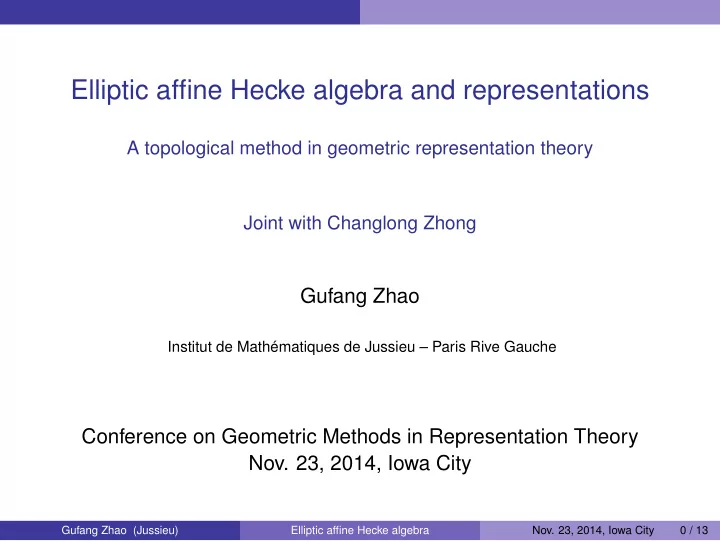
Elliptic affine Hecke algebra and representations A topological method in geometric representation theory Joint with Changlong Zhong Gufang Zhao Institut de Mathmatiques de Jussieu Paris Rive Gauche Conference on Geometric Methods in


slide-1
SLIDE 1

Elliptic affine Hecke algebra and representations

A topological method in geometric representation theory Joint with Changlong Zhong

Gufang Zhao

Institut de Mathématiques de Jussieu – Paris Rive Gauche

Conference on Geometric Methods in Representation Theory

  • Nov. 23, 2014, Iowa City

Gufang Zhao (Jussieu) Elliptic affine Hecke algebra

  • Nov. 23, 2014, Iowa City

0 / 13

slide-2
SLIDE 2

Outline

1

Definition of the elliptic affine Hecke algebra

2

Equivariant elliptic cohomology

3

Geometric study of the elliptic affine Hecke algebra

Gufang Zhao (Jussieu) Elliptic affine Hecke algebra

  • Nov. 23, 2014, Iowa City

0 / 13

slide-3
SLIDE 3

Definition of the elliptic affine Hecke algebra

Affine Hecke algebra

Let G be a simply connected complex algebraic group; T < B < G a maximal torus, and a Borel; Λ = the weight lattice; W = the Weyl group. W acts on Z[q±][Λ] in the natural way; For λ ∈ Λ, write eλ ∈ Z[q±][Λ]. For each simple root α, define the operator Tα ∈ EndZ[q±](Z[q±][Λ]) Tα = qeα − q−1 eα − 1 sα − q − q−1 eα − 1 . The affine Hecke algebra: Haff ⊆ EndZ[q±](Z[q±][Λ]) is generated by

Z[q±][Λ] and Tα, α ∈ ∆.

Gufang Zhao (Jussieu) Elliptic affine Hecke algebra

  • Nov. 23, 2014, Iowa City

1 / 13

slide-4
SLIDE 4

Definition of the elliptic affine Hecke algebra

Affine Hecke algebra: geometric construction

B := G/B.

KGm ×G(T∗B) Z[q±][Λ];

π : N := T∗B → N the Springer resolution;

for each x ∈ N, let Bx := π−1(x) be the Springer fiber; Z :=

N ×N N the Steinberg variety, with projections to the ith factor

pi : Z → T∗B, i = 1, 2;

Theorem (Demazure 1974, Lusztig 1990, etc)

1

For each simple root α, there is a class Tα ∈ KG×Gm(Z) such that the

  • perator p1∗(Tα · p∗

2−) : KGm ×G(T∗B) → KGm ×G(T∗B) acts by Tα.

2

This induces an isomorphism KGm ×G(Z) Haff.

3

For each x ∈ N, K(Bx) admits an action by Haff.

Gufang Zhao (Jussieu) Elliptic affine Hecke algebra

  • Nov. 23, 2014, Iowa City

2 / 13

slide-5
SLIDE 5

Definition of the elliptic affine Hecke algebra

Elliptic affine Hecke algebra

Let E be an elliptic curve. Let A := E ⊗Z Λ∨. Each root α gives a divisor Dα of A. Let π : A → A/W and let S := π∗OA on A/W. Note that W acts on S. Dα,q the divisor on A × E E ⊗Z (Z ⊕ Λ∨) defined by xα = q. For any open set U ⊆ A/W × E, consider rational sections of

(S ⊠ OE)|U#W, written as

w∈W fww where fw are rational sections of

S regular ways from Dα, such that

R1 for any root α, each fw has a pole of order ≤ 1 along the divisor Dα; R2 ∀α, the residues of fw and fsαw along Dα differ by a minors sign; R3 for any α ∈ wΦ+ ∩ Φ−, the section fw vanishes along the divisor Dα,q.

Theorem (Ginzburg-Kapranov-Vasserot 1997)

The above conditions define a sheaf of associative algebra H on A × E, called the elliptic affine Hecke algebra. H naturally acts on S ⊠ OE. The Demazure-Lusztig operator Tα = sn(q)

sn(xα) + (1 − sn(q) sn(xα))sα, α ∈ ∆ .

Gufang Zhao (Jussieu) Elliptic affine Hecke algebra

  • Nov. 23, 2014, Iowa City

3 / 13

slide-6
SLIDE 6

Definition of the elliptic affine Hecke algebra

Motivating questions

Is there a construction of the elliptic affine Hecke algebra as a convolution algebra? What are the irreducible representations of the elliptic affine Hecke algebra? Where does this algebra fit in the family of all these Hecke algebras? (Why should we care about it?)

Gufang Zhao (Jussieu) Elliptic affine Hecke algebra

  • Nov. 23, 2014, Iowa City

4 / 13

slide-7
SLIDE 7

Equivariant elliptic cohomology

Table of Contents

1

Definition of the elliptic affine Hecke algebra

2

Equivariant elliptic cohomology

3

Geometric study of the elliptic affine Hecke algebra

Gufang Zhao (Jussieu) Elliptic affine Hecke algebra

  • Nov. 23, 2014, Iowa City

4 / 13

slide-8
SLIDE 8

Equivariant elliptic cohomology

Equivariant elliptic cohomology

Let E → S be an arbitrary elliptic curve, together with a local coordinate l (a rational section of a line bundle which vanishes of order 1 at the identity section). The local coordinate l defines the structure of a cohomology theory

Ell∗, whose formal group law F(u, v) satisfies F(l(u), l(v)) = l(u + v).

Let G be a compact Lie group with maximal torus T, let AG be the moduli space of semistable topologically trivial G-bundles on E∨.

AT = En where n = rank T, and AG = AT/W. Example

When G = Un, we have AG E(n). Let Θn be the big diagonal divisor (considered as a line bundle). It has a natural section denoted by ϑn. When n = 1, Θn is the divisor O(−0) and ϑn is the Jacobi theta-function.

Gufang Zhao (Jussieu) Elliptic affine Hecke algebra

  • Nov. 23, 2014, Iowa City

5 / 13

slide-9
SLIDE 9

Equivariant elliptic cohomology

Equivariant elliptic cohomology

Theorem (Ginzburg-Kapranov-Vasserot 1995, Lurie 2005, etc)

For any G-space X, there is a sheaf of comm. algebras Ell0

G(X) on AG.

Ell0

T(pt) OAT ; and Ell0 G(pt) OAG.

∀a ∈ AT, let T(a) = ∩a∈AT′⊆AT T′ ⊆ T Ell0

T(X)a Ell0 T/T(a)(XT(a))0;

There is a Chern character ch : Ell0

T(X)∧ a ⊗ Q H∗ T(XT(a), Q)∧ 0.

Denote Spec(Ell0

G(X)) by AX

  • G. For any equivariant rank-n vector

bundle ξ : V → X, there is a classifying map cξ : AX

G → AGLn E(n).

Define Θ(ξ) = c−1

ξ (Θn). Then this extends to Θ : KG(X) → Pic(AX G).

For any equivariant regular embedding X → Y, there is a Thom isomorphism Ell0

G(X) ⊗ Θ(NXY) Ell0 G(Y, X).

For proper f : X → Y, there is a f∗ : Θ(Tf := TX − f∗TY) → Ell0

G(Y).

Gufang Zhao (Jussieu) Elliptic affine Hecke algebra

  • Nov. 23, 2014, Iowa City

6 / 13

slide-10
SLIDE 10

Equivariant elliptic cohomology

Elliptic cohomology: Chern classes

Recall that l is a local coordinate of E. For any r, i ∈ Z≥0, let σi be the i-th elementary symmetric function. Then σi(l)(x1, . . . , xr) := σi(l(x1), . . . , l(xr)) is a well-defined rational section of a line bundle on E(r). For any G-equivariant rank-r vector bundle ξ : V → X, let cξ : AX

G → E(r) be the GKV-classifying map.

Define the i-th l-Chern class of V to be c−1

ξ (σi(l)) as a rational section

  • f Ell∗(X).

For any rank-r equivariant vector bundle ξ : V → X, define cGKV

r

(V) := c−1

ξ (ϑr) ∈ Θ(V) c−1 ξ (Θr).

It follows from the Thom isomorphism theorem that multiplication by cGKV

r

(V) is equivalent to z∗

A ◦ zA∗ : Θ(V)∨ → Ell(X).

Gufang Zhao (Jussieu) Elliptic affine Hecke algebra

  • Nov. 23, 2014, Iowa City

7 / 13

slide-11
SLIDE 11

Geometric study of the elliptic affine Hecke algebra

Table of Contents

1

Definition of the elliptic affine Hecke algebra

2

Equivariant elliptic cohomology

3

Geometric study of the elliptic affine Hecke algebra

Gufang Zhao (Jussieu) Elliptic affine Hecke algebra

  • Nov. 23, 2014, Iowa City

7 / 13

slide-12
SLIDE 12

Geometric study of the elliptic affine Hecke algebra

The elliptic affine Demazure algebras

Let T be a torus. Recall Θ : Z[Λ] KT(pt) → Pic(AT).

Example

Let χ : T → S1 be a character, then Θ(χ) is the divisor Aker χ ⊆ AT. The pull-back section is denoted by ϑχ.

Definition

Let

S := ⊕λ∈Z[Λ]Θ(λ), with ring structure from the addition in Pic(AT).

Let B G/T; then AB

G AT En as scheme over AG = En/W.

For any simple root α, let pα : B → G/Pα be the natural projection. The operator pα∗ : Θ(Tpα) Lα → OApt

Pα is well-defined.

Proposition

We have p∗

α ◦ pα∗ = Xα = 1 ϑ(xα) − sα ϑ(xα) ∈ End(

S).

Gufang Zhao (Jussieu) Elliptic affine Hecke algebra

  • Nov. 23, 2014, Iowa City

8 / 13

slide-13
SLIDE 13

Geometric study of the elliptic affine Hecke algebra

Elliptic cohomology: Convolution

For any smooth M1 and M2, and a Lagrangian Z ⊆ T∗M1 × T∗M2, M1 T∗M1

π1

  • Z

p1

  • p2 T∗M2

M2

i2

  • .

Define ΞZ := Θ(p2) ⊗ Θ(p∗

1π∗ 1T∗M1) ⊗ Θ(p∗ 2π∗ 2T∗M2)−1 on AZ G.

There is an action ΞZ → H omAG(Θ(T∗M1)−1, Θ(T∗M2)−1). When M1 = M2 and Z ◦ Z = Z, then ΞZ is a sheaf of associative algebras and Θ(T∗M2)−1 on AM2

G is a representation.

Gufang Zhao (Jussieu) Elliptic affine Hecke algebra

  • Nov. 23, 2014, Iowa City

9 / 13

slide-14
SLIDE 14

Geometric study of the elliptic affine Hecke algebra

The elliptic affine Hecke algebras

π : N := T∗B → N the Springer resolution;

Z :=

N ×N N the Steinberg variety. Theorem (Z.-Zhong, to appear)

There is an isomorphism Ξ(Z) H. For each simple root α, the element Jα := cGKV

1

(Jα)

cGKV

1

(Jα ⊗ k ∨

q )

·      1 −

cl

1(kq)

cl

1(Jα)

     

as a rational section of Ξ(Zα) acts by convolution as

(1 − l(q)

l(xα))(sα + 1).

In particular, when E is an elliptic curve over C, Π = ΩE, and the local coordinate l = sn, we have Jα − id acting by the same Demazure-Lusztig operator sn(q)

sn(xα) + (1 − sn(q) sn(xα))sα as in GKV 95’.

Gufang Zhao (Jussieu) Elliptic affine Hecke algebra

  • Nov. 23, 2014, Iowa City

10 / 13

slide-15
SLIDE 15

Geometric study of the elliptic affine Hecke algebra

Relation with Cherednik’s double affine Hecke algebra

Take E to be the Tate elliptic curve C∗/qZ over Q(

(q) ).

The center of the elliptic affine Hecke algebra is OAG×E, where

AG = En/W; and H is locally free of rank #W2 over the center.

Braverman-Kazhdan 2011 + Cherednik-Ma 2009: There is a commutative subalgebra in the Cherednik’s double affine Hecke algebra, called the spherical DAHA, which is isomorphic to K(G∨(

(t) )).

Ando 2003 (based on Looijenga and Kac): K(G∨(

(t) ))) Ell∗

G(pt) OAG×E.

Gufang Zhao (Jussieu) Elliptic affine Hecke algebra

  • Nov. 23, 2014, Iowa City

11 / 13

slide-16
SLIDE 16

Geometric study of the elliptic affine Hecke algebra

Representations of the elliptic affine Hecke algebra

Definition

A representation of H is a coherent sheaf on AG, endowed with an action

  • f H.

Corollary

Assume E is an elliptic curve over C. For any t ∈ E non-torsion, the simple

H-representations supported on AG × {t} are parameterized by the set of

triples (a, x, χ), where a ∈ AG, a nilpotent element x ∈ NT(a,t) with T(a, t) ⊆ T × S1 as before, and χ an irrep. of C(a, t, x), up to G-conjugation. (Here C(a, t, x) = G(a, t, x)/G0(a, t, x) is the component group, with G(a, t, x) ⊂ G being the simultaneous centralizer of (a, t) and x.)

Gufang Zhao (Jussieu) Elliptic affine Hecke algebra

  • Nov. 23, 2014, Iowa City

12 / 13

slide-17
SLIDE 17

Thank You!!!