Electrostatic control of spin polarization in a quantum Hall - - PowerPoint PPT Presentation

electrostatic control of spin polarization
SMART_READER_LITE
LIVE PREVIEW

Electrostatic control of spin polarization in a quantum Hall - - PowerPoint PPT Presentation

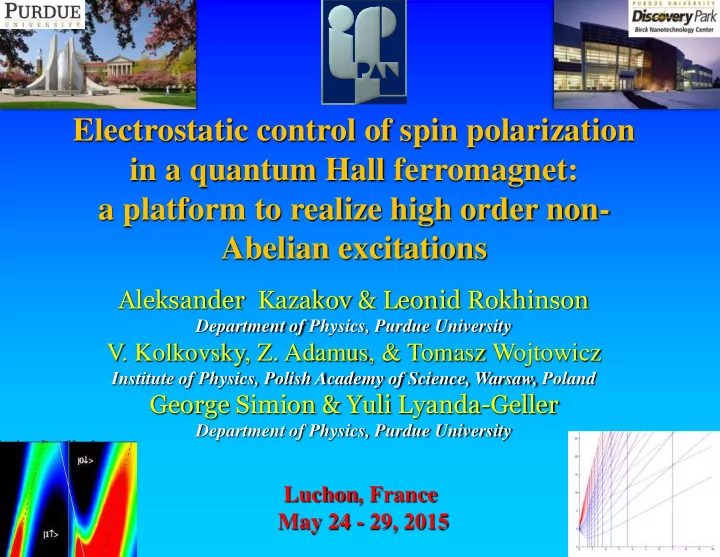
Electrostatic control of spin polarization in a quantum Hall ferromagnet: a platform to realize high order non- Abelian excitations Aleksander Kazakov & Leonid Rokhinson Department of Physics, Purdue University V. Kolkovsky, Z. Adamus,


slide-1
SLIDE 1

Luchon, France May 24 - 29, 2015

Electrostatic control of spin polarization in a quantum Hall ferromagnet: a platform to realize high order non- Abelian excitations

Aleksander Kazakov & Leonid Rokhinson

Department of Physics, Purdue University

  • V. Kolkovsky, Z. Adamus, & Tomasz Wojtowicz

Institute of Physics, Polish Academy of Science, Warsaw, Poland

George Simion & Yuli Lyanda-Geller

Department of Physics, Purdue University

slide-2
SLIDE 2

Engineering Majorana fermions

6/11/2015 Leonid Rokhinson, Purdue University 2

requirements: 1D spinless (one mode) superconductor topological superconductor

k 2D Bso  B k k EZ B = 0 Bso || B EZ EF

pairing possible

Sau, et al ’10, Alicea, et al ‘10

SC SC

slide-3
SLIDE 3

parameter space

6/11/2015 Leonid Rokhinson, Purdue Univesity 3

𝐹𝑎 > 𝛦2 + 𝐹𝐺

2

Bso  B

single-spin condition:

] 110 [ [110]

kx ky

d=20nm

w>200nm 𝐹𝑎~𝐹𝑇𝑃

to protect superconductivity:

2 2

2 2 ( / )

SO D z D

E k k d k     

6 1

2.6 [meV], [10 cm ]

SO

E k k

 

d=100nm

6 1

0.1 [meV], [10 cm ]

SO

E k k

 

smallest dimension defines Eso: small d ⇒ large Eso ⇒ large EF ⇒ less localization

slide-4
SLIDE 4

Characteristic 4 energy-flux relation

6/11/2015 Leonid Rokhinson, Purdue Univesity 4

modification of the Josephson phase trivial superconductor 2 Cooper pairs, I  sin(f) topological superconductor 4 Majorana particles, I  sin(f/2)

Kwon ’04

Lutchyn ‘10

Kitaev ‘01 𝑐† = (𝛿𝑚 − 𝑗𝛿𝑛)

slide-5
SLIDE 5

ac Josephson effect

6/11/2015 Leonid Rokhinson, Purdue Univesity 5

𝜚1 𝜚2 V 𝑒(Δ𝜚) 𝑒𝑢 = 2𝑓𝑊 ℏ 𝐽𝑡 = 𝐽𝑑 sin 𝜕𝐾𝑢 = 𝐽𝑑 sin 2𝑓𝑊 ℏ 𝑢 Current oscillates with frequency  V direct inverse 𝜚1 𝜚2 I 𝐽 = 𝐽0 + 𝐽𝜕sin(𝜕𝑢) Constant voltage steps  w 𝑊 = ℎ𝜕 2𝑓

slide-6
SLIDE 6
  • 200

200

  • 24
  • 12

12 24

  • 200

200

  • 200

200

  • 200

200

  • 200

200

V (V)

I (nA) B=0 B=1.0 T I (nA) B=1.6 T I (nA) B=2.1 T I (nA) B=2.5 T I (nA)

Disappearance of the first Shapiro step

6/11/2015 Leonid Rokhinson, Purdue Univesity 6

f = 3 GHz

LR, X. Liu, J. Furdyna, Nature Physics 8, 795 (2012)

dc rf ~ V

slide-7
SLIDE 7

Shapiro steps

6/11/2015 Leonid Rokhinson, Purdue Univesity 7

300 1000 1000 1000 100

  • 200

200 2 4 6 8 10 12

Vrf (mV)

I (nA)

5 10

dV/dI

B=0, f = 3 GHz

I0 (nA) I1 I2 I3 I4

  • 40
  • 32
  • 24
  • 16
  • 8

8 16 24 32 40

  • 300
  • 200
  • 100

100 200 300 20 40

f = 4 GHz Vrf = 14.25 mV V (V) dV/dI I (nA)

Δ𝐽𝑜=A|𝐾𝑜

2𝑓𝑤𝑠𝑔 ℏ𝜕𝑠𝑔

|

slide-8
SLIDE 8

dV/dI vs B

6/11/2015 Leonid Rokhinson, Purdue Univesity 8

step @ 6 V step @ 12 V

slide-9
SLIDE 9

4-periodic Josephson supercurrent in HgTe-based 3D TI

6/11/2015 Leonid Rokhinson, Purdue Univesity 9

arXiv:1503.05591

Wiedenmann, …M. Klapwijk, …, Seigo Tarucha, L. W. Molenkamp

slide-10
SLIDE 10

6/11/2015 Leonid Rokhinson, Purdue Univesity 10

Advantage of 1D wires: Majorana modes are localized

easy to perform spectroscopy

Disadvantage of 1D wires: Majorana modes are localized

almost impossible to perform exchange

quantum Hall effect magnetic semiconductors superconductivity new materials to support exotic non-Abelian excitations reconfigurable 1D topological superconductors in 2D systems

slide-11
SLIDE 11

Motivation and inspiration

6/11/2015 Leonid Rokhinson, Purdue Univesity 11

Exotic non-Abelian anyons from conventional fractional quantum Hall states David J. Clarke, Jason Alicea, and Kirill Shtengel Nature Commun., 2012, 4,, 1348 Topological Quantum Computation - From Basic Concepts to First Experiments Ady Stern & Netanel Lindner Science, 2013, 339, 1179

slide-12
SLIDE 12

6/11/2015 Leonid Rokhinson, Purdue University 12

Mn [Ar]3d54s2

exchange split ~3 eV (Hunds rule), ½ filled S=5/2

Ga [Ar]3d104s24p1 As [Ar]3d104s24p3

p-doping large s-d exchange (ferromagnetic) GaAs:Mn CdTe:Mn

Cd [Kr]4d105s2 Te [Kr]4d105s25p4

neutral impurity, large s-d exchange

Development of a new system CdTe:Mn QW

slide-13
SLIDE 13

Development of a new system

6/11/2015 Leonid Rokhinson, Purdue University 13

High mobility 2D gas in CdTe/CdMgTe QW m*=0.11, Eg=1.44 eV no Mn ~1% Mn add Mn into CdTe (neutral impurity with 5/2 spin)

slide-14
SLIDE 14

FQHE in CdTe:Mn

6/11/2015 Leonid Rokhinson, Purdue Univesity 14

Betthausen, et al, Phys. Rev. B 90, 115302 (2014)

  • T. Wojtowicz
slide-15
SLIDE 15

Anomalous Zeeman splitting in CdTe:Mn

6/11/2015 Leonid Rokhinson, Purdue University 15

𝐹𝑜,↑↓ = (𝑜 + 1 2 )ℏ𝜕𝑑 ± 1 2 𝑕∗𝜈𝐶𝐶 + 𝑦𝑁𝑜𝐹𝑡𝑒𝔆𝑇

𝑕𝜈𝐶𝑇𝐶 𝑙𝐶𝑈

cyclotron Zeeman g*1.6 s-d exchange (>0) 1.3% Mn 0.13% Mn for n=1

En (meV) En (meV) En (meV) B (Tesla) B (Tesla) B (Tesla)

2 4 6 8 10

  • 8
  • 6
  • 4
  • 2

2 4 6 8

slide-16
SLIDE 16

Magnetoreflectivity studies

6/11/2015 Leonid Rokhinson, Purdue Univesity 16

Wojtowicz, et al, PRB 59, R10437 (1999)

negatively charged exciton complex 𝑌

− (trion) to singlet 𝑌

transition under polarized 𝜏+/𝜏− light

slide-17
SLIDE 17

2 4 6 8 10

  • 8
  • 6
  • 4
  • 2

2 4 6 8

spin energy splitting (Kelvin) magnetic field (Tesla)

 = 1/m

new platform for non-Abelian excitations

6/11/2015 Leonid Rokhinson, Purdue University 17 B*

Ohmic SC contact

slide-18
SLIDE 18

2 4 6 8 10

  • 8
  • 6
  • 4
  • 2

2 4 6 8

spin energy splitting (Kelvin) magnetic field (Tesla)

 = 1/m

new platform for non-Abelian excitations

6/11/2015 Leonid Rokhinson, Purdue University 18

𝜉 =

1 𝑛, 𝐹𝑎 ↑ > 0

𝜉 =

1 𝑛, 𝐹𝑎 ↑ < 0

parafermions 𝐹𝑎 𝑦 𝐹𝐺

B* B*

braiding sequence

Ohmic SC contact

SC SC

slide-19
SLIDE 19

5 10

  • 20

20 40 60 80 7 8 9 10

  • 0.2

0.0 0.2 0.4

(a)

3 6 9 12

  • 1.0
  • 0.5

0.0 0.5 1.0

𝜉

𝐹𝑡

↑↓ (K)

magnetic field (T)

𝐶𝜉

𝜉 = 1

𝑛 |↓

parafermions 𝐹𝑡

↑↓

𝑦 𝐹𝐺

𝜉 = 1

𝑛 |↑

magnetic field (T) magnetic field (T) 𝑜 + 1

2 ℏ𝜕𝑑 + 𝐹𝑡 ↑↓ (meV)

𝐹𝑞

𝐷𝐺 + 𝐹𝑡 ↑↓ (meV)

(b) (c) (d)

|0, ↓ |1, ↓ |2, ↓ |3, ↓ |0, ↑ |1, ↑ |2, ↑ |3, ↑ |1, ↓ |2, ↓ |3, ↓ |4, ↓ |1, ↑ |2, ↑ |3, ↑ |4, ↑ |𝑞, 𝑡 |𝑜, 𝑡

𝜉 = 2

1 3 , 5 3 𝜉 = 2 3 , 4 3 , 2 5 , 8 5

Crossing of neighboring LLs

slide-20
SLIDE 20

Quantum Hall ferromagnet & level crossing

6/11/2015 Leonid Rokhinson, Purdue Univesity 20

Jaroszynski, et al, PRL 89, 266802 (2002) Jaroszynski, et al, AIP conference proceedings (2005)

uniformly Mn-doped quantum well

slide-21
SLIDE 21

Gate control of exchange

6/11/2015 Leonid Rokhinson, Purdue Univesity 21

20 40 60 80 100 120 140 160 180 200 0.0 0.1 0.2 0.3 0.4

band edge (meV) distance (nm)

𝐹𝑡𝑒 ∝ 𝜔𝑓 𝑦 𝜓𝑁𝑜(𝑦) 𝑒𝑦

100 120 140 0.0 0.2 0.4

VG1 VG2

bandedge [meV] depth from surface [nm] (x)

100 120 140 0.0 0.2 0.4

 bandedge [meV] depth from surface [nm]

0.0 0.1 0.2 0.3

wave function

dencity front gate exchange

100 120 140 0.0 0.2 0.4

 bandedge [meV] depth from surface [nm]

0.0 0.1 0.2 0.3

wave function

dencity back gate

  • verlap

exchange

VFG VBG

slide-22
SLIDE 22

Structures with asymmetric doping

6/11/2015 Leonid Rokhinson, Purdue Univesity 22

10 20 30 40 50 60 70 80 90

7x(5x1)

Layer number

011414A

10 20 30 40 50 60 70 80 90

7x(2x1)

Layer number

011514A

10 20 30 40 50 60 70 80 90

8x(3x1)

Layer number

011614A

10 20 30 40 50 60 70 80 90

6x(1x1)

Layer number

011714A

0.00 0.03 0.06 0.00 0.03 0.06 0.00 0.03 0.06 75 100 125 150 175 0.00 0.03 0.06

 bandedge [eV]

wafer #011414A 0.0 0.3 wafer #011514A 0.0 0.3 wafer #011614A 0.0 0.3

x [nm]

wafer #011714A 0.0 0.3

slide-23
SLIDE 23

Gate control of s-d exchange

6/11/2015 Leonid Rokhinson, Purdue Univesity 23

0.6 0.8 1 1.2 1.4 1.6 1.8 2 0.6 0.8 1 1.2 1.4 1.6 1.8 2

Exc = const Exc  

simulation: 5-12 simulation: 21-23 data: wafer #011414 data: B

*(Vg)/B *(-200) vs (Vg)/(-200)

log noralised overlap log normalized dencity change of the overlap with density E

x c

 1/

4 5 6 7 8 9

  • 10
  • 8
  • 6
  • 4
  • 2

2 4 6 8 10 12 14 16 18

  1

  2

Rxx (k) B (T) #011414 T=400 mK B @ 18° d023 VBG

  3

5 6 7 8 9

  • 200
  • 150
  • 100
  • 50

50 100 150

 2 2

1 

B (Tesla) VBG (Volts)

0.0 1.2 2.4 3.6 4.8 6.0

5 10 VBG = 0 Rxx (k)

Rxx (k)

0.0 0.5 1.0

#011414 Rxy (h/e

2)

B @ 18° T=400 mK

(1 ↓) (0 ↑) (0 ↓)

crossing 1   and   

1.3% Mn

slide-24
SLIDE 24

Gate control of the crossing

6/11/2015 Leonid Rokhinson, Purdue Univesity 24

4 6 8 50 100 150      1   2 >

B [T] Vback gate [V]

 = 2 |1,>

4 6 8 0,0 0,1 0,2 0,3

B [T] Vtop gate [V]

     1   2 > |1>  = 2

100 120 140 0.0 0.2 0.4

 bandedge [meV] depth from surface [nm]

0.0 0.1 0.2 0.3

wave function

dencity front gate exchange

100 120 140 0,0 0,2 0,4

 bandedge [meV] depth from surface [nm]

0,0 0,1 0,2 0,3

wave function

dencity back gate

  • verlap

exchange

VFG VBG 𝜉 = 2

slide-25
SLIDE 25

low Mn concentration

6/11/2015 Leonid Rokhinson, Purdue Univesity 25

beating in SdH

Node position:

𝐹𝑎 = 𝑂 + 1 2 ℏ𝜕𝐷 = 𝑕∗𝜈𝐶𝐶 + 𝛽𝑦𝑓𝑔𝑔Sℬ𝑇 𝑕𝜈𝐶𝑇𝐶 𝑙𝐶𝑈0

0.0 0.3 0.6

Rxx [k]

#081214 425 mK

0.00 0.25 0.50 0.75 0.0 0.8 1.6

E [meV]

B [T] 𝑜 + 1 2 ℏ𝜕𝑑

slide-26
SLIDE 26

0.0 0.2 0.4 0.6 0.8 0.0 0.5 1.0 1.5 2.0 2.5 3.0 3.5

Rxx [k] B [T] #081214

625 mK 33 mK

0.0 0.2 0.4 0.6 0.8 1.0 0.0 0.2 0.4 0.6 xeff = 0.34% T0 = 84 mK

node position [T] T [K]

# 081214 node 1 node 2 node 3 node 4 node 5 node 6 node 7 node 8

𝑂 + 1 2 ℏ𝜕𝐷 = 𝑕∗𝜈𝐶𝐶 + 𝛽𝑦𝑓𝑔𝑔Sℬ𝑇 𝑕𝜈𝐶𝑇𝐶 𝑙𝐶(𝑈

𝐵𝐺 + 𝑈)

SdH beating, xeff and TFM

temperature dependence

slide-27
SLIDE 27

Gate control of SdH beating

0,1 0,2 0,3 0,4 0,5 0,0 0,2 0,4 0,6 0,8 1,0

Rxx [k] B [T]

#090514A 200 V

  • 200 V
  • 200
  • 100

100 200 0.85 0.90 0.95 1.00 1.05 1.10

#090514 node 2 node 3 node 4 node 5

node position (Vbg) / node position (0V)

Vbg [V]

back gate dependence

slide-28
SLIDE 28

Comparison of high and low Mn concentrations

slide-29
SLIDE 29

Anticrossing between 1st and 2nd LLs

6/11/2015 Leonid Rokhinson, Purdue Univesity 29

200 300 400 600 800 0.1 1

resistance T, mK

1.12 exp K R T        

1

anticrossing gap betw een and E E

 

EAC = 1.12K = 96 eV

6.5 7.0 7.5 8.0 2 4

T =200mK

resistance B (tesla)

T =800mK

slide-30
SLIDE 30

The role of SO interactions

𝐼𝑇𝑃 = 𝛿𝐸𝝉 ⋅ 𝝀 + 𝛿𝑆 𝝉 × 𝒍 ⋅ 𝓕

𝜆 = ( 𝑙𝑦, 𝑙𝑧

2 − 𝑙𝑨 2 , 𝑙𝑧, 𝑙𝑨 2 − 𝑙𝑦 2 , 𝑙𝑨, 𝑙𝑦 2 − 𝑙𝑧 2 )

Only Rashba coupling contributes to N=1 and N+2 anticrossing

slide-31
SLIDE 31

Transport across a gate

6/11/2015 Leonid Rokhinson, Purdue Univesity 31 5 10 15 20 25 30

R [k]

Vfg = 50 mV R

g-u xx

R

gated xy

R

ungated xy

3 4 5 6 7 8 9 50 100 150 200 250 300

B [T]

Vfg [mV]

0.000 2.000 4.000 6.000 8.000 10.00 12.00 14.00

G

g-u xx [e

2/h]

Vbg = 100 V

n, m Landauer-Buttiker: 𝐻 = 𝐻0 𝑜(𝑜 + 𝑛) 𝑛 𝜉 = 2 𝑏𝑜𝑒 𝜉 = 3 𝑜 = 2, 𝑛 = 1 G = 6G0

slide-32
SLIDE 32

Transport across QHFm domain wall

6/11/2015 Leonid Rokhinson, Purdue Univesity 32 4 6 8 10 6 12 18 24

R [k] B [T] Vbg = 60 V Vfg = 0.3 V T = 100 mK ungated area gated area across the gate

6.6 6.8 7.0 7.2 7.4 7.6 1 2

4 6 8 10 6 12 18 24

R [k] B [T] Vbg = 60 V Vfg = 0.3 V T = 100 mK ungated area gated area across the gate

6 7 8 9 6

R [k] B [T] Vbg = 60 V Vfg = 0.3 V T = 100 mK ungated area gated area across the gate

slide-33
SLIDE 33

people involved

6/11/2015 Leonid Rokhinson, Purdue University 33

Aleksander Kazakov, Purdue University Tomasz Wojtowicz Institute of Physics, Polish Academy of Sciences

  • V. Kolkovsky & Z. Adamus, Polish Academy of Science

Yuli Lyanda-Geller, Purdue University