Electroporation -Formation of pores in the cell membrane due to - - PowerPoint PPT Presentation

electroporation
SMART_READER_LITE
LIVE PREVIEW

Electroporation -Formation of pores in the cell membrane due to - - PowerPoint PPT Presentation

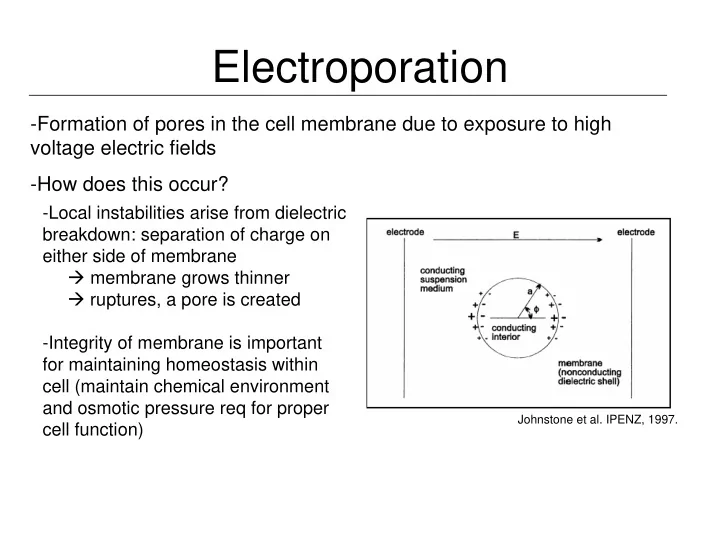
Electroporation -Formation of pores in the cell membrane due to exposure to high voltage electric fields -How does this occur? -Local instabilities arise from dielectric breakdown: separation of charge on either side of membrane membrane


slide-1
SLIDE 1

Electroporation

  • Formation of pores in the cell membrane due to exposure to high

voltage electric fields

  • How does this occur?
  • Local instabilities arise from dielectric

breakdown: separation of charge on either side of membrane membrane grows thinner ruptures, a pore is created

  • Integrity of membrane is important

for maintaining homeostasis within cell (maintain chemical environment and osmotic pressure req for proper cell function)

Johnstone et al. IPENZ, 1997.

slide-2
SLIDE 2

Low Electric Field Strengths

  • ”Reversible breakdown”: pores are small able to close back up
  • Advantages:

by increasing cell porosity, increase its rate of uptake lower doses of antibiotics/chemicals are needed

  • pportunity to introduce foreign material, e.g. genes
slide-3
SLIDE 3

High Electric Field Strength

  • Pores are so large/numerous cell lysis
  • Factors that determine the critical field strength needed for lysis

1) electric field strength 2) cell size: the smaller the cell, the lower the transmembrane potential, req stronger electric field before rupture 3) charge on cell and the surrounding solvent: some say the presence of salts increase the cell’s permeability, others say that you need deionized, nonconductive water in order to achieve high voltage gradients 4) type of electric field: AC have lower lysis rates compared to DC b/c it has varying field strengths—if cell passes the electrodes during a time of low field strength (deadband region), will survive 5) duration of electric field/ rate of fluid flow: pop of cell lysis is proportional to current duration and intensity—how much exposure

  • for 1 cm electrode gap: E = 0.2 kV/cm reversible breakdown

= 5 kV/cm cell lysis

slide-4
SLIDE 4

Cell Lysis

Park, Jong-Chul, et al. Appl Eniv Microbio. April 2003.

  • TEM of bacteria, V. Parahaemolyticus, suspended in sea water and

treated at 12V and 1A for 1s

  • A portion of the cell membrane has ruptured and much of its cell

contents have leaked out