SLIDE 1
Electrons and X-Rays Wilhelm C. Roentgen Joseph J. Thomson - - PowerPoint PPT Presentation
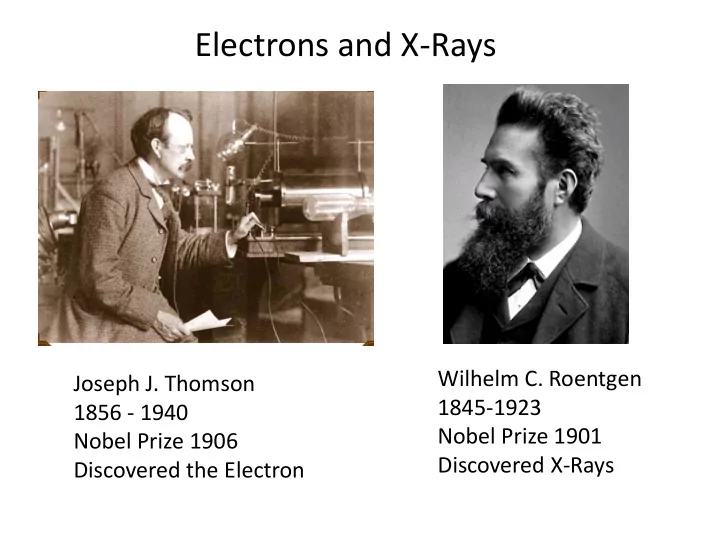
Electrons and X-Rays Wilhelm C. Roentgen Joseph J. Thomson 1845-1923 1856 - 1940 Nobel Prize 1901 Nobel Prize 1906 Discovered X-Rays Discovered the Electron ? ? Near Vacuum q/m ratio results surprising 1000 x larger than q/m for charged
SLIDE 2
SLIDE 3
SLIDE 4
SLIDE 5
q/m ratio results surprising 1000 x larger than q/m for charged hydrogen!
Thomson presented three hypotheses about cathode rays based on his 1897 experiments:
- 1. Cathode rays are charged particles (which he called
"corpuscles").
- 2. These corpuscles are constituents of the atom.
- 3. These corpuscles are the only constituents of the atom.
For More Information see AIP history of physics: Discovery of Electron http://www.aip.org/history/electron/
SLIDE 6
SLIDE 7
300 Volts KE=300 eV
50 V (1 CM)
SLIDE 8
SLIDE 9
SLIDE 10
What would a geek do with something like this?
SLIDE 11
What would a geek do with something like this? Turn the oscilloscope into a clock. How???
?
SLIDE 12
What would a geek do with something like this?
- scilloscope clock
Scope with X vs Y mode Connect Programmable Microprocessor Vary Voltages CH1 (X) CH2 (Y) Deflect the cathode rays! (electrons) Write a clock to the screen
Google “oscilloscope clocks”
SLIDE 13
http://www.techfresh.net/old-fashioned-cathode-ray-tube-clock/
Electron Accelerator (Cathode Ray Tube) Analog! Digital! GPS Receiver 2008: Electron Accelerator Clock with sub microsecond accuracy!
Micro Processor
SLIDE 14
One of the first computers With graphics display ~1975 Tektronix 4051 Display: 11” CRT Processor: Motorola 6800 8 bit Memory: 32K RAM Language: BASIC
“Just $6995. Less than most comparable alphanumeric
- nly systems”
SLIDE 15
SLIDE 16
SLIDE 17
SLIDE 18
SLIDE 19
SLIDE 20
SLIDE 21
SLIDE 22