Electronic Health Record Technology Contracts After HITECH - - PowerPoint PPT Presentation

electronic health record technology contracts after
SMART_READER_LITE
LIVE PREVIEW

Electronic Health Record Technology Contracts After HITECH - - PowerPoint PPT Presentation

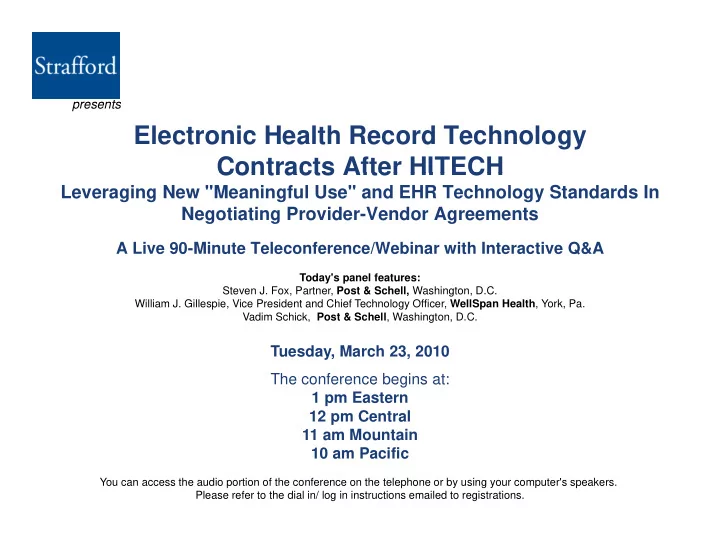
presents presents Electronic Health Record Technology Contracts After HITECH Contracts After HITECH Leveraging New "Meaningful Use" and EHR Technology Standards In Negotiating Provider-Vendor Agreements A Li A Live 90-Minute


slide-1
SLIDE 1

presents

Electronic Health Record Technology Contracts After HITECH

presents

Contracts After HITECH

Leveraging New "Meaningful Use" and EHR Technology Standards In Negotiating Provider-Vendor Agreements

A Li 90 Mi t T l f /W bi ith I t ti Q&A

Today's panel features: Steven J. Fox, Partner, Post & Schell, Washington, D.C. William J. Gillespie, Vice President and Chief Technology Officer, WellSpan Health, York, Pa. V di S hi k P t & S h ll W hi t D C

A Live 90-Minute Teleconference/Webinar with Interactive Q&A

Vadim Schick, Post & Schell, Washington, D.C.

Tuesday, March 23, 2010 The conference begins at: The conference begins at: 1 pm Eastern 12 pm Central 11 am Mountain 10 am Pacific 10 am Pacific

You can access the audio portion of the conference on the telephone or by using your computer's speakers. Please refer to the dial in/ log in instructions emailed to registrations.

slide-2
SLIDE 2

For CLE purposes, please let us know how many people are listening at your location by

  • closing the notification box
  • and typing in the chat box your

company name and the number of attendees.

  • Then click the blue icon beside the box

to send.

slide-3
SLIDE 3

Electronic Health Record T h l C t t ft Technology Contracts after HITECH

March 23, 2010 By Steven J. Fox, William J. “Buddy” Gillespie, and Vadim Schick

slide-4
SLIDE 4

Contents Contents

K A

  • Key Acronyms
  • ARRA, HITECH Act and the Proposed

D fi iti f M i f l U Definition of Meaningful Use

  • Incentives
  • Business drivers for software acquisition
  • Key Contractual Provisions

y

  • Case Study – WellSpan Health

2

slide-5
SLIDE 5

Key Acronyms y y

  • CAH = Critical Access Hospital

EP Eli ibl P f i l

  • EP = Eligible Professional
  • EH = Eligible Hospital
  • EHR = Electronic Health Record
  • MU = Meaningful Use
  • NPRM = Notice of Proposed Rule Making
  • FQHC = Federally Qualified Health Center
  • HPSA = Health Professional Shortage Area

3

slide-6
SLIDE 6

ARRA & HITECH Act ARRA & HITECH Act

  • American Reinvestment & Recovery Act
  • American Reinvestment & Recovery Act

(ARRA) – February 17, 2009

  • Includes HITECH Act

Includes HITECH Act

  • EHR Incentive NPRM issued December

30, 2009; published in Federal Register 30, 2009; published in Federal Register January 13, 2010

  • NPRM Comment Period Closed on March

15, 2010

4

slide-7
SLIDE 7

Meaningful Use Defined Meaningful Use Defined

  • An EP and an EH shall be considered a meaningful
  • An EP and an EH shall be considered a meaningful

EHR user for an EHR reporting period for a payment year if they meet the following three requirements:

  • Use certified EHR in a meaningful manner (ex. E-

Prescribing)

  • Utilize certified EHR technology that is connected in a

gy manner that provides for the electronic exchange of health information to improve the quality of healthcare such as promoting care coordination

  • Submit information on clinical quality measures and other

measures in a form and manner specified by the Secretary

5

slide-8
SLIDE 8

Certified EHR

  • A complete EHR or a combination of EHR

modules, each of which:

  • meets the requirements of a Qualified EHR; and
  • has been tested and certified in accordance with the

certification program established by the National certification program established by the National Coordinator as having met all applicable certification criteria adopted by the Secretary ONC l d NPRM tifi ti

  • ONC released an NPRM on certification
  • rganizations on March 3, 2010
  • certification standards were subject of an Interim

j Final Rule published on January 13, 2010

6

slide-9
SLIDE 9

NPRM on Meaningful Use g

  • Notice of Public Rule Making (NPRM) regarding meaningful

use published in Federal Register on January 13, 2010.

  • Five Policy Goals for MU*:
  • Improve quality, safety, efficiency, and reduce health

disparities

  • Engage Patients and Families
  • Improve Care Coordination
  • Ensure adequate privacy and security protections for

personal health information personal health information

  • Improve Population and Public Health
  • Note; Definition published in NPRM may change in the final

; p y g rule.

* Same five goals were presented by the HIT Policy Committee in August 2009. See also pp. 1867-1870 of NPRM.

7

slide-10
SLIDE 10

Meaningful Use Criteria Timeline Meaningful Use Criteria Timeline

2011 St 1 t / h d t 2011 – Stage 1: capture/share data 2013 – Stage 2: advanced clinical ith d i i processes with decision support 2015 St 3 i d t 2015 – Stage 3: improved outcomes

8

slide-11
SLIDE 11

Medicare Incentives EPs Medicare Incentives - EPs

9

slide-12
SLIDE 12

Medicare Incentives EHs Medicare Incentives – EHs

Initial Amount Initial Amount ($2 million plus additional amounts calculated in accordance with each hospital’s Medicare discharges) X Medicare Share Medicare Share (roughly, a hospital’s share of Medicare discharges over total discharges) X T iti F t Transition Factor: Year 1 – 100% Year 2 – 75% Year 3 – 50% Year 3 50% Year 4 – 25% Year 5 – 0%

10

slide-13
SLIDE 13

Medicaid Incentive Program Medicaid Incentive Program

  • EPs and EHs have the option to earn their incentive for the
  • EPs and EHs have the option to earn their incentive for the

first payment year through the adoption, implementation or upgrade of certified EHR technology

  • Do not have to demonstrate meaningful use in first year

Do not have to demonstrate meaningful use in first year

  • Unlike Medicare, Medicaid has no statutory implementation

date for making EHR incentive payments.

  • some states might be prepared to implement their program

so e states g t be p epa ed to p e e t t e p og a and make payments in 2010 for adopting, implementing, or upgrading certified EHR technology.

  • states can initiate payments after the final rule

11

slide-14
SLIDE 14

Medicaid Incentives EPs Medicaid Incentives – EPs

12

slide-15
SLIDE 15

Medicaid Incentives EHs Medicaid Incentives – EHs

  • Formula similar to Medicare
  • Formula similar to Medicare
  • Overall EHR Amount x Medicaid Share (Over 4 years)
  • Overall amount = Base Amount ($2M) plus Discharge

R l t d A t A li bl * f h t iti Related Amount Applicable* for each year x transition factor applicable for each year** X

  • Medicaid Share = Medicaid inpatient days plus

Medicaid managed care inpatient days divided by total inpatient bed days x estimated total charges i h it h di id d b ti t d t t l minus charity care charges divided by estimated total charges

13

slide-16
SLIDE 16

Licensing and Negotiations

14

slide-17
SLIDE 17

Provider Gap Analysis Provider Gap Analysis

  • Undertake compliance assessment re
  • Undertake compliance assessment re

gap between existing practices & Meaningful Use Meaningful Use

  • Restructure existing contractual

relationships p

  • Begin RFP/contract process to add

needed software applications and/or hardware

15

slide-18
SLIDE 18

Facts of Life Facts of Life

  • “Meaningful Use” is an evolving concept
  • Meaningful Use is an evolving concept –

it will change over time

  • Incentives insufficient to cover all real
  • Incentives insufficient to cover all real

costs of achieving Meaningful Use

  • Risk shifting will be attempted

Risk shifting will be attempted

  • You do not want to be the last one in line

16

slide-19
SLIDE 19

Manage the Initial Contract Process Manage the Initial Contract Process

D fi i t / t t

  • Define requirements / contract
  • RFP/RFS
  • Build a negotiation team
  • Control negotiations
  • Pay attention to the schedules
  • Timelines
  • Exhibits, schedules and/or attachments

17

slide-20
SLIDE 20

Build an HIT Contract Structure to Answer These Questions

Wh t i i ( h t d

  • What are we acquiring (vs. what do we

actually need)? Wh t i f d h ?

  • What are we paying for and when?
  • How to assure our requirements will be

t? met?

  • What happens if the product fails?

18

slide-21
SLIDE 21

What Are We Acquiring Relating to q g g Meaningful Use?

S ft

  • Software
  • Hardware
  • Professional services
  • Support and maintenance

19

slide-22
SLIDE 22

What Are We Paying For and When? What Are We Paying For and When?

  • Pricing metrics

g

  • Pay for performance
  • Time and materials vs fixed fee
  • Time and materials vs. fixed fee
  • Roles / responsibilities in workplan

Adj t t t h

  • Adjustment to charges
  • Price protection

20

slide-23
SLIDE 23

Payment Terms

  • Vendor standard contracts typically specify

payment terms by the calendar, regardless of whether milestones have been met

  • Milestone payments keep the provider in control
  • Milestone payments tied to achieving
  • perational goals give maximum vendor

alignment with your success alignment with your success

  • Offering vendor incentives (financial or other)

gives them a chance to win if you achieve your g y y business objectives (rather than just installing the software)

21

slide-24
SLIDE 24

How To Assure Our Requirements q Will Be Met?

  • Scope of License
  • Implementation Workplan
  • Implementation Workplan
  • Acceptance Testing
  • Warranties
  • Warranties
  • Service Levels

22

slide-25
SLIDE 25

Deliverables / Scope p

  • Requirements definition
  • Specific work done by whom based on

specific payment

  • Milestones, timelines & measurements
  • Specific roles / responsibilities

p p

  • Obligations for maintenance, updates &

repairs repairs

23

slide-26
SLIDE 26

Meaningful Use Requirements Meaningful Use Requirements

W k i

  • Work in progress
  • Agree to today’s definition / interpretation
  • Agree to agree to future regulatory

changes (“We don’t know what we don’t k ”) know.”)

  • Build a pro-rata cost for compliance

24

slide-27
SLIDE 27

Key Contractual Provisions

25

slide-28
SLIDE 28

Key Contractual Provisions Key Contractual Provisions

  • Definitions
  • License terms
  • Warranties / Support

C fid ti lit & i

  • Confidentiality & privacy
  • Limitation of Liability and Indemnification

T ti / A t

  • Testing / Acceptance
  • Pricing

Termination / ADR

  • Termination / ADR

Everything is negotiable

26

slide-29
SLIDE 29

Acceptance / Refund Acceptance / Refund

A t t ti it i

  • Acceptance testing criteria
  • Testing procedure
  • Timeframe
  • Remedies for non-acceptance

27

slide-30
SLIDE 30

License terms License terms

  • Shrink wrap licenses typically used for off the shelf
  • Shrink-wrap licenses, typically used for off-the-shelf

software

  • Site licenses, covering a specific geographical

l ti t i id li i location; enterprise-wide licenses, encompassing an entire business or institution; network licenses, for all users of a specified LAN (local area network) or WAN ( id t k) WAN (wide area network)

  • Named user or concurrent user licenses
  • ASP or SaaS (software as a service) licenses,

ASP or SaaS (software as a service) licenses, governing the right to use software on a subscription-type basis

28

slide-31
SLIDE 31

Warranties Warranties

Standard:

  • Compliance to documentation &

specifications

  • Interoperability / Interfaces
  • Compliance with laws & regulations
  • No viruses; security protections
  • Sunset issues

29

slide-32
SLIDE 32

Warranties Warranties

ARRA:

  • All products are “certified” and shall

remain so

  • Vendor will fully cooperate to enable

t t hi “M i f l U ” customer to achieve “Meaningful Use”

  • Vendor shall comply with all applicable

HITECH & HIPAA rules HITECH & HIPAA rules

30

slide-33
SLIDE 33

Service Levels Service Levels

U ti / d ti

  • Uptime / downtime
  • Response to severity level issues
  • Minimum acceptable SLAs
  • Remedies

31

slide-34
SLIDE 34

Support & Maintenance Support & Maintenance

  • Answer questions 24x7
  • Remote diagnostics
  • Updates, releases, versions, new products
  • Customizations / interfaces
  • Regulatory compliance
  • Limits on price increases
  • Limit vendor’s termination rights

g

32

slide-35
SLIDE 35

Financing Options g p

  • Vendor financing may seem like a win-win

situation

  • both parties are invested in successful

implementation and operation of the product: healthcare provider must achieve meaningful use healthcare provider must achieve meaningful use and the vendor will get paid when that happens

  • Vendor-financed deals also pose serious risks
  • Leverage issues
  • Meetings of deadlines
  • Financing and payment terms

Financing and payment terms

  • Many others

33

slide-36
SLIDE 36

Key Provisions in Financed Licenses

  • Healthcare providers must be especially vigilant

Healthcare providers must be especially vigilant about protecting their interests in vendor- financed transactions

  • Resist pressure to accept vendor’s standard

terms and conditions E i b t ti ti t i l d th

  • Engage in robust negotiations to include the

following safeguards

  • Note: the list below is by no means all-inclusive

Note: the list below is by no means all inclusive, it is merely a sampling of the required provisions

34

slide-37
SLIDE 37

Key Provisions (cont’d) Key Provisions (cont d)

  • Financing and payments
  • Financing and payments
  • No “hell or high water” clauses
  • Payments should be linked to vendor’s

y performance and achieving meaningful use

  • Restrict assignment of the note by vendor-

creditor creditor

  • Link loan and services/product agreements
  • Build some flexibility into the loans
  • Early repayment options
  • Refinancing options

35

slide-38
SLIDE 38

ASP / SaaS models ASP / SaaS models

  • Must avoid vendors holding data “hostage”
  • Must avoid vendors holding data hostage
  • Ensure access to customer data, including PHI,
  • n vendor’s systems

R l b k f d t

  • Regular back ups of data
  • Disaster Recovery
  • Mandate return of customer data upon

Mandate return of customer data upon termination of the contract

  • Ensure security of data and access to such data

if vendor goes out of business if vendor goes out of business

36

slide-39
SLIDE 39

Remedies Remedies

A t / R f d

  • Acceptance / Refund
  • Indemnification
  • Escalation / Alternative Dispute

Resolution

  • Termination

37

slide-40
SLIDE 40

Termination Termination

F

  • For cause
  • For convenience
  • For force majeure
  • Effect of termination; remedies

38

slide-41
SLIDE 41

Fine Print Fine Print

  • Limitation of Liability
  • Disclaimer of Consequential Damages
  • Needs to be mutual
  • Disclaimer of Implied Warranties

39

slide-42
SLIDE 42

Fine Print (Cont’d) Fine Print (Cont d)

Li it ti f Li bilit C t f

  • Limitation of Liability Carve-outs for:
  • Breach of confidentiality/privacy
  • Personal injury/death, property damage
  • Intellectual property infringement
  • Vendor’s breach resulting in healthcare

provider’s failure to achieve Meaningful Use in a timely manner Use in a timely manner

40

slide-43
SLIDE 43

Indemnities Indemnities

IP i f i t

  • IP infringement
  • Confidentiality, privacy & security

b h breaches

  • Personal injury and bodily harm

41

slide-44
SLIDE 44

Privacy, Security & y y Confidentiality

N d t t fid ti lit f PHI

  • Need to stress confidentiality of PHI
  • Who owns data; use of data by vendor
  • Intellectual property issues
  • Obligations of nondisclosure
  • Remedies for breach
  • Indemnification obligations

Indemnification obligations

42

slide-45
SLIDE 45

Manage Conflicts Post Signing Manage Conflicts Post Signing

D l l i

  • Develop common lexicon
  • Certification standards / best practices
  • Institute change control
  • Communicate early and often
  • Adhere to governance principles
  • Use dispute resolution / escalation

Use dispute resolution / escalation

43

slide-46
SLIDE 46

Governance Governance

O ti d t t i t

  • Operating and strategic teams
  • Shared strategic plan
  • Communication plan
  • Frequent meetings
  • Reporting requirements

44

slide-47
SLIDE 47

Dispute Resolution Dispute Resolution

  • Designate project sponsors for both
  • Designate project sponsors for both

parties

  • Meet and communicate frequently
  • Meet and communicate frequently
  • Escalate through higher levels of each
  • rganization
  • rganization
  • Continue contract while in dispute

resolution

  • Consider third party mediation / arbitration

45

slide-48
SLIDE 48

How to Avoid Disputes Regarding p g g Meaningful Use

  • Understand perspectives
  • Provide ongoing value

g g

  • Set proper expectations
  • Accountable leadership

Accountable leadership

  • Project management process

46

slide-49
SLIDE 49

Case Study Case Study WellSpan Health - WellSpan Health -

The Integrated Delivery System Perspective The Integrated Delivery System Perspective Perspective Perspective

47

slide-50
SLIDE 50

CASE STUDY CASE STUDY CASE STUDY CASE STUDY

  • Background
  • Tips from the Trench
  • Strategic IT Plan
  • Project Methodology

j gy

  • Vendor Relationships and Contracts
  • Conclusion
  • Conclusion

48

slide-51
SLIDE 51

IT Vision Statement IT Vision Statement IT Vision Statement IT Vision Statement

“WellSpan Health Will Implement the WellSpan Health Will Implement the Information Systems and Technology Necessary to Support Improved Clinical Care and Operating Efficiency, Improved S i f P ti t d F ili Service for Patients and Families, Ease of Use of Physicians and Staff, and Informed Management Decision and Informed Management Decision Making.”

49

slide-52
SLIDE 52

HIT Policy Committee MU G l MU Goals

  • Improve quality, safety, efficiency,

and reduce health disparities

  • Engage Patients and Families
  • Improve Care Coordination
  • Ensure adequate privacy and

q p y security protections for personal health information

  • Improve Population and Public

Health

50

slide-53
SLIDE 53

TIPs from the TRENCH

  • Bi-Annual Meetings between WellSpan

and Vendor executives and Vendor executives

  • Negotiate Organic growth in scope of

license license

  • Include Interface Specifications
  • Include Technical Specifications

p

  • Term vs. Perpetual license
  • Require a Technical Review prior to

q p contract discussions

51

slide-54
SLIDE 54

TIPs from the TRENCH

  • Verify that future Amendments reference

and are governed by the contract and are governed by the contract

  • Establish metrics and price points for

scope of license change scope of license change

  • Negotiate MSO & Sub Licensing terms
  • Lock fees for 24 to 36 months
  • Negotiate fixed price for additional

modules-futures

  • Negotiate renewal fee for term license

52

slide-55
SLIDE 55

TIPs from the TRENCH

  • Extend Warranty Period for life of Service

Agreement Agreement

  • Negotiate future discount on additional

software software

  • CLOUD/ASP/SaaS Considerations
  • Don’t let the contract gather dust

g

  • Involve the customer in the negotiations if

possible

  • Enjoy use of vendor product if vendor

breaches contract

53

slide-56
SLIDE 56

TIPs from the TRENCH

  • Negotiate 99.99 % uptime
  • Require vendor to provide data

i t t conversion to new system

  • Non-recruit clause

R i l lit t b l l

  • Require your locality to be legal

jurisdiction

  • Vendor must support standard virus

Vendor must support standard virus protection

  • Include sample implementation plan

p p p

  • Vendor sub-contractors must comply with

agreement

54

slide-57
SLIDE 57

TIPs from the TRENCH

  • Don’t pay for vendor’s implementation

methodology methodology

  • Right to hold payments under a good-faith

dispute dispute

  • Control and monitor vendor access to

system

  • Establish severity levels for problem

resolution/cure period J t “ ” t i t & li k t t

  • Just say “no” to point & click contracts

55

slide-58
SLIDE 58

TIPs from the TRENCH

  • Consider purchasing 3rd Party

hardware/software on prime-vendor paper

  • Mergers & Acquisitions- Position for the

inevitable H brid endors are e ol ing and

  • Hybrid vendors are evolving and

presenting new challenges

  • Hold vendor accountable to certify new

Hold vendor accountable to certify new features of 3rd party software

  • Know when to “fold-them”
  • Avoid “You”, “ Yours”, “Us” and “Ours”

references

56

slide-59
SLIDE 59

WellSpan Health WellSpan Health

Government

Financing System

Own Products

Physician Partnerships

Head Other

Delivery System

Cardiology

Continuous Improvement

Transparency

Insurers Business

  • HMO
  • Insured

PPO

  • PPO
  • TPA

Own Products

Disease Mental Health Pregnancy

Behavioral Health Pharmacy/Home Health Women & Children

Health Status A+ Access A+ Outcomes A+ Cost A+ Service A+ Third Party Contacts

Other Insurers Health Trauma Cancer

Surgical &Rehab Medical Women & Children

Service A+ Compliance A+ Viability A+

People with knowledge, skills and commitment Governance and Management Structures Management and Operational Support Systems Facility Management and Operational Support Systems Information Technology Medical Education Capital

57

slide-60
SLIDE 60

58

slide-61
SLIDE 61

Strategic IT Plan Strategic IT Plan

  • Best of Breed Applications

pp

  • Electronic Health Record
  • MSO offering for practice EHR
  • MSO offering for practice EHR
  • Care Communication
  • Health Information Exchange
  • ETL and Analytics

y

  • Technology Infrastructure

59

slide-62
SLIDE 62

Strategic Goals

  • WellSpan Health-wide linkage & connectivity

WellSpan Health wide linkage & connectivity with appropriate level of security

  • Universally conceived web presence

(eHealth)

  • Aligned provider connectivity, including

i l lli regional allies

  • Common Financial, Materials Management

and Decision Support System and Decision Support System

60

slide-63
SLIDE 63

Strategic Goals g

  • Common Data Base/repository containing all

ti t l t d i f ti patient related information

  • Common “touch & feel” across all IT

solutions solutions

  • Common systems for each functional area

within WellSpan Health

  • Seamless & portable access
  • Consideration of ROI

61

slide-64
SLIDE 64

Strategic Goals

  • Implement IT solutions with

appropriate levels of process re- appropriate levels of process re- engineering

  • Enhanced WellSpan Health

communications via multimedia

  • General use of rules-based logic

Support of Distance Learning

  • Support of Distance Learning
  • Decision Support System –

Financial and Clinical

62

slide-65
SLIDE 65

PROJECT METHODOLOGY

WellSpan Health’s System Selection WellSpan Health s System Selection and Implementation Methodology is a detailed process to assist WellSpan p p Clients, IS and Vendors to outline Information Technology initiatives in a gy linear fashion

63

slide-66
SLIDE 66

Project Knowledge Office (PKO)

  • Supports the WellSpan Health IT Strategy &

Implementation Process

  • Provides the operational plan for the

WellSpan vision of IT objectives across the WellSpan vision of IT objectives across the Integrated Delivery System

  • Provides Guidelines for RFP and Vendor

Provides Guidelines for RFP and Vendor Selection Process

  • Provides sample vendor contract for

reference

64

slide-67
SLIDE 67

PKO Methodology

Provides :

  • Guidelines for the Client, IS

and Vendor role and activities

  • Clear direction to maximize

effort synergy and economics effort, synergy, and economics

  • Standard of practice for IT

System implementation System implementation

65

slide-68
SLIDE 68

PKO Methodology

Successful IT Vendor selection and implementation requires: p q

  • Vision – Strategic Goals/Service Catalog

Vision Strategic Goals/Service Catalog

  • Process – Select Right Vendor
  • Planning
  • Planning
  • Collaboration between the Client, IS,

and Vendor as equal partners in the and Vendor as equal partners in the process and success

66

slide-69
SLIDE 69

MAINTAINING A HEALTHY CLIENT MAINTAINING A HEALTHY CLIENT-

  • VENDOR RELATIONSHIP

VENDOR RELATIONSHIP MAINTAINING A HEALTHY CLIENT MAINTAINING A HEALTHY CLIENT-

  • VENDOR RELATIONSHIP

VENDOR RELATIONSHIP VENDOR RELATIONSHIP VENDOR RELATIONSHIP VENDOR RELATIONSHIP VENDOR RELATIONSHIP

  • After-the-Handshake

Cli t R l

  • Client Role
  • Vendor Role
  • Sustaining the Relationship

67

slide-70
SLIDE 70

Vendor Vendor Vendor Vendor

WellSpan Health

68

slide-71
SLIDE 71

STRATEGIC CLIENT STRATEGIC CLIENT-

  • VENDOR

VENDOR RELATIONSHIP RELATIONSHIP STRATEGIC CLIENT STRATEGIC CLIENT-

  • VENDOR

VENDOR RELATIONSHIP RELATIONSHIP RELATIONSHIP RELATIONSHIP RELATIONSHIP RELATIONSHIP

  • Purpose:
  • Better Achieve Business

Better Achieve Business Mi i Th h T h l Mi i Th h T h l Mission Through Technology Mission Through Technology

69

slide-72
SLIDE 72

STRATEGIC CLIENT STRATEGIC CLIENT-

  • VENDOR

VENDOR RELATIONSHIP RELATIONSHIP STRATEGIC CLIENT STRATEGIC CLIENT-

  • VENDOR

VENDOR RELATIONSHIP RELATIONSHIP RELATIONSHIP RELATIONSHIP RELATIONSHIP RELATIONSHIP

  • Result:

Result:

  • Promotes a positive relationship

Promotes a positive relationship which can resolve ( which can resolve (almost almost) any ) any which can resolve ( which can resolve (almost almost) any ) any potential conflicts in a mutually potential conflicts in a mutually agreeable manner agreeable manner

70

slide-73
SLIDE 73

Client Vendor Relationship Client Vendor Relationship

Partnership Benefits: Partnership Benefits:

 Cost Management  Interface Optimization  Increased Competence  Focus and Control  Focus and Control

71

slide-74
SLIDE 74

Client Vendor Relationship Client Vendor Relationship

Partnership Benefits: Partnership Benefits:

Shared Risk Shared Risk

 Fixed and Variable Fee Schedules  Incentive-based Fees Incentive based Fees  Value-based Investments  Shared Reward

72

slide-75
SLIDE 75

Client Vendor Relationship Client Vendor Relationship

Client Responsibilities: Client Responsibilities:

 Provide Resources to Support the  Provide Resources to Support the

Implementation Plan  Deliver Technology to Support Vendor Certification  Complete Acceptance Testing On- schedule and notify Vendor in schedule and notify Vendor in Timely manner of Problems

73

slide-76
SLIDE 76

Client Vendor Relationship Client Vendor Relationship

Client Responsibilities: Client Responsibilities:

 Serve as Positive Reference if  Serve as Positive Reference if

Appropriate  Attend Executive and User Conferences and provide p constructive feedback  Notify Vendor of Change in  Notify Vendor of Change in Business Drivers

74

slide-77
SLIDE 77

Client Vendor Relationship Client Vendor Relationship

Vendor Responsibilities Vendor Responsibilities:

Client Agent for “Best of Breed”

 Client Agent for “Best of Breed”

Services  Partner Across the Continuum

  • f Change

 Help Client to Achieve Competitive Advantage  Deliver Business Results

75

slide-78
SLIDE 78

Client Vendor Relationship Client Vendor Relationship

Vendor Responsibilities Vendor Responsibilities:

 Benefit Client Organization,

people and Community  Flexible Approach to Partnering  Co-operate with other best of  Co operate with other best of breed vendors  Strategic Alliances with  Strategic Alliances with Suppliers and Competitors

76

slide-79
SLIDE 79

VENDOR CONTRACTS

  • 50 plus vendors; 190 contracts
  • Contracts Stored On-line
  • Protection of IT Investments

Protection of IT Investments

  • Integrating Information within and

beyond the IDS beyond the IDS

  • Maintaining Awareness of the IT Vision
  • HIPAA and Regulatory Compliance
  • HIPAA and Regulatory Compliance

77

slide-80
SLIDE 80

VENDOR CONTRACTS

  • Reduces or prevents potential issues

between WellSpan and Vendor between WellSpan and Vendor

  • Ties payment terms to the completion of

successful implementation-milestones successful implementation milestones

  • Should be perceived as a win-win by

WellSpan and Vendor

  • WellSpan and Vendor representatives

must be familiar with the key terms of the contract contract

78

slide-81
SLIDE 81

Conclusion Conclusion

  • The IT acquisition and contracting

processes are generally complex, processes are generally complex, intensive, critically important and often exasperating to all of the participants.

  • However, if the concepts, procedures and

lessons demonstrated above are learned and utilized the ultimate outcome is likely and utilized, the ultimate outcome is likely to be one that mutually benefits both vendor and customer.

  • Patience is the key to success.

79

slide-82
SLIDE 82

Questions & Discussion Questions & Discussion

80

slide-83
SLIDE 83

Contact Info

For additional information, please feel free to contact:

  • Steven J Fox (Washington D C )

Steven J. Fox (Washington, D.C.) SJFox@postschell.com (202) 661-6940

  • William “Buddy” Gillespie

wgillespie@wellspan.org (717) 851-2447

  • Vadim Schick (Washington, D.C.)

Vadim Schick (Washington, D.C.) VSchick@postschell.com (202) 661-6945

81