Electronic Cigarettes: How Will They Impact Human Health? Prue - - PowerPoint PPT Presentation

electronic cigarettes how will they impact human health
SMART_READER_LITE
LIVE PREVIEW

Electronic Cigarettes: How Will They Impact Human Health? Prue - - PowerPoint PPT Presentation

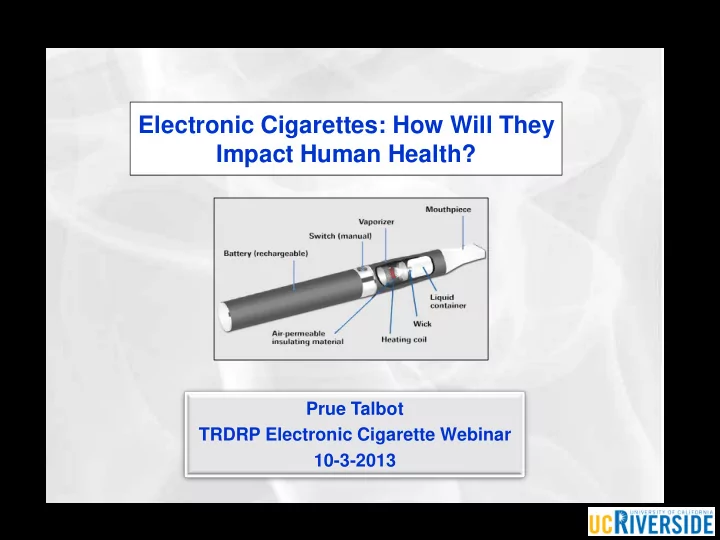
Electronic Cigarettes: How Will They Impact Human Health? Prue Talbot TRDRP Electronic Cigarette Webinar 10-3-2013 Conflict of Interest: none Disclosures: Our lab receives funding from TRDRP, training grants, and Fellowships and

slide-1
SLIDE 1

Electronic Cigarettes: How Will They Impact Human Health?

Prue Talbot TRDRP Electronic Cigarette Webinar 10-3-2013

slide-2
SLIDE 2
  • Conflict of Interest: none
  • Disclosures:
  • Our lab receives funding from TRDRP, training grants,

and Fellowships and Internships from NIH, NSF, TRDRP, CIRM and support for a shared Stem Cell Core Facility from CIRM

slide-3
SLIDE 3

Health Risks Linked to Conventional Smoking

ACTIVE SMOKER PASSIVE SMOKER PRENATAL EXPOSURE

slide-4
SLIDE 4

Do EC Present Health Benefits/Risks?

Are EC safer than conventional cigarettes? Do EC reduce the risk of cancer and other adverse effects linked to conventional cigarettes? Do any EC health effects overlap those of conventional cigarettes? Do EC produce their own set of positive/negative health effects?

SMOKERS EC USERS

  • +
  • ?

+?

slide-5
SLIDE 5

Health Effects of Electronic Cigarettes

In vitro studies using cells models Animal studies Human studies/Clinical Trials Epidemiological/Infodemiological Studies

slide-6
SLIDE 6

Purpose: 1. Compare relative cytotoxicity of different refill fluid products

  • 2. Determine if cytoxicity varies with different cells types

Study was motivated by EC users who asked us to evaluate refill fluids that made them ill.

In Vitro Cytotoxicity of EC Refill Fluids

Bahl et al 2012 Reproductive Toxicology 34:529

Cytotoxicity = ability of a chemical to kill cells IC50 = dose that kills half the cells

slide-7
SLIDE 7

Strategy for Cytotoxicity Screen

  • Two humectants
  • Five products that made users ill
  • 34 Refill fluids from 4 companies

Formazan MTT

hPF mNSC hESC

Bahl et al 2012 Reproductive Toxicology 34:529

slide-8
SLIDE 8

Hierarchy of Cytotoxicity for 41 Refill Fluids

Low (IC50 > 1%) Moderate 0.1% < IC50 < 1%) High (IC50 < 0.1%)

Bahl et al 2012

CYTOTOXICITY

slide-9
SLIDE 9

Cytotoxicity of Refill Fluids from Four Companies

Bahl et al 2012

Products ranged over all three categories of cytotoxicity for all the cell types

  • All companies had some products that were highly cytotoxic.
  • Most products were highly/moderately cytotoxic to stem cells and non-cytotoxic to hPF

Low Moderate High

slide-10
SLIDE 10

Follow-up On Cinnamon-Flavored Refill Fluids

Cinnamaldehyde 2-Methoxycinnamaldehyde Dipropylene glycol Vanillin

HIGH HIGH LOW LOW

Gas Chromatography-Mass Spectrometry was Used to Identify Chemicals in Cinnamon Ceylon

MTT Assay Was Used to Evaluate Cytotoxocity of Authentic Standards

Behar et al

slide-11
SLIDE 11

Cytotoxicity of Refill Fluids vs Aerosol

slide-12
SLIDE 12

Doses Were Prepared So Fluids and Aerosols Could Be Compared

Culture Medium Culture Medium

Refill fluid Aerosol

slide-13
SLIDE 13

Cytotoxicity of Aerosol vs Fluids – hPF 19 Products Compared

Behar and Razo

=

> <

68%: Refill fluids and aerosols were equally cytotoxic. N = 13 11%: Refill fluid was more cytotoxic than the aerosol. N = 2 21%: Aerosol was more cytotoxic than the refill fluid. N = 4

slide-14
SLIDE 14

Cytotoxicity Done on European EC Products Romagna et al 2013 Inhalation Toxicology 25:354-

361.

  • Examined aerosol from 21 EC products – compared to cigarette smoke.
  • Used mouse/BALB 3T3 cells –a mouse embryonic fibroblast line
  • Incubated 24 hours with test dilutions of aerosol or smoke.
  • Used IC30 to define cytoxicity.
  • Found cigarette smoke more cytotoxic than EC aerosol.
  • Found one EC aerosol (Coffee flavor) that was cytotoxic.
slide-15
SLIDE 15

Examples of Studies Done With Human EC Users

slide-16
SLIDE 16

Complete Blood Cell Count Markers Not Affected in EC Users and Those Passively Exposed

Flouris et al 2012 Food and Chemical Toxicology ▲ EC smoking ▀ Cigarette smoking ● Controls

  • Effect of EC and CC use
  • n use on complete

blood cell count.

  • Blood cell count

increased in those actively or passively smoking tobacco cigarettes .

  • Blood cell count was not

significantly affected in those actively or passively using EC.

slide-17
SLIDE 17

Safety Assessment of EC in Smokers

Miura et al 2011 Seikatsu Eisei 55:59-64.

  • 32 smokers used EC for 4 weeks (more than 150 EC puffs/day)
  • No abnormal changes in:
  • Blood pressure
  • Hematological data
  • Blood chemistry

No severe adverse events were observed. Concluded this EC may be a safe alternative to smoking.

slide-18
SLIDE 18

Peering through the mist: what does the chemistry of contaminants in electronic cigarettes tell us about health risk (2013)

Burstyn, Technical Report

  • Reviews recent EC peer reviewed and “grey” literature and makes predictions about

compliance with occupational exposure limits.

  • Concluded individual and combined exposures to contaminants in EC fall below

thresholds for concern for compounds with known toxicity, including

  • volatile organic chemicals (VOCs),
  • tobacco specific nitrosamines (TSNA), polycyclic aromatic hydrocarbons (PAHs),
  • metals.
  • Recommends monitoring health effects related to propylene glycol and glycerin.
  • Magnitude of the exposure is novel and at levels for concern given the lack of data on inhalation of

these chemicals at levels found in EC aerosol.

  • Does not consider inhalation of flavoring chemicals.
slide-19
SLIDE 19

Adverse Events Reported to the FDA

Chen 2012 Nicotine & Tobacco Research

  • Hospitalization for:
  • pneumonia,
  • congestive heart failure,
  • disorientation,
  • seizure,
  • hypotension,
  • aspiration pneumonia,
  • second degree burns to face

(explosion),

  • chest pain and rapid heart beat,
  • possible infant death secondary

to choking on EC,

  • loss of vision requiring surgery

N = 47 since 2008

N = 8

  • False advertising
  • Headache/migraine
  • Chest pain
  • Cough/sputum
  • Nausea/vomiting
  • Dizziness
  • Sleepy/tired
  • Feeling sick
  • Confusion/stupor
  • Sore throat
  • Shortness of breath
  • Abdominal pain
  • Pleurisy
  • Blurry vision

N = 39 https://www.accessdata.fda.gov/scripts/medwatch/

slide-20
SLIDE 20

Short Term Pulmonary Effects Using an EC

Vardavas et al 2012 Chest 141:1400-1406.

  • 30 healthy smokers – ad lib use of EC for 5 minutes
  • Controls used EC with cartridge removed
  • Four parameters of lung physiology were adversely affected by 5 minutes of

inhalation of EC aerosol

  • Concluded short term EC use produce adverse effects similar to those seen

with conventional cigarettes

  • Above changes were statistically different in controls and EC users but may

not be of major clinical importance

Evaluation of immediate effects of EC aerosol inhalation on airway mechanics

slide-21
SLIDE 21

EC: Do They have a Role in Smoking Cessation?

Odum et al 2012 Journal of Pharmacy Practice 25: 611

Bullen et al 2010 Tob Control 19:98 Etter and Bullen 2011 Addiction 106: 2017 Polosa et al 2011 BMC Public Health 11: 786. Etter 2010 BMC Public Health 10:231

slide-22
SLIDE 22

Smoking Cessation Can Be Hazardous To Your Health. 2013 Shawn and Nelson Emergency

Medicine 45:7-19.

  • Case study of 18 month old girl who drinks about 2ml of EC refill fluid
  • Rushed to emergency room with signs of nicotine poisoning
  • Was given IV fluids and monitored 24 hours
  • Her tachycardia and hypertension resolved
  • Was discharged and appeared to be ok
  • Parents were educated about safe storage of EC refill fluids.
slide-23
SLIDE 23

EC Use Linked to Exogenous Lipoid Pneumonia

McCauley et al 2012 Chest 141: 1110 - 1113.

  • EC user presented with exogenous lipoid pneumonia
  • Had been using EC about 7 months
  • Inflammation caused by deposition of lipid in the lungs
  • Chest CT showed opacities consistent with lipoid

pneumonia.

  • Macrophages in bronchoalveolar lavage fluid

were loaded with lipid.

  • Patient stopped using EC and her condition improved.
  • Hypothesized condition may have been caused by

inhaling EC aerosol.

slide-24
SLIDE 24

Hua et al 2013 JIMR 15: e59.

Circulatory Urogenital Ungrouped Chest Immune Integument Sensory Muscle/skeletal Digestive Neurological Respiratory Mouth/Throat at Endocrine

  • Infodemiological Approach
  • Total number of EC users = 492
  • 405 different symptoms reported
  • 78 positive symptoms
  • 326 negative symptoms
  • 12 Systems affected in EC users
slide-25
SLIDE 25

Hua et al 2013

slide-26
SLIDE 26

Do EC Reduce the Risk of Cancer?

  • This hypothesis is supported by lower levels of

carcinogens (TSNA and PAHs) in EC aerosol than in cigarette smoke. (e.g. Goniewicz 2013 Tob Control)

  • It will take long-term studies to know if using EC

reduces the risk of cancer.

  • Because many individuals use EC, these studies

could begin now.

?

EC

EC

CANCER CIGARETTES

slide-27
SLIDE 27

Other Public Health Concerns

  • EC may be a viable harm reduction product that reduces

health risks in individual who use EC instead of conventional cigarettes.

  • Current smokers may become addicted to EC rather

than quit smoking.

  • EC may be gateway products that attract young non-

smokers.

  • Use of EC in public places is being debated.
slide-28
SLIDE 28

Overall Summary

  • EC products vary in their cytotoxicity, and flavorings should be

tested carefully, as they can contribute to cytotoxicity.

  • Stem cells were more sensitive to refill fluids than

differentiated adult cells.

  • Experimental and infodemiological studies and surveys report

both positive and negative health effects associated with EC use.

  • It will be a number of years until we know the long-term health

effects of EC, including their effect on cancer. Cancer is a major public health question. But it is not the only question.

  • Much more work needs to be done on EC and their health

effects.

slide-29
SLIDE 29

Thanks to:

  • Dr. Sabrina Lin
  • Vasu Bahl
  • Barbara Davis
  • Rachel Behar
  • Crystal Hua
  • Yuhuan Wang
  • Nicole Xu
  • Mina Alfi
  • Alex Razo
  • Michael Dang
  • Anna Trtchounian
  • Monique Williams

mNSC provided by Dr. Evan Snyder Funding provided by TRDRP UCR Deans Fellowships Cornelius Hopper Fellowships

slide-30
SLIDE 30