
SLIDE 1
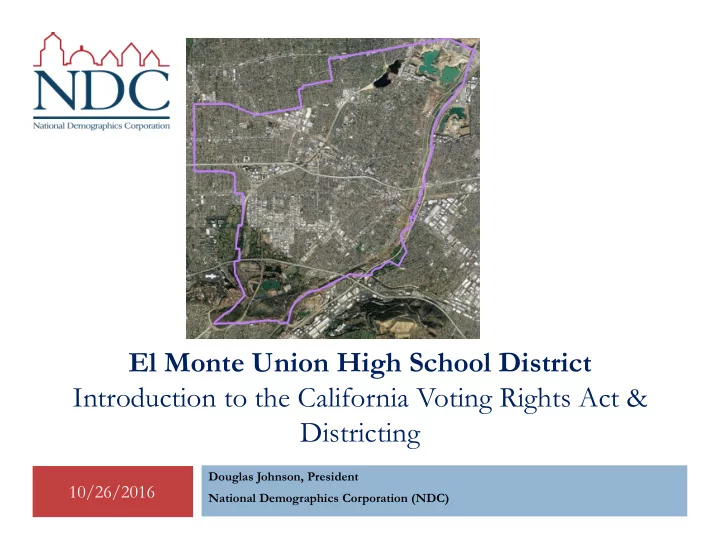
El Monte Union High School District Introduction to the California Voting Rights Act & Districting
Douglas Johnson, President National Demographics Corporation (NDC)
10/26/2016
El Monte Union High School District Introduction to the California - - PowerPoint PPT Presentation
El Monte Union High School District Introduction to the California Voting Rights Act & Districting Douglas Johnson, President 10/26/2016 National Demographics Corporation (NDC) CVRA Statewide Impact 2 Switched (or in the process of
Douglas Johnson, President National Demographics Corporation (NDC)
10/26/2016
Switched (or in the process of
At least 135 school districts 27 Community College Districts 32 cities 1 County Board of Supervisors
(the last not-by-district County)
8 water and other special districts. Key decisions & settlements Only Palmdale has gone to trial on the
merits (the city lost)
Key settlements:
Palmdale: $4.7 million Modesto: $3 million Anaheim: $1.1 million Whittier: $1 million Santa Barbara: $600,000 Tulare Hospital: plaintiff attorneys paid
$500,000
Madera Unified: plaintiff attorneys asked for
$1.8 million, but received about $170,000
Hanford Joint Union Schools: $118,000 Merced City: $42,000 Placentia: $20,000 2
10/26/2016
10/26/2016
Date Action Step 1 Presentation on map-drawing criteria, process and demographics; Board consideration
Step 2 Initial Board hearing to discuss draft plans: Board direction on which maps to take to public forums. Board hearing on election waiver. Step 3 Public Forums on Draft maps (optional) Step 4 Board public hearing & adoption of Trustee Areas resolution Step 5 County Committee on School District Organization hearing and vote on Board- adopted trustee area map (Must be complete at least 125 days prior to 1st by-area election date) Step 6 State Board of Education vote on election waiver
First round of by-area elections
Remaining trustee areas hold by-area elections
4
10/26/2016
Date Action Step 1 Presentation on map-drawing criteria, process and demographics; Board consideration
Step 2 Two board public hearings to gather public input on what neighborhoods and other elements should be the focus and/or building blocks of draft maps Step 3 Initial Board hearing to discuss draft plans: Board direction on which maps to take to public forums. Separate Board hearing on election waiver. Step 4 Public Forums on Draft maps (optional) Step 5 Board two additional Board public hearings, followed by adoption of Trustee Areas resolution Step 6 County Committee on School District Organization hearing and vote on Board- adopted trustee area map (Must be complete at least 125 days prior to 1st by-area election date) Step 7 State Board of Education vote on election waiver
First round of by-area elections
Remaining trustee areas hold by-area elections
5
10/26/2016
School Districts may not have to follow this process.
1.
2.
3.
Public comment hopefully will include:
Definitions of neighborhoods and “communities of interest” Suggesting individual districts or entire plans Sharing opinions on plans
6
10/26/2016
Equal Population
Federal Voting Rights Act
No Racial Gerrymandering
Communities of interest
Compact
Contiguous
Visible (Natural & man-made) boundaries
Respect voters’ choices
Planned future growth
Federal Laws Traditional Redistricting Principles
7
10/26/2016
There are many ways to define communities Best way to define a neighborhood remains to hear from the people
who live there
Some examples of communities of interest could include:
School attendance areas; housing developments; neighborhoods around parks;
horse-friendly neighborhoods
Some communities want to be unified to maximize their voice in single
election.
Other communities (often school attendance areas and senior living
communities) want to be divided so they have multiple representatives answering to them.
8
10/26/2016
The consultant typically draws 3 or 4 initial draft maps to help illustrate
Members of the public can submit or request alternative options If there are a lot of maps under consideration, after at least one hearing the
Board often narrows the list down to 2 or 3 – this enables the public to focus its input on the key maps under consideration
It is often possible to ‘mix and match’ parts of different maps to arrive at a
final map
The selection of a District-preferred map is done by majority vote of the
Board, followed by County Committee review and approval or disapproval
9
10/26/2016