Efficacy of Spiritual Integration Past research has demonstrated - - PDF document

efficacy of spiritual integration
SMART_READER_LITE
LIVE PREVIEW

Efficacy of Spiritual Integration Past research has demonstrated - - PDF document

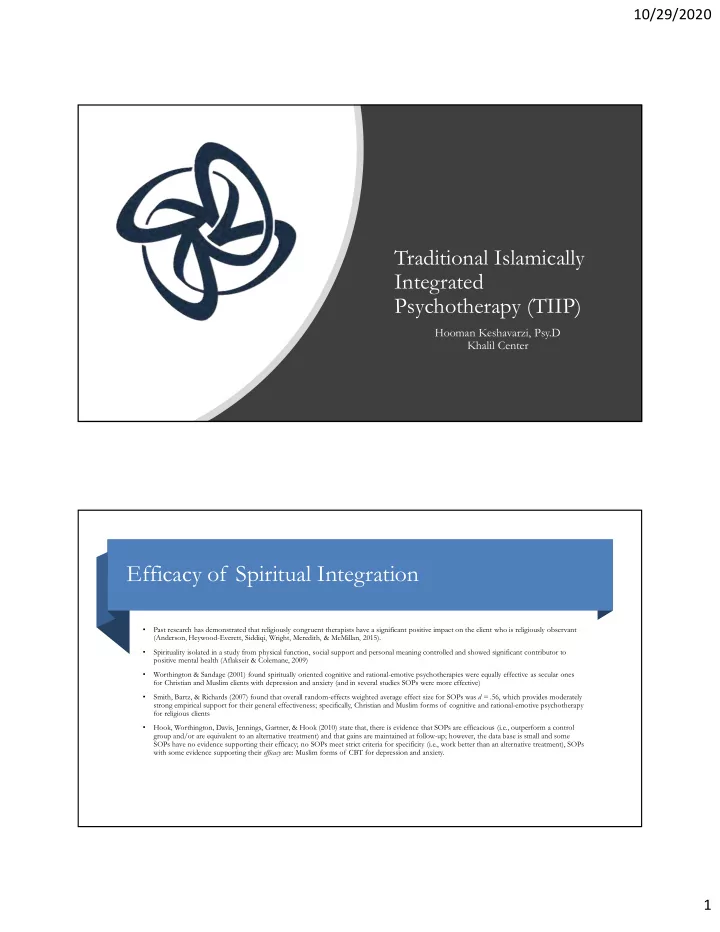
10/29/2020 Traditional Islamically Integrated Psychotherapy (TIIP) Hooman Keshavarzi, Psy.D Khalil Center Efficacy of Spiritual Integration Past research has demonstrated that religiously congruent therapists have a significant positive


slide-1
SLIDE 1

10/29/2020 1

Traditional Islamically Integrated Psychotherapy (TIIP)

Hooman Keshavarzi, Psy.D Khalil Center

Efficacy of Spiritual Integration

  • Past research has demonstrated that religiously congruent therapists have a significant positive impact on the client who is religiously observant

(Anderson, Heywood-Everett, Siddiqi, Wright, Meredith, & McMillan, 2015).

  • Spirituality isolated in a study from physical function, social support and personal meaning controlled and showed significant contributor to

positive mental health (Aflakseir & Colemane, 2009)

  • Worthington & Sandage (2001) found spiritually oriented cognitive and rational-emotive psychotherapies were equally effective as secular ones

for Christian and Muslim clients with depression and anxiety (and in several studies SOPs were more effective)

  • Smith, Bartz, & Richards (2007) found that overall random-effects weighted average effect size for SOPs was d = .56, which provides moderately

strong empirical support for their general effectiveness; specifically, Christian and Muslim forms of cognitive and rational-emotive psychotherapy for religious clients

  • Hook, Worthington, Davis, Jennings, Gartner, & Hook (2010) state that, there is evidence that SOPs are efficacious (i.e., outperform a control

group and/or are equivalent to an alternative treatment) and that gains are maintained at follow-up; however, the data base is small and some SOPs have no evidence supporting their efficacy; no SOPs meet strict criteria for specificity (i.e., work better than an alternative treatment), SOPs with some evidence supporting their efficacy are: Muslim forms of CBT for depression and anxiety.

slide-2
SLIDE 2

10/29/2020 2

Islamic Intellectual Heritage

The development of Islamic Religious Discourse saw the explosion of literature on human behavior (tahdheeb al-nafs) and character reformation (tahdheeb al-akhlaq) and ontology.

Era of Muhaditheen & Early Sufism

  • Ibn Sireen (32 H/654 AD)
  • Hasan Al-Basri (106 H/728 AD)
  • Harith al-Muhasibi (159 H/781 AD)
  • Ibrahim ibn Adham (158 H/782 AD)
  • Ahmad bin Hanbal (160H/780 AD)
  • Imam al-Bukhari (188 H/810 AD)
  • Imam Tirmidhi (202 H/824 AD)

Early Physicians/Polymaths

  • Abu Zayd al-Balkhi (228 H/850 AD)
  • Abu Yusuf al-Kindi (251 H/873 AD)
  • Abu Bakr al-Razi (232 H/854 AD)

Eary Mutakallimeen

  • Abu Mansur al-Maturidi (232 H/853 AD)
  • Abu al-Hasan al-Ashari (252 H/874 AD)
  • Abu Ja’far al-Tahawi (309 H/933 AD)

Golden Era Physicians/Philosophers  Abu Ali ibn Miskawayh (310 H/932 AD)  ibn Sina/Avicenna (358 H/980 AD)  ibn Rushd/Averroes (576 H/1198 AD) Later Mutakalimeen & Formalized Sufism  Abu al-Hafs Al-Nasfai (445 H/1067 AD)  Abu Hamid al-Ghazali (489 H/1111 AD)  Yahya ibn Habash Suhrawardi (532 H/1154 AD)  Muhyiddin ibn Arabi (543 H/1165 AD)  Jalaluddin al-Rumi (585H/1207 AD)  Ibn al-Qayyim al-Jawziyya (670 H/1292 AD)  Baha-uddin Naqshaband (696 H/1318 AD) Ottoman Era  Ibn Khaldun (710 H/1332 AD)  Sultan Bayezid II (825 H/1447 AD)  Taqi uddin ’Imam’ al-Birgivi (900 H/1522 AD)  Ahmad Sirhindi – Imam al- Rabbani (942 H/1564 AD)  Ibrahim al-Laqani (918 H/1540 AD)  Shah Waliullah Dehlawi (1081 H/1703 AD)  Ibrahim al-Bajuri (1161 H/1783 AD)

Pre-Ghazalī –Disciplines in Islamic Heritage

Application (‘Amal) Theory/Methodology (‘itqadi)

Disciplines Pure Kalam Fiqh al- Batin/Sufism Fiqh al-Zahir “Islamisized” Greek Philosophy Hikmah/Tibb

CORE Islamic Sciences Auxiliary Sciences

slide-3
SLIDE 3

10/29/2020 3

Post-Ghazalī – Kalamasized Philosophy

Application (‘Amal) Theory/Methodology (‘itqadi)

Islamic Disciplines Fiqh al-Akbar (Kalam) Fiqh al-Batin (Sufism) Fiqh al-Zahir Kalamasized Philosophy Hikmah/Tibb

CORE Islamic Sciences Auxiliary Sciences

Islamically Integrated Mental Healthcare

Application (‘Amal) Theory/Methodology (‘itqadi)

Islamic Disciplines Fiqh al-Akbar (Kalam) Fiqh al-Batin (Sufism) Fiqh al-Zahir Kalamasized ‘Western Sciences’ Tibb/ Mental Healthcare

CORE Islamic Sciences Auxiliary Sciences

slide-4
SLIDE 4

10/29/2020 4

Islamically Integrated Holistic Mental Healthcare within the context of the Islamic Sciences

Taking a TIIP approach

An integrative approach allows you to draw two types of interventions:

  • 1. Empirically validated interventions that are culturally and religiously

adapted.

  • 2. Exploratory Islamic interventions that may have promising value
slide-5
SLIDE 5

10/29/2020 5

Hence: Creation of TIIP

  • A structured articulation of an emerging Islamic
  • rientation to psychotherapy
  • TIIP is an integrative model of mental health care

that is grounded in the core principles of Islam while drawing upon empirical truths in psychology

  • TIIP is situated within an Islamic epistemological

and ontological framework, providing a discussion

  • f the nature and composition of the human

psyche, its drives, health, pathology, mechanisms

  • f psychological change, and principles of healing.

DOES TIIP WORK?

  • Conducted a Paired Value T-

Test to compare pre and post intervention scores.

  • Differences were statistically

significant at p=0.011

slide-6
SLIDE 6

10/29/2020 6

1 year Process Outcome Study on TIIP (107 patients – over 400 sessions)

Epistemology

slide-7
SLIDE 7

10/29/2020 7

A Sunni Conceptual Framework for Islamic Psychology

  • Maturidi/Ashari Sunni theology as a classical

Sunni approach toward the investigation of human cognition, behavior, emotion and spirituality.

  • Integrative by filtering and incorporating modern

behavioral science, through a classical sunni tradition, while re-presenting the sunni classical intellectual tradition for modern scientific consumption and application.

Sources of Knowledge (Asbaab al-ilm)

  • 1. Sensory (Hissi)
  • 2. Khabr (wahi & Takweeni)
  • 3. Rationality/reason (aqli)
  • Equality among all three sources of

knowledge

slide-8
SLIDE 8

10/29/2020 8

Epistemology

Empirical Knowledge

Rational Knowledge Mental Health

Revelational Knowledge

Doctrine of Occasionalism

slide-9
SLIDE 9

10/29/2020 9

Classification with regard to certainty

  • r its strength
  • Thubut
  • dalalah

Qatii (mansus alayhi)

  • Thubut
  • Dalalah

Dhani (ijtihad)

Examples

  • All the previous sources of knowledge fit into this.
  • Hissi/Empirical –
  • Qati – Brain stores memory.
  • Dhani – correlational data
  • Khabar –
  • Tawheed, sifat of Allah (wahi); China exists (takweeni)
  • Dhani – wiping over non-leather socks
  • Rational
  • Qatii – the whole of something is greater than the sum of its parts. Existence of
  • pposites.
  • Dhani – contingent worlds, life on other planets, speculative philosophy
slide-10
SLIDE 10

10/29/2020 10

Apparent Contradictions Between Sources

  • Any contradictions (taʿāruḍ) between conclusions originating in these sources are

understood to be only apparent and demand resolution through either: i. reconciliation (tatbiq), ii. abrogation (naskh), iii. interpretation (taʾwīl) (Farfur, Abdul Latif, 2002, pg. 155).

Example of Creation of Earth Question

  • For example, Qurʾānic verses mention

Allah’s creation of the universe in six “ayyām” (lit. days)

  • denote in their use of the term ayyām

not the customary 24-hour cycle of day and night or simply daytime (as

  • pposed to night) but broad and

ambiguous “periods” of time due to the rational unlikelihood that ayyām be restricted to earthly, normative time.

slide-11
SLIDE 11

10/29/2020 11

Example of Localization of Aql Question

  • For example, some Muslim scholastic

suggested that the metaphysical aql is physically located in the brain on account of cognitive faculties being impaired through brain damage despite the Qur’an’s apparent attribution of cognitive faculties to the heart in surah al-Hajj, verse 22.

  • Exegetes have offered several potential

meanings to this verse that consider empirical information and reason.

  • Meanwhile, the majority (jumhur) of discursive

theologians have maintained that the metaphysical aql is a property of the metaphysical heart but its metaphysical light stimulates the cognitive faculties in the brain, thereby reconciling the between empirical information, rationality and revelation (Bajuri, pg 273).

Objective Knowledge vs Subjective Religious Experience

slide-12
SLIDE 12

10/29/2020 12

Role of modern behavioral science w/in this Framework

  • Filtering modern behavioral science

through an Islamic epistemological and

  • ntological framework.
  • Ghazali (Horse Example)
  • Mantiq
  • Muslims generally used Medical examples in

their works, including sufi works.

  • Adopting research that provides insights

into the application of Islamic interventions with human beings, ie tajrabah.

  • Inherently Islamic & Islamic adaptations
  • f mainstream interventions

Ontological Framework

  • f Human Psyche,

Health & Pathology

slide-13
SLIDE 13

10/29/2020 13

Defining our Schema of Health: Islamic Primordial Purpose

  • God based salvation theory
  • Salvation from fire of Hell
  • Gnosis/Ihsan – God consciousness
  • Aspirations towards spiritual nourishment and

perfection.

  • Proximity to God and His messenger (Haque,

2004)

  • Leading a meaningful life (tied to original

purpose)

  • All on this pathway with different ranges of functioning:
  • Melting the Barriers for us to get to that goal:
  • Bio-Psycho-Social-Spiritual (Be they clinical or

not)

25

Balkhian Division: Clinical Pathology

Pathology Exogenous Endogenous

slide-14
SLIDE 14

10/29/2020 14

Pathology - Exogenous

  • Seen as impacting:
  • Prenatal - Primordially
  • Post-Natal Lifespan (Worldly)
  • Post-Mortum
  • A fundamental difference between an exclusively clinical conception of dysfunction and Islamic

holistic health is that Islam does not restrict dysfunction solely to the temporal world or to clinical impairment.

  • Character flaws that adversely impact a patient’s afterlife are also taken into consideration as well as such

character traits that lead to poor functioning even before they may become significantly impairing.

  • Narcissism

Beyond the DSM

  • In fact, Cloninger (2004) makes the argument that people who are naturally

inclined to desire deeper meaning in their lives as they face the inevitable reality of sickness, suffering, and mortality can only find lasting satisfaction and health in spiritual approaches to well-being.

  • Through spirituality, he asserts, one can find hope and meaning in life that

helps reduce vulnerability and increases resiliency to clinical pathologies (Cloninger, 2004).

slide-15
SLIDE 15

10/29/2020 15

Ontology of Human Psyche

  • Imam Shahab ad-Din Yahya Suhrawardi (d. 632 H/1244 AD), an ascetic scholar in

his Awarif al-Ma’arif, offers that it is permissible to discuss the nature of the ruh

  • r metaphysical essence of the human being, however it must be considered as a

possible meaning (ta’wil), not an interpretation (tafsir) of the Qur’anic term asserted with certainty (qaṭʿī) (pg. 243).

  • The existence of an inner metaphysical self is a matter of certainty in Islam, while

the specifics of its nature is probabilistic (Zanni).

  • Potentially falsifiable and probabilistic models as incontrovertible, or to consider

any contention with such models as un-Islamic.

  • Example: Is aql part of ruh?

Human is Dualism

  • 1. outer (ẓāhir) and inner

(bāṭin) self, or the physical self on one hand

  • 2. the metaphysical or

subtly physical self on the

  • ther
slide-16
SLIDE 16

10/29/2020 16

  • Heart – in the vicinity of physical heart lies a subtle metaphysical

essence (al-latifa al-rabaniyyah/Qalb)

  • Said differently, it is the metaphysical heart, with a light that

illuminates or enlivens the body. Ex. lamp that illuminates a room.

  • Subtle essence, With respect to (I’tibar)
  • cognition (tafakur) it is the aql.
  • the life force (hayat al-jasad/haywani) & divine celestial spirit (ruh

samawi)

  • its carnal/predatory desires or behavioral inclinations it is

known as the nafs (Bajuri)

  • All three are interacting, interchangeable and interconnected. They

are just different qualities of the same al-latifah al-rabaniyyah manifested in different forms.

al-Latifah al-Rabanniyah

(Ghazali)

al-Latifah al-Rabanniyah (Bajuri/Ghazali/Suhrawardi)

حور لقع سفن بلقيناويح حوريوامس حور

slide-17
SLIDE 17

10/29/2020 17

Intrapsychic Tension

Drive Theory – Competing Drives

  • Fitra - Human beings are all born with a

primordial, inherently good nature.

  • Comprehend universal truth, know

both good and evil

  • Recognition and inclination for the

Divine

  • Amongst such competing drives are

what Shāh Walī Allāh called the dichotomy of man’s angelic (malakūtī) and the animalistic (bahīmī) natural drives.

  • These animalistic drives arise out of

the pleasure seeking (quwat shahwi) and destructive instinct (quwat ghadabi).

slide-18
SLIDE 18

10/29/2020 18

Optimal Health

  • Suhrawardi, - competing drives between the ruh

haywani bashari and ruh samawi uluwi.

  • They become entrenched in the untrained nafs

ammarah (behavioral inclinations), but through

  • inkishāf (introspective awareness) and
  • tarbiya (spiritual training)
  • it is possible to reorient the fiṭra towards its angelic

tendencies (malakuti) and spiritual elevation (taraqi).

  • This embrace of the ruh samawi and its nurturance

leads to tranquility whereby the tension between the competing drives is released. However, left unchecked, lower carnal desires drive the person towards his bestial nature and render them vulnerable to the inculcation of evil traits and a satanic orientation (Ghazali p 137).

Qalb

  • Qalb – By qalb we refer to

the spiritual heart, which is the receptacle of all health and pathology. Input from any of the other components results in either the illumination or darkening of the heart:

slide-19
SLIDE 19

10/29/2020 19

Nafs – behavioral inclinations.

Nafs Ammarah Nafs lawwamah Nafs mutmainnah Nafs Shahwah/Appetitive Drives Ghadab/Survival/Aggressive drives

Aql (ةزيرغ)

نيب زييمت و قحلا و لطابلا و نسحلا حبقلا

ريكفت/فترك

بقاوع ةفرعم نم رومﻷا و راضملا عفانملاكاردا

slide-20
SLIDE 20

10/29/2020 20

Aql (Inherent

Metaphysical Disposition)

Distinguish between truth & falsehood; Good/Evil Reflection/cogn ition/Memory

Appreciation for the consequences

  • f actions

Conception

Restraint

Rūḥ

1. the human being’s spirit and life force (ruh haywani)

  • The origin of putting the drives of the

nafs ammarah into motion 2. the spirit’s inclination (ruh samawi uluwi) toward the sacred and longs for reconnection and remembrance of the divine.

  • Inner self that thirst’s for deeper

meaning, purpose and transcendence to its primordial state of aspiring for divine presence that corresponds to the nafs mutma’innah.

slide-21
SLIDE 21

10/29/2020 21

Ihsās

  • Loosely to as an individual’s basic emotions.
  • This is a secondary aspect of the human experience and may not warrant

admissibility as a separate and distinct aspect of the human psyche.

  • It can be seen as a byproduct of the interaction between nafs, ruh and ‘aql.
  • Emotions can have adaptive or healthy manifestations or become dysregulated and

unhealthy, such as man’s innate anger, which is positive when it produces assertiveness and dysfunctional if it produces aggression.

42

slide-22
SLIDE 22

10/29/2020 22

Process of Change

Nafs ʿAql Rūh Iḥsās Ittiḥād Excess Insufficient I’tidal

slide-23
SLIDE 23

10/29/2020 23

Case Simulations

Case Simulations

  • Abdullah comes in and discloses to you that he

feels dissatisfied with life. He does not feel like he is living for any particular reason and finds himself feeling sadness all the time. To

  • vercompensate for this sadness he notices

that his appetite has gone up and he eats to

  • cope. He is having a difficult time controlling his
  • eating. Additionally he reports that he is having

trouble with prayer and feels a void in his spirit.

slide-24
SLIDE 24

10/29/2020 24

  • Sister Aminah reports that she is always irritable at home. She is

irritable at home with her children and husband and finds herself becoming enraged. She states that she often finds herself crying at night and cannot really understand why she cries so much. She is a housewife that longed to go to college but she has been raising her 4 children since graduating from high school.

47

  • Abu Bakr states that he is angry that God did not allow him to marry a

woman that he had hoped for. He feels that God has not answered his prayers and states that he is angry with God. He believes that he has been living a good life and doesn’t understand why God would not answer his prayers. This is causing him to question his faith.

48

slide-25
SLIDE 25

10/29/2020 25

  • Sarah is not sure why she has been inflicted with a life-threatening
  • disease. She finds herself thinking that she is being punished by Allah

and has intense fear of dying. This fear is causing her intense anxiety that is exacerbating her physical condition.

49

  • Abdullah is struggling with pornography addiction, this is

accompanied by self-gratification (climax). He has been trying to control these impulses for years. He finds himself consistently

  • relapsing. He has gone for some weeks at a time without using

pornography but cannot seem to conquer this, consistent relapses cause him to feel depressed and suffers from poor self-esteem.

50

slide-26
SLIDE 26

10/29/2020 26

Background: 33-year-old working professional, married with 2 kids (Mixed Anxiety Depressive Disorder) Situation: Mom wants her to come over everyday.

ʿAql: Personalization vs Villainization

  • Judging me: thinks I am bad
  • ”I am hurting her”
  • “I am sinning”

Ihsās: Dysregulation

  • Anger
  • Shame/Guilt

Nafs: Avoidance vs Enmeshment

  • Doesn’t answer phone
  • Won’t visit
  • Irritability/disrespect with

mom

  • Visit excessively

(overcompensatory behaviors)

Rūḥ: Obedience to person vs Obedience to Allah

  • Religion is too hard, I

am going to hell anyway

  • no point in praying
  • disconnect from

faith

Personalization Mind-Reading Self-Conscious Villainization

Anger Guilt/Shame Avoidance Irritability Enmeshment

Connection w/mom  Connect w/Allah Disconnect w/mom  Disconnect w/Allah

slide-27
SLIDE 27

10/29/2020 27

Background: 35-year-old working professional male, married with 3 kids (GAD) Situation: Family complains that he is inflexible and refuses to go on trips.

ʿAql: Catastrophizing

  • If I do not get enough

sleep, I will be dysfunctional

Ihsās: Hyperviligence

  • Hyperarousal,
  • Anxiety/fear/worry

Nafs: Avoidance & Restrictive behavs

  • Avoidance behaviors (no

vacations, agoraphobia),

  • does not wake up for fajr

since it will disturb sleep.

  • Rigid routine

Rūḥ: Absence of tawakul

  • Missing prayer
  • Overreliance on

means

Catastrophizing Minimizing

Anxiety Too Relaxed

Avoidance Restrictive Behaviors Too Flexible

Overreliance

  • n means

Neglect means

Example Intervention:

As anxiety goes up, energy goes down. Therapist: How much energy do you have when you get 8 hours of sleep: Client: 10 energy level and 0 anxiety level. Therapist: How much energy do you have when you get 5 hours of sleep: Client: 2 energy level and 5 anxiety level. Therapist: Your theoretical score should be 7 energy level, 0 anxiety level. But when you add 5 anxiety level, it decreased your ACTUAL energy level to 2 (7 – 5). If we decrease anxiety, then it will increase your energy level Client: How? Therapist: Through changing your perspective (ʿaql), changing your behaviors (nafs) and increasing tawakul (rūh), which will lower your anxiety (ihsās).

10 5 1 10 5 1 Anxiety Energy