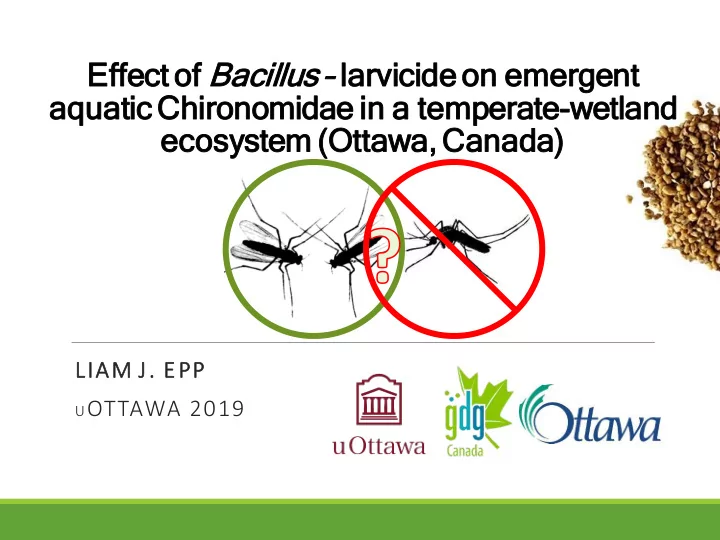
Effe ffect of
- f Bac
acillus – lar arvicide deon
- n em
emer ergent nt aq aqua uatic Chi Chirono nomidae in n a a tem temperate-wetlan and ec ecos
- system (Otta
ttawa, a, Cana Canada)
LIAM J. EPP
UOTTAWA 2019
Effe ffect of of Bac acillus lar arvicide deon on em emer - - PowerPoint PPT Presentation
Effe ffect of of Bac acillus lar arvicide deon on em emer ergent nt aq aqua uatic Chi Chirono nomidae in n a a tem temperate-wetlan and ec ecos osystem (Otta ttawa, a, Cana Canada) LIAM J. EPP U OTTAWA 2019 Non-target
UOTTAWA 2019
3
2Lepper & Taylor (1998), 3Webb (1969), 4Dickman (2000), 5Hershey et al. (1998), 6Lundstrӧm et al. (2010b), 7Lagadic et al. (2016), 8Poulin (2012), 9Lundstrӧm et al. (2010a), 10Östman et al. (2008); 11Duguma et al. (2015), Photo: Toronto Star
Nematocera
3
Nematocera
SOUTH MARCH HIGHLANDS CONSERVATION FOREST (BTI/BTI2) CARP (CTRL)
Emerg rgence ce Tra rap
Week ek of Year ear Abund undanc ance e (log
10(y
(y+1)) 1)) Chironom ronomidae dae Emergenc ergence
May Sept CHI Individuals/Site/Week: 25.9 (BTI) & 38.7 (CTRL) 2018 p=0.003
CHIRONOMIDAE CULICIDAE Treatment Period (May → Mid-June) Mid-June → August
Direc rect effec ects?
Abundanc undance e (log
10(y
(y+1)) 1)) Annual nual Chiro ronom nomidae dae Emerge ergenc nce
1 2
0.0 0.5 1.0
ALL YEARS Ento & Environ Triplot RDA
RDA1 RDA2 BTI BTI2 CTRL
DIP COL CHI ARA ODO OTH LEP HYM ORT CUL EPH PLE BOL HEM
Conductivity..uS.cm Water.Temperature..Celcius Average.Water.Depth..cm
Redun dundanc ancy Anal nalysis: Combi bini ning ng Emerge ergenc nce e with h Env nvironm ronment ent
CUL CHI
TREATMENT EFFECT in all models!
Biodi divers ersity
P= 0.057 Shannon Diversity Species/ Taxa- Richness
emergence response models
HYM LEP ODO CUL DIP EPH ARA CHI COL 2016 2017 2018 2016 2017 2018 2016 2017 2018 0.4 0.5 0.7 0.3 0.5 1.0 0.3 0.5 0.7 0.8 0.9 1.0 0.6 0.7 1.0 0.3 0.4 0.4 0.5 0.6 0.4 0.5 0.7 0.4 0.5 0.6
Year Abundance [log10(y+1)] Treatment BTI BTI2 CTRL
Nitrate.NO3..mg.L Sulphate.SO4..mg.L Surface.Area..m2 Water.Temperature..Celcius Average.Water.Depth..cm Ammonia.NH3..mg.L Dissolved.Oxygen..mg.L pH Conductivity..uS.cm 15 20 25 30 35 40 15 20 25 30 35 40 15 20 25 30 35 40 15 20 25 30 35 40 15 20 25 30 35 40 15 20 25 30 35 40 15 20 25 30 35 40 15 20 25 30 35 40 15 20 25 30 35 40 500 1000 1500 1 2 30000 60000 90000 3 4 5 6 7 8 20 40 60 10 20 20 40 60 80 10 20 30 0.0 0.5 1.0 1.5 2.0
Year Measurement Year 2016 2017 2018
1 World Health Organization (1999). Microbial Pest Control Agent Bacillus thuringiensis
(Environmental Health Criteria 217). Geneva, Switzerland. Retrieved from http://www.who.int/ipcs/publications/ehc/en/EHC217.PDF
2 Leeper, D.A. & Taylor, B.E. (1998). Insect Emergence from a South Carolina (USA) Temporary
Wetland Pond, with Emphasis on the Chironomidae (Diptera). J. N. Am. Benthol. Soc., 17(1):54-72.
3 Webb, D.W. (1969). Production of wetland Chironomidae (Diptera) and the effects of using Bacillus
thuringiensis israelensis for mosquito control. Journal of the Kansas Entomological Society, 42(1), 91- 108.
4 Dickman, M. (2000). Impacts of a mosquito selective pesticide, Bti, on the macroinvertebrates of a
subtropical stream in Hong Kong. Chemosphere, 41, 209-217.
5 Hershey, A.E., Lima, A.R., Niemi, G.J. & Regal, R.R. (1998). Effects of Bacillus thuringiensis
israelensis Bti and methoprene on nontarget macroinvertebrates in Minnesota wetlands. Ecological Applications, 8, 41-60.
6 Lundstrӧm, J.O., Schӓfer, M.L., Petersson, E., Persson Vinnersten, T.Z., Landin, J. & Brodin, Y.
(2010b). Production of wetland Chironomidae (Diptera) and the effects of using Bacillus thuringiensis israelensis for mosquito control. Bulletin of Entomological Research, 100, 117-125. doi:10.1017/S0007485309990137.
7 Lagadic, L., Schäfer, R.B., Roucaute, M., Szöcs, E., Chouin, S., de Maupeouc, J., Duchet C.,
Franquet, E., Hunsec, B.L., Bertrand, C., Fayolle S., Francés, B., Rozier, Y., Foussadier, R., Santoni, J.B. & Lagneau, C. (2016). No association between the use of Bti for mosquito control and the dynamics of non-target aquatic invertebrates in French coastal and continental wetlands. Science of the Total Environment, 553, 486–494. http://dx.doi.org/10.1016/j.scitotenv.2016.02. 096.et al. (2016),
8 Poulin, B. (2012). Indirect effects of bioinsecticides on the nontarget fauna: The Camargue experiment calls for future
9 Lundström, J.O., Brodin, Y., Schäfer, M.L., Vinnersten, T.Z.P. & Östman, Ö. (2010a). High species richness of
Chironomidae (Diptera) in temporary flooded wetlands associated with high species turn-over rates. Bulletin of Entomological Research, 100(4), 433–444. doi: 10.1017/S0007485309990472.
10 10 Östman, O., Lundstrӧm, J.O. & Persson Vinnersten, T.Z. (2008). Effects of mosquito larvae removal with Bacillus
thuringiensis israelensis (Bti) on natural protozoan communities. Hydrobiologia, 607, 231-235. doi: 10.1007/s10750-008- 9387-z.
11 11 Duguma, D., Hall, M.W., Rugman-Jones, P., Stouthamer. R., Neufeld, J.D. & Walton, W.E. (2015). Microbial
communities and nutrient dynamics in experimental microcosms are altered after the application of a high dose of Bti. Journal of Applied Ecology, 52, 763–773. doi: 10.1111/1365-2664.12422.
12 12 Government of Canada. (2016). Climate data [Daily Data Report for 2016]. Ottawa, Ontario, Canada. Retrieved from:
http://climate.weather.gc.ca/climate_data/daily_data_e.html? StationID =49568
13 13 Government of Canada. (2017). Climate data [Daily Data Report for 2017]. Ottawa, Ontario, Canada. Retrieved from:
http://climate.weather.gc.ca/climate_data/daily_data_e.html? StationID =49568
14 14Zheng, M.-L., Zhang, D.-J., Damiens, D. D., Lees, R.S. & Gilles, J.R.L. (2015). Standard operating procedures for
standardized mass rearing of the dengue and chikungunya vectors Aedes aegypti and Aedes albopictus (Diptera: Culicidae) - II - Egg storage and hatching. Parasites & Vectors, 8, 348. http://doi.org/10.1186/s13071-015-0951-x Photo (Slide 6):The Toronto Star https://www.thestar.com/news/gta/2009/05/22/clouds_of_midges_thats_just_bug_love.html