Edge and Corner Detection Reading: Chapter 8 (skip 8.1) Goal: - - PowerPoint PPT Presentation

edge and corner detection
SMART_READER_LITE
LIVE PREVIEW

Edge and Corner Detection Reading: Chapter 8 (skip 8.1) Goal: - - PowerPoint PPT Presentation

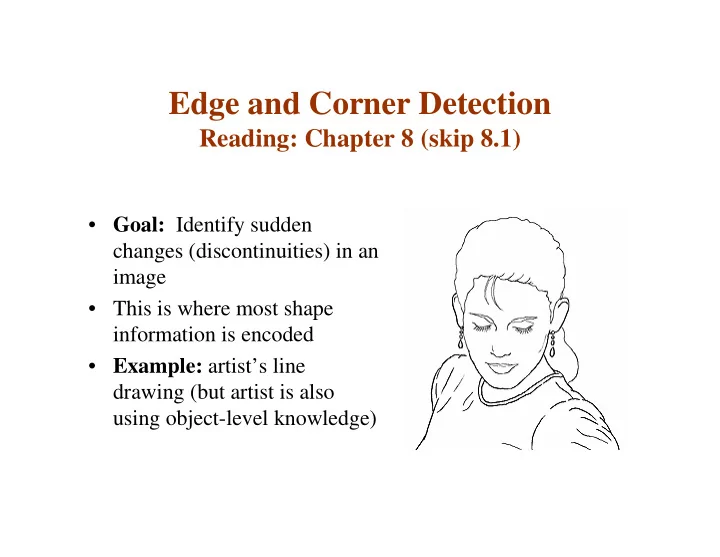
Edge and Corner Detection Reading: Chapter 8 (skip 8.1) Goal: Identify sudden changes (discontinuities) in an image This is where most shape information is encoded Example: artists line drawing (but artist is also using


slide-1
SLIDE 1

Edge and Corner Detection

Reading: Chapter 8 (skip 8.1)

  • Goal: Identify sudden

changes (discontinuities) in an image

  • This is where most shape

information is encoded

  • Example: artist’s line

drawing (but artist is also using object-level knowledge)

slide-2
SLIDE 2

What causes an edge?

  • Slide credit: Christopher Rasmussen
slide-3
SLIDE 3

Smoothing and Differentiation

  • Edge: a location with high gradient (derivative)
  • Need smoothing to reduce noise prior to taking derivative
  • Need two derivatives, in x and y direction.
  • We can use derivative of Gaussian filters
  • because differentiation is convolution, and

convolution is associative: D * (G * I) = (D * G) * I

slide-4
SLIDE 4

Derivative of Gaussian

Slide credit: Christopher Rasmussen

Gradient magnitude is computed from these.

slide-5
SLIDE 5

Gradient magnitude

slide-6
SLIDE 6

Scale

Increased smoothing:

  • Eliminates noise edges.
  • Makes edges smoother and thicker.
  • Removes fine detail.
slide-7
SLIDE 7

Canny Edge Detection

Steps:

  • 1. Apply derivative of Gaussian
  • 2. Non-maximum suppression
  • Thin multi-pixel wide “ridges” down to single

pixel width

  • 3. Linking and thresholding
  • Low, high edge-strength thresholds
  • Accept all edges over low threshold that are

connected to edge over high threshold

  • Matlab: edge(I, ‘canny’)
slide-8
SLIDE 8

Non-maximum suppression: Select the single maximum point across the width

  • f an edge.
slide-9
SLIDE 9

Non-maximum suppression At q, the value must be larger than values interpolated at p or r.

slide-10
SLIDE 10

Examples: Non-Maximum Suppression

  • !"#
  • Slide credit: Christopher Rasmussen
slide-11
SLIDE 11
slide-12
SLIDE 12

fine scale (σ = 1) high threshold

slide-13
SLIDE 13

coarse scale, (σ = 4) high threshold

slide-14
SLIDE 14

coarse scale (σ = 4) low threshold

slide-15
SLIDE 15

Linking to the next edge point

Assume the marked point is an edge point. Take the normal to the gradient at that point and use this to predict continuation points (either r or s).

slide-16
SLIDE 16

Edge Hysteresis

  • Hysteresis: A lag or momentum factor
  • Idea: Maintain two thresholds khigh and klow

– Use khigh to find strong edges to start edge chain – Use klow to find weak edges which continue edge chain

  • Typical ratio of thresholds is roughly

khigh / klow = 2

slide-17
SLIDE 17

Example: Canny Edge Detection

  • $
  • %

&%

slide-18
SLIDE 18

Example: Canny Edge Detection

'()

Slide credit: Christopher Rasmussen

slide-19
SLIDE 19

Finding Corners

Edge detectors perform poorly at corners. Corners provide repeatable points for matching, so are worth detecting. Idea:

  • Exactly at a corner, gradient is ill defined.
  • However, in the region around a corner,

gradient has two or more different values.

slide-20
SLIDE 20

The Harris corner detector

        =

∑ ∑ ∑ ∑

2 2 y y x y x x

I I I I I I C

Form the second-moment matrix:

Sum over a small region around the hypothetical corner Gradient with respect to x, times gradient with respect to y Matrix is symmetric

Slide credit: David Jacobs

slide-21
SLIDE 21

      =         =

∑ ∑ ∑ ∑

2 1 2 2

λ λ

y y x y x x

I I I I I I C

First, consider case where: This means dominant gradient directions align with x or y axis If either λ is close to 0, then this is not a corner, so look for locations where both are large.

Simple Case

Slide credit: David Jacobs

slide-22
SLIDE 22

General Case

It can be shown that since C is symmetric:

R R C       =

− 2 1 1

λ λ

So every case is like a rotated version of the

  • ne on last slide.

Slide credit: David Jacobs

slide-23
SLIDE 23

So, to detect corners

  • Filter image with Gaussian to reduce noise
  • Compute magnitude of the x and y gradients at

each pixel

  • Construct C in a window around each pixel

(Harris uses a Gaussian window – just blur)

  • Solve for product of λs (determinant of C)
  • If λs are both big (product reaches local maximum

and is above threshold), we have a corner (Harris also checks that ratio of λs is not too high)

slide-24
SLIDE 24

Gradient orientations

slide-25
SLIDE 25

Closeup of gradient orientation at each pixel

slide-26
SLIDE 26

Corners are detected where the product of the ellipse axis lengths reaches a local maximum.

slide-27
SLIDE 27

Harris corners

  • Originally developed as features for motion tracking
  • Greatly reduces amount of computation compared to

tracking every pixel

  • Translation and rotation invariant (but not scale invariant)