Ecosystem Services and Global Change The Environmental Dimension - - PowerPoint PPT Presentation

ecosystem services and global change the environmental
SMART_READER_LITE
LIVE PREVIEW

Ecosystem Services and Global Change The Environmental Dimension - - PowerPoint PPT Presentation

Ecosystem Services and Global Change The Environmental Dimension of Human Vulnerability Dagmar Schrter Federal Environment Agency, Vienna, Austria George Perkins Marsh Institute, Clark University, USA Outline 1. The concept of


slide-1
SLIDE 1

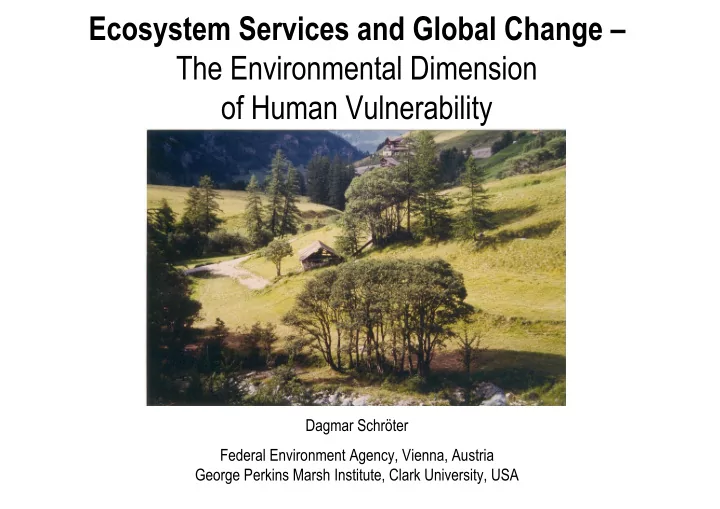
Dagmar Schröter Federal Environment Agency, Vienna, Austria George Perkins Marsh Institute, Clark University, USA

Ecosystem Services and Global Change – The Environmental Dimension

  • f Human Vulnerability
slide-2
SLIDE 2

Outline

1. The concept of Ecosystem Services. 2. Three examples showing its application:

  • Organisms (short),
  • environmental history (short),
  • future projections (long).

3. Discussant opinion:

  • Ecosystem Services from a Social Science Perspective.

4. Discussion with all of YOU. Surprise Speaker Anthony Patt

slide-3
SLIDE 3

Ecosystem services form vital links between humans and their environment.

Gretchen C. Daily, 1997: “Nature’s Services”.

food production flood protection carbon storage biodiversity shelter for livestock game reserve fibre production beauty recreation pollination tourist attraction fodder production stabilising micro-climate fire prevention slope stability water storage

slide-4
SLIDE 4

A Recent Example

„Wheat prices continued to rise amid fears that Australia‘s imminent harvest will be smaller than forecast because of

  • drought. Wheat from Australia was

meant to help replenish worldwide stocks, which are depleted in part because of flooding that damaged harvest in Europe.“ September 8th, 2007, The Economist.

slide-5
SLIDE 5

1910 1930

slide-6
SLIDE 6

A change in thinking: “mainstreaming ecosystems”

ecosystems ‘wilderness’ recreation global changes water food & fiber energy forestry health settlement human well-being ecosystems

e c

  • s

y s t e m s e r v i c e s e c

  • s

y s t e m s e r v i c e s

Schröter, CID Harvard Working Paper, 2005.

slide-7
SLIDE 7

Discoveries needed…

ecosystems

biodiversity structure food webs ...

well-being ecosystem services

provisioning... regulating... cultural... supporting... health basic materials security choices social relations

? ?

Based on: Millennium Ecosystem Assessment, 2003.

slide-8
SLIDE 8

Example 1: Organisms, Ecosystem Services and Global Change

Cantharellus cibarius Schoenbornia humicola Bullinularia indica Euglypha strigosa Nebela lageniformis Nematode mouthparts Dicyrtoma fusca Actinomycete spores Acari Bacteria

Photo credits: Nematoda and mites - D.H. Wall Collembola - A. Pflug Testate Amoebae - D. Schröter

slide-9
SLIDE 9

Organisms of the Decomposer Food Web

Climate regulation Carbon storage Soil formation Decomposition Nutrient cycling Nitrogen mineralisation Ecosystem Service Ecological Process

CO2 CO2 CO2 CO2 CO2 CO2 CO2 CO2 CO2

N

slide-10
SLIDE 10

NOx CO2 NHy CH4

Decomposer food webs

  • n a climatic and depositional gradient

Wolters et al. 2000. In: Carbon and Nitrogen Cycling in Forest Ecosystems. Posch 2002 and Alcamo et al. 2002, Env. Science & Policy. atmospheric N deposition negligible N intermediate NN high

slide-11
SLIDE 11

1. Same total biomass, 2. Increasing total carbon flux, and 3. Shift in structure (fungal → bacterial/protozoa based food web). fungi bacteria fauna N-SE S-SE FR DE

nitrogen

~70/30 ~50/40 % fungi/bacteria

Structure and function are linked

Schröter et al. 2003. Oikos. Schröter and Dekker 2005. In: Food Webs.

slide-12
SLIDE 12

Hispaniola: One Island, Two Stories

Haiti and the Dominican Republic

Example 2: Environmental History, Ecosystem Services and Vulnerability

slide-13
SLIDE 13

Hurricane Jeanne, 2004

  • Jeanne brought torrential rainfall to Hispaniola
  • In Haiti this resulted in flooding and mudslides
  • Similar exposure, different vulnerability

206 Million 14 009 9 11 Dominican Republic 200 000 Resulting homeless 7 Billion 21 Million Damage (US$) 40 000 315 594 Total affected 14 048 Lost homes 2 620 Injured 6 2 745 Direct casualties Florida Haiti

EM-DAT, Emergency Disasters Data Base, Université Catholique de Louvain; and National Hurricane Center, NOAA.

slide-14
SLIDE 14

Farming Marginal Lands

Soil erosion leads to river silting, desertification, loss of hydropower option, hazards.

slide-15
SLIDE 15

Degradation seen from space

From space: clear divide between Haiti and the Dominican Republic. Both have similar water resources. Photo: NASA.

Ecosystem services obviously affected: Slope stabilisation, soil fertility maintenance, water purification, recreational value …

slide-16
SLIDE 16

One Island, Two Stories

Poor, but booming economy Poorest country

  • utside Africa

Economy Exports Subsistence Agriculture Large industry Few enclaves Tourism Low (1.6%) High (3%) Population growth rate 74 4 National Parks 28 ~5 Dominican Republic 1 Forest area (%) ~10 Population (Millions) Haiti

Diamond, Collapse, 2005. Schröter, CID Harvard Working Paper, 2005.

slide-17
SLIDE 17

Example 3: Ecosystem Services

  • n a European Scale

A Vulnerability Study

slide-18
SLIDE 18

Main result

The vulnerability of some European regions to global changes in the 21st century is likely to increase due to decreased supply of ecosystem services, particularly in the Mediterranean and mountain regions, as a study based on multiple scenarios of climate and land use change, a range of ecosystem models, and an embedded stakeholder dialogue shows.

Project details ATEAM: 17 partners and sub-contractors. Funded by the European Union, 2001-2004.

Schröter et al. 2005. Science.

slide-19
SLIDE 19

Sectors, ecological services and modelled indicators

Metzger & Schröter 2006. Regional Environmental Change.

  • Runoff quantity
  • Runoff seasonality
  • Additional number of people under water stress

Water supply (domestic, industrial, agricultural, hydropower, navigation) Water

  • Agricultural land area (Farmer livelihood)
  • Suitability of crops
  • Biomass energy yield

Food & fibre production Biomass energy production Agriculture

  • Species richness and turnover (plants,

mammals, birds, reptiles, amphibian)

  • Shifts in suitable habitats

Beauty Life support processes (e.g. pollination) Nature conservation

  • Snow (elevation of snow line)
  • Slope stability

Winter sports opportunities Recreation Tourism

  • Tree productivity: growing stock & increment
  • Frequency of forest fires
  • Shifts in suitable tree species

Wood & fibre production Biomass energy production Forestry

  • Carbon storage in vegetation
  • Carbon storage in soil

Climate protection Carbon storage

Modelled indicator Service Sector
slide-20
SLIDE 20

European Vulnerability Study

dialogue between stakeholders and scientists

maps of vulnerability

multiple scenarios of global change:

CO2 climate, socio-econ. land use, N deposition ecosystem models

changes in ecosystem services

combined indicators

changes in adaptive capacity

socio- economic

Methodology

www.pik-potsdam.de/ATEAM

slide-21
SLIDE 21

Stakeholder Dialogue

  • Aims
  • Identify relevant indicators for ecosystem services
  • Settle useful scales and units
  • Discuss thresholds to indicate limits of adaptive capacity
  • Discuss results, clarify and agree on formats
  • Format
  • 3 large workshops (beginning, middle, end)
  • 11 smaller workshops focussing on particular sectors
  • People (multiple countries and languages)
  • 203 identified
  • 152 invited
  • 58 participated in at least one event

De la Vega-Leinert et al. 2008. Regional Environmental Change.

slide-22
SLIDE 22

Stakeholder Dialogue

Who were our stakeholders?

  • Private sector: farmers, land owners, agricultural

association, hydropower and bioenergy producers, foresters, paper industry, winter tourism enterprises, tourism consultants, and more

  • Non-governmental organisations: Nature conservation

(e.g. RSPB), Bioenergy promoters

  • Policy makers and governmental organisations:
  • Federal environmental agencies
  • EU directorates
  • UNFCCC
  • European Environmental Agency (EEA)
  • German Foreign Ministry
slide-23
SLIDE 23

dialogue between stakeholders and scientists

European Vulnerability Study

maps of vulnerability

multiple scenarios of global change:

CO2 climate, socio-econ. land use, N deposition ecosystem models

changes in ecosystem services

combined indicators

changes in adaptive capacity

socio- economic

Methodology

www.pik-potsdam.de/ATEAM

slide-24
SLIDE 24

Climate Scenarios (four general circulation models, GCM)

HadCM3 PCM2 CGCM2 CSIRO2

Environment/Society Economy Globalisation Regionalisation

SRES quantification: Energy use (integrated assessment model IMAGE)

350 450 550 650 750 850 950 2000 2050 2100 350 450 550 650 750 850 950 2000 2050 2100 350 450 550 650 750 850 950 2000 2050 21 00 350 450 550 650 750 850 950 2000 2050 2100

A1f 960 ppmv A2 850 ppmv B1 515 ppmv B2 605 ppmv Globalisation Economy Regionalisation Environment/Society

Atmospheric greenhouse gas concentration Landuse Change Scenarios (agriculture, forest, grassland, urban, protected area)

A2 B2 A1f B1

slide-25
SLIDE 25

Communicating uncertainty

  • Multiple scenarios
  • Focus on seven priority scenarios
  • Variation across storylines reflects socio-economic

choices

  • Variation across GCMs reflects “climatic uncertainty”

A1fi HadCM3 A2 PCM A2 CGCM2 A2 CSIRO B2 HadCM3 B1 HadCM3 A2 HadCM3 “climatic uncertainty” Socio-economic choices B1 PCM B1 CGCM2 B1 CSIRO A1fi PCM A1fi CGCM2 A1fi CSIRO B2 PCM B2 CGCM2 B2 CSIRO

slide-26
SLIDE 26

Annual average precipitation anomalies for A2 (%)

2051-2080 compared to 1961-1990 ∆P Iberian Peninsula JJA

  • 14 to -27 %

(for A2, across GCMs)

  • 18 to -26 %

(for HadCM3, across storylines)

Schröter et al. 2005. Science.

slide-27
SLIDE 27

Changes of cropland area for food production by 2080

Schröter et al. 2005. Science. Rounsevell et al. 2005. Agric. Ecosyst. Environ. Kankaanpää & Carter 2004. Finn. Env.

slide-28
SLIDE 28

dialogue between stakeholders and scientists

European Vulnerability Study

maps of vulnerability

multiple scenarios of global change:

CO2 climate, socio-econ. land use, N deposition ecosystem models

changes in ecosystem services

combined indicators

changes in adaptive capacity

socio- economic

Methodology

www.pik-potsdam.de/ATEAM

slide-29
SLIDE 29

Water

  • By 2080, with climate change 6-44 million additional

people projected to live under severely limited water resources*.

  • Water stress projected to increase for 18-70 million

already stressed people.

  • 14-38% of the Mediterranean population would be

living in watersheds with increased water stress.

  • Runoff seasonality changes in Northern and alpine

catchments → implications for

  • Hydropower,
  • Downstream users (industry, agriculture, tourism,

domestic sector, navigation).

Zierl et al. 2005. Water Resour. Res. Arnell et al. 2004. Global Environmental Change. Schröter et al. 2005. Science.

* less than 1700 m3 per capita and year

slide-30
SLIDE 30

Alpine runoff regimes

month 100 200 300 400 1 2 3 4 5 6 7 8 9 10 11 12 current A1FI HadCM3 A2 HadCM3 B1 HadCM3 B2 HadCM3 A2 CGCM2 A2 CSIRO2 A2 PCM2

Zierl et al. 2005. Water Resour. Res.

Example Dischma valley, 2051 - 2080 mm

slide-31
SLIDE 31

Carbon storage

  • Europe‘s terrestrial biosphere currently acts

as a net carbon sink.

  • All scenarios show a weakening of this

carbon sink after 2050.

  • Positive effects of land use, negative effects
  • f climate change:

– Drought stress and increased fire risk in Mediterranean, – Boreal forests accumulate carbon, but eventually soil loses more than trees take up.

Schröter et al. 2005. Science.

slide-32
SLIDE 32

Declining carbon sink after 2050

  • 0.05
  • 0.04
  • 0.03
  • 0.02
  • 0.01

0.01 0.02 0.03 0.04 0.05 0.06 1900 1925 1950 1975 2000 20

NBE due to landuse change [PgC yr

  • 1]

975 2000 2025 2050 2075

  • 0.08
  • 0.06
  • 0.04
  • 0.02

0.02 0.04 0.06 0.08 1900 NBE [PgC yr-1] 975 2000 2025 2050 2075 pre-industrial natural variation A2 B2 A1f B1

Land use change only: positive effect, sink increases. Land use and climate change together: negative effect, sink declines.

Zaehle 2005. PhD Thesis.

slide-33
SLIDE 33

Does it matter?

  • 0.2

0.2 0.4 0.6 0.8 1 1.2 1.4 1.6 1.8 2 1970 1990 2010 2030 2050 2070 2090 C emission [PgC/year] A1f A2 B1 B2

Carbon uptake by land use change vs. anthropogenic emissions.

Zaehle et al. 2007. Ecosystems.

→ even the most optimistic additional potential sink is very small.

slide-34
SLIDE 34

… our digital atlas: ATEAM mapping tool

  • Ca. 3200 maps and many more summarising charts.

Download at www.pik-potsdam.de/ATEAM

Metzger, Leemans, Schröter, Cramer and the ATEAM consortium. 2004. The ATEAM vulnerability mapping tool. Quantitative Approaches in Systems Analysis No. 27, CD-ROM publication, Office C.T. de Wit Graduate School, PE&RC, Wageningen, The Netherlands.

slide-35
SLIDE 35

Explore scenarios... Run simple queries...

European Environment Agency agreed to further develop this tool.

slide-36
SLIDE 36

Conclusions

1. Global change vulnerability has an environmental dimension through reduction in the supply of vital ecosystem services. 2. The concept of ecosystem services enables us to

  • clearly phrase applied research questions,
  • carry out transdisciplinary research and science-policy-user dialogues,
  • mainstream environmental concerns, including biodiversity protection.

3. Ecosystem features and their management matter for ecosystem service supply. 4. People value ecosystem services differently. 5. Global changes, such as N deposition, climate and land use change, alter supply of ecosystem services.

  • spatially explicit studies (maps of impacts) can support management of these

changes.

slide-37
SLIDE 37

Thank you.

slide-38
SLIDE 38

Global carbon fluxes

Net anthropogenic

  • utput

6.3 ± 0.6 Net terrestrial uptake 2.3 ± 1.3 Net ocean uptake 2.3 ± 0.8 soil 1600 plants 600 Carbon sinks and sources (Gt C a-1) carbon flux from soil = decomposition

? ?

slide-39
SLIDE 39

Annual average temperature anomalies for A2 (ºC)

2051-2080 compared to 1961-1990 ∆T 2.7 to 3.4ºC (for A2, across GCMs) 2.1 to 4.4ºC (for HadCM3, across storylines)

Schröter et al. 2005. Science.

slide-40
SLIDE 40

Will you be able to integrate these insights into your work? Yes Some Not really No Have you gained useful insights

  • n the topics covered?

Yes Some Not really

Evaluation

n = 25 stakeholders

De la Vega-Leinert et al. 2008 . Regional Environmental Change.

slide-41
SLIDE 41

A1FI

  • Agricultural area for food production declines

substantially by 2080. Some is used for bioenergy production.

  • Production concentrated in optimal locations.
  • Forest area increases only slightly.
  • Urban area increases due to non-restrictive

planning.

  • Protected area increases. Emphasis on

recreational use.

A2

  • Agricultural area for food production declines

substantially by 2080. Some is used for bioenergy production.

  • Changes are distributed equally across Europe.
  • Forest area increases only slightly.
  • Urban area increases due to rising population and

incomes.

  • Protected area increases. Conservation networks

strongly fragmented.

B1

  • Agricultural area for food production declines

substantially by 2080. Some is used for bioenergy production.

  • Cropland is concentrated in optimal

locations.Grassland is protected by policy.

  • Forest area increases. New forests are located on

surplus agricultural land.

  • Urban land use pressure is low. Restrictive

planning leads to compact cities.

  • Protected area increases. Strict protection of

biodiversity.

B2

  • Rural development policies maintain agriculture in

most places. Changes reflect switch from food to bioenergy production or forestry.

  • Forest area increases more than in all other

scenarios.

  • Urban area increases only slightly due to stable

populatrion and slow growth in income. Restrictive planning leads to compact cities.

  • Protected area increases. Strict protection of at

local level.

Rounsevell et al. 2005. Agric. Ecosyst. Environ.

Global Regional Environmental Economic

slide-42
SLIDE 42

A1 FI - hadcm3 : 2080 -baseline

  • 15.00%
  • 10.00%
  • 5.00%

0.00% 5.00% 10.00% 15.00% Urban arable grassland forest biofuels surplus

  • thers

A2-hadcm3 : 2080-baseline

  • 15.00%
  • 10.00%
  • 5.00%

0.00% 5.00% 10.00% 15.00% Urban arable grassland forest biofuels surplus

  • thers

B1-hadcm3 : 2080-baseline

  • 15.00%
  • 10.00%
  • 5.00%

0.00% 5.00% 10.00% 15.00% Urban arable grassland forest biofuels surplus

  • thers

B2-hadcm3 : 2080-baseline

  • 15.00%
  • 10.00%
  • 5.00%

0.00% 5.00% 10.00% 15.00% Urban arable grassland forest biofuels surplus

  • thers

% of European land surface

Land use change scenarios

Rounsevell et al. 2005. Agric. Ecosyst. Environ. Kankaanpää & Carter 2004. Finn. Env.