SLIDE 1
Slide 1 / 47 Slide 2 / 47
www.njctl.org
Ecosystem Dynamics Classwork & Homework
Slide 3 / 47
Classwork #1: Food Webs
Slide 4 / 47
1 Why is a food web useful? What does it show?
Slide 5 / 47
2 If animals cannot make their own food or create their own energy, where does their energy come from?
Slide 6 / 47
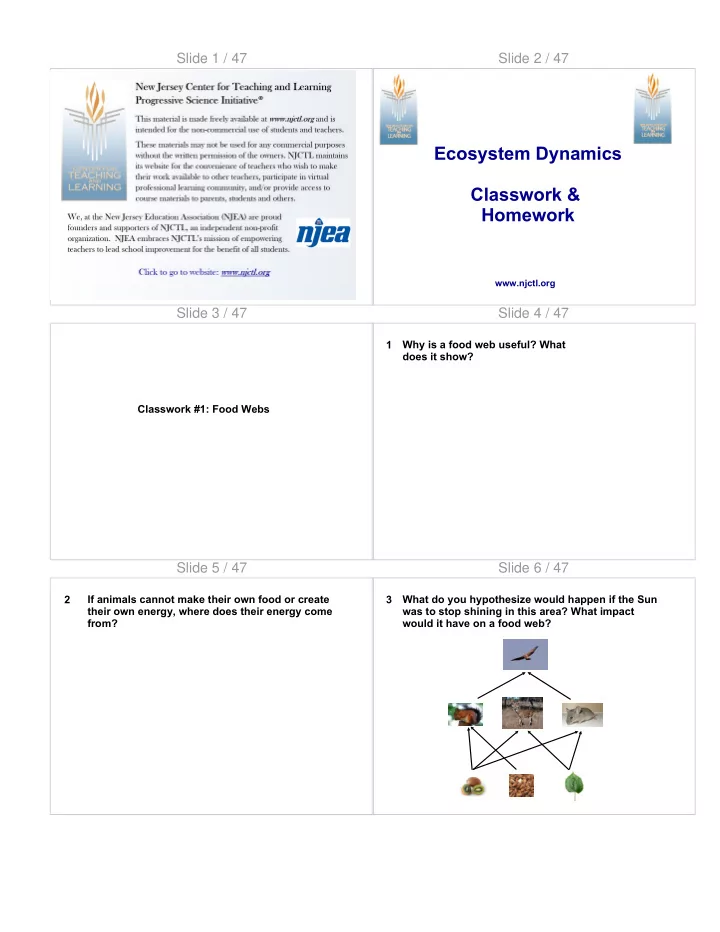
3 What do you hypothesize would happen if the Sun was to stop shining in this area? What impact would it have on a food web?
SLIDE 2 Slide 7 / 47
4 Describe the difference between a primary consumer and a secondary consumer.
Slide 8 / 47
5 Correctly set up the following food web:
- a. Bears are secondary consumers of
rabbits, deer and foxes
- b. Deer eat berries and leaves
- c. Rabbits eat berries and leaves
- d. Foxes eat rabbits
Slide 9 / 47
Homework: Food Webs
Slide 10 / 47
6 What kind of food would an herbivore eat? Give an example.
Slide 11 / 47
7 What kind of food would a carnivore eat? Give an example.
Slide 12 / 47
8 What kind of food would an omnivore eat? Give an example.
SLIDE 3 Slide 13 / 47
9 What level of consumers are humans?
Slide 14 / 47
10 Create a food web of your local area. Include at least 2 producers, 2 primary consumers and 2 secondary consumers.
Slide 15 / 47
Classwork: Decomposers
Slide 16 / 47
11 Define decomposition.
Slide 17 / 47
12 What are two organisms that help with decomposition?
Slide 18 / 47
13 What effect does the growth of mushrooms have
- n the surrounding environment?
SLIDE 4
Slide 19 / 47
14 Why is composting a positive thing to do in your garden?
Slide 20 / 47
15 List three factors that impact the rate of decomposition.
Slide 21 / 47
Homework: Decomposers
Slide 22 / 47
16 What types of organisms are examples of fungi?
Slide 23 / 47
17 Why is decomposition important for an ecosystem?
Slide 24 / 47
18 How can you speed up the process of decomposition?
SLIDE 5
Slide 25 / 47
19 Bill is testing the effects of decomposition on two identical pieces of bread. One piece of bread is placed in an empty plastic bag. One is placed in a bag with water. One is placed in a bag with water and placed under a heat lamp. Which do you expect to rot the most? Why?
Slide 26 / 47
Classwork: Cycles of Matter
Slide 27 / 47
20 How do we define matter? Give two examples.
Slide 28 / 47
21 What are all living things primarily made up of?
Slide 29 / 47
22 How does the matter that makes up plants make its way to a secondary consumer?
Slide 30 / 47
23 What is responsible for recycling dead matter?
SLIDE 6 Slide 31 / 47
24 What role does the environment play in the cycle
- f matter? Give two examples.
Slide 32 / 47
Homework: Cycles of Matter
Slide 33 / 47
25 What is soil composed of?
Slide 34 / 47
26 How does the Law of the Conservation of Mass apply to a food web?
Slide 35 / 47
27 What are the three main elements that make up the human body? Which substance makes up between 60%-75% of the human body?
Slide 36 / 47
28 What would happen if matter was not returned to the soil?
SLIDE 7 Slide 37 / 47
29 Create a model that displays the movement of matter between plants, animals, decomposers and the environment.
Slide 38 / 47
Classwork: Maintaining an Ecosystem
Slide 39 / 47
30 What are the four basic needs of organisms?
Slide 40 / 47
31 Why are plants so important to an ecosystem?
Slide 41 / 47
32 What negative effects does overpopulation have
Slide 42 / 47
33 Why is the introduction of the cane toad in Australia having negative effects on the ecosystem? What efforts are being made to stop their spread?
SLIDE 8
Slide 43 / 47
Homework: Maintaining an Ecosystem
Slide 44 / 47
34 Why are ecosystems considered fragile?
Slide 45 / 47
35 How do organisms make sure that they maintain a proper population balance?
Slide 46 / 47
36 What negative effects does over-hunting have on an ecosystem?
Slide 47 / 47
37 What is the difference between a native species and an alien species?