Economics of Land Degradation Insights fro In rom an evaluation - - PowerPoint PPT Presentation

economics of land degradation
SMART_READER_LITE
LIVE PREVIEW

Economics of Land Degradation Insights fro In rom an evaluation - - PowerPoint PPT Presentation

Economics of Land Degradation Insights fro In rom an evaluation study in in Bundelkhand by Development Alt lternatives Gro roup Side Event Evaluating the Presented at UNCCD COP 14 Impact of Land Remediation Rio Pavilion through the


slide-1
SLIDE 1

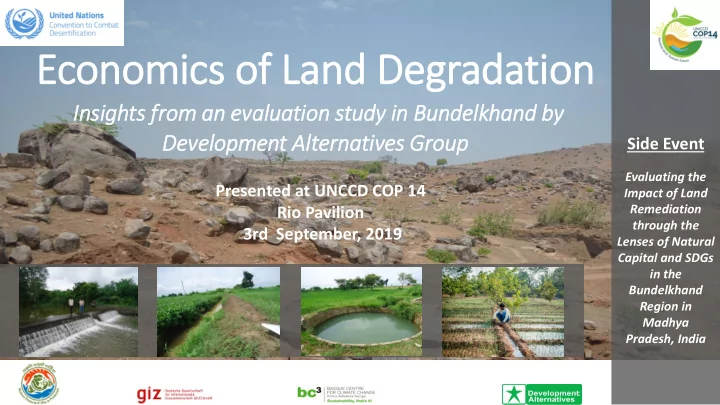
Economics of Land Degradation

In Insights fro rom an evaluation study in in Bundelkhand by Development Alt lternatives Gro roup

Side Event

Evaluating the Impact of Land Remediation through the Lenses of Natural Capital and SDGs in the Bundelkhand Region in Madhya Pradesh, India

Presented at UNCCD COP 14 Rio Pavilion 3rd September, 2019

slide-2
SLIDE 2

Content

  • Land Degradation – Current scenario in India
  • Bundelkhand – A Brief Profile
  • Introduction to Project- ELD
  • ELD Methodology Adapted to Local Context
  • Insights from Field : TBL impact of Land Management.
  • Initial Evaluation Findings
  • Opportunities for India
  • Emerging Questions
slide-3
SLIDE 3

The India Context : Land Degradation and Livelihood Dependence on Land

  • India, with 2.4% of the world’s land but 17% of its population has

very low per capita availability of land (SoER, 2015)

  • 97 mn (i.e. 29%) hectares of land is under degradation and of this

83 Mha is undergoing desertification (SoER, 2015)

  • Major causes of degradation are water erosion (36 Mha) and wind

erosion (18 Mha) (SoER, 2015)

  • 67% of net sown area is rain-fed and therefore completely

dependent on ecosystems for water access (CRIDA)

  • India is losing Rs. 28,500 crore, on account of degraded lands equal

to 12% of total value productivity of these lands (Ankita Rai, 2015)

slide-4
SLIDE 4

Environmental Social Economic

  • Reduced precipitation rate

by 32% between 2013- 2018 (IMD)

  • 33% of the cropped area

receives less than 750 mm rainfall

  • 22 % of total area under

forests mainly shrub and heavily encroached

  • Shift in monsoon period by

55-60 days, from mid-June to mid-August

  • 70% of tanks, ponds and

reservoirs are dry due to fall in surface and groundwater

  • Per capita income is 50-

55% lower than the national average

  • 67% population is in

agriculture and 77% of those are small and marginal farmers

  • Small and fragmented

size land holdings

  • Per capita food

availability is only 330kg per annum

  • Seasonal migration rate in

Bundelkhand is 39.4%

  • Aggregated HDI rank at

0.594 is amongst the lowest in the country (India average is 0.663)

  • Average literacy rate 66 % ,

lower than the state average of MP and UP which is 69%

  • 48 % of population below

poverty line

  • 26% of population belong

to lower social class

The Bundelkhand Context
slide-5
SLIDE 5

Research & Policy Influence

  • Crop diversification and

integrated farming

  • Climate resilient agri-

practice

  • Organic farming
  • Farmer producer Org.
  • Awareness generation
  • Climate adaptive

decentralized planning

  • Ecological rejuvenation in

arid and semi arid region

  • Afforestation
  • Soil water conservation
  • Participatory net

planning

  • GIS based planning
  • Water use efficiency

Outreach & Awareness Creation through Rural Communication Channels Training & Capacity Building

Development Alternative's Work on Natural Resource Management in Bundelkhand

Watershed Development Sustainable Agriculture Climate Adaptive Planning Reviving Natural Ecosystems

slide-6
SLIDE 6

Insight from Field : Triple Bottom-Line Impact of Land Management

Social Wellbeing Economic Development Ecological Security TBL Impact social cohesion pollination services improved biodiversity, biomass drought resilience Improved agri-practice aquifer recharge, soil OC, moisture improved income

Integrated Natural Resource Management

reduced degradation, erosion participatory management investment in health, education reduced migration improved crop yield, fodder

Improved Natural Capital

slide-7
SLIDE 7
  • We present an ‘economic’ approach that values natural

resources under different management regimes to combat desertification.

  • Using the value of ecosystem services, the augmented

value of our natural capital is estimated as a function of how the ecosystems are used and managed.

  • Increases in the value of services of land through

remediation are compared with the costs of remediation.

Introduction to the Current Study

Valuing land as a function

  • f how it

is used

slide-8
SLIDE 8

To evaluate the potential of land remediation activities as beneficial and cost effective measures for combating desertification To develop a toolkit for assessment of similar land remediation programmes under similar environmental and socio- economic conditions To evaluate changes in SDG indicator values for a reduction in land degradation.

Introduction to the Current Study

Geographical Coverage

3 districts : Datia, Shivpuri, Niwari Comparison Period 2013 and 2018 Partners:

slide-9
SLIDE 9

Primary and secondary data collection Economic valuation GIS based mapping

ELD Research Methodology Adapted to Local Context

Inception Geographical categorizatio n Types of Ecosystem Services Ecosystem services and economics Identifying Patterns and Pressures Cost benefit analysis and

  • thers

Take action Perceptions Mapping

Habitat Quality Carbon storage and Sequestration Crop Pollination Forest Carbon Edge Effects Nutrient Delivery Ratio Annual Water Yield Sediment Delivery Ratio Crop Production Seasonal Water Yield Visitation: Recreation and Tourism InVEST GLOBIO

Software based analysis

Carbon storage and Sequestration Crop Production

SDGs Mapping

Social Capital

Social capital assessment

slide-10
SLIDE 10

Zooming In

Initial Evaluation Findings – Land Use Changes from 2013 to 2018 – In Intervention Cluster

2013 2018

slide-11
SLIDE 11

Initial Evaluation Findings – Land Use Changes from 2013 to 2018 – In Intervention Cluster

Conversion of single cropped land to double cropped land Increase in on-farm habitation 2013 2018

slide-12
SLIDE 12

Initial Evaluation Findings – Relative Change in Land Use from 2013 to 2018 – In Intervention & Control Cluster

Control Intervention 2013 2018

  • Increase in area under

double cropping by 3 times in the beneficiary village

  • All the single crop area

during rabi season (Oct- Feb) got converted to double cropping, farmers have started cultivating Khariff season crops like paddy, groundnut and Black gram

  • Increase in double crop

area in control villages also, but not as much as in intervention villages

slide-13
SLIDE 13

Initial Evaluation Findings-Crop Production

10000 20000 30000 40000 50000 60000 70000 80000 90000

2013 2019 TOTAL PRODUCTION ( In quintals) Intervention Villages Control Villages

500 1000 1500 2000 2500 3000

2013 2019 CROP AREA ( In ha) Intervention Villages Control Villages

7.4 30 6.4 17.7

2013 2019 PRODUCTIVITY (Quintals/ha) Intervention Villages Control villages 11692 53939 10332 30812 2013 2019 VALUE PER HA (INR) Intervention Villages Control Villages

slide-14
SLIDE 14

Benefits from land Remediation

  • Rs. Lakh

If Sustained ( For 30 years) If Limited (For 10 years) Crop Production 10,033 6,020 Carbon Sequestered 332 199 Total 10,364 6,219 Costs of Remediation (Project costs) 450 450 Benefit-Cost Ratio* 23.0 13.8

Benefits from land remediation

*Benefits are present values at 4% discount rate

slide-15
SLIDE 15
  • The initial results show that the benefits received from the

land remediation activities (natural capital) are much greater than the costs and are unparalleled in terms of economic value

  • The study can provide scientific evidence for policy

recommendation of where to invest in remediation and how much to invest

  • It can contribute to India’s commitment of achieving the LDN

targets of halting any further land degradation and rehabilitation of at least 30 m ha degraded wasteland, forest and agricultural land

  • Inference from the study- further opportunity
slide-16
SLIDE 16
  • Can this methodology play an important role in restoring the land

degradation and achieving the LDN target ?

  • Can this contribute to the decision making and incentivize

investments in land restoration?

  • Can this influence biodiversity conservation and better management
  • f ecosystem services

Key Emerging Questions

slide-17
SLIDE 17

THANK YOU