SLIDE 1
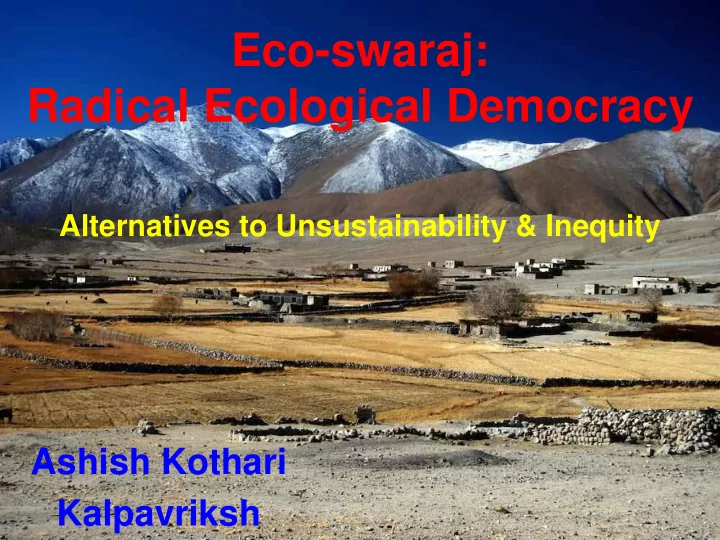
Eco-swaraj: Radical Ecological Democracy
Alternatives to Unsustainability & Inequity
Ashish Kothari Kalpavriksh
SLIDE 2 Today’s menu …
- Unappetiser: violence of development / growth
- Appetiser: alternatives at the grassroots
- Main dish: frameworks of transformation
- Coffee: some key questions to ponder over
- Dessert: confluences
SLIDE 3 India ...
- Human settlement 70,000 years old
- Urban ‘civilisations’ 5000 years old
- Population: 1.2 billion people
- Livelihoods: 65-70% agriculture dependent
- Culture: 800 living languages
- Complex social dynamics: caste, religion,
ethnicities
- Biodiversity: 7-8% of world biodiversity on
2% of its landmass
- 150+ years of colonisation by Britain;
independence 1947
SLIDE 4 Economic globalisation
- 1947-1991: Socialist economy
- 1991-onwards: Integration into global economy:
– Privatisation / foreign investments – Liberalisation – Export-import priority – Consumption boom
SLIDE 5 India’s Impressive Growth
- World’s 2nd highest growth rate; 7th largest economy
- 800 million mobile phones
- Indian corporations now multinational
- Better services/opportunities for middle class
SLIDE 6 Dominant vision of ‘development’
Violence against nature, communities, and cultures … growth as cancer
SLIDE 7 Self-devouring growth
World Bank (2013): Costs of environmental damage = 5.7% points econ. Growth
(impacts taken into account)
- urban & indoor air pollution
- inadequate water supply, sanitation and hygiene
- agricultural damage by soil salinity, water-logging and soil erosion
- pasture degradation
- deforestation
SLIDE 8 Jobless growth; continuing and new poverty
- Myth of growing employment: ‘jobless
growth’ in organised sector:
– 26.7 million in 1991 – 30 million in 2012
- 20% unemployment among youth
- % below poverty line: 38 to 70%
- World’s largest number of malnourished
and undernourished women/children
- 60 million people displaced by
‘development’ projects
SLIDE 9 ‘Green revolution’ model
- High cost of inputs, low purchase prices = farmer indebtness
- Destruction of soil productivity, dependence on market & govt
Destruction of India’s agriculture
>300,000 suicides (many in heartland of green revolution!)
SLIDE 10
Clash of civilisations …
From livelihoods as ways of life …
SLIDE 11 … to livelihoods as jobs, divorced from rest of life:
Violence against each of us: our identity, our health, our well-being!
Livelihoods to Deadlihoods
Illustrator unknown
SLIDE 12 1% richest own 50% wealth!!!!
Growing inequities, deprivation
SLIDE 13
Are there alternatives?
SLIDE 14 Alternatives to what? Structural roots of unsustainability & inequity
Concentration of power Capitalism State-dominated regimes Patriarchy Caste / race / ethnicity ….
SLIDE 15 Resistance …
… is part of the alternative
“Civil society responsible for 2-3% GDP loss” Ministry
satyagraha
SLIDE 16
Assertion of self- determination & ancient ways of life, recognition of the unrecognised
Dongria Kondh indigenous people vs. Vedanta corporation & Indian state
SLIDE 17 India: alternative initiatives for well-being
Water Crafts Shelter Food Energy Governance Livelihoods Conservation
Village revitalisation Urban sustainability
Learning Health
Producer companies
Inclusion Sexuality Gende r
SLIDE 18 Alternatives across the world
Commons Solidarity economy Degrowth Buen vivir / sumaq kawsay Ubuntu / ukama / unhu Ecofeminism Agroecology / permaculture Biocivilisation Ecosocialism Zapatista Kurdish Rojava Kyosei Country
SLIDE 19
Food sovereignty: sustainable agriculture
SLIDE 20
- Reviving traditional agr diversity, community grain banks
- Empowering women/dalit farmers, securing land rights
- Creating consumer-producer links (Zaheerabad org. food restaurant)
- Linking to Public Distribution System
- Community media (films, radio)
Deccan Development Society (Andhra Pradesh)
SLIDE 21
Water security: do we need big dams and canals?
SLIDE 22
Arvari Sansad (Parliament), Rajasthan: water and food sovereignty through ecoregional governance
SLIDE 23
Natural resources: conservation & livelihoods
SLIDE 24 Self-rule & decentralised governance: Mendha-Lekha (Maharashtra)
Informed decisions through monitoring, and regular study circles (abhyas gat)
All decisions by consensus in gram sabha (village assembly)
SLIDE 25 Conservation of 1800 ha forests, now with full rights under Forest Rights Act
Vivek Gour-Broome
Earnings from sustainable forest use (over Rs. 20 million in last few years), and use of govt schemes towards:
- Full employment, energy security, new
livelihoods (barefoot engineers, GIS mapping)
2013: all agricultural land donated to village, collective ownership
“Our government in Mumbai and Delhi, we are the government in our village”
SLIDE 26 Elsewhere in the world ….
- Indigenous peoples’ assemblies
- Zapatista self-governed region: people’s assemblies,
- versight councils, rotating ‘leadership’
- Kurdish Rojava autonomous region
- Latin American experiments: direct and delegated
democracy (e.g. Venezuela’s consejos comunales,
neighbourhood assemblies “we don’t want to be government, we want to govern”)
- Australia east coast corridor, landscape-level
governance
SLIDE 27
Indigenous peoples’ and community conserved areas (ICCAs)
SLIDE 28
Livelihood security
SLIDE 29
Jharcraft
(Jharkhand) Employment for >3 lakh families… reviving crafts, reducing outmigration
SLIDE 30
Dharani farmer producer company, Andhra Pradesh
(facilitated by Timbaktu Collective)
SLIDE 31 Rural revitalisation:
- utmigration is not inevitable
Ralegan Siddhi & Hivare Bazaar (Maharashtra), Kuthambakkam (TN) Kudumbashree (Kerala)
SLIDE 32 Right to a Sustainable City
‘’Homes in the City’, Bhuj (Kachchh, Gujarat)
- self-reliance in water (India’s lowest rainfall)
- solid waste management and sanitation
- re-commoning of spaces
- livelihoods for the poor
- self-built, dignified housing for poor
(Hunnarshala, Sahjeevan, Kutch Mahila Vikas Sangathan, ACT, Setu)
SLIDE 33 Middle class actions …
Lake revival / conservation, water harvesting, garbage management (Bengaluru, Salem)
Participatory budgeting (Bengaluru/Pune)
‘Maptivism’ by Transparent Chennai reStore (non-profit store), Chennai
SLIDE 34 Elsewhere in the world ...
- Factory take-over and democratic running by workers,
Argentina, Greece …
- Land re-appropriation movement (MST), Brazil
- Commons / solidarity initiatives, cooperatives (e.g.
Barcelona’s Cooperativa Integral)
- Local /social currencies (Helsinki, Bristol, Barcelona?)
- Cuba’s urban agriculture
- Transition Towns, Europe
- and many more…
SLIDE 35
Knowledge, consciousness, attitudes, worldviews …
SLIDE 36 Learning / education: re-locating it in community, ecological roots, creativity, inquisitiveness …
- Adharshila, MP
- Jeevanshala, Narmada
- SECMOL, Ladakh
- Imli-Mahua, Chhattisgarh
- Marudam, Tamil Nadu
- Adivasi Academy, Guj
- Swaraj University, Rajasthan
- Beeja Vidyapeeth, Uttarakhand
- Bhoomi College, Karnataka
Skhole = leisure!
SLIDE 37 Intergenerational transmission of knowledge
- Surshala (music)
- Karigarshala (construction)
- Sagarshala (coastal communities)
- Kala Vidyapeeth (crafts)
- Parageohydrologists
Traditional & new skills for livelihoods
SLIDE 38 Technology by/for/with/of people
Technological innovations to reduce ecological impact, reach & be governed by the marginalised (malkha cotton weaving, AP; Hunnarshala housing, Kachchh; Solar passive architecture, Ladakh)
SLIDE 39 Alternative Media, Communications, Arts
Freedom from govt & corporate control:
- Community radio (>150); FM?
- Mobile-based (CGNetSwara, Chhattisgarh)
- Movement newsletters, folk theatre
- Film/video (Video Volunteers)
- Internet (Scroll, Wire, Infochange, India Together …)
- ‘Social’ networks … virtual communities
Pic: Puroshottam Thakur
SLIDE 40 The government responds…
– Right to Information Act – National Employment Guarantee Act – Scheduled Tribes and Other Forest Dwellers (Recognition of Forest Rights) Act 2006
– Organic farming policies / programmes in 16 states: Sikkim 100% by 2015, Kerala by 2020? – Activity-based learning, Tamil Nadu
SLIDE 41
Can we discern elements of a holistic framework from these initiatives?
SLIDE 42 Ecological resilience & wisdom Radical democracy Economic democracy Social justice & wellbeing Culture & knowledge diversity
Towards a sustainable and equitable society
5 interconnected, integrated circles
SLIDE 43 Eco-swaraj: Radical ecological democracy
(Radical = going to the roots, challenging the conventional)
- achieving human well-being, through:
– empowering all citizens & communities to participate in decision-making – ensuring socio-economic equity & justice – respecting the limits of the earth Community (at various levels) as basic unit of organisation, not state or private corporation
SLIDE 44 A NEW POLITICS
Direct democracy (local): decentralised and nested decision- making Direct democracy (state/national): referendums & deliberative processes Delegated/representative democracy, with mechanisms of accountability (right to recall, public audit, reporting back…) Ecoregional planning across states and countries … political units aligned with ecological and cultural ones? Borderless world? Conditions: Rights, Capacity, Forums, and Maturity
SLIDE 45 A NEW ECONOMICS
Mindful of ecological / planetary limits Open localisation: self-sufficiency/sovereignty in basic needs, larger trade built on this Production, consumption (prosumption) locally controlled; & sustainable consumption line? Re-integrating work & leisure: livelihoods Re-commoning private & state property Demonetisation & decentralisation of currencies: Relations of caring/sharing, local exchange systems, restructuring the market (haat)
SLIDE 46
Biekerech (Luxembourg): Energy Autonomy, Sustainability, Decarbonisation
Towards 100% self-sufficiency in energy (heating, power)
SLIDE 47
Local currencies, or demonetising exchange!
Beki local currency, Biekerech, Luxembourg
SLIDE 48 A JUST SOCIETY
Towards equity amongst classes castes (eradication of) genders ethnic groups species ‘able’ities Towards universal rights-based approaches (including for children!), infused with responsibilities … sarvodaya
SLIDE 49 CULTURE AND KNOWLEDGE
Respecting non-divisive diversity of languages, cuisines, knowledges Democratic R&D / S&T / knowledge / innovation: in public domain, participatory, transparent Media and arts commons Opportunities for spiritual / ethical growth (without falling into trap of communal religious institutions)
SLIDE 50 Alternative globalisation
- Global flow of ideas, cultures, materials
(millennia old) NOT
- Globalisation dominated by:
–unrestricted financial and economic flows –imposition of one model of ‘development’ across the world
SLIDE 51
RENEWED RELATIONSHIP WITH/IN NATURE
SLIDE 52
- Diversity and pluralism (of ideas, knowledge, ecologies, economies,
ideologies, polities, cultures…)
- Self-reliance for basic needs (swavalamban)
- Self-governance / autonomy (swashasan / swaraj)
- Cooperation, collectivity, solidarity, commons
- Rights with responsibilities of meaningful participation
- Dignity & creativity of labour (shram)
- Qualitative pursuit of happiness
- Equity / justice / inclusion (sarvodaya)
- Simplicity / sufficiency / enoughness (aparigraha)
- Rights of nature / respect for all life forms
- Non-violence, peace, harmony (ahimsa)
- Subsidiarity & ecoregionalism
Values & principles of transformative alternatives ….
SLIDE 53 Worldviews from elsewhere …
- Indigenous peoples’ territorial struggles and notions of
well-being
– buen vivir: sumak kawsay (Andes), suma qamana (Bolivia), kume mongen (Chile) – ubuntu (S. Africa), umuntu (Uganda), ukama (Zimbabwe), eti uwem (W. Africa)
- Degrowth, Commons, Solidarity economy,
Biocivilisation, Ecosocialism …
SLIDE 54 Issues for dialogue….
Would there be a state? Its form and role? What would be the nature of global governance? (Not the UN!) Would there be a private business sector? Profits, or revenues channelised back into social purposes?
SLIDE 55 Issues for dialogue….
How do scattered, often small initiatives face larger forces? Who will catalyse the transformation: Mass movements? NGOs? Worker unions? Political parties? What is nature of individual freedoms within community living?
SLIDE 56
Vikalp Sangams (Alternatives Confluences):
practical collaborations, democratic visioning of futures
SLIDE 57 Vikalp Sangams (regional)
Andhra Pradesh, Oct 2014 Tamil Nadu, Feb 2015 Ladakh: July 2015 Maharashtra, October 2015 Kachchh, July 2016
(thematic)
Energy democracy: March 2016 Food sovereignty : 2016 & 2017 Youth: early 2017 Learning and education: 2017 Arts: 2017?
SLIDE 58
Visioning the future, grassroots-up
SLIDE 59 (www.alternativesindia.org)
www.vikalpsangam.org
transformap.co
wiki.p2pfoundation.net
SLIDE 60
A wild idea: how about a big GAFf?
Global Alternatives Forum
SLIDE 61
For continuing the dialogue …