ECFS-CTN Perspective: Interaction with Investigators Sponsors - - - PowerPoint PPT Presentation

ecfs ctn perspective interaction with investigators
SMART_READER_LITE
LIVE PREVIEW

ECFS-CTN Perspective: Interaction with Investigators Sponsors - - - PowerPoint PPT Presentation

ECFS-CTN Perspective: Interaction with Investigators Sponsors - Regulators Update for EnprEMA Meeting, May 16th, 2017 Tim Lee, ECFS-CTN Director How do the Clinical Trial Networks add value? Experts in delivering clinical trials in the


slide-1
SLIDE 1

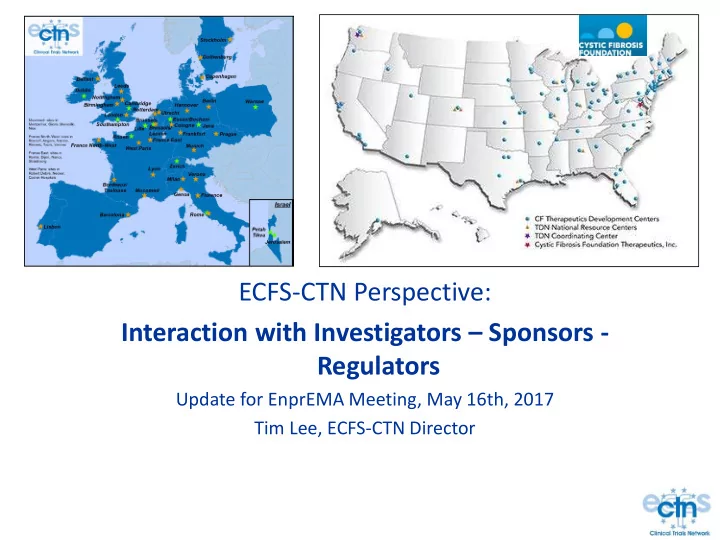
ECFS-CTN Perspective: Interaction with Investigators – Sponsors - Regulators

Update for EnprEMA Meeting, May 16th, 2017 Tim Lee, ECFS-CTN Director
slide-2
SLIDE 2

How do the Clinical Trial Networks add value?

  • Experts in delivering clinical trials in the

population in question (country and/or disease specific) – especially feasibility

  • Know best countries/sites for specific study

requirements

  • Dealing with whole pipeline – see full context

(although much of this will be confidential)

  • Involve patients in prioritisation/feasibility
  • No conflict of interest (other than wanting best
  • utcome for patients)
slide-3
SLIDE 3

Cystic Fibrosis Landscape

  • A rare disease (75,000 affected worldwide)
  • Life shortening (current UK predicted life expectancy

45.1 years1 improving rapidly)

  • Current very active pipeline from multiple pharma
  • CFTR modulator drugs (potential for considerable

gains in life expectancy)

  • Mucolytics to reduce chest infections/scarring
  • Improved antibiotics including inhaled therapies
  • Anti-inflammatories to reduce lung scarring
  • Treatments for pancreatic/liver/GI disease seen in CF
  • CFTR modulator drugs approved so far very expensive,

not available in many countries

1) UK CF Registry 2016

slide-4
SLIDE 4

Current challenges (1)

  • In a rare disease drug development costs can

rapidly lead to new drugs being unaffordable for some Healthcare Providers

http://www.pharmafile.com/news/503575/nice-draft-guidance-says-no-cystic-fibrosis-drug-orkambi https://www.thetimes.co.uk/article/german-deal-sets-high-price-for-orkambi-pkkls0lc8

slide-5
SLIDE 5

Current Challenges (2):We need a worldwide CF clinical trials strategy in age of CFTR modulators

Mayer-Hamblett N et al. Thorax 2016

Very large studies may be needed Costs/blinding of active comparator Studies more deliverable

slide-6
SLIDE 6

Alternative study designs:

Mayer-Hamblett N et al. Thorax 2016

  • For example: 1 month withdrawal from

standard of care modulator

Needs careful safety monitoring Pre-determined stopping criteria

slide-7
SLIDE 7

Sponsor – ECFS-CTN Interaction

Some sponsors approach CTN before PIP submitted Most sponsors approach CTN after PIP with individual study protocols but before protocol is finalised Once CDAs arranged discussion about CTN processes and specific study questions between sponsor and CTN Director and CTN Co-ordinator Protocol Review Agreement and CTN Protocol Review Protocol accepted to run in CTN with specific feedback Protocol deferred with specific feedback Protocol not accepted to run in CTN

Sponsor responds to feedback Protocol may be amended Sponsor responds to feedback Protocol may be amended Protocol may run outside CTN Or sponsor may go back to regulator Or protocol may not progress

Feasibility agreement – Site Feasibility Questionnaire Site selection and study set-up Study runs Regular telcos/meetings between Sponsor and CTN Director and CTN Co-ordinator

slide-8
SLIDE 8

Advocacy for patients to sponsors– examples

  • Guaranteed Enrollment Plan for Sites – across most CFTR

modulator studies

  • Anti-inflammatory study: Request for further safety data
  • Infant study: Request for data showing effect on lung

development

  • Successful lobbying that subjects involved in early CFTR

modulator studies should not be excluded from later studies

  • Protocol feasibility – impact on work and school attendance
  • endpoints that are minimally disruptive/unpleasant
  • Speed of safety reporting back to sites
  • Improving Screening experience and efficiency eg genotype

reporting

  • Suggesting Registry type studies are conducted by existing

Registries

  • Advised sponsors on concerns about ultimate drug costs
slide-9
SLIDE 9

Interactions with Regulators

  • Participation in EMA workshop to standardise outcome measures and priorities for CF Clinical

Trials – and ongoing general advice/consultation (both ways)

  • Importance of In Vitro assays on Intestinal Organoids for predicting response for CF patients

with rare CF mutations

  • Responsed to EMA scoping Document Revision of Guideline on Clinical Development of New

Treatments for people with Cystic Fibrosis (CHMP/EWP/9147/08) and encouraged responses from other stakeholders (eg Sponsors; Patient Organisations; US Cystic Fibrosis Foundation Therapeutics Development Network).

  • Liaise with US Cystic Fibrosis Foundation Therapeutics Development Network over

interactions with FDA

  • Regularly invite speakers with regulatory expertise to our ECFS-CTN Steerco meetings to

discuss changing landscape and strategic priorities

  • Involvement in Enpr-EMA committees and working groups
slide-10
SLIDE 10

ECFS-CTN – Thank you

Fiona Dunlevy Quality Manager Katia Reeber Tim Lee Els Aertgeerts Veerle Bulteel Kate Hayes Co-ordinating Centre Team ECFS-CTN Site Leads, Basel June 2017