
SLIDE 1
Eaton Primary School
Learning Together Through Challenge
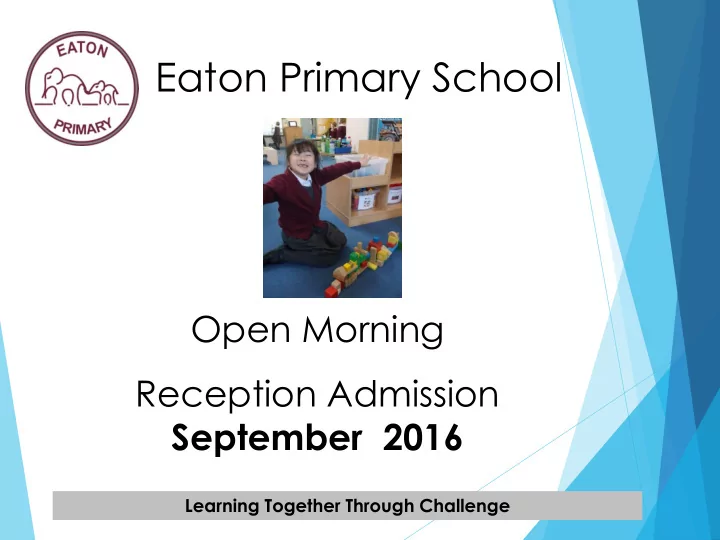
Eaton Primary School Open Morning Reception Admission September - - PowerPoint PPT Presentation
Eaton Primary School Open Morning Reception Admission September 2016 Learning Together Through Challenge Welcome from Headteacher, Mr Lowe Vision and Values Our Vision Every child has a happy, safe, and inspiring learning journey. Our
Learning Together Through Challenge
Our Vision Every child has a happy, safe, and inspiring learning journey. Our Values We strive to achieve our aims through promoting and acting on the values of Trust, Openness, Respect and Integrity.
To provide a safe and stimulating learning
environment, through robust financial management and adherence to policy and procedure, in which we all continually strive to provide excellence for our children.
To fulfil the potential of every child, through
encouragement and challenge, so that they can be adaptable and self-sufficient and are prepared for life ahead.
To achieve high levels of motivation and well-being
for our employees, through quality training and personal development.
To foster trust and confidence from our community
partners, so that we can both learn from and contribute to our local, national and global neighbours.
Evolution Academy Trust – Board of
Governing Body – Parents and
Senior Leadership Team –
Headteacher, Deputy and Assistant Heads
Children in the Reception year follow a curriculum called the Early Years Foundation Stage. This framework supports children to become active, motivated and independent learners. The EYFS is a play-based curriculum which covers seven key areas of learning. At Eaton Primary School, these areas are delivered in a cross-curricular, practical way. This allows children to use and apply their learning in a variety of contexts.
Reception Topic Plan
Autumn Term
Marvellous Me!
Half Term Seasons, Weather and days of the week are on-going throughout the year.
Let’s Celebrate!
Sprin ing T Term
Bears Changes
Summer Term
Let’s Pretend Treasure These topics cover the 7 areas of learning: Communication and Language, Personal, Social and Emotional Development, Physical Development, Literacy, Mathematics, Understanding the World and Expressive Arts and Design.
Reception school times- 8:40am – 3:15pm Our timetable allows opportunities for direct teaching, group work and independent play. Below is an example of a ‘typical’ day in Reception, although we remain flexible to meet the needs of the children.
Morning: 8:40- Early bird activities 8:55- Register 9:00- Read, Write Inc. (our phonics scheme) 9:25- Group work and independent learning time
10:30- Mathematics carpet session 10:45- Group work and independent learning time
11:40- Tidy up time followed by a story 12:00- Lunchtime
Afternoon: 12:00- Lunchtime 1:00- End of lunchtime, return to class ready for afternoon learning 1:15- Register followed by topic carpet session 1:30- Group work and independent learning time 2:45- Tidy up time followed by stories, songs and getting ready for hometime 3:15- Hometime
We use a comprehensive phonics scheme called Read,
Write Inc. This is a structured, fast-paced programme that enables all children to quickly learn to read and write.
Children take part in a fun, interactive phonics session
each day. They learn a new letter sound, practise the correct formation and begin to read and spell words containing the sounds they know.
As the primary approach, children are taught to ‘sound-
confident with this, they extend their reading and writing to include captions and sentences.
During our independent learning time, children are
provided with a wide range of opportunities to apply their new phonic knowledge. For example:
Can you practise writing the new letter in the sand tray,
etc?
Can you write a label for the animals in the vet role
play area?
Can you read the words and match them to the
pictures?
The two-way communication between home and school is vital in supporting your child’s learning. We aim to involve parents in their child’s learning as often as possible. Here are a few of the ways we do this:
pop into class at the start of the school day and support your child as they enjoy an activity
approach to recording learning. You can log on to view your child’s profile and add your own comments and photographs.
Reception staff support and extend children's learning
during group work and their own play.
To evidence the learning taking place, staff take
photographs and make written observations on iPads. These are uploaded to ‘Tapestry’ to create a record of each child’s achievements.
Tapestry enables parents to:
Log on to view these photographs and written
See how this evidence fits with our Early Years assessment criteria.
Find out what your child’s ‘next steps’ for learning are.
Upload your own photographs/ written comments to share what your child has achieved at home.