Eating through Nutrition Policy Margo G. Wootan, D.Sc. Director, - - PowerPoint PPT Presentation

eating through
SMART_READER_LITE
LIVE PREVIEW

Eating through Nutrition Policy Margo G. Wootan, D.Sc. Director, - - PowerPoint PPT Presentation

Supporting Healthy Eating through Nutrition Policy Margo G. Wootan, D.Sc. Director, Nutrition Policy www.cspinet.org/nutritionpolicy There is no neutral ubiquity of food & sugary drinks whats available food formulations


slide-1
SLIDE 1

www.cspinet.org/nutritionpolicy

Margo G. Wootan, D.Sc. Director, Nutrition Policy
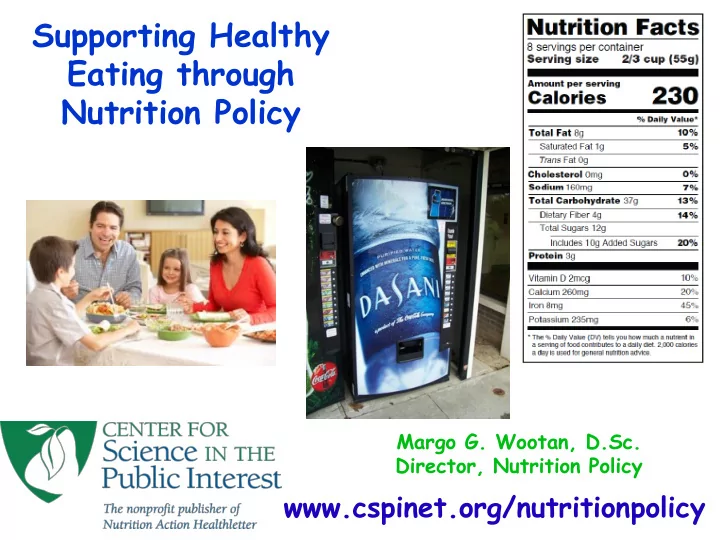
Supporting Healthy Eating through Nutrition Policy

slide-2
SLIDE 2
  • ubiquity of food & sugary drinks
  • what’s available
  • food formulations
  • package/portion size
  • price, what’s on sale
  • ads and marketing
  • placement in stores/on menus

There is no neutral

slide-3
SLIDE 3

Unconscious, automatic food behavior

slide-4
SLIDE 4

Defaults

  • de·fault (di fáwlt) n. A choice automatically

made by someone else

  • People stick with defaults
  • Beneficial defaults acceptable
  • There’s no neutral—beneficial v harmful

defaults

  • Default portions sizes and packaging, food

formulations, pairings

slide-5
SLIDE 5

Defaults: formulations

slide-6
SLIDE 6

Healthy Defaults at Disney World

Source: Using Healthy Defaults in Walt Disney World Restaurants to Improve Nutritional Choices, Peters, et al. (2016)

slide-7
SLIDE 7
slide-8
SLIDE 8

Children’s meals

  • Eating out = 1/4 of children's calories
  • Restaurant marketing to kids
  • Studies link eating out with obesity

and higher caloric intakes; children’s meals high in calories, salt, fats

  • 2012: 97% of kids’ meals unhealthy
  • 2008: 99% of kids’ meals unhealthy
  • McDonald’s, Wendy’s, Burger King,

Dairy Queen, Applebee’s, Jack in the Box dropped sugary drinks from kids’ menu

  • Kid’s Meal Policies
  • Passed: Santa Clara County San

Francisco, Davis, Stockton, Perris

  • Introduced: MD, HI, VT, NYC, NYS
slide-9
SLIDE 9

New York Arizona New Mexico Ohio Iowa

Oklahoma

United States of America

Texas

Implemented Passed Introduced 2009 Introduced 2003-2008

State and Local Menu Labeling Policies

Arkansas Missouri Illinois Indiana Kentucky Tennessee West- Virginia Pennsylvania Maine California Hawaii Florida Washington Oregon King County, WA Multnomah County* San Francisco* LA County Davidson County, TN** Vermont Ulster County, NY Rockland County, NY Lane County, OR Connecticut Albany County, NY New Jersey New Hampshire Massachusetts Philadelphia Delaware Maryland Washington, DC Montgomery County, MD San Mateo County* Santa Clara County* *Superceded by state law. **TN Legislature retracted county regulations. April 2011 Chicago, IL Suffolk County, NY Nassau County, NY Rhode Island New York, NY Westchester County, NY Schenectady County

slide-10
SLIDE 10

Menu Labeling

  • Chains; ≥20 outlets
  • Calories on menus, menu

boards, food tags, buffets, vending

  • Other nutrition info on

brochures, posters, etc.

  • May 5, 2017
  • 30 cal/person/day =

effect on ordering

  • 40 cal/entrée = effect on

reformulation

  • Awareness campaign:

– Education – Reformulation

slide-11
SLIDE 11

Common Sense Nutrition Disclosure Act

  • HR 772/S 261
  • Opposed by public health

groups

  • Deny customers calorie

information

  • Industry-determined serving

sizes

  • Weaken enforcement/

consumer protection

  • Bill passed House, not Senate
slide-12
SLIDE 12

Changes:

  • new “added sugars” line
  • added sugars Daily Value
  • bolder calories
  • remove clutter: “Calories

from Fat” & nutrient table

  • vitamins A & C voluntary
  • Potassium & vitamin D

required

  • improved fiber definition
  • some serving sizes

revised

slide-13
SLIDE 13

Retail prompts to buy

economic drivers v. health considerations

  • Product availability,

placement, shelf space

  • Store layout
  • Pricing, couponing, sales
  • Food pairings
  • Displays
  • In-store promotions

 Voluntary action by retailers, manufacturers  Local ordinances  Checkout

Full report free online: cspinet.org/rigged

slide-14
SLIDE 14

Food Service Guidelines (Procurement) Growing Movement

  • Procurement, plus:

– pricing – marketing – placement – menu labeling

slide-15
SLIDE 15

Where Foods/Beverages are Sold or Served

  • Federal, state, local governments
  • Worksites
  • Hospitals
  • Assisted-living communities
  • Institutionalized populations
  • Community‐based organizations

(including faith‐based)

  • Colleges and universities
  • Child care
  • School systems

Venues Settings

Cafeterias Snack Bars Vending Lunch Rooms Meetings Conferences

slide-16
SLIDE 16

Stepwise implementation (start with one agency and expand)

– Delaware: state parks

– Palm Beach County, FL: DoH – Portland, OR: parks and rec

Implement policy in all government agencies at once

– City-wide vending: Los Angeles, San Francisco, Chula Vista County, Contra Costa County – NYC for food served through programs, childcare, corrections

Provide policy as a model to other workplaces (Seattle/King County)

Phased-in vs. Statewide Policy

slide-17
SLIDE 17

Vending on Public Property

cspinet.org/vendingcontradications.pdf

slide-18
SLIDE 18

Vending on Public Property

cspinet.org/vendingcontradications.pdf

slide-19
SLIDE 19

Healthy Meetings

  • National Alliance for

Nutrition and Activity Healthy Meeting Toolkit

  • Healthy Meeting Pledge
  • www.healthymeeting.org
slide-20
SLIDE 20

For More Information

  • Model standards
  • Fact Sheets

– General – Randolph-Sheppard – Financial Impact

  • Toolkits
  • Promotional/educational signs

and materials

  • Model legislation

http://bit.ly/CSPI-FSG

slide-21
SLIDE 21

2010 Child Nutrition Reauthorization

  • Healthy, Hunger-Free Kids

Act, S. 3307

  • School lunch, breakfast,

CACFP, WIC, summer foods, after-school suppers

  • $4.5 B (2010) v. $487 M

(2004)

  • Improve access, funding

and nutritional quality of school foods

slide-22
SLIDE 22

Food sold outside

  • f school meals:
  • Vending
  • A la carte
  • School stores
  • Fundraisers
slide-23
SLIDE 23

USDA School Meal Regs

slide-24
SLIDE 24

Schools Meeting School Lunch Standards

10 20 30 40 50 60 70 80 90 100 1991-2ᵃ 2004-5ᵇ 2009-10ᶜ 2014ᵈ

Percent

a. School Nutrition Dietary Assessment Study (SNDA) b. SNDA II c. SNDA IV d. USDA 6-cent certification data for school districts

slide-25
SLIDE 25

Threats to school nutrition

  • Policy riders on spending bills
  • CNR delayed
  • House Freedom Caucus hit list
  • Conservative lobbyists
  • Administrative action

– TA, technical assistance,

guidance, enforcement

  • St. Louis Post-Dispatch
slide-26
SLIDE 26

Food Marketing Is Effective

  • Companies know marketing

works: $2 billion/year

  • Studies show marketing gets

children’s attention & affects food choices, food preferences, purchase requests, diets & health

– Watching TV linked to obesity

  • Kids misled by and don’t

understand advertising

  • Parents know marketing works
slide-27
SLIDE 27

Marketing undermines parents and affects what others feed children

slide-28
SLIDE 28

Interagency Working Group on Food Marketed to Children

  • Develop nutrition

stds

  • Identify marketing

approaches

  • Define kid-

targeted marketing

slide-29
SLIDE 29

Children’s Food and Beverage Advertising Initiative

18 Participating Companies

6 pledge no child-directed ads 12 use nutrition criteria for child-directed ads

slide-30
SLIDE 30

Nickelodeon Food Ads

slide-31
SLIDE 31

Strengthen self-regulation

  • All companies need to have

marketing policy

– Entertainment companies

  • Strengthen nutrition

standards

  • Cover all marketing

– In-school, on-package, in-store, toy give-aways, kids’ menus

  • Strong definition of kid-

targeted marketing

slide-32
SLIDE 32

Soft drink taxes

  • Current funding for nutrition and physical

activity is inadequate

  • 35 states tax soft drinks

– Some state soda taxes are earmarked

  • 1¢/oz. soft drink = $13 billion/yr nationally

– Reduce intake by 15% – Decrease medical costs by $1.7B/yr – Reduce diabetes, heart attacks, strokes, premature deaths

slide-33
SLIDE 33
  • 40 year history (since 1971)
  • Mission:
  • Make it easier to eat healthfully
  • Prevent/mitigate diet and obesity

related diseases

  • Educate the public
  • Nutrition Action Healthletter
  • Press
  • Books
  • Reports
  • National, state and local policy

Center for Science in the Public Interest

slide-34
SLIDE 34

Misinformation Overload

slide-35
SLIDE 35
slide-36
SLIDE 36
  • Nature of journalism—they cover news
  • Diet book authors want to sell books
  • Food industry marketing, deceptive labeling

and ads, funding biased research

  • Generated confusion threatens:
  • the public’s health
  • nutrition policy

Nutrition Confusion

slide-37
SLIDE 37

cspinet.org/ actnow

www.cspinet.org nutritionpolicy@cspinet.org