
SLIDE 1
East Coast
Uniform and Presentation Standards
F U R T H E R T O G E T H E R
East Coast Uniform and Presentation Standards F U R T H E R T O G - - PDF document
East Coast Uniform and Presentation Standards F U R T H E R T O G E T H E R Looking your best Presentation Standards You are the face of East Coast, so the way you look Hair and make-up to look smart, natural and and present yourself
F U R T H E R T O G E T H E R
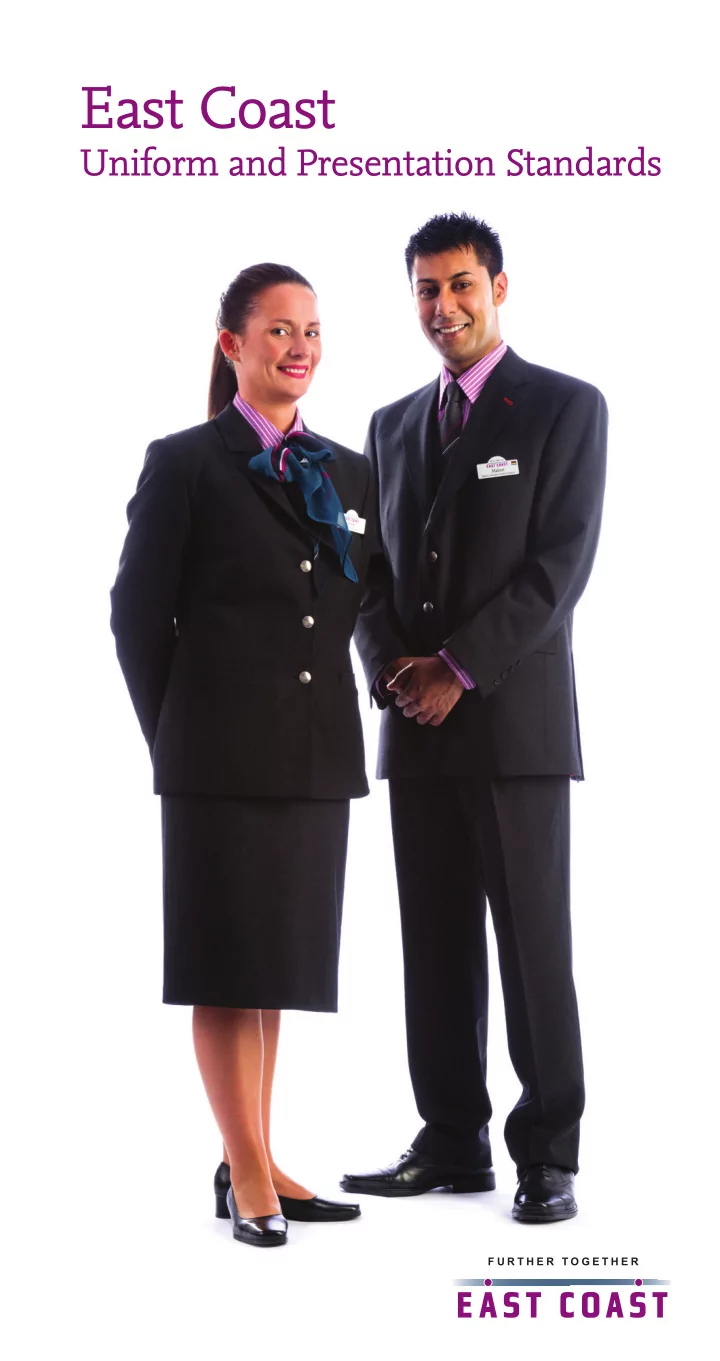
You are the face of East Coast, so the way you look and present yourself influences what our customers think of you and East Coast. That’s why it’s such an important part of your role to look good and well presented at all times. This helps to create a great first and lasting impression, for all the right reasons. The uniform style embraces our brand and company spirit, and reflects the professional image that our customers expect of East Coast. The uniform range is designed to make you feel smart, stylish and proud to represent East Coast. We want you to deliver a consistent and well presented image to our customers, day in day out. This guide sets out our East Coast Uniform and Presentation standards. Your uniform is unique to the area of the business in which you work and the role that you perform. Please refer to the standards which are applicable to your role. When on duty and in view of our customers you must present yourself and your uniform to the standards detailed in this guide.
2
Hair and make-up – to look smart, natural and appropriate for work to portray a professional image. Hair that is shoulder length or longer is to be tied back with a small black or natural hair coloured band. To pin hair back, use discreet pins. Facial hair – beards and moustaches are to be kept neat and trimmed, or maintain a clean shaven look at all times. Personal hygiene – take a pride in your appearance and maintain a high level of personal hygiene. Jewellery – necklaces to be worn inside uniform garments, only one small stud in each ear, no more than three discreet rings and one single bracelet. Tooth jewellery and facial piercing, including tongue, cheek and eyebrow piercings, are not permitted. Tattoos – tattoos are to be covered. However, if you have a tattoo on the hand which cannot be practically covered i.e. by the shirt or blouse long sleeve, providing it covers only a small part of the hand and is not offensive, this is acceptable. Chewing gum – chewing gum is not permitted. Food Handlers – if you’re handling food, follow the Food Safety Policy standards at all times.
1
3 5
Uniform Standards
The following standards are designed to portray a consistent East Coast look. Name badge – to be worn at all times, on the left side, and attached to the badge welt on the outermost garment, not the lanyard. One company or union badge can also be worn on the left lapel. Company lanyard – to be worn at all times, with your ID or SCWID card attached. Station team members can wear a second company lanyard for attaching the
whilst on-board, and wear it at all other times. Only company issued lanyards are to be worn. Shoes – Company shoes are to be worn. In exceptional cases if you are unable to wear the company shoe, speak to your Line Manager. All shoes must meet the required specification – plain black sturdy shoe, with non-slip sole and tread. A ladies court shoe heel is to be no more than 2 inches high. For safety and standards purposes, any non-company shoes are to be checked for suitability with your Line Manager before being worn. Socks – black socks are to be worn with trousers. Tights – to be flesh coloured, or nearly black if preferred, keeping to a low denier (10-15 as a guideline). In winter, or if exceptionally cold, plain black opaque tights can be worn. Waistcoat – can be worn as an outer garment or under the jacket. To be worn at all times when working on board the train. In exceptional conditions i.e. high temperatures, led by the Crew Leader, the full team may remove the waistcoat. The full team are to return to standard as soon as possible, i.e. next leg of the journey or next shift. Apron – to be worn by the team member preparing and cooking food in the kitchen, and can continue to be worn whilst delivering the hot food service. The apron is then to be removed and the waistcoat worn, consistent with the full crew. The waistcoat may also be worn under the apron. Bags and belongings – carry only company issued
T-Key holder – to be worn attached to the uniform belt. Overcoat – wear the company issued coat or anorak as needed, over your uniform. No substitutes are to be made. Fleece – to be worn under the overcoat only, so that it is not visible. Technical teams can wear the fleece as an outer garment. Winter scarf – to be worn with, and tucked into the overcoat. Winter uniform beanie hat – if it’s cold, it can be worn with the company hat badge positioned centrally at the front. Tabards – to be worn as directed, for Customer Service duties. Maternity wear – maternity uniform garments are included within our range, and available to order. Religious garments – please discuss this with your Line Manager.
4
7 8 6 9
Scarf to be worn at all times, tied under the blouse collar, in a bow, and positioned centrally over the top fastened button. Blouse to be neatly ironed, tucked in and with the top button fastened. Long sleeves to be worn buttoned up at the wrist. Waistcoat can be worn as an
when working on board the train. Jumper to be kept clean and worn with sleeves down to the
garment or under the jacket. On stations and to and from trains, jumper to be worn with the jacket. Trousers and Skirts to be clean, neatly ironed and always worn with the uniform belt. Tie to be worn at all times, positioned centrally and over the fastened top shirt button. A clip on tie is recommended, however if choosing to wear a standard tie, tie it so the stripes begin just below the knot. Shirt to be neatly ironed, tucked into trousers and fully buttoned up, including long sleeves buttoned at the wrist. Waistcoat can be worn as an
when working on board the train. Jumper to be kept clean and worn with sleeves down to the
garment or under the jacket. On stations and to and from trains, jumper to be worn with the jacket. Trousers to be clean, neatly ironed and always worn with the uniform belt.
10 11
Polo shirt to be clean and neatly
buttoned up to the top and tucked into trousers. Trousers to be clean, neatly ironed and always worn with the uniform belt. Fleece can be worn as an outer garment or under the anorak.
Uniform Standards
Uniform Standards
Hat to be clean and neatly ironed. Neckerchief to be clean and neatly
around the neck in a double knot, sitting centrally and with the ends tucked into the jacket. Jacket to be clean and neatly ironed. Trousers to be clean and neatly ironed. Apron to be clean and neatly ironed.
Uniform Standards
121212 12
Your uniform is your own personal issue, and it’s up to you to keep it in tip-top condition at all times. Before washing, please take time to read the care instructions provided on each garment label. The following guidelines will help to maintain the smart appearance and life of your uniform.
and dry flat
taking them off – this helps to keep their shape. You are responsible for keeping your uniform maintained, clean, ironed and smart at all times. Remember…
items are permitted
East Coast uniform standards please follow the
Line Manager.
13 14