EASM 2014 2002, effectively creating two entirely new entities; MK - - PDF document

easm 2014
SMART_READER_LITE
LIVE PREVIEW

EASM 2014 2002, effectively creating two entirely new entities; MK - - PDF document

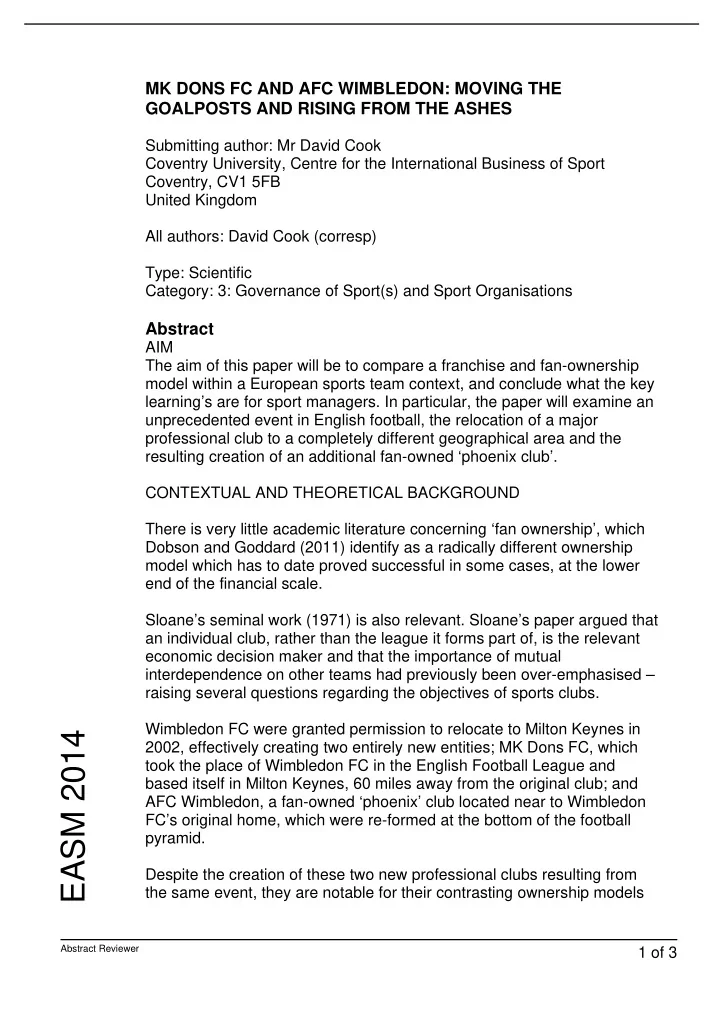
MK DONS FC AND AFC WIMBLEDON: MOVING THE GOALPOSTS AND RISING FROM THE ASHES Submitting author: Mr David Cook Coventry University, Centre for the International Business of Sport Coventry, CV1 5FB United Kingdom All authors: David Cook


slide-1
SLIDE 1

MK DONS FC AND AFC WIMBLEDON: MOVING THE GOALPOSTS AND RISING FROM THE ASHES

Submitting author: Mr David Cook Coventry University, Centre for the International Business of Sport Coventry, CV1 5FB United Kingdom All authors: David Cook (corresp) Type: Scientific Category: 3: Governance of Sport(s) and Sport Organisations

Abstract

AIM The aim of this paper will be to compare a franchise and fan-ownership model within a European sports team context, and conclude what the key learning’s are for sport managers. In particular, the paper will examine an unprecedented event in English football, the relocation of a major professional club to a completely different geographical area and the resulting creation of an additional fan-owned ‘phoenix club’.

  • CONTEXTUAL AND THEORETICAL BACKGROUND
  • There is very little academic literature concerning ‘fan ownership’, which

Dobson and Goddard (2011) identify as a radically different ownership model which has to date proved successful in some cases, at the lower end of the financial scale.

  • Sloane’s seminal work (1971) is also relevant. Sloane’s paper argued that

an individual club, rather than the league it forms part of, is the relevant economic decision maker and that the importance of mutual interdependence on other teams had previously been over-emphasised – raising several questions regarding the objectives of sports clubs.

  • Wimbledon FC were granted permission to relocate to Milton Keynes in

2002, effectively creating two entirely new entities; MK Dons FC, which took the place of Wimbledon FC in the English Football League and based itself in Milton Keynes, 60 miles away from the original club; and AFC Wimbledon, a fan-owned ‘phoenix’ club located near to Wimbledon FC’s original home, which were re-formed at the bottom of the football pyramid.

  • Despite the creation of these two new professional clubs resulting from

the same event, they are notable for their contrasting ownership models 1 of 3

Abstract Reviewer

EASM 2014

slide-2
SLIDE 2

and the reaction they have received from both the media and the wider football community in Great Britain.

  • In US sport, franchising is commonplace, but has rarely been as

successful in Europe. Recent examples of franchise relocation in the US can be seen in baseball, ice hockey and basketball. Within American Major League Soccer (MLS), there has been a long history of franchising, with clubs historically disappearing from one location and then being re-introduced in another. The merits of Shropshire’s (1995) extensive work on sports franchising in America are also considered in this case.

  • Unlike the European model of competitive league team sports, major US

sports operate closed leagues where new teams appear based on market growth and profit potential, as opposed to success on the field of

  • play. In America, these franchises are viewed as being a form of

entertainment, but their primary objective, as for any successful business, is to make money. On the contrary, in England, for example, football clubs have grown out of the communities in which they are situated and franchising was practically unheard of until Wimbledon FC was granted permission to relocate.

  • METHOD

This exploratory research employed a case study methodology concerned with the value that an in-depth understanding of a ‘franchise’ and ‘fan-owned’ English football club would add to the investigation as a

  • whole. Semi-structured interviews were conducted with key stakeholders

at the clubs involved.

  • FINDINGS

AFC Wimbledon’s Dons Trust has been proactive in their efforts to re- establish the brand values and in many ways create a much stronger brand than the former Wimbledon FC possessed. MK Dons embrace a strategy designed to alleviate the ‘distance’ that appears to have been created between supporters and several clubs at the top of English

  • football. Combined with impressive targeting and measurement of young

supporters, MK Dons are the only football club occupying such a large catchment area without direct competition from another league club. Other large urban settlements without a league club may make for an interesting proposition.

  • IMPLICATIONS

This is first known study that examines the concept of franchising and fan-ownership in practice at English professional football clubs. Given the growing commercialisation/globalisation of the game with an increasing amount of major foreign investment, this case offers important lessons about club governance to European sports teams. 2 of 3

Abstract Reviewer

EASM 2014

slide-3
SLIDE 3

References

BBC (2014) David Beckham ‘living a dream’ with MLS franchise in Miami, last accessed 16th March 2014 from http://www.bbc.co.uk/sport/0/football/26054220 Cornwell, R. (2011) “The US franchise system…coming to a league near you?”, The Independent, 22 October Dobson, S. & Goddard, J. (2011) The Economics of Football (2nd Ed.) Cambridge University Press, Cambridge Mail Online (2013) Dean Lewington: My dad can’t wait to assist in Brazil…but I’m worrying about his hair! And who should claim Wimbledon’s 1988 FA Cup win? Nobody, last accessed 16th March 2014 at http://www.bbc.co.uk/sport/0/football/26054220 Sloane, P. (1971) The economics of professional football: the football club as a utility maximiser. Scottish Journal of Political Economy 7, 121- 146 Shropshire, K.L. (1995), The Sports Franchise Game: Cities in Pursuit of Sports Franchises, Events, Stadiums, and Arenas; University of Pennsylvania Press, Philadelphia 3 of 3

Abstract Reviewer

EASM 2014