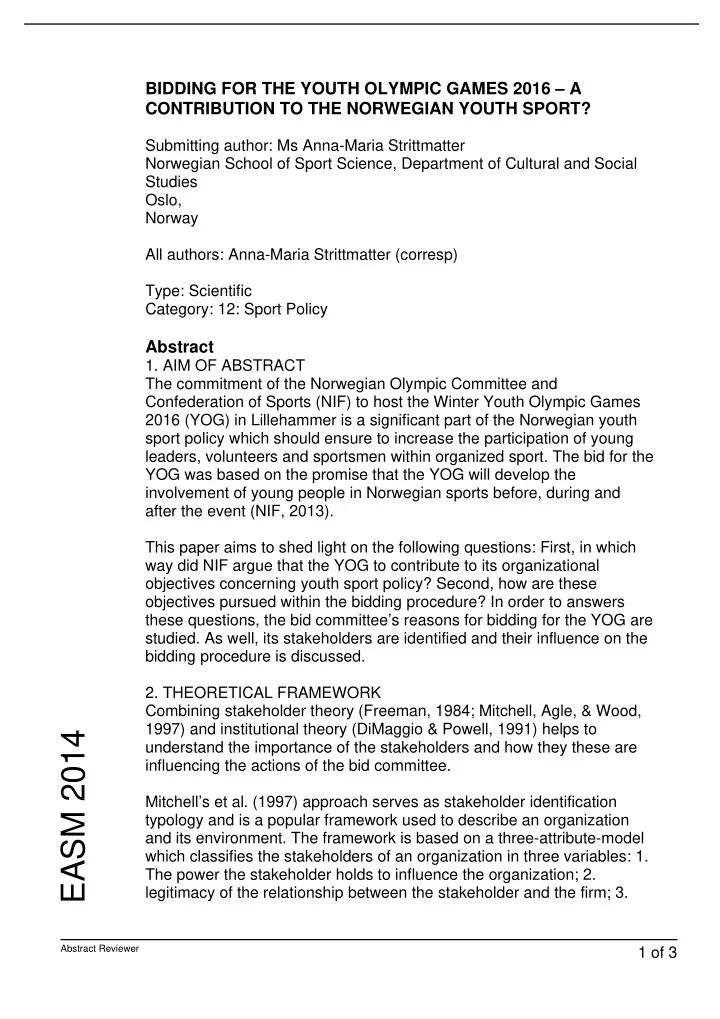
EASM 2014 understand the importance of the stakeholders and how they - - PDF document

easm 2014
SMART_READER_LITE
LIVE PREVIEW

EASM 2014 understand the importance of the stakeholders and how they - - PDF document

BIDDING FOR THE YOUTH OLYMPIC GAMES 2016 A CONTRIBUTION TO THE NORWEGIAN YOUTH SPORT? Submitting author: Ms Anna-Maria Strittmatter Norwegian School of Sport Science, Department of Cultural and Social Studies Oslo, Norway All authors:


slide-1
SLIDE 1

BIDDING FOR THE YOUTH OLYMPIC GAMES 2016 – A CONTRIBUTION TO THE NORWEGIAN YOUTH SPORT?

Submitting author: Ms Anna-Maria Strittmatter Norwegian School of Sport Science, Department of Cultural and Social Studies Oslo, Norway All authors: Anna-Maria Strittmatter (corresp) Type: Scientific Category: 12: Sport Policy

Abstract

  • 1. AIM OF ABSTRACT

The commitment of the Norwegian Olympic Committee and Confederation of Sports (NIF) to host the Winter Youth Olympic Games 2016 (YOG) in Lillehammer is a significant part of the Norwegian youth sport policy which should ensure to increase the participation of young leaders, volunteers and sportsmen within organized sport. The bid for the YOG was based on the promise that the YOG will develop the involvement of young people in Norwegian sports before, during and after the event (NIF, 2013).

  • This paper aims to shed light on the following questions: First, in which

way did NIF argue that the YOG to contribute to its organizational

  • bjectives concerning youth sport policy? Second, how are these
  • bjectives pursued within the bidding procedure? In order to answers

these questions, the bid committee’s reasons for bidding for the YOG are

  • studied. As well, its stakeholders are identified and their influence on the

bidding procedure is discussed.

  • 2. THEORETICAL FRAMEWORK

Combining stakeholder theory (Freeman, 1984; Mitchell, Agle, & Wood, 1997) and institutional theory (DiMaggio & Powell, 1991) helps to understand the importance of the stakeholders and how they these are influencing the actions of the bid committee.

  • Mitchell’s et al. (1997) approach serves as stakeholder identification

typology and is a popular framework used to describe an organization and its environment. The framework is based on a three-attribute-model which classifies the stakeholders of an organization in three variables: 1. The power the stakeholder holds to influence the organization; 2. legitimacy of the relationship between the stakeholder and the firm; 3. 1 of 3

Abstract Reviewer

EASM 2014

slide-2
SLIDE 2

The urgency of the claim the stakeholder has on the organization (Mitchell et al., 1997). The stakeholder’s salience is increasing parallel with the numbers of attributes they possess (Mitchell et al., 1997).

  • The institutional theoretical framework (DiMaggio & Powell, 1991) serves

to explain the external and internal pressures the bid committee experienced as well as the process of resistance and challenges of

  • rganizations. Furthermore, it helps to describe the position of an
  • rganization within a social structure and to understand pressure on an
  • rganization. According to Di Maggio & Powell (1991), organizations

undergo isomorphic processes: 1) coercive isomorphism which appears when organizations are influenced by pressure on institutions their resources are dependent on, such as non-profit organizations; 2) mimetic isomorphism occurs when organization follow other actors due to uncertainty of how to behave; 3) normative isomorphism can appear through expertise in the network (DiMaggio & Powell, 1991).

  • By combining these two theories this paper will discuss how the

stakeholders use their salient positions in order to pursue their goals within the bid committee as well as how the NIF is coping with these institutional pressures in regard of fulfilling their own goals.

  • 3. METHODOLOGY

The data collection of this research is based on multiple sources of information including analysis of archival material and participant

  • bservation in meetings concerning the Lillehammer bid for the YOG,

whereas interviews with representatives of the bid committee and stakeholders serve as the most important source of information. The time frame of the existence of the bid committee is used as case. Applying the analytic tactic of Miles & Hubermann (1994), the data were firstly coded inductively, which correspondents to an descriptive, open coding followed by a deductive coding which is based on the theoretical frameworks mentioned above.

  • 4. RESULTS, DISCUSSION AND CONLUSION

Since this research is still in data interpretation stage valid results could not have been identified by the time of submission. But the data collection is almost completed, so the results will surely be presented at the EASM 2014 conference. From the data that have been gathered until now, one can implicate the following findings: The stakeholders with political and financial influence have been the most salient to the YOG. As well, the educational institutions were important actors for setting together the requirements of the IOC concerning the program of the YOG.

  • The intention for future research based on this article is to see if and how

the youth will be involved in the planning and implementing phase of the

  • YOG. The degree of the stakeholder’s salience, as well as the

2 of 3

Abstract Reviewer

EASM 2014

slide-3
SLIDE 3

institutional pressures is changing as the committee develops within its lifecycle: from the bid committee to organization committee. It is interesting to examine how the degree of influence by the different stakeholders on the committee is changing over time.

References

DiMaggio, P., & Powell, W. W. (1991). The Iron Cage revisited: Institutional isomorphism and collective rationality. In P. DiMaggio & W.

  • W. Powell (Eds.), The New Institutionalism in Organizational Analysis

(pp. 63-82). Chicago: University of Chicago Press.

  • Freeman, R. E. (1984). Strategic management: a stakeholder approach.

Boston: Pitman.

  • Miles, M. B., & Huberman, A. M. (1994). Qualitative data analysis: an

expanded sourcebook. Thousand Oaks, Calif.: Sage.

  • Mitchell, R. K., Agle, B. R., & Wood, D. J. (1997). Toward a Theory of

Stakeholder Identification and Salience: Defining the Principle of who and What Really Counts. Academy of Management Review, 22(4), 853- 886.

  • NIF. (2013). Annual Report 2012 "Årsrapport 2012". Oslo: Norwegian

Olympic and Paralympic Committee and Confederation of Sports . 3 of 3

Abstract Reviewer

EASM 2014