
SLIDE 1
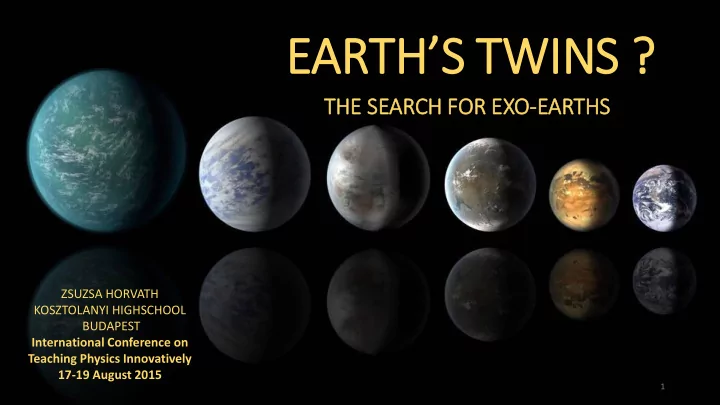
EARTH’S TWINS ?
THE SEARCH FOR EXO-EARTHS
ZSUZSA HORVATH KOSZTOLANYI HIGHSCHOOL BUDAPEST International Conference on Teaching Physics Innovatively 17-19 August 2015
1
EARTHS TWINS ? THE SEARCH FOR EXO-EARTHS ZSUZSA HORVATH - - PowerPoint PPT Presentation
EARTHS TWINS ? THE SEARCH FOR EXO-EARTHS ZSUZSA HORVATH KOSZTOLANYI HIGHSCHOOL BUDAPEST International Conference on Teaching Physics Innovatively 17-19 August 2015 1 Earth and Mars 2 ARE WE ALONE IN THE UNIVERSE? Are Earth-size
THE SEARCH FOR EXO-EARTHS
ZSUZSA HORVATH KOSZTOLANYI HIGHSCHOOL BUDAPEST International Conference on Teaching Physics Innovatively 17-19 August 2015
1
2
Is there life beyond Earth? Where is everybody?(Enrico Fermi) Will we find intelligent life? What is life? Could we detect life? How did life evolve on the Earth? What makes a world habitable? Can we live in elsewhere in the universe? How did the Solar System form? How many alien solar systems have been found so far? What fractions of stars host planets? Are Earth-size planets in the habitable zone of stars common or rare in our galaxy? What are the most important exoplanet discoveries so far? What is the nearest exoplanet to Earth and our solar system? Are there Earth-like planets around our nearest stellar neighbor? What is the shortest distance between an exoplanet and its parent or host star so far? What is the strongest surface gravity for an exoplanet so far? …
3
4
5
Imaging
Radial velocity (Spectroscopic method) Transit method Gravitational microlensing Astrometry, Pulsar timing and others
6
7
The radial velocity graph of 51 Pegasi
8
Artist’s concept of 51 Pegasi b, the first exoplanet detected around Sun- like star (1995) Image via Dr. Seth Shostac/SPL
9
10
11
12
13
14
15
TESS (2017) Transiting Extrasolar Survey Satelitte CHEOPS (2017) Characterizing ExOPlanet Satellite PLATO (2024) Planetary Transits and Oscillations of stars JWST (2018) James Webb Space Telescope
17
(PlanetQuest Interactive, NASA)
18
http://www.planethunters.org http://planetquest.jpl.nasa.gov/interactives http://eyes.jpl.nasa.gov/eyes-on-exoplanets.html
"I believe we are going to have strong indications of life beyond Earth in the next decade and definitive evidence in the next 10 to 20 years," "We know where to look, we know how to look, and in most cases we have the technology," Ellen Stofan, chief scientist for the National Aeronautics and Space Administration
20
21
http://kepler.nasa.gov/ http://planetquest.jpl.nasa.gov/science http://lcogt.net/spacebook/exoplanets/ http://exoplanet.eu/catalog/ http://phl.upr.edu/projects/habitable-exoplanets-catalog
22