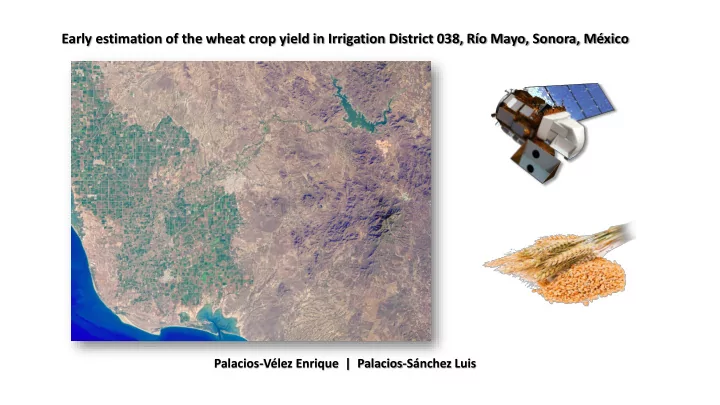
SLIDE 1
Early estimation of the wheat crop yield in Irrigation District 038, Río Mayo, Sonora, México
Palacios-Vélez Enrique | Palacios-Sánchez Luis
SLIDE 2
In Report No. 28 of the International Water Management Institute (IWMI), related with the evaluation of irrigated area in the Bhakra irrigation system in India, using remote sensing and geographic information systems (GIS), a classification of the productivity of the land was made by using satellite images with which the values of the Normalized Difference Vegetation Index (NDVI) are calculated, and they are related with yields from the wheat crop, which dominates this irrigation system of 1.3 million hectares. India wheat
Study background
SLIDE 3
Report result map:
Study background
Yield = 10.99 * NDVI – 3.75 with R2 = 0.8594 S.E. = 0.217 t/ha
SLIDE 4
Relation between yield and NDVI
Yield = 12.88 * NDVI - 4.130 with R2 = 0.873 S.E. = 0.495 t/ha Mexico wheat In Mexico we have found similar relationships between NDVI values calculated from Landsat during flowering and yield of wheat and barley. The function obtained in irrigation district Río Mayo shows:
SLIDE 5
Other conditions
Although the aforementioned relationship between the value of NDVI during bloom and yield has some validity, it has been observed that is not enough, because weather changes during its development, can affect yield. During the monitoring of the development of wheat cultivation in the Irrigation District of Río Mayo this year, a high NDVI during bloom was observed, but crop yield was lower than in previous years.
SLIDE 6 Other conditions
Ripening wheat in the current year was presented about 30 days earlier than in other years, whereby the amount
energy received by the crop was not enough for adequate grain growth. The energy used by the crop, can be estimated based
the accumulated temperature to each phenological stage of development, called Growing Degree Day (Celsius degrees).
SLIDE 7
Other conditions
The figure shows how changes the NDVI in the development of sorghum in accordance with the cumulative growing degree days.
SLIDE 8
Module 15 of irrigation district case
In Río Mayo irrigation district cumulative degree days was calculated, according to the date of the satellite pass and respective average of NDVI for all plots with wheat for the past three years and also the average wheat yield in Module 15. The values of the cumulative degree days for each date of maximum NDVI and its relation to yields are shown in the figures. In the right figure a linear relationship between GDD and yield is shown.
SLIDE 9 Results
During the last three agricultural cycles: 2012-2013, 2013-2014 and 2014-2015, measurements were made of the wheat yield through sampling in several of the district’s irrigation modules, where this crop predominates, occupying between 75 % and 80 % of the module’s area.
Year Max NDVI
- GDD. total Yield. t/ha Max Day NDVI
GDD Max Val. 2013 0.89 2331 6.91 128 1663 2014 0.73 2169 6.62 144 1573 2015 0.77 1809 5.19 96 1180 Information on Module 15
SLIDE 10
Results
Module Year GDD at NDVI max Total GDD Yield t/ha Yield dif. Mod_05 2014 1573 2169 6.24 Mod_05 2015 1006 1678 4.81 1.43 Mod_06 2014 1573 2463 6.51 Mod_06 2015 1180 1809 5.42 1.09 Mod_10 2014 2046 2464 7.08 Mod_10 2015 1180 1921 5.19 1.89 Mod_13 2014 1573 2464 6.83 Mod_13 2015 1180 1809 4.68 2.15 Mod_15 2014 1573 2169 6.62 Mod_15 2015 1180 1809 5.19 1.43
Information about the yield variation in 5 Modules in last two years
SLIDE 11 Modeling crop development
1 2 3 4 5 6 7 8 20 40 60 80 100 120 140 160 180
Cumulative NDVI Days from sowing
Plot 4572 in Irrigation District 038, Río Mayo (2011)
NDVI Gompertz Logistic
y y Y k dt dy
m
) (
y
Lny LnY k dt dy
m
) exp( 1 ct y y Y Y y
m m
) exp( 1 ct b a y
Logistic
) exp( exp ct b a y
) exp( 1 ct b a y b Ln c tm 1 1
c b tm
Gompertz
) exp( exp kt b Y y
m
) exp( exp ct b a y
SLIDE 12 Results
0.202 = E. S. 0.9916, = ) * 0298 . exp( * 638 . 33 1 479 . 5
2
R con t y
128 . . . , 994 . ) * 035 . exp( * 137 . 40 1 672 . 4
2
E S R con t y 201 . . . , 989 . ) * 032 . exp( * 769 . 11 1 105 . 5
2
E S R con t y
2013 2014 2015
The longer the crop lasts, there was higher yield; it should be noted that in 2013, there was a longer duration of the crop than in 2015, and in 2014 it can be appreciated that there is an intermediate value.
SLIDE 13 Results
In the figures it can be seen that the growth rates in years 2013 and 2014 show certain similarities, with the variant of a higher maximum value in 2013; however, it is evident that the 2015 curve is completely out of phase, the maximum value happened prematurely, which agrees with the position
- f the NDVI values of the images
SLIDE 14
Conclusions
It can be concluded that under “normal” meteorological conditions, an estimate of the yield value can be made based on the maximum NDVI value observed, which generally agrees with the time when anthesis happens, or flowering of the crop. However, a very fast growth of the biomass does not allow accumulating enough energy and, therefore, a decrease in yield can be expected, which could be proportional to the deviation observed in cumulated GDD and even simply in days, with regard to the more frequent or “normal” value. Thus, an early estimation of the yield could be performed based on the maximum level of the NDVI, corrected in function of the date of its presentation, which allows evaluating the heat units accumulated. ¡ THANKS VERY MUCH !