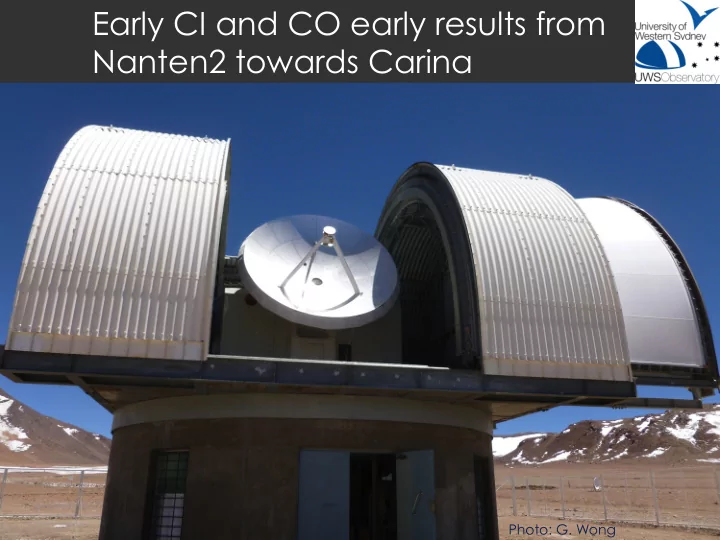
SLIDE 1 Early CI and CO early results from Nanten2 towards Carina
Photo: G. Wong
SLIDE 2
Introduction
¤ Carina
¤ What is it? ¤ Why are we observing it?
¤ Observations done towards the region ¤ Comparing Spectra to previous observations
SLIDE 3
The Carina Nebula
SLIDE 4
What is it?
¤ Also known as the Great Nebula in Carina, the Eta Carina Nebula, or NGC 3372, as well as "Grand Nebula” ¤ Extreme stellar population (distance ~2.3 kpc of the sun). ¤ Evaporating the gas and dust reservoirs which young stars are trying to accrete. ¤ Up until recently, mid-1990s, Carina was viewed as an evolved HII region devoid of active star formation. ¤ Formation occurring on the edges of the nebula.
SLIDE 5 Why study it?
¤ Carina Nebular (NGC 3372) ideal location to study:
¤ Formation of stars (low and high mass) ¤ Stars being formed in molecular clouds about 5-10pc away from massive stars (Eta Carinae and HD 93129A) ¤ UV radiation and stellar winds ¤ An environment that will change rapidly when massive stars go supernova (1-2Myr) and form a giant superbubble
¤ Different stages of star formation has been observed in this region. ¤ Only can be observed in the Southern Hemisphere. ¤ Ionised hydrogen ¤ Atomic Carbon
SLIDE 6 What lines do we observe?
¤ CI 3P1-3P0 492 GHz 37 arcsec = 0.010 deg ¤ CI 3P2-3P1 809 GHz 22 arcsec ¤ CO J=4-3 460 GHz 39 arcsec = 0.011 deg ¤ CO J=7-6 806 GHz 22 arcsec = 0.006 deg ¤ Started observations in CI 3P1-3P0 (492 GHz) and more recently CO 4-3 (460 GHz) ¤ For more information: http://www.astro.uni-koeln.de/nanten2/node/173
SLIDE 7 12 CO 1-0 image
taken from Mopra. Overlaid with footprints for
NANTEN2.
SLIDE 8
Water Vapor
SLIDE 9 12CO 1-0 (Mopra)
CO 4-3 (Nanten2)
SLIDE 10 12CO 1-0 (Mopra)
2008: CO 4-3 (Nanten2) 2013: CO 4-3 (Nanten2)
SLIDE 11 12CO 1-0
(Mopra) CI 1-0 (Nanten2)
SLIDE 12 12CO 1-0
(Mopra) 2008: CI 4-3 (green & black) 2013: CI 4-3 (blue)
SLIDE 13
WARNING! Scaling needed!
SLIDE 14
Sample spectra 12CO 2-1
SLIDE 15
Sample spectra 2008 – CO4-3 CI 1-0
SLIDE 16
Spectra 2013, 2014 – CO4-3 CI 1-0
SLIDE 17
Next Steps
¤ Carina CI (3P1-3P0) and CO (4-3)
¤ check observed tiles ¤ Scaling factor ¤ check observed tiles ¤ Comparisons to previous observation
¤ Other observations! - Musca dark lane
¤ Collaboration with Nagoya Uni (Kengo Tachihara) ¤ CI (3P1-3P0) and CO (4-3) ¤ Compliment Nanten2 and Mopra observations ¤ Files uploaded to SMART and Wiki created
SLIDE 18