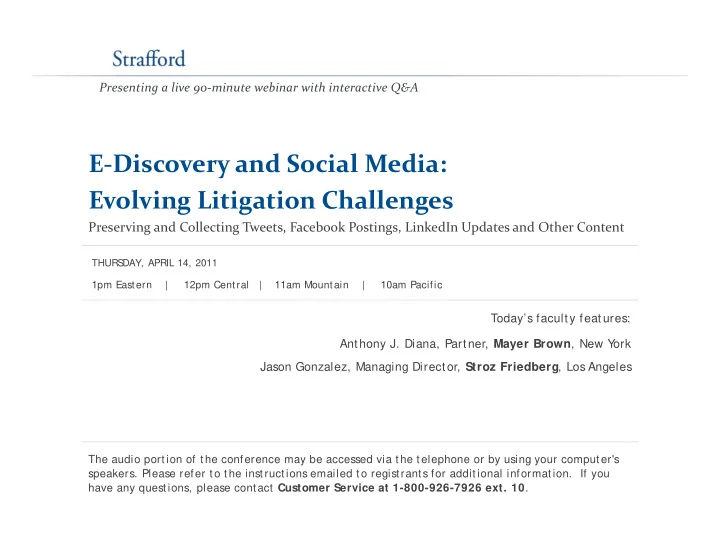
E Discovery and Social Media: y Evolving Litigation Challenges - - PowerPoint PPT Presentation

e discovery and social media y evolving litigation
SMART_READER_LITE
LIVE PREVIEW

E Discovery and Social Media: y Evolving Litigation Challenges - - PowerPoint PPT Presentation

Presenting a live 90 minute webinar with interactive Q&A E Discovery and Social Media: y Evolving Litigation Challenges Preserving and Collecting Tweets, Facebook Postings, LinkedIn Updates and Other Content THURS DAY, APRIL 14, 2011


slide-1
SLIDE 1

Presenting a live 90‐minute webinar with interactive Q&A

E‐Discovery and Social Media: y Evolving Litigation Challenges

Preserving and Collecting Tweets, Facebook Postings, LinkedIn Updates and Other Content

T d ’ f l f

1pm Eastern | 12pm Central | 11am Mountain | 10am Pacific THURS DAY, APRIL 14, 2011

Today’s faculty features: Anthony J. Diana, Partner, Mayer Brown, New Y

  • rk

Jason Gonzalez, Managing Director, Stroz Friedberg, Los Angeles

The audio portion of the conference may be accessed via the telephone or by using your computer's

  • speakers. Please refer to the instructions emailed to registrants for additional information. If you

have any questions, please contact Customer Service at 1-800-926-7926 ext. 10.

slide-2
SLIDE 2

Conference Materials

If you have not printed the conference materials for this program, please complete the following steps:

  • Click on the + sign next to “ Conference Materials” in the middle of the left-

hand column on your screen hand column on your screen.

  • Click on the tab labeled “ Handouts” that appears, and there you will see a

PDF of the slides for today's program.

  • Double click on the PDF and a separate page will open.

Double click on the PDF and a separate page will open.

  • Print the slides by clicking on the printer icon.
slide-3
SLIDE 3

Continuing Education Credits

FOR LIVE EVENT ONLY

For CLE purposes, please let us know how many people are listening at your location by completing each of the following steps:

  • Close the notification box
  • In the chat box, type (1) your company name and (2) the number of

attendees at your location

  • Click the blue icon beside the box to send
slide-4
SLIDE 4

Tips for Optimal Quality

S d Q lit S

  • und Quality

If you are listening via your computer speakers, please note that the quality of your sound will vary depending on the speed and quality of your internet connection. If the sound quality is not satisfactory and you are listening via your computer speakers, you may listen via the phone: dial 1-866-873-1442 and enter your PIN when prompted Otherwise please send us a chat or e mail when prompted. Otherwise, please send us a chat or e-mail sound@ straffordpub.com immediately so we can address the problem. If you dialed in and have any difficulties during the call, press *0 for assistance.

Viewing Qualit y

To maximize your screen, press the F11 key on your keyboard. To exit full screen, press the F11 key again press the F11 key again.

slide-5
SLIDE 5

S i l M di R l ti Social Media Revolution

E‐Discovery and Social Media: Evolving Litigation Challenges

Anthony Diana, Mayer Brown Jason Gonzalez, Stroz Friedberg April 14, 2011

Mayer Brown is a global legal services organization comprising legal practices that are separate entities ("Mayer Brown Practices"). The Mayer Brown Practices are: Mayer Brown LLP, a limited liability partnership established in the United States; Mayer Brown International LLP, a limited liability partnership incorporated in England and Wales; Mayer Brown JSM, a Hong Kong partnership, and its associated entities in Asia; and Tauil & Chequer Advogados, a Brazilian law partnership with which Mayer Brown is associated. "Mayer Brown" and the Mayer Brown logo are the trademarks of the Mayer Brown Practices in their respective jurisdictions.

slide-6
SLIDE 6

E‐DISCOVERY AND SOCIAL MEDIA: EVOLVING LITIGATION CHALLENGES

  • AGENDA

– What Is Social Media? – How Can Social Media Be Used in Litigation and Government g Investigations? – What Are the Challenges for Proper Preservation and Forensic C ll ti f S i l M di ? Collection of Social Media? – How Can Social Media Impact a Litigation/Investigation Response Plan? p – What Are the Likely Future Developments for Social Media and its Use in Litigation/Investigations?

6

slide-7
SLIDE 7

WHAT IS SOCIAL MEDIA?

  • Social Media

– Interactive

  • Types of social media

– Facebook – Web‐based – Communications with many – Twitter – LinkedIn y people

  • Categories of social media

– Blogs – Organization‐sponsored,

  • utwardly‐facing, sites

– Internal sites, blogs, work spaces – Employees’ personal sites Employees personal sites

7

slide-8
SLIDE 8

The History Of Social Networks

Niche D ti Sit Dating Sites Open Communities Communities

The User Has Always

User Homepages

The User Has Always Determined the Content

8

slide-9
SLIDE 9

Social Network Demographics

Twitter

0‐17 18‐24

Usage by Age

Facebook MySpace LinkedIn

25‐34 35‐44 45‐54 55‐64

Social Network Usage By Country Home & Work

Country Time per Person (hh:mm:ss)

0% 50% 100%

65+

Usage by Gender

(hh:mm:ss) Average 5:27:33 Italy 6:27:53 Australia 6:25:21 United States 6:02:34

30 40 50 60 70

Male

Usage by Gender

United Kingdom 5:50:56 Spain 4:50:49 Brazil 4:27:54 France 4:12:01

10 20 30

Female

Germany 3:47:24 Switzerland 3:26:00 Japan 2:37:07

Source: The Nielsen Company Source: Google Ad Planner

9

slide-10
SLIDE 10

WHAT IS SOCIAL MEDIA?

  • Why so powerful?

– Reach – Credibility Credibility

  • Nielsen study found that 70% of internet users trust online

recommendations

– Interactivity Interactivity – Speed and ease of use – Type of information available

  • Digital word‐of‐mouth marketing is expected to top $3

billion by 2013 y

10

slide-11
SLIDE 11

HOW CAN SOCIAL MEDIA BE USED IN LITIGATION AND GOVERNMENT INVESTIGATIONS?

  • Sponsored External Sites

Evidence of communications with customers – Evidence of communications with customers

  • False Advertising Claims
  • Securities Fraud Claims
  • “Records” for regulatory purposes

– Evidence relating to employees or potential employees

  • Employment‐related litigation
  • Employment decisions

– Evidence of an Organization’s Self‐Image

  • Themes or narrative
  • Punitive damages

11

slide-12
SLIDE 12

HOW CAN SOCIAL MEDIA BE USED IN LITIGATION AND GOVERNMENT INVESTIGATIONS?

  • Internal Sites

Evidence of communications with and among employees – Evidence of communications with and among employees

  • Employment litigation (discrimination, workers comp, hiring and firing

decisions, etc.)

  • State of mind: intent, fraud, negligence, conspiracy
  • Admissions

12

slide-13
SLIDE 13

HOW CAN SOCIAL MEDIA BE USED IN LITIGATION AND GOVERNMENT INVESTIGATIONS?

  • Personal Sites

– Evidence of time and place

  • Criminal cases

– Evidence of actions

  • Divorce
  • Employment

– Evidence of communications

  • Employment litigation
  • State of mind: intent, fraud, negligence, conspiracy
  • Admissions

– Evidence of bias

  • Jury Section

13

slide-14
SLIDE 14

Taxonomy Of Data

1

  • Service Data: what you provide (name, age, credit card #)

2

  • Disclosed Data: what you post (updates, tweets, photos)

E t t d D t h t t th l ’ 3

  • Entrusted Data: what you post on other people’s pages
  • Incidental Data: what others post about you

4 Incidental Data: what others post about you 5

  • Behavioral Data: info about your friends, likes, habits

5 6

  • Derived Data: algorithmic inferences about you

6

Schneier, Bruce. “A Taxonomy of Social Networking Data.” IEEE Security & Privacy. July/August 2010.

14

slide-15
SLIDE 15

The Big Three

Li k t Oth U Links to Other Users Public Messages P i M Private Messages Chat h Photos Biographical Information Affiliations File Sharing Geolocation

15

slide-16
SLIDE 16

Geolocation

16

slide-17
SLIDE 17

Geolocation Considerations

Approximate Locations

C b 300

  • Can be over 300 meters away

Easily Falsified y

  • Requires limited coding

You are Here …?

17

slide-18
SLIDE 18

Investigating Anonymous Comments

Traditional Technique of Following the Subpoena Chain

Web

Traditional Technique of Following the Subpoena Chain

Web Forum

ISP

Internet

Subscribers

Id ifi bl A h E Identifiable Accounts that Escape Anonymizers

18

slide-19
SLIDE 19

Identification of Evidence Online Preservation Preservation Desktop and L t Subpoenas Laptops to Sites Mobile Phones Computer Memory Phones Search Engine C h Memory Caches

19

slide-20
SLIDE 20

Evidence Gathering

Twitter Linked‐In Facebook

HTML

YouTube

/

  • Full Featured

API

  • HTML

Capture

  • Check for

Dynamic

  • HTML

capture

  • A/V

Capture

  • A/V

Capture

  • Custom

Scripts

Dynamic Content

Scripts

20

slide-21
SLIDE 21

Evidence Gathering From Hard Drives

File carving for “text”:” and }]} Searching for UIDs Si K ’ E S i t Simon Key’s EnScript Internet Evidence Finder Internet Evidence Finder

21

slide-22
SLIDE 22

Evidence Gathering From Smartphones

Links to

Facebook

Facebook

Photographs

Facebook UIDs

Facebook iPhone Database

Facebook Friends’ First & Last Names UIDs Names

AppDomain‐com.facebook.Facebook‐Documents/friends.db

22

slide-23
SLIDE 23

Authenticating Under 901(a)

“The requirement of authentication or identification diti d t t d i ibilit as a condition precedent to admissibility is satisfied by evidence sufficient to support a finding that the matter in question is what its proponent claims.”

23

slide-24
SLIDE 24

Laying A Foundation For Authentication

  • Trace originating IP back to subject’s computer
  • Obtain subscriber information for the subject account
  • Tie sent items to a smartphone
  • Time‐line communications to book‐end subject

communication

  • Get data for timeline from on‐line repository or forensic

review of hard drive, smartphone

  • Establish password‐protected nature of the account
  • Party to a communication testifies as to authenticity

24

slide-25
SLIDE 25

The Right To Privacy Settings

Crispin v. Christian Audigier Inc., 2010 U.S. Dist. Lexis 52832 (C.D. Calif. May 26, 2010) Employer sought to make use of messages on Facebook, MySpace and

  • ther sites from the employee about the
  • employer. Federal judge ruled that one

to one messages are considered private and that “wall postings” may be considered private depending on the privacy settings. Since Crispin’s privacy p y g p p y settings were set to allow only friends to view his postings, they are considered as private as email. The court used the 1986 law, the Electronic Communications “Old electronic communications laws mixed with cutting edge electronic communication on social networking sites mean that individual judges , Privacy Act, to determine the privacy implications of the messages. The decision required the judge to place current technology into a 1980s j g have wide leeway in determining what online is private and what’s not.”

Hill, Kashmir. “Do Your Social Networking Privacy Settings Matter If You Get Sued?” Forbes com blogs: The Not So Private Parts 27

current technology into a 1980s framework of digital communications.

If You Get Sued? Forbes.com blogs: The Not‐So Private Parts. 27

  • Sept. 2010.

25

slide-26
SLIDE 26

The Right To Privacy Settings

Romano v. Steelcase Inc., 2010 WL 3703242 (N.Y. Sup. Ct. Sept. 21, 2010) Romano fell off a Steelcase Inc. office chair and claimed injuries that prevented her from work and leisure activities. Information publically prevented her from work and leisure activities. Information publically available on social networking sites countered statements made by

  • Romano. Defendant, Steelcase Inc., sought to discover messages and

postings from Facebook and MySpace. Romano responded that those communications were protected as they were private. The Judge ruled that “Plaintiffs who place their physical condition in controversy, may not shield from disclosure material which is necessary to the defense f ” ( )

  • f the action.” Present and historical (deleted) messages were

deemed discoverable.

26

slide-27
SLIDE 27

How Can Social Media Impact A Litigation/ Investigation Response Plan? g / g p

  • Controlling the information

– Creation and implementation of social media policy

  • External‐sponsored, internal and personal

C i i h l i

  • Consistent with regulations

– FINRA Guidance on Blogs and Social Networking Web Sites (Jan 2010) – FDA call for Comments: Promotion of FDA‐Regulated Medical FDA call for Comments: Promotion of FDA Regulated Medical Products Using the Internet and Social Media Tools (Sept 2009) – SEC Release No. 34‐58288

  • Consistent with privacy concerns
  • Need input from Legal, Compliance, Information Security, Records

Management, Human Resources, Marketing and Business

27

slide-28
SLIDE 28

How Can Social Media Impact A Litigation/ Investigation Response Plan? g / g p

  • Controlling the information

– Enforcement and monitoring

  • Effective procedures

h l

  • Technology
  • Consequences for breach of policies

28

slide-29
SLIDE 29

How Can Social Media Impact A Litigation/ Investigation Response Plan? g / g p

  • Develop a legal hold plan that includes social media

– Guidelines for when to preserve social media sites

  • Reasonably anticipate litigation/filing of complaint/investigation

l

  • Relevance
  • Evergreen holds (newly created modifications to sites)
  • Personal sites

Personal sites – Privacy concerns

– Procedures for preserving social media sites

  • Snapshots and backups
  • Notice to third‐party providers
  • Control over employees

29

slide-30
SLIDE 30

How Can Social Media Impact A Litigation/ Investigation Response Plan? g / g p

  • Collection and production of social media

– Challenges and burdens

  • Lack of legal guidance

L k f h i l

  • Lack of technical support

– Indexing – Searching Searching – “Forensic collections”

  • Difficulties in reviewing for relevance
  • Privacy issues with personal sites—limiting collection to relevant

information

30

slide-31
SLIDE 31

What Are The Likely Future Developments For Social Media And Its Use In Litigation/ Investigations? g / g

  • Key source of evidence in all types of litigations and

investigations investigations

  • Law will always be a step behind technology—so increased

legal risk legal risk

  • Technology developed to help with monitoring,

compliance preservation and production compliance, preservation and production

  • Privacy laws and information security, particularly when

involving foreign data becoming more important in involving foreign data, becoming more important in litigations and investigations

31

slide-32
SLIDE 32

Contact Information

Anthony Diana Anthony Diana

Mayer Brown LLP

adiana@mayerbrown.com

Jason Gonzalez

Stroz Friedberg LLC

jgonzalez@strozfriedberg.com

32