
SLIDE 1
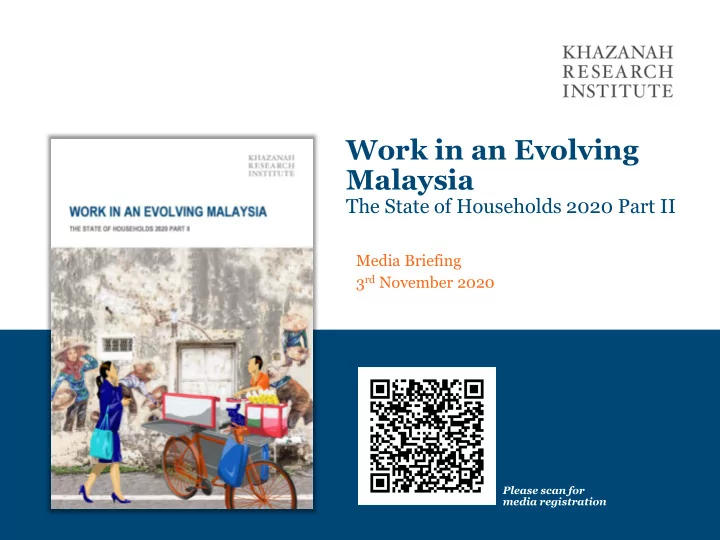
Work in an Evolving Malaysia
The State of Households 2020 Part II
Media Briefing 3rd November 2020
Please scan for media registration
Work in an Evolving Malaysia The State of Households 2020 Part II - - PowerPoint PPT Presentation
Work in an Evolving Malaysia The State of Households 2020 Part II Media Briefing 3 rd November 2020 Please scan for media registration WORK IN AN EVOLVING MALAYSIA THE STATE OF HOUSEHOLDS 2020 PART II Please scan for media MEDIA BRIEFING
Media Briefing 3rd November 2020
Please scan for media registration
Khazanah Research Institute
THE STATE OF HOUSEHOLDS 2020 PART II MEDIA BRIEFING
Scan here for press release, full report and accompanying materials
10:00AM Opening remarks
by Tan Sri Nor Mohamed Yakcop, Chairman of KRI
10:15AM Presentation of Key Findings
from Work in an Evolving Malaysia by Siti Aiysyah Tumin, Nur Thuraya Sazali and Hawati Abdul Hamid, Researchers at KRI
10:45AM Q&A* with Media 11:15AM End
*Journalists can start to type any questions in the Q&A function at the start of presentation to be answered during Q&A session. In the interest of time, we ask that journalists keep to questions related to the Report or KRI. Thank you.
Please scan for media registration
3rd November 2020 Media Briefing
Work in an Evolving Malaysia The State of Households 2020 Part II
3rd November 2020 Media Briefing
Work in an Evolving Malaysia The State of Households 2020 Part II
Khazanah Research Institute Khazanah Research Institute
Khazanah Research Institute
+
Work in an Evolving Malaysia
Share of mean household income, by household head income source, 2012–2019
Note: Data expressed in 2019 prices. Source: DOS (2020b) and KRI Calculations
66.6 65.0 63.0 61.6 17.2 16.0 15.6 17.3 9.7 11.4 12.9 12.9 6.5 7.6 8.5 8.2 0.0 10.0 20.0 30.0 40.0 50.0 60.0 70.0 80.0 90.0 100.0 2012 2014 2016 2019 % Self-employment Paid employment Properties & investment Current transfers
6
Khazanah Research Institute
+
AAGR A: 8.2% B: 7.1 C: 3.5 D: 4.6 MALAYSIA: 6.3 A: 2.5% B: 2.3 C: 2.2 D: 3.8 MALAYSIA: 3.1 A: 5.4% B: 5.7 C: 5.2 D: 5.9 MALAYSIA: 5.6
Work in an Evolving Malaysia
2,552 9,581 1,338 4,239 1,708 5,873 2,000 4,000 6,000 8,000 10,000 1989 1992 1995 1997 1999 2002 2004 2007 2009 2012 2014 2016 2019 RM10,000
Real median monthly household income by state group, 1989–2019
Note: Data expressed in 2019 prices. AAGR stands for average annual growth rate. Source: DOS (2020b), EPU (n.d.c) and KRI calculations
Group C Group A MALAYSIA Group B Group D
KL, Putrajaya & Selangor Johor, Melaka, N. Sembilan, P. Pinang & Terengganu Labuan, Sabah & Sarawak Kedah, Kelantan, Pahang, Perak & Perlis
7
Khazanah Research Institute
+
Work in an Evolving Malaysia Percentage point change in share of mean household income, by source for household head, by state, 2014–2019
Note: A negative percentage point change implies a decrease in the share of an income source and not necessarily a decrease in absolute RM terms. Source: DOS (2017), DOS (2020b), KRI calculations
1.2
Selangor Putrajaya KL
0.8 Sarawak Sabah Labuan 2.9 4.2 2.5 1.8 Perlis Perak Pahang Kelantan Kedah 0.7 1.9 Terengganu P.Pinang N.Sembilan Melaka Johor Paid employment Self-employment Property & investment Current transfers
+4.0 +8.0 ppt
Decreased income share Increased income share 0.0
8
Khazanah Research Institute
+
Work in an Evolving Malaysia
9
State grouping, by household income, 2019
Selangor RM8,210 Sarawak RM4,544 Labuan RM6,726 Sabah RM4,235 Perak RM4,273 Pahang RM4,440 N.Sembilan RM5,005 Terengganu RM5,545 Melaka RM6,054 Johor RM6,427 Kelantan RM3,563 Kedah RM4,325 P.Pinang RM6,169 Perlis RM4,594 KL RM10,549 Putrajaya RM9,983
Sarawak Corridor
Energy Sabah Development Corridor Iskandar Malaysia Northern Corridor Economic Region East Coast Economic Region
Malaysia median: RM 5,873
Regional economic group and median household income, 2019
Note: Economic region based on EPU (2018). Map not to scale. Source: DOS (2020a), KRI classification and calculations
Household income ≥ 30% of national level in 2019, Peninsular states
Group A: KL, Putrajaya & Selangor Group B: Johor, Melaka,
Terengganu Group C:Labuan, Sabah & Sarawak Group D: Kedah, Kelantan, Pahang, Perak & Perlis
Household income ± 20% of national level in 2019, Peninsular states States in East Malaysia Household income below national level in 2019, other states
Periods in Malaysian economic development
Industrialisation, before AFC 1997/98
Period 1: 1989-1997 Period 2: 1999-2007 Period 3: 2009-2019
Deindustrialisation, before GFC 2007/08 Moderated deindustrialisation, after GFC
Khazanah Research Institute Khazanah Research Institute
Khazanah Research Institute
+Work in an Evolving Malaysia
Employment share, by economic activity and state group, 1982 – 2019
Note: Data unavailable for 1991 and 1994. Shaded areas cover Period 1 (1989 to 1997), Period 2 (1999 to 2007) and Period 3 (2009 to 2019) respectively. Source: DOS (2020b), KRI calculations
11
Group C Group A MALAYSIA Group B Group D
KL, Putrajaya & Selangor Johor, Melaka, N. Sembilan, P. Pinang & Terengganu Labuan, Sabah & Sarawak Kedah, Kelantan, Pahang, Perak & Perlis
Agriculture Manufacturing
23.6 10.2 10 20 30 40 50 1982 1987 1993 1999 2004 2009 2014 2019 50% 25.0 17.8 10 20 30 40 1982 1987 1993 1999 2004 2009 2014 2019 40%
Khazanah Research Institute
+Work in an Evolving Malaysia
Note: High-technology manufacturing refers to E&E products and transport equipment. Mid-technology manufacturing refers to manufacturing of petroleum, chemical, rubber, plastic, non-metallic mineral, basic metal and fabricated metal products. Low-technology manufacturing refers to manufacturing of food, beverages, tobacco, textiles, wearing apparel, leather, wood, furniture, paper and printing products. Adapted from Ng, Tan and Tan (2018). Source: DOS (2017a), KRI calculations
12
38.7 37.6 45.7 15.5 33.6 33.4 38.5 30.7 20.3 35.9 27.9 23.9 23.6 64.2 30.5 20 40 60 80 100 MALAYSIA Group A Group B Group C Group D 100%
Group A: KL, Putrajaya & Selangor Group B: Johor, Melaka, N. Sembilan,
Terengganu Group C: Labuan, Sabah & Sarawak Group D: Kedah, Kelantan, Pahang, Perak & Perlis MALAYSIA
36.7 39.7 46.1 5.1 39.4 43.1 37.2 38.0 69.4 41.1 20.2 23.1 15.9 25.6 19.5 20 40 60 80 100 MALAYSIA Group A Group B Group C Group D
Group A: KL, Putrajaya & Selangor Group B: Johor, Melaka, N. Sembilan,
Terengganu Group C: Labuan, Sabah & Sarawak Group D: Kedah, Kelantan, Pahang, Perak & Perlis MALAYSIA
100% Low-tech Mid-tech High-tech
Employment Value added Manufacturing employment and value added share, by subsector and state group, 2015
Khazanah Research Institute
+Work in an Evolving Malaysia
13
Note: Data unavailable for 1991 and 1994. Shaded areas cover Period 1 (1989 to 1997), Period 2 (1999 to 2007) and Period 3 (2009 to 2019) respectively. Source: DOS (2020b), KRI calculations
Modern services Other services
Group C Group A MALAYSIA Group B Group D
KL, Putrajaya & Selangor Johor, Melaka, N. Sembilan, P. Pinang & Terengganu Labuan, Sabah & Sarawak Kedah, Kelantan, Pahang, Perak & Perlis
14.6 6.8 5 10 15 20 1982 1987 1993 1999 2004 2009 2014 2019 20% 59.4 56.1 30 40 50 60 1982 1987 1993 1999 2004 2009 2014 2019 60%
Employment share, by economic activity and state group, 1982 – 2019
Khazanah Research Institute
+Work in an Evolving Malaysia
14
5.5 4.0 4.3 7.4 6.4
0.2
4 8 Malaysia Group A Group B Group C Group D 8 ppt “Traditional services” Wholesale & retail, transportation & storage; admin & support services; accommodation & food;
“Social services” Education; health & social work; public administration, defense & compulsory social services; utility services “Modern services” Finance & insurance; real estate; information & communication; professional, scientific & technical
A: KL, Putrajaya, Selangor B: Johor, Melaka, N. Sembilan, P. Pinang, Terengganu C: Labuan, Sabah, Sarawak D: Kedah, Kelantan, Pahang, Perak, Perlis MALAYSIA
Group A: KL, Putrajaya & Selangor Group B: Johor, Melaka, N. Sembilan,
Terengganu
Group C: Labuan, Sabah & Sarawak Group D: Kedah, Kelantan, Pahang, Perak & Perlis MALAYSIA
Source: DOS (2020b), KRI calculations
Change in services employment share, by subsector and state group, 2009 – 2019
Khazanah Research Institute
+Work in an Evolving Malaysia
Capital formation per GDP share, 1989 – 2019 Annual value added and total wages paid per employment, by firm type, 2015
Note: Shaded areas refer to Period 1 (1989 to 1997), Period 2 (1999 to 2007) and Period 3 (2009 to 2018) respectively. Values displayed in constant RM. Source: World Bank (n.d.b), KRI calculations
15
Source: DOS (2016a), DOS (2017a), KRI calculations
0.0 10.0 20.0 30.0 40.0 50.0 1989 1994 1999 2004 2009 2014 2019 Avg.: 38.2% CAGR: 16.2% Avg.: 23.6% CAGR: 5.8% Avg.: 23.9% CAGR: 6.1% 50% 74 183 23 38 50 100 150 200 SME Large SME Large RM200k Value added per employment Total wages paid per employment
Khazanah Research Institute Khazanah Research Institute
Khazanah Research Institute
+Work in an Evolving Malaysia
Working age population share and LFPR, by state group, 2019 Women’s LFPR by state group, 1982 – 2019
Source: DOS (2017b), DOS (2020b), KRI calculations
17
69.4 71.2 68.9 71.5 66.8 68.7 74.8 67.5 69.3 63.1 55 60 65 70 75 80 MALAYSIA Group A Group B Group C Group D 80% Share of working age population Labour force participation rate
A: KL, Putrajaya, Selangor B: Johor, Melaka,
Terengganu C: Labuan, Sabah, Sarawak D: Kedah, Kelantan, Pahang, Perak, Perlis MALAYSIA
67.7% 55.6% 30% 40% 50% 60% 70% 1982 1987 1993 1999 2004 2009 2014 2019
Note: Data unavailable for 1991 and 1994. Shaded regions cover Period 1 (1989 to 1997), Period 2 (1999 to 2007) and Period 3 (2009 to 2019) respectively. Source: DOS (2020b), KRI calculations A: KL, Putrajaya, Selangor MALAYSIA B: Johor, Melaka, N. Sembilan, P. Pinang, Terengganu C: Labuan, Sabah, Sarawak D: Kedah, Kelantan, Pahang, Perak, Perlis
Khazanah Research Institute
+Work in an Evolving Malaysia
Source: DOS (2020c), KRI calculations
18 Unemployment rate, by demographic characteristic and state group, 2019
3.3 2.8 2.5
4.7 3.2
10.5 10 8.2
12.5 10.9
1.7 1.8 1.4 2.2 1.4 5 10 15 MALAYSIA Group A Group B Group C Group D Overall Youth (15 to 24) Adult (25 to 64) A: KL, Putrajaya, Selangor B: Johor, Melaka,
Terengganu C: Labuan, Sabah, Sarawak D: Kedah, Kelantan, Pahang, Perak, Perlis MALAYSIA 15%
Khazanah Research Institute
+Work in an Evolving Malaysia
Change in employment share, by skill level and state group, 2001 – 2019
Note: Skill classification follows DOS (Various years.c). Source: DOS (2020b), KRI calculations
19
3.2 4.9 4.0
1.7
11.3 1.5
4 8 12 Malaysia Group A Group B Group C Group D
A: Kuala Lumpur, Putrajaya, Selangor B: Johor, Melaka,
Terengganu C: Labuan, Sabah, Sarawak D: Kedah, Kelantan, Pahang, Perak, Perlis
12ppt
MALAYSIA
Low skilled Semi-skilled Skilled
Khazanah Research Institute
+Work in an Evolving Malaysia
Median and mean monthly wages, 2019
Note: Refer to wages of citizens only. Source: DOS (2019f), KRI calculations
20
1,000 2,000 3,000 4,000 5,000 KL Putrajaya Selangor Johor Melaka
Terengganu Labuan Sabah Sarawak Kedah Kelantan Pahang Perak Perlis Median Mean Median Malaysia: RM2,442 RM5,000 Mean Malaysia: RM3,224
Khazanah Research Institute
+Work in an Evolving Malaysia
Share of vulnerable employment, by state group, 1982 – 2019
Note: Data unavailable for 1991 and 1994. Shaded regions cover Period 1 (1989 to 1997), Period 2 (1999 to 2007) and Period 3 (2009 to 2019) respectively. Vulnerable employment includes own account workers and unpaid family workers. Source: ILO (2018b). Source: DOS (2020b), KRI calculations
21
0.0 20.0 40.0 60.0 1982 1987 1993 1999 2004 2009 2014 2019 60% A: KL, Putrajaya, Selangor MALAYSIA B: Johor, Melaka, N. Sembilan,
C: Labuan, Sabah, Sarawak D: Kedah, Kelantan, Pahang, Perak, Perlis
Khazanah Research Institute Khazanah Research Institute
Khazanah Research Institute
+Work in an Evolving Malaysia
Job and wage polarisation, by skill level and occupation, 2011 – 2019
Note: Skill classification follows ILO (n.d.c) and DOS (various years.b). Source: DOS (2020i), DOS (2020b), KRI calculations
23
1.5
0.0
2.6
2.4
0.0 Skilled Semi-skilled Low skilled Managers Professionals
Clerical workers Service & sales workers Skilled agricultural workers Craft workers Production operators Elementary occupations Semi-skilled Skilled Low-skilled 5,073 2,205 1,751 8,855 5,589 3,651 2,482 2,060 2,247 2,197 2,144 1,751 3.9 3.6 5.2 5.6 4.1 3.1 2.9 3.4 5.9 3.9 4.3 5.2 Overall
Change in employment share (ppt, 2011 - 2019 Mean monthly salary (RM, 2019) Annual wage growth (%, 2011 – 2019)
Service & sales workers
Khazanah Research Institute
+Work in an Evolving Malaysia
Employment share versus automation probability, 2016
Source: Data cited in KRI (2018c), methodology based on KRI (2017a), KRI calculations
24
Health professionals Sales … Skilled agricultural workers 10 20 50 100 Employment share (%) Automation probability (%) Skilled Semi-skilled Low skilled
Sales workers
MALAYSIA 50 100 50 100 Adjusted employment share (%) Unadjusted employment share (%)
MALAYSIA Adjusted: 48.8% Unadjusted: 67.8% Estimated employment share susceptible to automation, by selected developing country, latest available year
Note: Grey space indicates that adjusted technological unemployment (TU) is lower than unadjusted TU. Source: World Bank (2016)
Khazanah Research Institute Khazanah Research Institute
Khazanah Research Institute
+Work in an Evolving Malaysia
Automation probability versus jobs that can work from home share and Malaysia’s employment share, by occupation
Note: Automation probability refers to computerisable probability estimated based on US 2013 employment data, jobs that can work from home share estimated based on US 2020 employment data (higher share means the job is more likely to survive Covid-19 as they can continue working from home when countries implement containment measures). Bubble sizes indicate Malaysia’s share of employed persons in 2016. Source: Data cited in KRI (2017a), KRI calculations based on Dingel and Neiman (2020)
26
Teaching professionals Info & communications tech professionals Business and admin professionals General & keyboard clerks Sales workers
20 40 60 80 100 120
20 40 60 80 100 120 140 160 180 Automation probability (%) Jobs that can work from home share (%) Skilled Semi-skilled Low skilled Sample Reference: 5% Employment share (Malaysia)
0% 0%
Sales workers
Khazanah Research Institute
+Work in an Evolving Malaysia
Unemployment rate, by selected country, Q2 2019 and Q2 2020 Share of respondents, by employment status and effects of MCO during Covid-19, March 2020
Note: The second quarterly ended in June, except for the Philippines (July). Source: CEIC (n.d.)
27
Note: Data is not representative. Source: DOS(2020)
46.6 23.8 1.1 50 100 Work from home Leave (paid) Leave (unpaid) Job loss Changing hours No impact 100% Employees Employers Own account workers 5.4 3.3 4.1 3.0 2.4 2.2 1.0 10.0 5.1 4.3 4.0 2.8 2.7 2.0 2 4 6 8 10 12 Philippines MALAYSIA South Korea Singapore Japan Vietnam Thailand Q2 2020 Q2 2019 0% MALAYSIA
Khazanah Research Institute
Unemployment and labour force participation rate, 2019 vs 2020
Source: DOS (2020)
28
68.6 68.5 68.5 68.5 68.5 68.6 68.5 68.6 3.3 3.3 3.4 3.4 3.3 3.3 3.3 3.3 January February Mac April May June July August
2019 Potential reasons (1) people might have to take up any jobs with less hours (2) people might leave the labour market out of discouragement or necessity
68.9 68.7 68.6 68.1 68.0 68.1 68.1 68.4 3.2 3.3 3.9 5.0 5.3 4.9 4.7 4.7 January February Mac April May June July August
2020 Unemployment rate Labour force participation rate
+Work in an Evolving Malaysia
Khazanah Research Institute Khazanah Research Institute
Khazanah Research Institute
+Work in an Evolving Malaysia
30
While most surveyed young workers in Kuala Lumpur earned more than mandated minimum wage level, many still earned below the living wage
Surveyed young employed person share, by earning relative to living wage, Kuala Lumpur, 2018
Note: Real (in 2018 prices) thresholds were applied on surveyed data. Source: KRI (2018b), KRI calculations
Some economic activities remain to be dangerous, although we have seen declining injury rates over time
Fatal injuries per 100,000 workers, by economic activities, 2011 – 2017
5 10 15 20 25 30 2011 2012 2013 2015 2017 Agriculture, forestry and fishing Mining and quarrying Manufacturing Construction Services
Source: ILOSTAT (n.d.), KRI calculations
88 77 52 4 12 23 48 96 50 100 Single (BNM) Single, with a car (EPF) Single, without a car (EPF) Minimum wage Earning below Earning above 0%
Khazanah Research Institute
+Work in an Evolving Malaysia
31
“Opportunities for work that is productive and delivers a fair income, security in the workplace and social protection for families, better prospects for personal development and social integration, freedom for people to express their concerns, organize and participate in the decisions that affect their lives and equality of opportunity and treatment for all women and men.”
International Labor Organization Virtuous cycle of decent work
More decent work Higher earnings Higher savings Higher investment
Rights at work Productive Employment Social Protection Social dialogue
earnings and productive work
work, family and personal life
work
security of work
treatment
security
dialogue, & workplace relations
PILLARS OF DECENT WORK
Source: International Labour Organization, KRI illustration
Khazanah Research Institute
Scan for press release, full report and accompanying materials
+Work in an Evolving Malaysia Media Briefing Please scan for media registration
Khazanah Research Institute
For any follow-up questions, please contact the following KRI researchers: Siti Aiysyah Tumin siti.tumin@KRInstitute.org
Nur Thuraya Sazali thuraya.sazali@KRInstitute.org
Hawati Abdul Hamid hawati.hamid@KRInstitute.org
+Work in an Evolving Malaysia Media Briefing
Scan for press release, full report and accompanying materials
Khazanah Research Institute
+Work in an Evolving Malaysia Media Briefing
@KRInstitute Or Khazanah Research Institute www.KRInstitute.org