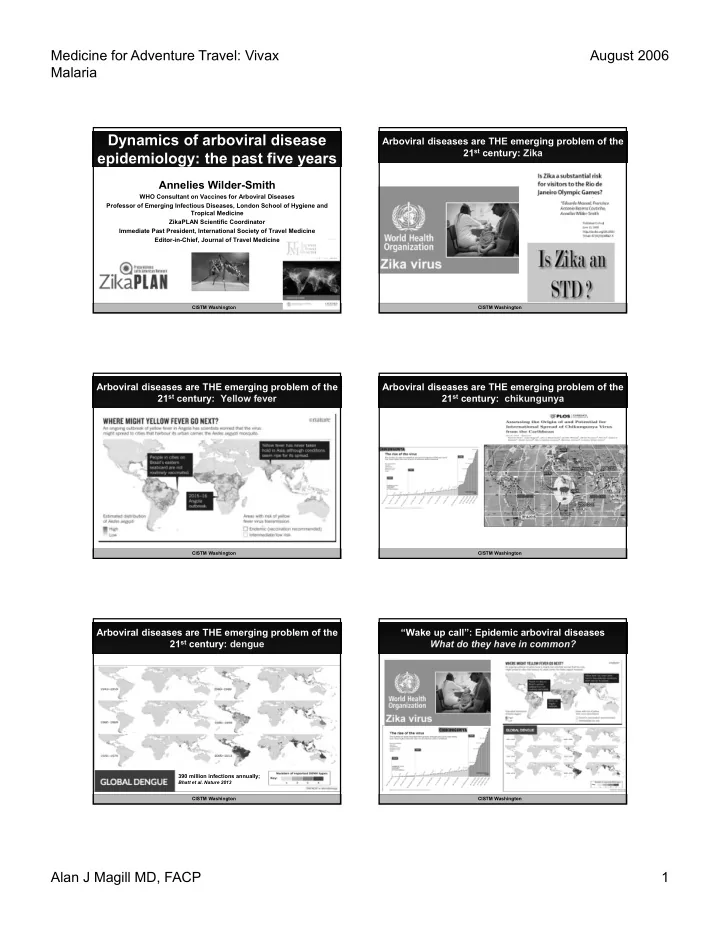
Dynamics of arboviral disease Arboviral diseases are THE emerging - - PDF document

dynamics of arboviral disease
SMART_READER_LITE
LIVE PREVIEW

Dynamics of arboviral disease Arboviral diseases are THE emerging - - PDF document

Medicine for Adventure Travel: Vivax August 2006 Malaria Dynamics of arboviral disease Arboviral diseases are THE emerging problem of the 21 st century: Zika epidemiology: the past five years p gy p y Annelies Wilder-Smith WHO Consultant


slide-1
SLIDE 1

Medicine for Adventure Travel: Vivax Malaria August 2006 Alan J Magill MD, FACP 1

p gy p y Dynamics of arboviral disease epidemiology: the past five years

Annelies Wilder-Smith

WHO Consultant on Vaccines for Arboviral Diseases Professor of Emerging Infectious Diseases, London School of Hygiene and Tropical Medicine ZikaPLAN Scientific Coordinator Immediate Past President, International Society of Travel Medicine Editor-in-Chief, Journal of Travel Medicine

CISTM Washington

Arboviral diseases are THE emerging problem of the 21st century: Zika

CISTM Washington

Arboviral diseases are THE emerging problem of the 21st century: Yellow fever

CISTM Washington

Arboviral diseases are THE emerging problem of the 21st century: chikungunya

CISTM Washington

Arboviral diseases are THE emerging problem of the 21st century: dengue

CISTM Washington

390 million infections annually;

Bhatt et al. Nature 2013

“Wake up call”: Epidemic arboviral diseases What do they have in common?

CISTM Washington

slide-2
SLIDE 2

Medicine for Adventure Travel: Vivax Malaria August 2006 Alan J Magill MD, FACP 2

Aedes

CISTM Washington

Aedes aegypti Aedes albopictus Relative Vectorial Capacity

Liu-Helmersson J, Stenlund H, Wilder-Smith A, Rocklöv J (2014) Vectorial Capacity of Aedes aegypti: Effects of Temperature and Implications for Global Dengue Epidemic Potential. PLoS ONE 9(3): e89783. doi:10.1371/journal.pone.0089783 http://www.plosone.org/article/info:doi/10.1371/journal.pone.0089783

2070-2099 1980-2009

CISTM Washington CISTM Washington

Population growth drives dengue in Singapore

Variable Relative Risk (Relative contribution_ Population growth 42.7 (86%) Mean temperature 1.8 Climate variables combined 7.1 (14%)

CISTM Washington

Population density facilitates transmission Massive urbanization without the appropriate infrastructure

CISTM Washington DengueTools

slide-3
SLIDE 3

Medicine for Adventure Travel: Vivax Malaria August 2006 Alan J Magill MD, FACP 3

Other arboviral diseases

CISTM Washington

West Nile Virus Distribution Pre-1999

CISTM Washington

Current Approximate West Nile Virus Distribution

CISTM Washington CISTM Washington

Japanese Encephalitis

CISTM Washington

  • Culex is the

primary vector

  • Aedes
  • Anopheles

CISTM Washington

slide-4
SLIDE 4

Medicine for Adventure Travel: Vivax Malaria August 2006 Alan J Magill MD, FACP 4 Reasons for the geographic expansion of arboviral diseases

  • Modern transportation (Globalization)
  • Climate change
  • Virus evolution
  • Lack of effective vector control
  • Demographic changes (Population growth and

population densities)

  • Environmental change
  • Socioeconomic factors
  • Unprecedented urban growth

CISTM Washington

What is the next arbovirus outbreak?

E Severity Probability of occurring

Yellow fever Ross River O’nyong nyong

Mayaro

Spondweni Bwamba Rift Valley Japanese encephalitis Sindbis

Flavivirus Alphavirus Bunyaviridae

VEE Wesselsbron Sepik

Edge Hill Usutu Kedougou

Me Tri Tembusu

CISTM Washington CISTM Washington