Dynamic Programming Sequence Of Decisions Sequence of decisions. - - PDF document

dynamic programming sequence of decisions
SMART_READER_LITE
LIVE PREVIEW

Dynamic Programming Sequence Of Decisions Sequence of decisions. - - PDF document

Dynamic Programming Sequence Of Decisions Sequence of decisions. As in the greedy method, the solution to a problem is viewed as the result of a Problem state. sequence of decisions. Principle of optimality. Unlike the


slide-1
SLIDE 1

Dynamic Programming

  • Sequence of decisions.
  • Problem state.
  • Principle of optimality.
  • Dynamic Programming Recurrence

Equations.

  • Solution of recurrence equations.

Sequence Of Decisions

  • As in the greedy method, the solution to a

problem is viewed as the result of a sequence of decisions.

  • Unlike the greedy method, decisions are not

made in a greedy and binding manner.

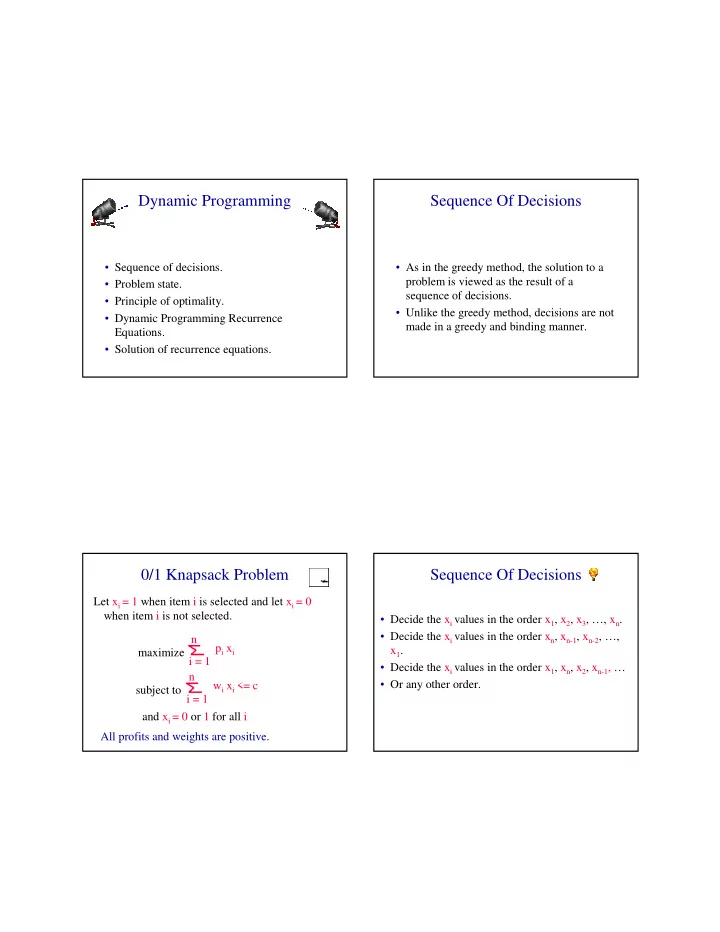
0/1 Knapsack Problem

Let xi = 1 when item i is selected and let xi = 0 when item i is not selected. i = 1 n pi xi maximize i = 1 n wi xi <= c subject to and xi = 0 or 1 for all i All profits and weights are positive.

Sequence Of Decisions

  • Decide the xi values in the order x1, x2, x3, …, xn.
  • Decide the xi values in the order xn, xn-1, xn-2, …,

x1.

  • Decide the xi values in the order x1, xn, x2, xn-1, …
  • Or any other order.
slide-2
SLIDE 2

Problem State

  • The state of the 0/1 knapsack problem is given by

the weights and profits of the available items the capacity of the knapsack

  • When a decision on one of the xi values is made,

the problem state changes.

item i is no longer available the remaining knapsack capacity may be less

Problem State

  • Suppose that decisions are made in the order x1, x2, x3,

…, xn.

  • The initial state of the problem is described by the pair

(1, c).

Items 1 through n are available (the weights, profits and n are implicit). The available knapsack capacity is c.

  • Following the first decision the state becomes one of the

following:

(2, c) … when the decision is to set x1= 0. (2, c-w1) … when the decision is to set x1= 1.

Problem State

  • Suppose that decisions are made in the order xn, xn-1, xn-2,

…, x1.

  • The initial state of the problem is described by the pair

(n, c).

Items 1 through n are available (the weights, profits and first item index are implicit). The available knapsack capacity is c.

  • Following the first decision the state becomes one of the

following:

(n-1, c) … when the decision is to set xn= 0. (n-1, c-wn) … when the decision is to set xn= 1.

Principle Of Optimality

  • An optimal solution satisfies the following

property:

No matter what the first decision, the remaining decisions are optimal with respect to the state that results from this decision.

  • Dynamic programming may be used only when

the principle of optimality holds.

slide-3
SLIDE 3

0/1 Knapsack Problem

  • Suppose that decisions are made in the order x1,

x2, x3, …, xn.

  • Let x1= a1, x2 = a2, x3 = a3, …, xn = an be an
  • ptimal solution.
  • If a1 = 0, then following the first decision the state

is (2, c).

  • a2, a3, …, an must be an optimal solution to the

knapsack instance given by the state (2,c).

x1 = a1 = 0

  • If not, this instance has a better solution b2, b3,

…, bn. i = 2 n pi xi maximize i = 2 n wi xi <= c subject to and xi = 0 or 1 for all i i = 2 n pi bi > i = 2 n pi ai

x1 = a1 = 0

  • x1= a1, x2 = b2, x3 = b3, …, xn= bn is a better

solution to the original instance than is x1= a1, x2 = a2, x3 = a3, …, xn = an.

  • So x1= a1, x2 = a2, x3 = a3, …, xn = an cannot

be an optimal solution … a contradiction with the assumption that it is optimal.

x1 = a1 = 1

  • Next, consider the case a1 = 1. Following the

first decision the state is (2, c-w1).

  • a2, a3, …, an must be an optimal solution to

the knapsack instance given by the state (2,c

  • w1).
slide-4
SLIDE 4

x1 = a1 = 1

  • If not, this instance has a better solution b2, b3,

…, bn. i = 2 n pi xi maximize i = 2 n wi xi <= c- w1 subject to and xi = 0 or 1 for all i i = 2 n pi bi > i = 2 n pi ai

x1 = a1 = 1

  • x1= a1, x2 = b2, x3 = b3, …, xn= bn is a better

solution to the original instance than is x1= a1, x2 = a2, x3 = a3, …, xn = an.

  • So x1= a1, x2 = a2, x3 = a3, …, xn = an cannot be an
  • ptimal solution … a contradiction with the

assumption that it is optimal.

0/1 Knapsack Problem

  • Therefore, no matter what the first decision, the

remaining decisions are optimal with respect to the state that results from this decision.

  • The principle of optimality holds and dynamic

programming may be applied.

Dynamic Programming Recurrence

  • Let f(i,y) be the profit value of the optimal solution to

the knapsack instance defined by the state (i,y).

Items i through n are available. Available capacity is y.

  • For the time being assume that we wish to determine
  • nly the value of the best solution.

Later we will worry about determining the xis that yield this maximum value.

  • Under this assumption, our task is to determine f(1,c).
slide-5
SLIDE 5

Dynamic Programming Recurrence

  • f(n,y) is the value of the optimal solution to the

knapsack instance defined by the state (n,y).

Only item n is available. Available capacity is y.

  • If wn <= y, f(n,y) = pn.
  • If wn > y, f(n,y) = 0.

Dynamic Programming Recurrence

  • Suppose that i < n.
  • f(i,y) is the value of the optimal solution to the

knapsack instance defined by the state (i,y).

Items i through n are available. Available capacity is y.

  • Suppose that in the optimal solution for the state

(i,y), the first decision is to set xi= 0.

  • From the principle of optimality (we have

shown that this principle holds for the knapsack problem), it follows that f(i,y) = f(i+1,y).

Dynamic Programming Recurrence

  • The only other possibility for the first decision

is xi= 1.

  • The case xi= 1 can arise only when y >= wi.
  • From the principle of optimality, it follows that

f(i,y) = f(i+1,y-wi) + pi.

  • Combining the two cases, we get

f(i,y) = f(i+1,y) whenever y < wi. f(i,y) = max{f(i+1,y), f(i+1,y-wi) + pi}, y >= wi.

Recursive Code

/** @return f(i,y) */ private static int f(int i, int y) { if (i == n) return (y < w[n]) ? 0 : p[n]; if (y < w[i]) return f(i + 1, y); return Math.max(f(i + 1, y), f(i + 1, y - w[i]) + p[i]); }

slide-6
SLIDE 6

Recursion Tree

f(1,c) f(2,c) f(2,c-w1) f(3,c) f(3,c-w2) f(3,c-w1) f(3,c-w1 –w2) f(4,c) f(4,c-w3) f(4,c-w2) f(5,c) f(4,c-w1 –w3) f(5,c-w1 –w3 –w4)

Time Complexity

  • Let t(n) be the time required when n items are

available.

  • t(0) = t(1) = a, where a is a constant.
  • When t > 1,

t(n) <= 2t(n-1) + b, where b is a constant.

  • t(n) = O(2n).

Solving dynamic programming recurrences recursively can be hazardous to run time.

Reducing Run Time

f(1,c) f(2,c) f(2,c-w1) f(3,c) f(3,c-w2) f(3,c-w1) f(3,c-w1 –w2) f(4,c) f(4,c-w3) f(4,c-w2) f(5,c) f(4,c-w1 –w3) f(5,c-w1 –w3 –w4)

Time Complexity

  • Level i of the recursion tree has up to 2i-1 nodes.
  • At each such node an f(i,y) is computed.
  • Several nodes may compute the same f(i,y).
  • We can save time by not recomputing already

computed f(i,y)s.

  • Save computed f(i,y)s in a dictionary.

Key is (i, y) value. f(i, y) is computed recursively only when (i,y) is not in the dictionary. Otherwise, the dictionary value is used.

slide-7
SLIDE 7

Integer Weights

  • Assume that each weight is an integer.
  • The knapsack capacity c may also be assumed

to be an integer.

  • Only f(i,y)s with 1 <= i <= n and 0 <= y <= c

are of interest.

  • Even though level i of the recursion tree has up

to 2i-1 nodes, at most c+1 represent different f(i,y)s.

Integer Weights Dictionary

  • Use an array fArray[][] as the dictionary.
  • fArray[1:n][0:c]
  • fArray[i][y] = -1 iff f(i,y) not yet computed.
  • This initialization is done before the recursive method

is invoked.

  • The initialization takes O(cn) time.

No Recomputation Code

private static int f(int i, int y) { if (fArray[i][y] >= 0) return fArray[i][y]; if (i == n) {fArray[i][y] = (y < w[n]) ? 0 : p[n]; return fArray[i][y];} if (y < w[i]) fArray[i][y] = f(i + 1, y); else fArray[i][y] = Math.max(f(i + 1, y), f(i + 1, y - w[i]) + p[i]); return fArray[i][y]; }

Time Complexity

  • t(n) = O(cn).
  • Analysis done in text.
  • Good when cn is small relative to 2n.
  • n = 3, c = 1010101

w = [100102, 1000321, 6327] p = [102, 505, 5]

  • 2n = 8
  • cn = 3030303