Dynamic Networks and Social Media Prof. Kathleen M. Carley - - PDF document

dynamic networks and social media prof kathleen m carley
SMART_READER_LITE
LIVE PREVIEW

Dynamic Networks and Social Media Prof. Kathleen M. Carley - - PDF document

6/7/2020 Dynamic Networks and Social Media Prof. Kathleen M. Carley @CMU_CASOS Illustrative Component Systems All developed with some ONR sponsorship Purpose Presenter TweetTracker Capture and visualize large number of tweets Arizona


slide-1
SLIDE 1

6/7/2020 1

Dynamic Networks and Social Media

  • Prof. Kathleen M. Carley

@CMU_CASOS

Illustrative Component Systems

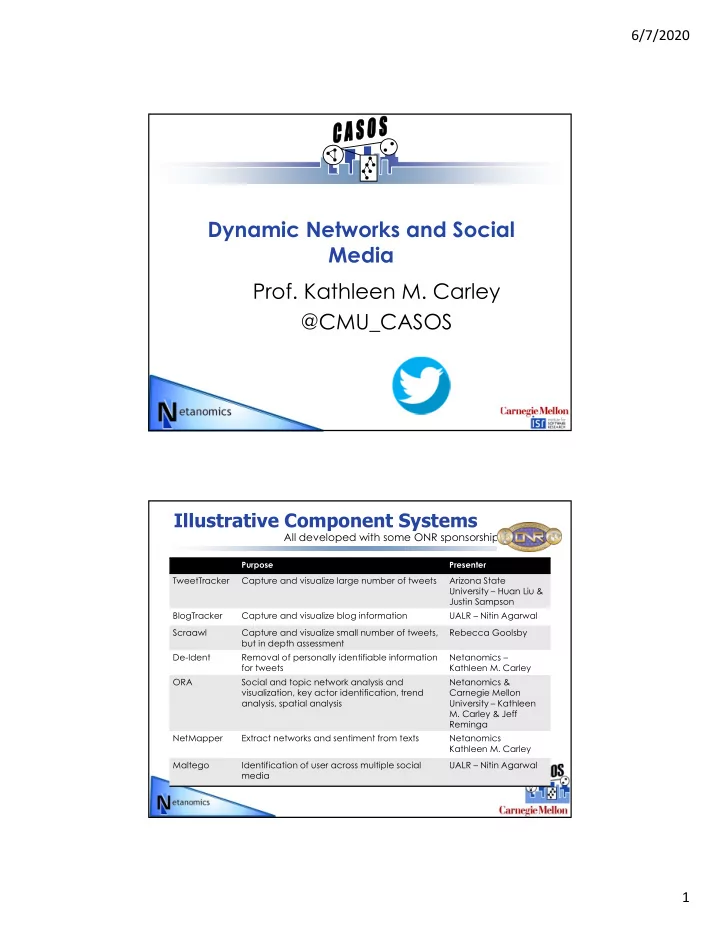
Purpose Presenter TweetTracker Capture and visualize large number of tweets Arizona State University – Huan Liu & Justin Sampson BlogTracker Capture and visualize blog information UALR – Nitin Agarwal Scraawl Capture and visualize small number of tweets, but in depth assessment Rebecca Goolsby De-Ident Removal of personally identifiable information for tweets Netanomics – Kathleen M. Carley ORA Social and topic network analysis and visualization, key actor identification, trend analysis, spatial analysis Netanomics & Carnegie Mellon University – Kathleen

  • M. Carley & Jeff

Reminga NetMapper Extract networks and sentiment from texts Netanomics Kathleen M. Carley Maltego Identification of user across multiple social media UALR – Nitin Agarwal

All developed with some ONR sponsorship

slide-2
SLIDE 2

6/7/2020 2

Illustrative Tool-Chain

ORA TweetTracker De-Identifier

Raw Tweets Anonymiz ed Tweets Anonymize d Tweets

Maltego BlogTrackers Scraawl

Tweet Ids

Twitter API

Raw Tweets

NetMapper

User IDs User IDs

Bot Identifier

Understanding the Digital Landscape

  • Finding and tracking Topic Oriented Communities
  • Finding key actors
  • Finding narratives
  • Comparing groups
  • Comparing narratives
  • Altering groups
  • Altering narratives
  • Creating groups
  • Creating narratives

4

It’s the conversation It’s the actors

slide-3
SLIDE 3

6/7/2020 3

Who’s on Social Media?

  • Organizations
  • Individuals

BOTS

Key Actor Analysis In Twitter

  • Super Spreaders

– High in influence – Look at twitter report – Who are top

  • Super Friends (Super Reciprocals)

– Use sum of mentions and retweets then save only the reciprocal (minimum) – Look at key entity report – Who are top in degree centrality

  • Who is in echo-chambers

– Do locate groups – local patterns cliques – Look at who in most cliques

slide-4
SLIDE 4

6/7/2020 4

Key Theories

  • Social Influence

– A person’s opinions are a function of the opinions of those with whom they interact – In social media, most user’s cannot discriminate between bots, corporate accounts, and individual users and so are influenced by all of those

  • Generalized Other

– “what everyone thinks” – People don’t recall each person – but instead generalize about people as groups and infer information about individuals based on group membership – In social media, people tend to think everyone knows the top items in the scroll window

  • Confirmation Bias

– People have a tendency to form opinions quickly and then to only pay attention to data that confirms that opinion – In social media, if you can affect which messages are at the top of the scroll you control the initial opinion

Key Theories

  • Super-spreader

– A communicator who has exceptional ability to spread information – In social media, a combination of communicates frequently, frequently followed, frequently mentioned, crosses between platforms

  • Reciprocity & Super-friends

– Reciprocity is mutual communication/mention … – A communicator who is in a particularly large cliques of users all of whom mutually communicate

  • Echo Chamber

– A group of users and topics that are strongly interconnected – In an echo chamber ideas reflect back and forth through reciprocated links confirming what everybody knows and escalating emotions

slide-5
SLIDE 5

6/7/2020 5

Seeing Top Actors

  • Take top person
  • Run sphere of influence visualization – what do

you see

  • Take top person
  • Run total degree over time – What do you see

Social Influence

  • Influences 14
  • Influenced by 15
  • Influences 18
  • Influenced by 7
slide-6
SLIDE 6

6/7/2020 6

In the Overall Network the Influence Looks Different

Echo chamber Superfriend Superspreader

Social Influence

Your Beliefs depend on Beliefs in Your Network

slide-7
SLIDE 7

6/7/2020 7

Relies on High Dimensional Networks

Actor Idea / Resource Actor Idea / Resource

Coordination & Manipulation Involve

  • Increase community size
  • Increase density
  • Promote particular messages
  • Promote particular people

– Relying on “the generalized other” – Coordination - Ensure that “everyone knows” – Manipulation - Create an impression that “everyone knows”

slide-8
SLIDE 8

6/7/2020 8

Exploiting Technology and Social Cognition

Technology

  • Scroll through technology

– Frequent or repeated at top – Infrequent at bottom

  • Prioritization

– Which followers get messages – Which topics & actors get recommended – Appears to take into account group density and

  • pinion leaders
  • Abandoned accounts

– Re-purposed

Social Cognition

  • Create apparent consensus –

relying on the generalized

  • ther
  • Create groups – us/them
  • Stereotype
  • Infer from individual to a

group

  • Use of weak ties for news

and strong ties for controversy

Cognition

  • Confirmation bias
  • Intimidation
  • Escalation of commitment

Topic Groups at the heart of exploits

  • Topic Groups
  • IVCC Method for Topic

Group Detection

  • Co-clustering on social

network and knowledge network

Tweeter Hashtag Hashtag Tweeter

A

  • C
slide-9
SLIDE 9

6/7/2020 9

  • CASOS Jihadist Twitter Network (CJTN):
  • 16,000 active tweeters promoting one or more of the major Sunni

Jihadist groups engaged in Syria, Northern Iraq and Yemen.

  • Topic group is
  • Driven by events – events alter discourse and membership
  • Segmented by language

Analysis: Volume and Hash Tag Analysis

Recruiters and Propagandists

  • Twitter is needed for broad

reach, but is relatively insecure for communication

  • A recruiter must use the

@mention to point recruits to propaganda or move the discussion to a more secure platform

  • Extracting tweets with

@mentions and URLs highlights recruiters, recruits, propaganda, and applications used for more secure communication

Analysis: Key Users and Roles

slide-10
SLIDE 10

6/7/2020 10

Linking Social Media to Real World

  • People with reciprocated social media ties are more

likely to have real world tie 73%

  • Stronger links, reciprocated ties, more likely to be

used for controversial information or personal information

  • News or entertainment – equally likely on any tie
  • Real world networks are more “perfect” than on-line –

more dense, fewer “hangers on”

  • So …
  • Online topic groups often have a real world group,

real world group more of an echo-chamber

  • Sending messages to excite an existing topic group

results in longer half-life of message

Russian State Destabilization Strategy

  • Two topic groups - differ on basic issue e.g. gun control
  • Social influence bots retweet opinion leader of choice

– Dramatically escalates opinion leader increases their spread – Bots get prioritized and their messages appear in member scrolls

  • Send messages that are more extreme
  • Exploits generalized other – apparent consensus, and

fosters escalation of commitment

slide-11
SLIDE 11

6/7/2020 11

Distinct communities would likely be interpretable by analysts

Isis/Syrian Issues Topic Group Social Influence Bots

  • Create an echo chamber
  • Gain entry through linking to

superspreader

  • Appear as superfriend
  • Tricks twitter

– into recommending – Prioritizing messages Creates a second echo chamber

  • Alter message by promoting

benefactor

Firibinome bot – dense network built through mentions

slide-12
SLIDE 12

6/7/2020 12

Bots Can Manipulate Community Structure

Core Firibi Bot

App Sign Up, solicits donations for children of Syria

Syria Focused Extremist Topic Group “Dense Community” Firibi Benifactor

Example: Firibi Follower

Firibi Follower

Sophisticated use of @mentions can be used to increase size and interconnections within topic groups

Spreading Narratives

slide-13
SLIDE 13

6/7/2020 13

Bots Building Community

  • Two distinct topic groups

– Alt-right topic group – Evangelical topic group

  • Appear to be middle aged American Women

– Both have a core agenda

  • Both densely connected
  • Social bot used in connecting groups

– Makes it appear that each group is in favor of other’s agenda – Might be bridging the evangelical community with a particular candidate – Might be simulating a fake grass-roots movement

Using Community

  • SI-bots

– Follow general opinion leader

  • Increasing the spread of the message

– Mention each other

  • Create the appearance of wide spread agreement to follow
  • pinion leader
  • Causes Twitter to recommend the “benefactor” accounts
  • These accounts can contain apps

– If you join they then tweet from your account – Increasing the appearance of wide spread agreement

– Scroll through technology puts most recent on top

  • High volume of posts ensures much to scroll through
  • Without constant attention and groveling through “old”

material – you don’t even see that your account is being used

slide-14
SLIDE 14

6/7/2020 14

SI-Bots Promote Accounts and Impact Influence - Alt Right Creating Apparent Consensus Through Topic Group Grooming

  • Black circles were

manually identified as SI-Bots

  • All have political

agendas

  • Many others have

this bot-like behavior

  • Large size gives the

impression of “everyone”

  • Evangelical women’s

group grooming

slide-15
SLIDE 15

6/7/2020 15

Euromaidan Image Sharing Purpose: Build community

  • f young males

FiribiNome Social Botnet Purpose: promote du3a.org #Influencemarketing, #Kred:

Sophisticated use of @mentions can be used to grow communities, gain influence, or promote accounts

Influence Manipulation with Social Influence Bots

Recruitment May Require 2 Narratives

  • Translated hash tags

retweeted by core si- bots within the Euromaidan Image Sharing topic group

  • Black terms are

predominantly associated with Euromaidan propaganda and Russian occupation

  • f Crimea
  • Grey terms are

predominantly associated with the sharing of pornographic pictures

slide-16
SLIDE 16

6/7/2020 16

Findings

  • SI-Bots are used to inflate influence metrics

through reciprocal mentioning behavior.

– Some accounts drop in influence by 60% in network measures like coreness after removing SI-Bots

  • SI-Bots form multiple sub-communities each with

distinct intentions.

– traditional foci (e.g. explicit influence marketing) – more nefarious goals (e.g. promoting particular political ideologies).

  • Bot creators use directed social engineering to

accomplish goals.

– E.g., dataset sharing lewd images of women to attract young men interspersed with calls to violence

Rhetorical Use Case

  • Analyzing Content

– Words – Strategies – Beyond words

32

slide-17
SLIDE 17

6/7/2020 17

Analyzing Content

  • Content Analysis

– Counting words

  • Key Entity Analysis

– Language technology for finding people, organizations, locations

  • Topic Analysis

– Identifying groups of “concepts” and documents that go together – Latent Direchelet Analysis - LDA – Latent Semantic Analysis - LSA

  • Sentiment Analysis
  • Theme Analysis

– Identifying things that fit together vis a focus or a strategy

Key Theories

  • Rhetorical Power

– Use of words that get you to think about many different things, that are frequently used, that are related to many things – e.g. stereotypes – Messages with words with more rhetorical power have greater reach – In social media, create power by co-mentions and frequent mentions

  • Conversational Drift

– Shift from one topic to another – natural – due to half life – In social media, speed the process by what topics you choose

  • Cognitive Dissonance

– Felling of unease due to discussions that are at odds with what you expect – Lead to increasing emotional stress, and either greater commitment to group or leaving of group – In social media, create dissonance through information strategies that lead to apparent contradictions

slide-18
SLIDE 18

6/7/2020 18

Associated Information Strategies

  • Apparent Consensus

– Make it appear that there is wide spread agreement

  • Shift Attention

– Overwhelm the information space – Create competing topic

  • Encourage Disassociation

– Present false information – Making fun of

Rhetorical Power

  • Concepts are high in rhetorical power if they

meet one or more of these criteria

– Are frequently used by many people

  • E.g. #Trump

– Are part of many conversations

  • Evokable & or Invokable
  • If used, makes you think of many other things

– E.g., use of #NATO might evoke responses in

  • Many things that are said make you think of this

– #Trump

– Are frequently cycled through

  • Stereotypes, allusions, symbols … have high

rhetorical power

slide-19
SLIDE 19

6/7/2020 19

Cube analysis of communicative power

Consensus K-Betweenness Degree placeholders stereotypes standard symbols emblems buzzwords factoids

  • rdinary

words allusions

Low High High High

Building Apparent Consensus

  • Using concepts high in rhetorical power makes

everybody think they understand what you are talking about

  • Creates the appearance of consensus

– E.g., we all agree that democracy is good – But we all mean different things by democracy

  • Build grass roots support using messages in

which concepts with rhetorical power are used

slide-20
SLIDE 20

6/7/2020 20

Conversational Drift

  • Conversations drift natural
  • In general most “topic-groups” grow and change

in response to real world events

  • Encourage drift by

– Spamming a large number of topics – Tricking twitter into prioritizing your message – Linking your message to existing topic – threadjacking – …

Conversational Drift is Diagnostic

  • After a disaster when is the situation normal

again?

– When people start tweeting about Justin Bieber

  • When is a situation critical

– When it has a disproportional half-life

  • Are people interested in you

– How long do people stay on your issue?

slide-21
SLIDE 21

6/7/2020 21

Cognitive Dissonance

  • This makes me feel uncomfortable !!!
  • People naturally try to reduce cognitive

dissonance

– Change yourself – Change who you interact with

  • Creating cognitive dissonance

– Strategy to build allegiance to a group – Strategy to rid the group of those you don’t want

Creating Cognitive Dissonance In Social Media

  • Use of “off-color” humor
  • Use of images
  • Fake news
  • Using URLs linked to fake news
  • ----- but strategy has to be used “surgically”
  • Key is to create dissonance only sometimes
slide-22
SLIDE 22

6/7/2020 22

Propaganda Dissemination via Real and Fake News Sites

  • 75 of 2167 unique websites (shortened urls)

shared within a propaganda dissemination community focused on ongoing events in Syria

  • Many are “fake” news-sites

Enhanced by Humor and Fake Images

  • As Anakonda begins – Russian information
  • perations begin

Source: Carley, CMU (ORA) and Liu, ASU (TweetTrac Most retweeted message

slide-23
SLIDE 23

6/7/2020 23

So what to do in Social Media

  • Identify communities that are close in topics and

interaction

– Densely connected groups of individuals and topics

  • Assess trending topics

– See if any of these are promoted by bots

  • Who is talking about what

– Concepts used by many – Concepts special to a few

  • Are key actors pointing to common urls

– Common images – Common videos

  • Who is using humor about whom