Dynamic Memory Management The Linux Perspective Allocating - - PDF document

dynamic memory management
SMART_READER_LITE
LIVE PREVIEW

Dynamic Memory Management The Linux Perspective Allocating - - PDF document

CPSC 410/611 : Operating Systems Dynamic Memory Management The Linux Perspective Allocating memory: The Interface Buddy System Slab Allocation Reading: Silberschatz (8 th ed.), Chapters 9.8


slide-1
SLIDE 1

CPSC 410/611 : Operating Systems Memory Management: Dynamic Memory Management 1

Dynamic Memory Management

  • The Linux Perspective
  • Allocating memory: The Interface
  • Buddy System
  • Slab Allocation
  • Reading: Silberschatz (8th ed.), Chapters 9.8 and 21.6

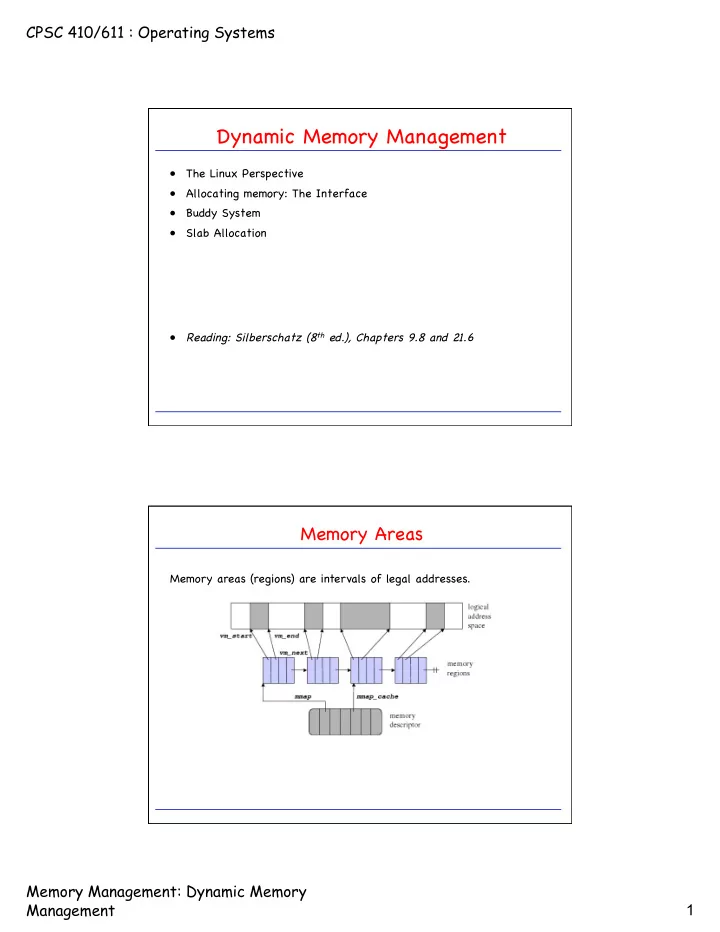
Memory Areas

Memory areas (regions) are intervals of legal addresses.

slide-2
SLIDE 2

CPSC 410/611 : Operating Systems Memory Management: Dynamic Memory Management 2

The Process Address Space

  • When does new memory get allocated?

– Process stack grows – Process “creates” (attaches) to shared memory segment (shmat()) – Process expands heap (malloc()) – New process gets created (fork()) – New program gets loaded into memory (execve()) – Map a file to memory (mmap())

  • Create new address interval:

– Kernel uses do_mmap() call. – Available through system call mmap() in user space.

Allocating Pages

  • Requesting frames:

struct page * alloc_pages(uint gfp_mask, uint order)

  • Requesting pages (logical addresses):

ulong __get_free_pages(uint gfp_mask, uint order)

  • In both cases:

– request allocates 2order pages/frames

– gfp_mask specifies details about request:

  • memory zone
  • behavior of allocator (blocking/unblocking request, etc.)
  • e.g. GFP_KERNEL, GFP_ATOMIC, GFP_DMA, etc.
slide-3
SLIDE 3

CPSC 410/611 : Operating Systems Memory Management: Dynamic Memory Management 3

Allocation at Different Levels

  • alloc_pages() and __get_free_pages()

– allocate pages, at low level – useful to allocate contiguous pages/frames.

  • byte-sized allocations:

– kmalloc(size, gfp_mask)

  • allocate physically contiguous sequence
  • f bytes

– vmalloc(size, gfp_mask)

  • allocate virtually contiguous sequence
  • f bytes
  • explicit user-level allocation:

– malloc(size)

  • allocate virtually contiguous sequence of bytes at user level

How does this all work?

  • alloc_pages() and __get_free_pages()

– allocate pages, at low level – useful to allocate contiguous pages/frames.

  • byte-sized allocations:

– kmalloc(size, gfp_mask)

  • allocate physically contiguous sequence
  • f bytes

– vmalloc(size, gfp_mask)

  • allocate virtually contiguous sequence
  • f bytes
  • explicit user-level allocation:

– malloc(size)

  • allocate virtually contiguous sequence of bytes at user level

Bu Buddy Sys y System! em! Sl Slab b Allocator (+ c (+ cachin ing)

slide-4
SLIDE 4

CPSC 410/611 : Operating Systems Memory Management: Dynamic Memory Management 4

Naïve Allocation in Action

64k 64k 64k 64k 64k 64k 64k 64k 64k 64k 64k 64k 64k 64k 64k 64k 1024k free list

Buddy System Allocation

  • Allocation:

– Increase size of request to next power of 2*. – Look up block in free lists. – If exists, allocate. – If none exists, split next larger block in half, put first half (the “buddy”) on free list, and return second half.

  • De-Allocation:

– Return segment to free list. – Check if buddy is free. If so, coalesce.

  • For details, see lecture.

Harry Markowitz 1927- 1990 Nobel Memorial Prize in Economics (*) For case of binary buddy system. References: Donald Knuth: The Art of Computer Programming Volume 1: Fundamental

  • Algorithms. Second Edition (Reading, Massachusetts: Addison-Wesley, 1997), pp. 435-455.

ISBN 0-201-89683-4

slide-5
SLIDE 5

CPSC 410/611 : Operating Systems Memory Management: Dynamic Memory Management 5

37k? 37k? 64k 150k? 150k? 67k? 7k? 11 112k? 2k?

Buddy System in Action

64k 64k 64k 64k 64k 64k 64k 64k 64k 64k 64k 64k 64k 64k 64k 64k 1024k 512k 512k 256k 128k 64k 64k 1024k 512k 256k 128k 64k free lists 128k 128k 128k 128k 256k 256k 256k 128k 256k

Slab Allocation

  • First described by Jeff Bonwick for the SunOS kernel.
  • Currently used in Linux and other kernels.
  • Key observations:

– Kernel memory often used for allocated for a finite set of

  • bjects, such as file descriptors and other common structures.

– Amount of time required to initialize a regular object in the kernel exceedes the amount of time required to allocate and de-allocate it.

  • Conclusion:

– Instead of freeing the memory back to a global pool, have the memory remain initialized for its intended purpose.

  • References: "The Slab Allocator: An Object-Caching Kernel

Memory Allocator (1994)”

slide-6
SLIDE 6

CPSC 410/611 : Operating Systems Memory Management: Dynamic Memory Management 6

Slab Allocation (II)

  • Set of objects pre-allocated
  • Marked as free
  • When needed, assign a free one and mark as used
  • No free ones available?

– allocate a new slab – slab states (full, empty, partial) – fill partial slab first

  • Advantages:

– no fragmentation – memory requests satisfied quickly