Dye Sensitized Solar Cells: R&D Issues Jason B. Baxter - - PowerPoint PPT Presentation

dye sensitized solar cells r d issues
SMART_READER_LITE
LIVE PREVIEW

Dye Sensitized Solar Cells: R&D Issues Jason B. Baxter - - PowerPoint PPT Presentation

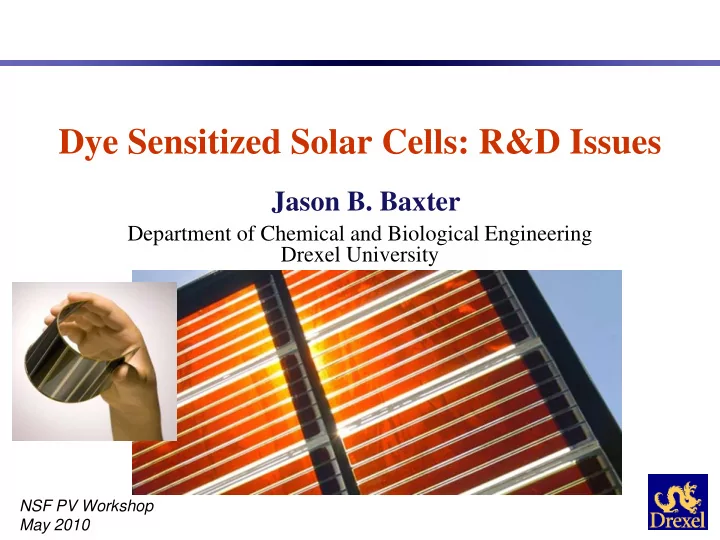
Dye Sensitized Solar Cells: R&D Issues Jason B. Baxter Department of Chemical and Biological Engineering Drexel University NSF PV Workshop May 2010 Dye Sensitized Solar Cells TiO 2 sensitized with monolayer of dye for light harvesting.


slide-1
SLIDE 1

Dye Sensitized Solar Cells: R&D Issues

Department of Chemical and Biological Engineering Drexel University

NSF PV Workshop May 2010
Jason B. Baxter

slide-2
SLIDE 2

Dye Sensitized Solar Cells

  • TiO2 sensitized with monolayer of dye for light harvesting.
  • Semiconductor provides high surface area, good electron transport.

– Nanocrystalline, mesoporous TiO2 film on TCO/glass.

  • Redox mediator completes circuit.
  • Record efficiency 11.1%

10 µm

O’Regan and Gratzel, Nature, 1991. Gratzel, Nature, 2001.

Electrolyte TiO2/Dye Conducting glass Cathode Load

E

slide-3
SLIDE 3

Elementary Processes in DSSCs

Electrolyte Dye TiO2 I-/I3

  • Load

Voc= Ec-Eredox

E

So/S+ S*

  • Electron injection into TiO2

is rapid, t ~ 0.1-1 ps.

  • Injection quantum

efficiency ~ 1.

  • Photovoltage is due to ∆µ

between SC and electrolyte.

  • Electron diffusion time

through TiO2 ~ 0.1-1 ms.

  • Electron recombination

reduces photon-to-current conversion.

3

2 3 I e I

− − −

+  →

e e

400 500 600 700 0.00 0.02 0.04 0.06 0.08 0.10 0.12 0.14

Absorbance (a.u.) Wavelength (nm) Pt

slide-4
SLIDE 4

Efficiencies Over Time

slide-5
SLIDE 5

Efficiencies Over Time

  • Champion research cell (as of Jan. 2010)- Sharp 11.1%

– Jsc 22.0 mA/cm2, Voc 0.729 V, FF 65.2% – Gratzel has unconfirmed cell >12%

  • Champion module: Sony 8.5% (17 cm2)
slide-6
SLIDE 6

Advantages of DSSCs

  • Low cost

– Inexpensive to manufacture, roll-to-roll processing possible – Low embodied energy (<1 yr payback)

  • Non-toxic, earth-abundant materials (except Pt, Ru)
  • Good performance in diverse light conditions: high angle of

incidence, low intensity, partial shadowing

  • Can be lightweight, flexible
  • Can be semi-transparent, bifacial, selected colors
slide-7
SLIDE 7

DSSC Commercialization

  • G24 Innovations

– 120 MW plant, on flexible metal foil – First commercial product in 2009

  • Dyesol (materials and processing tools)
  • 3GSolar
  • SolarPrint
  • Samsung, Sharp, Sony, Toyota
  • Many start-ups: TiSol, etc.

http://www.dyesol.com/conference09

slide-8
SLIDE 8

Rooftop

3G Solar (Israel) Aisin Seiki / Toyota (Japan)

slide-9
SLIDE 9

Building-Integrated PV

http://www.samsungsdi.com

slide-10
SLIDE 10

Portable Electronics

G24 Innovations (Wales)

slide-11
SLIDE 11

Indoor / Decorative

Aisin Seiki (Japan)

slide-12
SLIDE 12

R&D Challenges for DSSCs

  • Lab efficiencies <12% and stagnating

– Low red and near-IR absorption – Low extinction coefficient requires high surface area – Only I-/I3

  • redox couple has slow recombination kinetics, but it has

unnecessarily large overpotential

  • Stability and robustness

– Liquid electrolyte is undesirable, but solid state hole conductors give lower efficiency – 108 turnovers of dye required for 20 year lifetime – I-/I3

  • is corrosive
slide-13
SLIDE 13

Margins to Increase Efficiency

Estimated efficiency of DSSCs employing dyes with increased spectral coverage in conjunction with redox shuttles with varying solution potentials. Efficiencies > 15% are, in principle, achievable in many configurations when there is minimal overpotential (ca. 200 mV) for dye regeneration (dotted line). From Hamann, Energy & Env. Sci., 2008, p. 66.

slide-14
SLIDE 14

New Sensitizers

  • Requirements for sensitizers:

– Broad spectral coverage – High absorption cross-section (enables thinner devices) – Appropriate energetics to match oxide, redox – Fast kinetics for injection, regeneration – Stable for many (~108) turnovers

N719

slide-15
SLIDE 15

Alternative Sensitizers

  • Strategies

– Ligands to shift bands, broaden spectral coverage – Other classes of dyes – Donor-acceptor molecules – Porphyrin oligomers – Dye multilayers – Blends or tandem cells – Quantum dots

N3 (Ru bpy) porphyrin phthalocyanine indoline coumarin

slide-16
SLIDE 16

New Redox Couples

  • Requirements:

– Fast dye regeneration – Slow recombination with electrons from oxide (only I-/I3

  • is slow

enough for conventional cell) – Redox potential matched to dye HOMO (I-/I3

  • has 500 mV
  • verpotential, reducing Voc)

– Stable and non-corrosive

  • Alternatives:

– Halogens: Br-/Br3

  • – Pseudohalogens: (SeCN)2/SeCN-

– Cobalt polypyridyl complexes – Cu(dmp)2

2+/+ (dimethylphenanthroline)

slide-17
SLIDE 17

New Photoanodes

  • Requirements:

– Large surface area for dye loading – Sufficiently fast electron transport to the substrate compared to recombination (fast transport not necessary for conventional cell, but will be for other redox couples) – Open pore structure for dye sensitization and transport of redox couple – Transparent (but scattering can help), with appropriate band positions – For commercialization- scalable and inexpensive

  • Alternatives:

– Other oxides: ZnO, SnO2, SrTiO3 – Other architectures

  • Aerogels: larger surface area, larger porosity, less robust
  • Nanowire/nanotube arrays: directed transport, but lower surface area
slide-18
SLIDE 18

Advantages of Nanowire Arrays

  • Nanowires provide a

direct path to the substrate for fast charge transport.

e-

  • Faster transport can

tolerate faster recombination- other redox couples can increase V

  • c by ~300

mV.

  • Aligned pores for

facile pore filling and direct path for hole transport.

e- Baxter, Nanotechnology, 2006, S304. Baxter, Appl. Phys. Lett., 2005, 053114.

slide-19
SLIDE 19
  • Optimizing one material at a time has not resulted in

significant increases in efficiency in the last 10-15 years.

  • Multiple materials must be changed simultaneously to achieve

large improvements.

slide-20
SLIDE 20

Replacing the Liquid Electrolyte

  • Solid state hole conductors are more robust, but efficiencies are lower.
  • Difficulties in filling tortuous pore network limits thickness and

efficiency.

  • Possible alternatives:

– Solid organic hole conductors: spiro-OMeTAD

  • Max η=4% with 2 µm thickness (Snaith,
  • Angew. Chem. Int. Ed., 2005, p. 6413)

– Room temperature ionic liquids (molten salts)

  • Imidazolium iodide: η=8.2%, retained 93% performance after 1000 hrs light

soak @ 60 ºC (Bai, Nature Mat., 2008, p. 626)

– Polymer electrolytes, gels – Inorganic p-type: CuSCN, CuI

  • Faster recombination than liquid
slide-21
SLIDE 21

Extremely Thin Absorber Solar Cells

  • High absorbance with smaller roughness factor

than DSSCs.

  • Improved robustness- all inorganic.
  • Can offer more efficient charge separation and

cheaper processing than planar thin film PV.

On-going work in Baxter Lab (NSF CAREER, CBET-0846464)

slide-22
SLIDE 22

Lifetime Testing of DSSCs

  • Requirements for outdoor use (required for Si, but not DSSCs so far)

– UV plus 55 ºC, 1000 hours – 85 ºC, 1000 hours – Humidity and temperature cycling (sealing issues)

Ionic liquid DSSC Bai, Nature Mat., 2008, p. 626.

slide-23
SLIDE 23

Lifetime Testing of DSSCs

slide-24
SLIDE 24

Manufacturing

  • Low cost, high throughput, robust processing

– Roll to roll screen printing, inkjet printing etc.

www.samsungsdi.com www.g24i.com

slide-25
SLIDE 25

Summary of Directions for Research

  • New combinations of materials to increase efficiency and stability

– Multiple materials must be changed simultaneously – Mainly academic (so far, academics have emphasized efficiency over stability and lifetime)

  • Low-cost, high-throughput manufacturing methods

– Academic and industrial

  • New ways to integrate DSSCs for new/emerging markets

– Mainly industrial

slide-26
SLIDE 26

Useful References

  • T.W. Hamann, R.A. Jensen, A.B.F. Martinson, H. Van Ryswyk, and J.T. Hupp. "Advancing beyond

current generation dye-sensitized solar cells," Energy and Environmental Science. 2008, 1.

  • H.J. Snaith, and M. Gratzel. "Enhanced charge mobility in a molecular hole transporter via addition
  • f redox inactive ionic dopant: Implication to dye-sensitized solar cells," Applied Physics Letters.

2006, 89.

  • J.B. Baxter, A.M. Walker, K. van Ommering, and E.S. Aydil. "Synthesis and Characterization of

ZnO Nanowires and their Integration into Dye Sensitized Solar Cells," Nanotechnology. 2006, 17, S304-S312.

  • M. Gratzel. "Photoelectrochemical cells," Nature. 2001, 414, 338-344.
  • H. Tributsch. "Dye sensitization solar cells: a critical assessment of the learning curve,"

Coordination Chemistry Reviews. 2004, 248, 1511-1530.

  • Y. Bai, Y.M. Cao, J. Zhang, M. Wang, R.Z. Li, P. Wang, S.M. Zakeeruddin, and M. Gratzel. "High-

performance dye-sensitized solar cells based on solvent-free electrolytes produced from eutectic melts," Nature Materials. 2008, 7, 626-630.

  • Slides from M. Gratzel’s invited talk available at http://www.energy.upenn.edu/solar09.html
  • Websites of companies mentioned in earlier slides