
SLIDE 1
Sabrina Stierwalt (UVa/NRAO)
PanSTARRS-1 gri
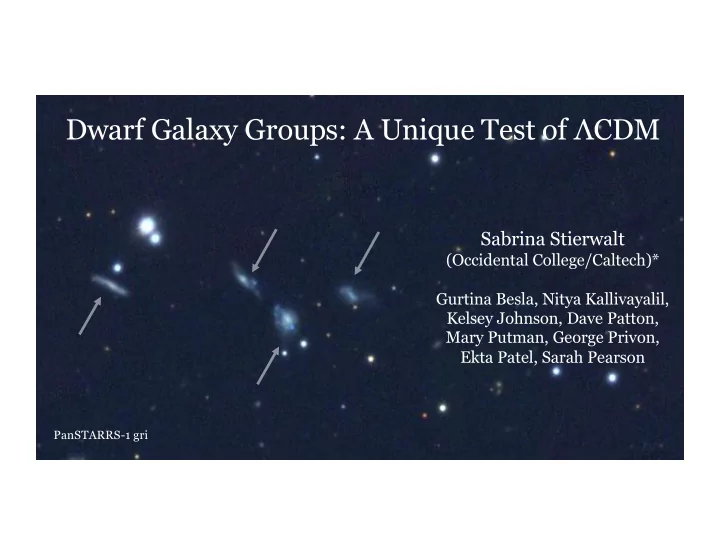
Dwarf Galaxy Groups: A Unique Test of CDM Sabrina Stierwalt - - PowerPoint PPT Presentation
Dwarf Galaxy Groups: A Unique Test of CDM Sabrina Stierwalt (Occidental College/Caltech)* Gurtina Besla, Nitya Kallivayalil, Kelsey Johnson, Dave Patton, Mary Putman, George Privon, Ekta Patel, Sarah Pearson PanSTARRS-1 gri Sabrina
Sabrina Stierwalt (UVa/NRAO)
PanSTARRS-1 gri
Sabrina Stierwalt (UVa/NRAO) Putman+02; Koposov+15 Sales, Navarro, Kallivayalil+17
Sabrina Stierwalt TNT Dwarf Galaxy Groups
!CDM predicts that dwarf galaxies should have their own satellites.
D’Onghia & Lake 08
Dooley+17b
Sabrina Stierwalt (UVa/NRAO)
NGC4485/4490 NGC4449
Sabrina Stierwalt TNT Dwarf Galaxy Groups
Sabrina Stierwalt (UVa/NRAO)
Sabrina Stierwalt TNT Dwarf Galaxy Groups
Sabrina Stierwalt (UVa/NRAO)
TNT First Results (Stierwalt+15,+17; Besla+18)
dwarfs
presence of a massive neighbor
SDSS & Illustris (when applying SDSS sensitivity limits) 1) How do galaxy mergers proceed at low mass and what does that mean for their role in the build up of more massive galaxies? 2) How do mergers affect the evolution of dwarf galaxies themselves (for example, can they explain the burstiness of dwarfs?) 3) Can we characterize the physics of star formation and feedback triggered by interactions at low metallicity, as windows to high z?
Sabrina Stierwalt TNT Dwarf Galaxy Groups
Sabrina Stierwalt (UVa/NRAO)
Group status confirmed with APO spectroscopy and the Maryland Magellan Tunable Filter
Sabrina Stierwalt TNT Dwarf Galaxy Groups
Sabrina Stierwalt (UVa/NRAO)
Stierwalt et al. 2017, Nature Astronomy
Sabrina Stierwalt TNT Dwarf Galaxy Groups
* Each group has at least 3 members (some have 4-5) with 7 < log(M*/Msun) < 9.4 each * 2D projected sizes are: 16 – 80 kpc * 3D velocity dispersions are: 37 km/s < σ3D < 209 km/s * Mass-to-light ratios predicted for groups to be bound groups: 12 < Mtot/LB [Msun/Lsun] < 80 * Three groups have a log(M*) ~ 9.2-9.4 dwarf and a log(M*) ~ 8.2-8.4 dwarf
Sabrina Stierwalt (UVa/NRAO)
− − − 300 Velocity difference from group mean [km/s] − − − 20 40 60 80 100 120 140 1D Velocity Dispersion (km/s) 0.0 0.5 1.0 1.5 2D Projected Size (Mpc) TNT Groups Tully06 Groups HCG31 Not Isolated
Annibali et al. 2016 DDO 68
Sabrina Stierwalt TNT Dwarf Galaxy Groups
Sabrina Stierwalt (UVa/NRAO) Sabrina Stierwalt TNT Dwarf Galaxy Groups
PanSTARRS-1 gri PanSTARRS-1 gri SDSS ugriz
Sabrina Stierwalt (UVa/NRAO)
% with companion of similar M* % with 0.02 < Msat/Mprim < 0.4
Sales et al. 2013
Sabrina Stierwalt TNT Dwarf Galaxy Groups
Besla+18: mean number of companions per dwarf (N=0.04) agrees between SDSS & Illustris
Sabrina Stierwalt (UVa/NRAO)
Sales et al. predicts: dwarf satellites of other dwarfs will have line of sight velocity differences of ~100 km/s TNT observes: ΔVLOS < 125 km/s for 4 groups and 200 < ΔVLOS < 300 km/s for 3 groups
Sales et al. 2013
Sabrina Stierwalt TNT Dwarf Galaxy Groups
Sabrina Stierwalt (UVa/NRAO)
Sabrina Stierwalt TNT Dwarf Galaxy Groups
Besla et al. 2018