
SLIDE 1
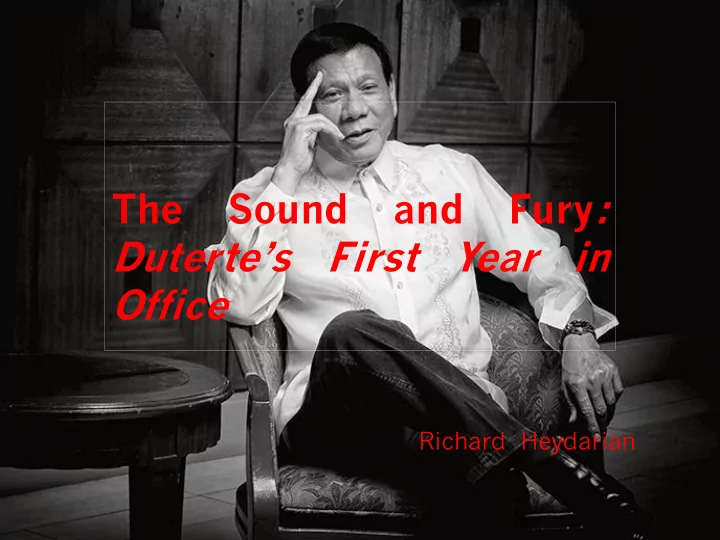
Dutertes First Year in Office Richard Heydarian Outline - - PowerPoint PPT Presentation
The Sound and Fury : Dutertes First Year in Office Richard Heydarian Outline Emerging Markets and Political Cycles Dutertes Rise and What it Means First Year in Office Dilemmas and Opportunities Ahead The Politics of
macroeconomic trajectory (Sharma 2012; 2013;2016)
memory - 55% approval rating heading into twilight months in office
economic reforms (e.g., Tetangco in BSP).
results, but signal reformist intention
Serendipitous convergence of 5 factors:
1.
Advent of post-recession QE and inflow of “hot money” into EM;
2.
Descent of BRICS and tier-1 EMs, placing spotlight on tier-2 Ems;
3.
Denouement of macro-prudential reforms, beginning in mid-200s;
4.
Political stability brought about by Aquino’s administration;
5.
Resilience of remittances and dynamism of services sectors (i.e., BPO, retail, real estate);
Thaksin scenario: A candidate with a core base confined to D &
E, but not favorable reception among ABC;
Jokowi Scenario: An inexperienced but popular leader could
struggle to initiate major reforms, partly due to absence of strong base constituency
Abhisit scenario: Technocratic-managerial leader, but no
charisma and mass following
“Erap” scenario: Populist but erratic leadership, combined with
sense of impunity/hubris, could lead to political backlash
Strongest among the ABC class: AB, who seek law and order
for better business environment, while C and upper-Ds, the ‘aspirational middle class’, who resent ‘glass ceiling’ of mobility and worry about basic safety (moderate-to-high elasticity in political leaning, particularly the NCR-Luzon area)
“Populist” charisma: Folksy persona, informality, anti-elitist
rhetoric, accessibility, and perceived “political outsider” image.
Strongman: Limited respect for institutions of checks and
balances, micro-manager (still ‘mayor’ mode), and openly threatening regime change;
Key strength: Perceived as non-corrupt, decisive and single-
minded, and a radical “change” from usual mold of national politicians (“Iba Siya”); effective and systematic discrediting
(“Oligarchy/Dilaw/Elitista/Trapo/Salita Lang, Walang Gawa”).
The Showman: Similar to other emerging market populists
such as Hugo Chavez, he can hold long-winding, humor-laded, laid back, and entertaining speeches; cuss words interpreted as ‘authenticity’;
Dirty Harry: Effective deployment of ‘penal populism’: I
maybe an SOB, but I am your SOB against the real forces of evil (i.e., criminals, drugs users, oligarchy, imperialist powers)
The Machiavelli: Knows how to get things done, mobilize
support and build coalitions, ensure loyalty, and combine the Fox (charm) and the Lion (strength) to win over people.
Past decade has seen the rise of populists and/or strongmen around emerging market democracies
Recep Tayyip Erdoğan (Turkey) – Former mayor of Istanbul, who won landslide elections on the back of decisive brand of leadership, mobilizing the priousunderclass and emerging middle class against the laic, Westernized elite;
Narendra Mod I (India): Former governor of booming Gujarat state, who a landslide elections in India by harnessing Hindu nationalism, anti- elitist rhetoric, and touting his decisive, non-corrupt brand of leadership.
Joko Widodo (Indonesia): Former mayor of small city of Solo, and shortly governor of Jakarta, who won on the back of massive middle class, youth mobilization based on the promise of nationalism, economic protectionism, social justice (redistributive policies) and departure from the national oligarchy;
Opportunity for Positive Change:
1.
Peace negotiations – more inclusive and committed negotiations with the Reds and Islamist rebels
2.
Anti-Trust Regulation – Competition Commission (under Balisacan) and less attachment to the oligarchy
3.
Infrastructure development – Dutertenomics, address ‘under-spending’
and stronger international support (Japan and China)
4.
Necessary constitutional amendments – relaxation of restrictions on foreign investments, joint development in PH EEZ, presidential term
amateurish tactics, flip-flopping pronouncements, which could undermine PH’s strategic signal’s credibility. Trump, though, could help the situation;
affinity with the Reds, the direction of peace negotiations and relations with American and China; offer of bonuses and salary increase important, plus appointment of 7 AFP chiefs of staff to cabinet/sub-cabinet positions.
and update tax rates, improve collection and reduce exemptions; strong counter-lobby, especially among cooperatives, and, lesser degree, real estate/auto industries.
Economic growth robust, with DOF and BSP maintaining policy competence, but greater volatility in investment sentiment and policy predictability Opportunity cost: Foregone investments by Western counterparts, particularly EU. (year-on-year investment down by 90%. From $1.44b to $141m).
Duterte maintain robust levels of popularity (though no counter- historical), but discover limits of his unilateral decision-making power on key policies (i.e., SCS; communists rebels; US and counter-terrorism, war on drugs) as aura of invincibility is gradually shattered;
Weakening of institutions, from law enforcement to judiciary and legislative, giving way to proto-authoritarian system;
Specter of Putin-style crackdown on free-liberal media
Opposition weakened, lack of central leadership and appealing narrative