
SLIDE 1
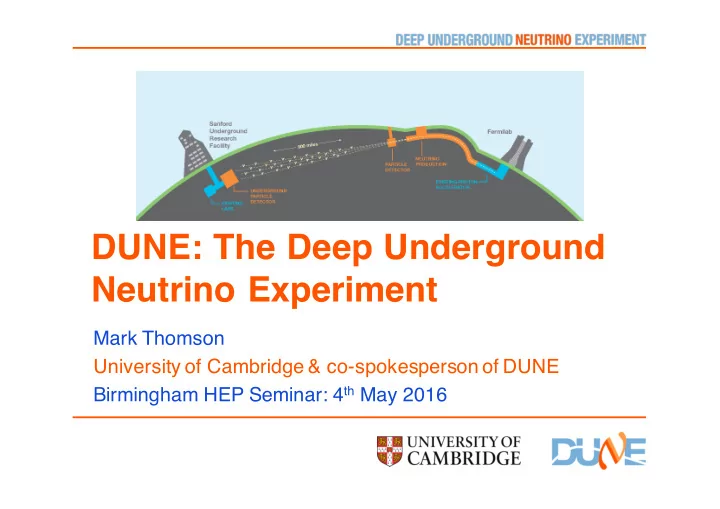
DUNE: The Deep Underground Neutrino Experiment
Mark Thomson University of Cambridge & co-spokesperson of DUNE Birmingham HEP Seminar: 4th May 2016
DUNE: The Deep Underground Neutrino Experiment Mark Thomson - - PowerPoint PPT Presentation
DUNE: The Deep Underground Neutrino Experiment Mark Thomson University of Cambridge & co-spokesperson of DUNE Birmingham HEP Seminar: 4 th May 2016 Topic Slides 1: Context: The 2012 Revolution 1 2: Why are neutrinos so important 2
Mark Thomson University of Cambridge & co-spokesperson of DUNE Birmingham HEP Seminar: 4th May 2016
Topic Slides 1: Context: The 2012 Revolution 1 2: Why are neutrinos so important 2 3: Neutrinos – known unknowns 4 4: How to Detect CPV with Neutrinos? 4 5: LBNF/DUNE 6 5.1: DUNE Science Strategy 5 6: DUNE Neutrino Physics 5 7: LBNF 2 8: The DUNE Far Detector 5 9: The DUNE Near Detector 1 10: Political Context 1 11: Opportunities on DUNE 1 12: Summary 1 Total 38
04/05/2016 3 Mark Thomson | DUNE
04/05/2016 4 Mark Thomson | DUNE
« Two major discoveries in particle physics § A SM-like Higgs boson (ATLAS, CMS)
§ θ13 ~ 10o (T2K, MINOS, Daya Bay, RENO)
04/05/2016 5 Mark Thomson | DUNE
« Two major discoveries in particle physics § A SM-like Higgs boson (ATLAS, CMS)
§ θ13 ~ 10o (T2K, MINOS, Daya Bay, RENO)
0.5 1 1.5 2 0.9 1
L/ km Observed/No Oscillations
100 120 140 160 50 100
mγγ/GeV ATLAS Weighted Events
« Now standard textbook physics* § launch the next steps
*apologies for gratuitous plug
H θ13
04/05/2016 6 Mark Thomson | DUNE
04/05/2016 7 Mark Thomson | DUNE
« Neutrino masses are anomalously small
§ Why is this the case … BSM physics !
Dirac mass terms, Higgs coupling together L- and R-handed chiral fermionic fields
Yf √ 2 v ⇣ fLfR + fRfL ⌘
§ This could be the origin of neutrino masses
Existence of RH neutrino – a rather minimal extension to the SM?
§ But a RH neutrino is a gauge singlet
Can now add “by hand” a new Majorana mass term to the SM Lagrangian, involving only the RH field (and conjugate)
∼ Mνc
RνR
This additional freedom might explain why neutrino masses are “different”
04/05/2016 8 Mark Thomson | DUNE
« Is there a connection to the GUT scale? § If both Dirac and Majorana mass terms are present § The seesaw mechanism: the physical “mass eigenstates” are those in the basis where the mass matrix is diagonal
(nothing to prevent this)
L ∼ − 1
2
⇣ νL νc
R
⌘ 0 mD mD M ! νc
L
νR !
Light LH neutrino + heavy RH neutrino
mν ≈ m2
D
M
mN ≈ M
§ With to get to right range of small neutrino masses:
mD ∼ m`
M ∼ 1012 − 1016 GeV
+ implies Lepton # violation
04/05/2016 9 Mark Thomson | DUNE
« Is there a connection to the GUT scale? § If both Dirac and Majorana mass terms are present § The seesaw mechanism: the physical “mass eigenstates” are those in the basis where the mass matrix is diagonal
(nothing to prevent this)
L ∼ − 1
2
⇣ νL νc
R
⌘ 0 mD mD M ! νc
L
νR !
Light LH neutrino + heavy RH neutrino
mν ≈ m2
D
M
mN ≈ M
§ With to get to right range of small neutrino masses:
mD ∼ m`
M ∼ 1012 − 1016 GeV
+ implies Lepton # violation
04/05/2016 10 Mark Thomson | DUNE
04/05/2016 11 Mark Thomson | DUNE
« Neutrino flavor oscillations now a well established physical phenomenon
§ Neutrinos have non-zero mass § Neutrino mass eigenstates (ν1, ν2, ν3 ) ≠ weak eigenstates (νe, νµ, ντ )
P(νµ → νe) = sin2(2θ) sin2 1.27∆m2[eV2]L[km] Eν[GeV] !
500 1000 1500 2000 0.5 1
P(νe → νx) L / km
P(νe → νµ) P(νe → νe)
sin22θ
dependence
L/Eν
Two-flavour limit:
04/05/2016 12 Mark Thomson | DUNE
« Unitary PNMS matrix mixing described by: § three “Euler angles”: § and one complex phase:
UPMNS = Ue1 Ue2 Ue3 Uµ1 Uµ2 Uµ3 Uτ1 Uτ2 Uτ3 = 1 0 c23 s23 0 −s23 c23 c13 0 s13e−iδ 1 −s13eiδ 0 c13 c12 s12 0 −s12 c12 0 0 1
(θ12, θ13, θ23)
δ
with
« If then SM leptonic sector CP violation (CPV) § CPV effects § now know that is relatively large
∝ sin θ13 δ , {0, π} θ13
CPV is observable with conventional ν beams
LBNF/DUNE Hyper-Kamiokande
sij = sin θij ; cij = cos θij
04/05/2016 13 Mark Thomson | DUNE
« We now know a lot about the neutrino sector « But still many profound questions
§ Why are neutrino masses so small ?
§ Are there light sterile neutrino states ?
§ What is the neutrino mass hierarchy ?
§ Is CP violated in the leptonic sector ?
CKM PMNS NH PMNS IH
vs.
04/05/2016 14 Mark Thomson | DUNE
« Next generation Long-Baseline experiments (such as DUNE) can address three of these questions:
§ Why are neutrino masses so small ?
§ Are there light sterile neutrino states ?
§ What is the neutrino mass hierarchy ?
§ Is CP violated in the leptonic sector ?
Breaks 3-flavor paradigm
CKM PMNS NH PMNS IH
vs.
04/05/2016 15 Mark Thomson | DUNE
Is CP violated in the neutrino sector ? « If
the answer is YES
δ , {0, π}
« Strong motivation to aim for a definitive
§ If yes, would provide support* for the hypothesis of Leptogenesis as the mechanism for generating the matter-antimatter asymmetry in the universe
*not proof, since still need to connect low-scale ν CPV physics to the high-scale N CPV physics
§ Ideally want “precise” measurement of CP phase
04/05/2016 16 Mark Thomson | DUNE
04/05/2016 17 Mark Thomson | DUNE
P(νµ → νe) − P(νµ → νe) =4s12s13c2
13s23c23 sin δ
× sin ∆m2
21
2E + sin ∆m2
23
2E + sin ∆m2
31
2E
« CPV different oscillation rates for s and s
« Requires § now know that this is true, § but, despite hints, don’t yet know “much” about {θ12, θ13, θ23} , {0, π}
θ13 ⇡ 9
δ
« So “just” measure ? « Not quite, there is a complication… P(νµ → νe) − P(νµ → νe)
vacuum osc.
04/05/2016 18 Mark Thomson | DUNE
« Even in the absence of CPV Neutrinos travel through material that is not CP symmetric, i.e. matter not antimatter « In vacuum, the mass eigenstates correspond to the eigenstates of the Hamiltonian: § they propagate independently (with appropriate phases) « In matter, there is an effective potential due to the forward weak scattering processes:
P(νµ → νe) − P(νµ → νe) = 0 V = ± √ 2GFne
Different sign for vs
νe νe ν1, ν2, ν3
04/05/2016 19 Mark Thomson | DUNE
H |ν1i |ν2i |ν3i = i d dt |ν1i |ν2i |ν3i = E1 0 E2 0 E3 |ν1i |ν2i |ν3i + V|νei
« Accounting for this potential term, gives a Hamiltonian that is not diagonal in the basis of the mass eigenstates « Complicates the simple picture !!!!
A = 2 √ 2GFneE = 7.6 × 10⁻⁵eV2 · ρ g cm−3 · E GeV
P(νµ → νe) − P(νµ → νe) = 16A ∆m2
31
sin2 ∆m2
31L
4E c2
13s2 13s2 23(1 − 2s2 13)
− 2AL E sin ∆m2
31L
4E c2
13s2 13s2 23(1 − 2s2 13)
− 8∆m2
21L
2E sin2 ∆m2
31L
4E sin δ · s13c2
13c23s23c12s12
with ME ME CPV
ME
04/05/2016 20 Mark Thomson | DUNE
H |ν1i |ν2i |ν3i = i d dt |ν1i |ν2i |ν3i = E1 0 E2 0 E3 |ν1i |ν2i |ν3i + V|νei
« Accounting for this potential term, gives a Hamiltonian that is not diagonal in the basis of the mass eigenstates « Complicates the simple picture !!!!
A = 2 √ 2GFneE = 7.6 × 10⁻⁵eV2 · ρ g cm−3 · E GeV
P(νµ → νe) − P(νµ → νe) = 16A ∆m2
31
sin2 ∆m2
31L
4E c2
13s2 13s2 23(1 − 2s2 13)
− 2AL E sin ∆m2
31L
4E c2
13s2 13s2 23(1 − 2s2 13)
− 8∆m2
21L
2E sin2 ∆m2
31L
4E sin δ · s13c2
13c23s23c12s12
with ME ME CPV
ME
What we measure Small Proportional to L What we want
04/05/2016 21 Mark Thomson | DUNE
EITHER: « Keep L small (~200 km): so that matter effects are insignificant § First oscillation maximum: § Want high flux at oscillation maximum
∆m2
31L
4E ∼ π 2
Off-axis beam: narrow range of neutrino energies OR: « Make L large (>1000 km): measure the matter effects (i.e. MH) § First oscillation maximum: § Unfold CPV from Matter Effects through E dependence
∆m2
31L
4E ∼ π 2
On-axis beam: wide range of neutrino energies
Eν > 2 GeV Eν < 1 GeV
04/05/2016 22 Mark Thomson | DUNE
EITHER: « Keep L small (~200 km): so that matter effects are insignificant § First oscillation maximum: § Want high flux at oscillation maximum
∆m2
31L
4E ∼ π 2
Off-axis beam: narrow range of neutrino energies OR: « Make L large (>1000 km): measure the matter effects (i.e. MH) § First oscillation maximum: § Unfold CPV from Matter Effects through E dependence
∆m2
31L
4E ∼ π 2
On-axis beam: wide range of neutrino energies
Eν > 2 GeV Eν < 1 GeV
04/05/2016 23 Mark Thomson | DUNE
04/05/2016 24 Mark Thomson | DUNE
« Intense beam of or fired 1300 km at a large detector
νµ νµ
« Compare and oscillations
νµ → νe νµ → νe
« Probe fundamental differences between matter & antimatter
νµ νµ νµ ντ ντ ντ νµ νµ νe
04/05/2016 25 Mark Thomson | DUNE
«LBNF/DUNE
§ Muon neutrinos/anti-antineutrinos from high-power proton beam
§ Large underground LAr detector at Sanford Underground Research Facility (SURF) in South Dakota
§ Highly-capable Near Detector system
LBNF/DUNE – Fermilab in 2025
04/05/2016 26 Mark Thomson | DUNE
LBNF/DUNE – Fermilab in 2025
04/05/2016 27 Mark Thomson | DUNE
04/05/2016 28 Mark Thomson | DUNE
P5 strategic review of US HEP
– as a international collaboration bringing together the
international neutrino community
– ambitious scientific goals with discovery potential for:
Resulted in the formation of the DUNE collaboration with strong representation from:
– LBNE (mostly US) – LBNO (mostly Europe) – Other interested institutes
04/05/2016 29 Mark Thomson | DUNE
Things are moving very fast…
–
Over 200 people attended in person
– paves the way to approval of excavation in FY17
04/05/2016 30 Mark Thomson | DUNE
has strong support from:
–
This is the future flagship project for Fermilab – “no plan B”
–
Very significant agreements on CERN – US collaboration
+ Strong international interest: Brazil, India, Italy, Switzerland, UK, …
04/05/2016 31 Mark Thomson | DUNE
USA UK Italy India Other Switzerland Spain France Brazil Americas Poland Czech Republic USA India Other UK Italy Brazil France Americas Poland Switzerland Spain Czech Republic
As of today: 856 Collaborators from 149 Institutes DUNE has broad international support
04/05/2016 32 Mark Thomson | DUNE
A neutrino interaction in the ArgoNEUTdetector at Fermilab
ν
Unprecedented precision utilizing a massive Liquid Argon TPC
04/05/2016 33 Mark Thomson | DUNE
Focus on fundamental open questions in particle physics and astroparticle physics:
–
Discover CP Violation in the leptonic sector
–
Mass Hierarchy
–
Precision Oscillation Physics:
–
e.g. targeting SUSY-favored modes,
–
Galactic core collapse supernova, sensitivity to νe
p → K+ν
04/05/2016 34 Mark Thomson | DUNE
Focus on fundamental open questions in particle physics and astroparticle physics:
–
Discover CP Violation in the leptonic sector
–
Mass Hierarchy
–
Precision Oscillation Physics:
–
e.g. targeting SUSY-favored modes,
–
Galactic core collapse supernova, sensitivity to νe
p → K+ν
04/05/2016 35 Mark Thomson | DUNE
Measure neutrino spectra at 1300 km in a wide-band beam
FD ND νµ νµ
µ & νe
04/05/2016 36 Mark Thomson | DUNE
… then repeat for antineutrinos
FD ND νµ νµ
µ & νe
04/05/2016 37 Mark Thomson | DUNE
Proton decay is expected in most new physics models
– For example, look for kaons from SUSY-inspired GUT p-decay
modes such as
wireno. time
cathode kaondecay muondecay
0.5m
E ~ O(200 MeV) p → K+ν
04/05/2016 38 Mark Thomson | DUNE
Proton decay is expected in most new physics models
– For example, look for kaons from SUSY-inspired GUT p-decay
modes such as
p → K+ν
wireno. time
cathode kaondecay muondecay
0.5m
“simulated” p-decay Remove incoming particle
§ Clean signature very low backgrounds
1 Mt.yr
ES Ar
40 eν Ar
40 eν
04/05/2016 39 Mark Thomson | DUNE
A core collapse supernova produces an incredibly intense burst of neutrinos
galactic supernova bursts
– In argon (uniquely)the largest sensitivity is to νe
E ~ O(10 MeV)
νe + 40Ar → e− + 40K
∗
Time (seconds)
10
10 1 Events per bin 10 20 30 40 50 60 70
Infall Neutronization Accretion CoolingES Ar
40 eν Ar
40 eν
Physics Highlights include: § Possibility to “see” neutron star formation stage § Even the potential to see black hole formation !
Energy time
04/05/2016 40 Mark Thomson | DUNE
04/05/2016 41 Mark Thomson | DUNE
Measure neutrino spectra at 1300 km in a wide-band beam
a and search for BSM effects (e.g. NSI) in a single experiment
–
Long baseline:
–
Wide-band beam:
Reconstructed Energy (GeV)
1 2 3 4 5 6 7 8Events/0.25 GeV
100 200 300 400 500 600 700 800 CC µ ν Signal NC ) CC τ ν + τ ν ( CC µ ν Bkgd CDR Reference Design Optimized Design disappearance µ ν DUNE mode ν 150 kt-MW-yr )=0.45 23 θ ( 2 sinReconstructed Energy (GeV)
1 2 3 4 5 6 7 8Events/0.25 GeV
20 40 60 80 100 120 ) CC e ν + e ν Signal ( ) CC e ν + e ν Beam ( NC ) CC τ ν + τ ν ( ) CC µ ν + µ ν ( CDR Reference Design Optimized Design appearance e ν DUNE mode ν 150 kt-MW-yr =0 CP δ Normal MH, )=0.45 23 θ ( 2 sinReconstructed Energy (GeV)
1 2 3 4 5 6 7 8Events/0.25 GeV
5 10 15 20 25 30 35 ) CC e ν + e ν Signal ( ) CC e ν + e ν Beam ( NC ) CC τ ν + τ ν ( ) CC µ ν + µ ν ( CDR Reference Design Optimized Design appearance e ν DUNE mode ν 150 kt-MW-yr =0 CP δ Normal MH, )=0.45 23 θ ( 2 sinReconstructed Energy (GeV)
1 2 3 4 5 6 7 8Events/0.25 GeV
50 100 150 200 250 300 350 CC µ ν Signal CC µ ν Bkgd NC ) CC τ ν + τ ν ( CDR Reference Design Optimized Design disappearance µ ν DUNE mode ν 150 kt-MW-yr )=0.45 23 θ ( 2 sinνµ / νµ disappearance νe / νe appearance
E ~ few GeV
MH Sensitivity
04/05/2016 42 Mark Thomson | DUNE
« Sensitivities depend on multiple factors: § Other parameters, e.g. δ § Beam spectrum, …
Exposure (kt-MW-years) 200 400 600 800 1000 1200 1400
2χ ∆ 5 10 15 20 25 30 35 40
CDR Reference Design Optimized Design
0% 50% 100%MH
MH significance
MH Sensitivity
04/05/2016 43 Mark Thomson | DUNE
« Sensitivities depend on multiple factors: § Other parameters, e.g. δ § Beam spectrum, …
Exposure (kt-MW-years) 200 400 600 800 1000 1200 1400
2χ ∆ 5 10 15 20 25 30 35 40
CDR Reference Design Optimized Design
0% 50% 100%MH
MH significance
MH and CPV Sensitivities
04/05/2016 44 Mark Thomson | DUNE
« Sensitivities depend on multiple factors: § Other parameters, e.g. δ § Beam spectrum, …
Exposure (kt-MW-years) 200 400 600 800 1000 1200 1400
2χ ∆ 5 10 15 20 25 30 35 40
CDR Reference Design Optimized Design
0% 50% 100%MH
Exposure (kt-MW-years) 200 400 600 800 1000 1200 1400
2χ ∆ = σ 2 4 6 8 10 12
CDR Reference Design Optimized Design
25% 50% 75%CPV
MH significance CPV significance
MH and CPV Sensitivities
04/05/2016 45 Mark Thomson | DUNE
« Sensitivities depend on multiple factors: § Other parameters, e.g. δ § Beam spectrum, …
Exposure (kt-MW-years) 200 400 600 800 1000 1200 1400
2χ ∆ 5 10 15 20 25 30 35 40
CDR Reference Design Optimized Design
0% 50% 100%MH
Exposure (kt-MW-years) 200 400 600 800 1000 1200 1400
2χ ∆ = σ 2 4 6 8 10 12
CDR Reference Design Optimized Design
25% 50% 75%CPV
MH significance CPV significance
Beyond discovery: measurement of δ
04/05/2016 46 Mark Thomson | DUNE
«CPV “coverage” is just one way of looking at sensitivity… «Can also express in terms of the uncertainty on δ
Start to ~approach current level of precision on quark-sector CPV phase (although takes time)
04/05/2016 47 Mark Thomson | DUNE
Rapidly reach scientifically interesting sensitivities:
– e.g. in best-case scenario for Mass Hierarchy :
– e.g. in best-case scenario for CPV (δCP = +π/2) :
– e.g. in best-case scenario for CPV (δCP = +π/2) :
«Genuine potential for early physics discovery Discovery Strong evidence Discovery
~2 years ~3-4 years ~6-7 years
04/05/2016 48 Mark Thomson | DUNE
DUNE physics:
– Definitive 5σ determination of MH – Probe leptonic CPV – Precisely test 3-flavor oscillation paradigm
physics
– Extend sensitivity to nucleon decay – Unique measurements of supernova neutrinos (if one
should occur in lifetime of experiment)
04/05/2016 49 Mark Thomson | DUNE
04/05/2016 50 Mark Thomson | DUNE
04/05/2016 51 Mark Thomson | DUNE
« LBNF: the world’s most intense high-energy ν beam
§ 1.2 MW from day one
§ upgradable to 2.4 MW « Requires PIP-II (proton-improvement plan) § $0.5B upgrade of FNAL accelerator infrastructure § Replace existing 400 MeV LINAC with 800 MeV SC LINAC
« In beam-based long-baseline neutrino physics:
§ beam power drives the sensitivity
04/05/2016 52 Mark Thomson | DUNE
hadrons § i) Start with an intense (MW) proton beam from PIP-II § ii) Point towards South Dakota § iii) Smash high-energy (~80 GeV) protons into a target § iv) Focus positive pions/kaons § v) Allow them to decay § vi) Absorb remaining charged particles in rock § vii) Left with a “collimated” beam
νµ π+ → µ+νµ
i) ii) iii) v) iv) vii) vi)
p p p π ν, , µ ν
04/05/2016 53 Mark Thomson | DUNE
hadrons § i) Start with an intense (MW) proton beam from PIP-II § ii) Point towards South Dakota § iii) Smash high-energy (~80 GeV) protons into a target § iv) Focus positive pions/kaons § v) Allow them to decay § vi) Absorb remaining charged particles in rock § vii) Left with a “collimated” beam
νµ π+ → µ+νµ
i) ii) iii) v) iv) vii) vi)
p p p π ν, , µ ν
04/05/2016 54 Mark Thomson | DUNE
04/05/2016 55 Mark Thomson | DUNE
Cavern Layout at the Sanford Underground Research Facility based
FD modules
–
Allows for staged construction of FD
–
Gives flexibility for evolution of LArTPC technology design
necessarily identical
#1 #2 #3 #4
04/05/2016 56 Mark Thomson | DUNE
DUNE Far Detector site
Davis Campus:
Ross Campus:
Green = new excavation commences in 2017
04/05/2016 57 Mark Thomson | DUNE
A modular implementation of Single-Phase TPC
14.4 m 12 m
time / ms wire #
E
ν
e−
time / ms wire # time / ms
wire #
−180 kV
C A A A A C C
Anode planes Cathode planes
Steel Cryostat
3.6 m
04/05/2016 58 Mark Thomson | DUNE
A modular implementation of Single-Phase TPC
14.4 m 12 m
time / ms wire #
E
ν
e−
−180 kV
C A A A A C C
Anode planes Cathode planes
Steel Cryostat
3.6 m
04/05/2016 59 Mark Thomson | DUNE
Modular implementation of Single-Phase TPC
– Active volume: 12m x 14m x 58m – 150 Anode Plane Assemblies
– 200 Cathode Plane Assemblies
Second & subsequent far detector modules
– Not assumed to be exactly the same, could be:
A A A C C
S/N≈100 DP Readout
04/05/2016 60 Mark Thomson | DUNE
e.g. single-phase APA/CPA LAr-TPC:
– 35-t prototype (run ended 03/2016)
tests of basic design
04/05/2016 61 Mark Thomson | DUNE
e.g. single-phase APA/CPA LAr-TPC:
– 35-t prototype (run ended 03/2016)
tests of basic design
– MicroBooNE (operational since 2015) – SBND (aiming for operation in 2018)
04/05/2016 62 Mark Thomson | DUNE
e.g. single-phase APA/CPA LAr-TPC:
– 35-t prototype (run ended 03/2016)
tests of basic design
– MicroBooNE (operational since 2015) – SBND (aiming for operation in 2018)
cat the CERN Neutrino Platform
– Single-Phase & Dual-Phase – Engineering prototypes, e.g. SP:
– Aiming for operation in 2018
04/05/2016 63 Mark Thomson | DUNE
e.g. single-phase APA/CPA LAr-TPC:
– 35-t prototype (run ended 03/2016)
tests of basic design
– MicroBooNE (operational since 2015) – SBND (aiming for operation in 2018)
cat the CERN Neutrino Platform
– Single-Phase & Dual-Phase – Engineering prototypes, e.g. SP:
– Aiming for operation in 2018
04/05/2016 64 Mark Thomson | DUNE
04/05/2016 65 Mark Thomson | DUNE
CDR design is the the NOMAD-inspired FGT
–
Central straw-tube tracking system
–
Lead-scintillator sampling ECAL
–
RPC-based muon tracking systems
–
Constraints on cross sections and the neutrino flux
–
A rich self-contained non-oscillation neutrino physics program
–
N
Will result in unprecedented samples of ν interactions
– >100 million interactions over a wide range of energies:
04/05/2016 66 Mark Thomson | DUNE
04/05/2016 67 Mark Thomson | DUNE
« LBNF/DUNE will be:
§ The first international “mega-science” project hosted by the US
§ The first U.S. project run as an international collaboration
04/05/2016 68 Mark Thomson | DUNE
« LBNF/DUNE will be:
§ The first international “mega-science” project hosted by the US
§ The first U.S. project run as an international collaboration
« The U.S. is serious:
§ LBNF/DUNE is Fermilab’s future flagship project § Very strong support from Fermilab & the U.S. DOE § CD3a in December – funding request for excavation in FY17 currently with DOE
04/05/2016 69 Mark Thomson | DUNE
« LBNF/DUNE will be:
§ The first international “mega-science” project hosted by the US
§ The first U.S. project run as an international collaboration
« The U.S. is serious:
§ LBNF/DUNE is Fermilab’s future flagship project § Very strong support from Fermilab & the U.S. DOE § CD3a in December – funding request for excavation in FY17 currently with DOE
« A game-changer for CERN and the U.S.
§ Historic agreement between U.S. and CERN § US contributes to LHC upgrade (high-field magnets) § CERN contributes to Far site infrastructure
04/05/2016 70 Mark Thomson | DUNE
« LBNF/DUNE will be:
§ The first international “mega-science” project hosted by the US
§ The first U.S. project run as an international collaboration
« The U.S. is serious:
§ LBNF/DUNE is Fermilab’s future flagship project § Very strong support from Fermilab & the U.S. DOE § CD3a in December – funding request for excavation in FY17 currently with DOE
« A game-changer for CERN and the U.S.
§ Historic agreement between U.S. and CERN § US contributes to LHC upgrade (high-field magnets) § CERN contributes to Far site infrastructure
« First truly global neutrino experiment
04/05/2016 71 Mark Thomson | DUNE
« LBNF/DUNE will be:
§ The first international “mega-science” project hosted by the US
§ The first U.S. project run as an international collaboration
« The U.S. is serious:
§ LBNF/DUNE is Fermilab’s future flagship project § Very strong support from Fermilab & the U.S. DOE § CD3a in December – funding request for excavation in FY17 currently with DOE
« A game-changer for CERN and the U.S.
§ Historic agreement between U.S. and CERN § US contributes to LHC upgrade (high-field magnets) § CERN contributes to Far site infrastructure
« First truly global neutrino experiment
04/05/2016 72 Mark Thomson | DUNE
Opportunities in DUNE
04/05/2016 73 Mark Thomson | DUNE
DUNE is moving rapidly
DUNE: the next large global Particle Physics project
– many synergies with collider experiments
– Hardware: e.g. photon detection system (scintillator + SiPMs) – DAQ/Computing: continuous readout = high-data rates – Software: LAr-TPC reconstruction
Opportunities in DUNE
04/05/2016 74 Mark Thomson | DUNE
DUNE is moving rapidly
DUNE: the next large global Particle Physics project
– many synergies with collider experiments
– Hardware: e.g. photon detection system (scintillator + SiPMs) – DAQ/Computing: continuous readout = high-data rates – Software: LAr-TPC reconstruction
04/05/2016 75 Mark Thomson | DUNE
04/05/2016 76 Mark Thomson | DUNE
«DUNE will
§ Probe leptonic CPV with unprecedented position § Definitively determine the MH to greater than 5 σ § Test the three-flavor hypothesis § Significantly advance the discovery potential for proton decay § (With luck) provide a wealth of information on Supernova bursts neutrino physics and astrophysics
04/05/2016 77 Mark Thomson | DUNE
«DUNE will
§ Probe leptonic CPV with unprecedented position § Definitively determine the MH to greater than 5 σ § Test the three-flavor hypothesis § Significantly advance the discovery potential for proton decay § (With luck) provide a wealth of information on Supernova bursts neutrino physics and astrophysics
«This is an exciting time
§ DUNE is now ballistic § The timescales are not long:
04/05/2016 78 Mark Thomson | DUNE
«DUNE will
§ Probe leptonic CPV with unprecedented position § Definitively determine the MH to greater than 5 σ § Test the three-flavor hypothesis § Significantly advance the discovery potential for proton decay § (With luck) provide a wealth of information on Supernova bursts neutrino physics and astrophysics
«This is an exciting time
§ DUNE is now ballistic § The timescales are not long:
«An international community is forming – including CERN
§ LBNF/DUNE represents a major new scientific opportunity for particle physics
04/05/2016 79 Mark Thomson | DUNE
04/05/2016 80 Mark Thomson | DUNE
04/05/2016 81 Mark Thomson | DUNE
04/05/2016 82 Mark Thomson | DUNE
δCP & θ 23
Exposure (kt-MW-years) 200 400 600 800 1000 1200 1400 Resolution (degrees)
CP
δ 5 10 15 20 25 30 35 40
Resolution
CP
δ
DUNE Sensitivity Normal Hierarchy = 0.085
13
θ 2
2
sin = 0.45
23
θ
2
sin
° = 0
CPδ ° = 90
CPδ
Resolution
CP
δ
Exposure (kt-MW-years) 200 400 600 800 1000 1200 1400 Resolution
23
θ
2
sin 0.005 0.01 0.015 0.02 0.025 0.03 0.035 0.04
Resolution
23
θ
2
sin
DUNE Sensitivity Normal Hierarchy = 0.085
13
θ 2
2
sin = 0.45
23
θ
2
sin
Resolution
23
θ
2
sin
04/05/2016 83 Mark Thomson | DUNE
p → K ν
04/05/2016 84 Mark Thomson | DUNE
04/05/2016 85 Mark Thomson | DUNE
Following LBNO approach, genetic algorithm used to optimize horn design – increase neutrino flux at lower energies
Energy (GeV)
µ
ν
1 2 3 4 5 6 7
/ Year
2
s / GeV / m
µ
ν Unoscillated
10 20 30 40 50 60 70 80
9
10 ×
Mode ν Flux,
µν
Optimized, 241x4 m DP Optimized, 195x4 m DP Enhanced Reference, 250x4 m DP Enhanced Reference, 204x6 m DP Reference, 204x4 m DP
Horn 1
04/05/2016 86 Mark Thomson | DUNE
04/05/2016 87 Mark Thomson | DUNE
Real progress in last year – driven by 35-t & MicroBooNE
True electron energy (GeV)
1 2 3 4 5
Efficiency of pattern recognition
0.2 0.4 0.6 0.8 1
CC
eν 5 GeV
True muon momentum (GeV)
1 2 3 4 5
Efficiency of pattern recognition
0.2 0.4 0.6 0.8 1
CC
µν 5 GeV
4 GeV e CC
(a)
"-
e-
#
p
#
04/05/2016 88 Mark Thomson | DUNE
04/05/2016 89 Mark Thomson | DUNE
FY27 FY26 FY25 FY24 FY23 FY22 FY21 FY20 FY19 FY18 FY17 FY16
Install Detector #1
FY15
Fill & Commission Detector #1 Construction of Detector #1 Components Construction of Detector #2 Components Install Detector #2 Fill & Commission Detector #2 Construction of Detector #3 Components Install Detector #3 CERN Test Final Design and Production Set-up Preliminary Design
Start Full Scale Mockup Cryostat #1 Ready for Detector Installation Cryostat #2 Ready for Detector Installation Cryostat #3 Ready for Detector Installation Cryostat #4 Ready for Detector Installation
Install Detector #4 Fill & Commission Detector #4
Dec-19 CD-2/3c Project Baseline/ Construction Approval Jul-15 CD-1 Refresh Review
Construction of Detector #4 Components Fill & Commission Detector #3
Indicative schedule
04/05/2016 90 Mark Thomson | DUNE
FY27 FY26 FY25 FY24 FY23 FY22 FY21 FY20 FY19 FY18 FY17 FY16
Install Detector #1
FY15
Fill & Commission Detector #1 Construction of Detector #1 Components Construction of Detector #2 Components Install Detector #2 Fill & Commission Detector #2 Construction of Detector #3 Components Install Detector #3 CERN Test Final Design and Production Set-up Preliminary Design
Start Full Scale Mockup Cryostat #1 Ready for Detector Installation Cryostat #2 Ready for Detector Installation Cryostat #3 Ready for Detector Installation Cryostat #4 Ready for Detector Installation
Install Detector #4 Fill & Commission Detector #4
Dec-19 CD-2/3c Project Baseline/ Construction Approval Jul-15 CD-1 Refresh Review
Construction of Detector #4 Components Fill & Commission Detector #3
Indicative schedule
04/05/2016 91 Mark Thomson | DUNE
04/05/2016 92 Mark Thomson | DUNE
For Conceptual Design Report
–
See later in talk for plans
–
Use parameterized single-particle response based on achieved/expected performance (with ICARUS and elsewhere)
–
Based on current understanding of cross section/hadro-production uncertainties + Expected constraints from near detector
Oscillation physics with atmospheric neutrinos
04/05/2016 93 Mark Thomson | DUNE
Many inputs calculation (implemented in GLoBeS):
–
80 GeV protons
–
204m x 4m He-filled decay pipe
–
1.07 MW
–
NuMI-style two horn system
–
Horn system optimized for lower energies
–
Based on previous experience
(ICARUS, ArgoNEUT, …)
–
GENIE 2.8.4
–
CC & NC
–
all (anti)neutrino flavors
Exclusive ν-nucleon cross sections
04/05/2016 94 Mark Thomson | DUNE
–
Parameterized detector response for individual final-state particles
Particle Type Threshold (KE) Energy/momentum Resolution Angular Resolution µ± 30 MeV Contained: from track length Exiting: 30 % 1o π± 100 MeV MIP-like: from track length Contained π-like track: 5% Showering/Exiting: 30 % 1o e±/γ 30 MeV 2% ⊕ 15 %/√(E/GeV) 1o p 50 MeV p < 400 MeV: 10 % p > 400 MeV: 5% ⊕ 30%/√(E/GeV) 5o n 50 MeV 440%/√(E/GeV) 5o
50 MeV 5% ⊕ 30%/√(E/GeV) 5o *current assumptions to be addressed by FD Task Force
04/05/2016 95 Mark Thomson | DUNE
CC νe
–
Generate neutrino interactions using GENIE
–
Fast MC smears response at generated final-state particle level
–
“Reconstructed” neutrino energy
–
kNN-based MV technique used for νe “event selection”, parameterized as efficiencies
–
Used as inputs to GLoBES νe appearance
04/05/2016 96 Mark Thomson | DUNE
–
Anticipated uncertainties based on MINOS/T2K experience
–
Supported by preliminary fast simulation studies of ND
Source MINOS νe T2K νe DUNE νe Flux after N/F extrapolation 0.3 % 3.2 % 2 % Interaction Model 2.7 % 5.3 % ~ 2 % Energy Scale (νµ) 3.5 %
(2 %) Energy Scale (νe) 2.7 % 2 % 2 % FiducialVolume 2.4 % 1 % 1 % Total 5.7 % 6.8 % 3.6 %
–
For sensitivities used: 5 % ⨁ 2 %
–
where 5 % is correlated with νµ & 2 % is uncorrelated νe only
04/05/2016 97 Mark Thomson | DUNE
04/05/2016 98 Mark Thomson | DUNE
Hyper-K is the proposed third generation large water Cherenkov detector in the Kamioka mine
Kamiokande (1983-1996) Super-Kamiokande (1996-) Hyper-Kamiokande (202?-)
3 kton 50 kton 1 Mton
§ Inner detector volume = 0.74 Mton § Fiducialvolume = 0.56 Mton § Photomultiplier tubes: 99,000 20” inner detector & 25,000 8” outer detector
04/05/2016 99 Mark Thomson | DUNE
« Upgraded JPARC beam « At least 750 kW expected at start of experiment
§ Physics studies assume 7.5x10⁷MW.s exposure
§ Beam sharing between neutrinos:antineutrinos = 1 : 3
« Hyper-K is off-axis
§ Narrow-band beam, centered on first oscillation maximum § Baseline = 295 km matter effects are small
04/05/2016 100 Mark Thomson | DUNE
Focus on fundamental open questions in particle physics and astro-particle physics:
–
CPV from J-PARC neutrino beam
–
Mass Hierarchy from Atmospheric Neutrinos
–
Solar neutrinos
–
Particularly strong for decays with
–
Galactic core collapse supernova
π0
04/05/2016 101 Mark Thomson | DUNE
Focus on fundamental open questions in particle physics and astro-particle physics:
–
CPV from J-PARC neutrino beam - matter effects are small
–
Mass Hierarchy from Atmospheric Neutrinos
–
Solar neutrinos
–
Particularly strong for decays with
–
Galactic core collapse supernova, sensitivity to νe
π0 « Significant complementarity with DUNE physics
04/05/2016 102 Mark Thomson | DUNE
δCP = 0 δCP = 0
« High-statistics for appearance
*here focus only on neutrino oscillations Beam mode Signal Background Total NC 3016 28 11 503 20 172 3750 396 2110 4 5 222 265 265 3397
νµ
νµ νµ →νe νµ →νe
νµ
νe νe νµ νe/νe
04/05/2016 103 Mark Thomson | DUNE
« CPV sensitivity from event counts § + some shape information
04/05/2016 104 Mark Thomson | DUNE
« CPV sensitivity based on: § 10 years @ 750 kW or 5 years at 1.5 MW § Assume MH is already known « CPV coverage: § 76 % at 3 σ § 58 % at 5 σ