Dual-Phase: Light Read-Out ~720 PMT s (1 PMT/ m2) TC A Item - - PowerPoint PPT Presentation

dual phase light read out
SMART_READER_LITE
LIVE PREVIEW

Dual-Phase: Light Read-Out ~720 PMT s (1 PMT/ m2) TC A Item - - PowerPoint PPT Presentation

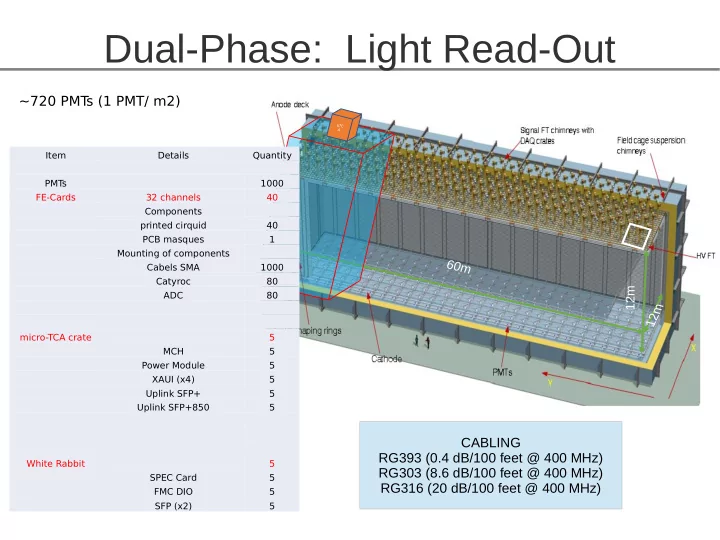
Dual-Phase: Light Read-Out ~720 PMT s (1 PMT/ m2) TC A Item Details Quantity PMT s 1000 FE-Cards 32 channels 40 Components printed cirquid 40 PCB masques 1 Mounting of components Cabels SMA 1000 Catyroc 80 12m ADC 80


slide-1
SLIDE 1

Dual-Phase: Light Read-Out

12m

µTC A

~720 PMT s (1 PMT/ m2)

Item Details Quantity PMT s 1000 FE-Cards 32 channels 40 Components printed cirquid 40 PCB masques 1 Mounting of components Cabels SMA 1000 Catyroc 80 ADC 80 micro-TCA crate 5 MCH 5 Power Module 5 XAUI (x4) 5 Uplink SFP+ 5 Uplink SFP+850 5 White Rabbit 5 SPEC Card 5 FMC DIO 5 SFP (x2) 5

CABLING RG393 (0.4 dB/100 feet @ 400 MHz) RG303 (8.6 dB/100 feet @ 400 MHz) RG316 (20 dB/100 feet @ 400 MHz)

slide-2
SLIDE 2

2

LRO Card in brief

Development for protoDUNE-DP consists of a daughter board (IPNL, LAPP, Omega, APC) and a commercial motherboard. 16 channels Anti-aliasing low pass filter ADC: AD9249 65 MHz, 14 bits provides waveform with a window of ± 4ms around beam trigger down- sampled to 400 ns ASIC: CATIROC Provides auto-triggered channel- wise Q, t and generates light trigger

More hardware details can be found in: DUNE FD DAQ Workshop Oct 30-31 https://indico.fnal.gov/event/15366/session/4/contribution/30/material/slides/1.pdf

slide-3
SLIDE 3

3

ADC & Catiroc

ADC

  • Digitisation at 25ns (possibility to read
  • ut 25ns for special events/runs)
  • Downsampled to 400ns (same as

Charge ReadOut).

  • 16 channel, 2Vp-p, 14 bit [DNL <0.6

LSB, INL <0.9 LSB]

  • Possibility of online processing in

FPGA

CatiROC (Omega)

  • 16 channel for negative pulses

– High/Low noise amplifiers for small and large

signals (charge precision ~30 fC)

  • Variable 8-bit gain/amplifier/channel

– Preamp followed by 2 variable slow shapers to

measure up to 50 pC

  • Time: coarse + fine timing

– 10 bit Wilkingson ADC to convert charge and

fine time at 160 MHz

– Deadtime ~5 us – 2 x 16 effective channels (2 capacitors)

  • Fast shaper/channel followed by a discriminator*

for auto-triggering

– Timestamp of 26 bits course time

* One common, leading edge 10 bit threshold

System is flexible Cross-calibration ADC-CatiROC ASIC gives early and precise channelwise Q,T ADC waveform

slide-4
SLIDE 4

4

Global Scheme

LRO Card fully integrable into existing framework (Charge ReadOut) uTCA standard Synchronised channels per card AMC motherboard takes clock through uTCA backplane Crate Sync – dedicated White Rabbit, uTCA slave node acts a sync receiver distributing clocks to the back plane Data readout through data link

slide-5
SLIDE 5

5

Plan

Firmware development of daughter board Testing with pulse generator/PMT signals Installation protoDUNE DP Development of DUNE card

NOW

April 2018 June-Oct 2018 June 2018-Oct 2019

slide-6
SLIDE 6

6

Prospectives

Merger of Daughter and IPNL developed Mother board

  • AdvancedMC (AMC)

doublewidth slots

  • 32 channel (2 ADC, 2

ASICs)

  • Lower spec FPGA
  • 32 channels * 11 cards =

352 channels per uTCA crate

  • Continuous read-out (as for

Charge)

  • Increase Dynamic Range of

ADC (currently ± 1V, include DC offset)

  • Pulse processing on FPGA
slide-7
SLIDE 7

7

Interface PhotoDetection

  • Number of readout channels (to be determined by

simulations and/or measurements). Simulations must be complete and include attenuation, Rayleigh scattering, cathode transparency, PDE of coated PMTs.

  • Dynamic range at the input to Front-End
  • Deep understanding of PMT characteristics: saturation,

recovery time, ringing, pre-, delayed and after pulsing, since this impacts the FE electronics (e.g. trigger scheme, dead time)

  • Ringing should be suppressed at the level of the PMT base

to avoid creating false multiple events, which will result in an increased dead-time and the generation of spurious LRO triggers.

  • Definition of connectors to be used at the FE input panel.