dt < | ( ) | h t (this has to do with system stability - - PDF document

dt h t this has to do with system stability system
SMART_READER_LITE
LIVE PREVIEW

dt < | ( ) | h t (this has to do with system stability - - PDF document

CT, LTI Systems CT, LTI Systems Consider the following CT LTI system: Chapter 5 Chapter 5 ( ) ( ) ( ) x t h t y t Frequency Domain Analysis Frequency Domain Analysis of Systems of Systems Assumption: the impulse response h ( t


slide-1
SLIDE 1

1 1 Chapter 5 Frequency Domain Analysis

  • f Systems

Chapter 5 Frequency Domain Analysis

  • f Systems
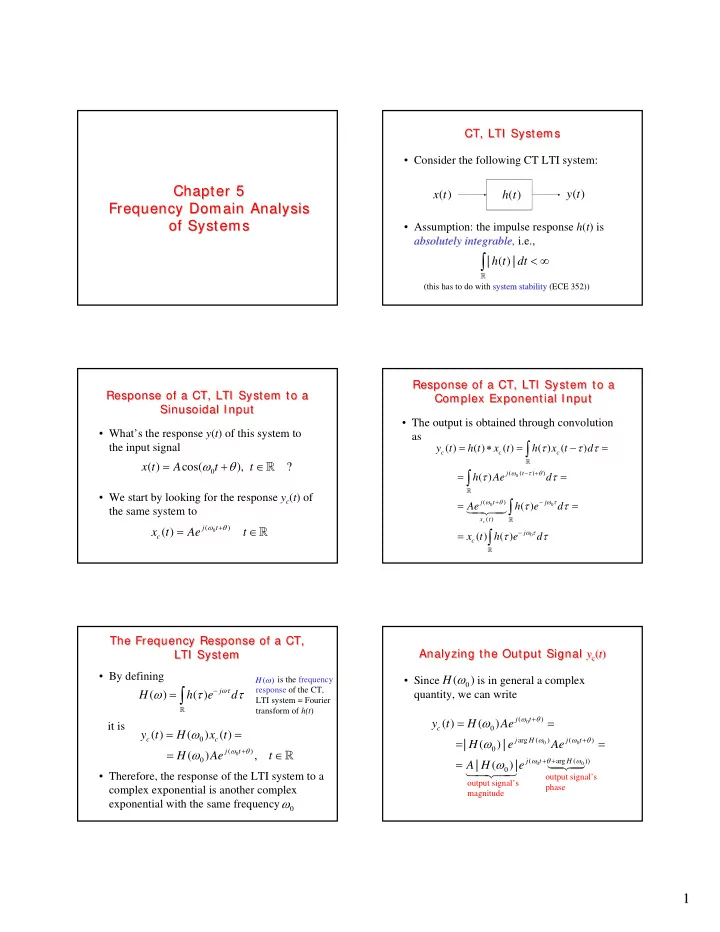
  • Consider the following CT LTI system:
  • Assumption: the impulse response h(t) is

absolutely absolutely integrable integrable, , i.e., CT, LTI Systems CT, LTI Systems

( ) y t ( ) x t ( ) h t | ( ) | h t dt < ∞

  • (this has to do with system stability

system stability (ECE 352))

  • What’s the response y(t) of this system to

the input signal

  • We start by looking for the response yc(t) of

the same system to Response of a CT, LTI System to a Sinusoidal Input Response of a CT, LTI System to a Sinusoidal Input

( ) cos( ), ? x t A t t ω θ = + ∈

( )

( )

j t c

x t Ae t

ω θ +

= ∈

  • The output is obtained through convolution

as Response of a CT, LTI System to a Complex Exponential Input Response of a CT, LTI System to a Complex Exponential Input

( ( ) ) ( ) ( )

( ) ( ) ( ) ( ) ( ) ( ) ( ) ( ) ( )

c

c c c j t j t j x t j c

y t h t x t h x t d h Ae d Ae h e d x t h e d

ω τ θ ω θ ω τ ω τ

τ τ τ τ τ τ τ τ τ

− + + − −

= ∗ = − = = = = = =

∫ ∫ ∫ ∫

  • By defining

it is

  • Therefore, the response of the LTI system to a

complex exponential is another complex exponential with the same frequency The Frequency Response of a CT, LTI System The Frequency Response of a CT, LTI System

( ) ( )

j

H h e d

ωτ

ω τ τ

= ∫

  • (

)

( ) ( ) ( ) ( ) ,

c c j t

y t H x t H Ae t

ω θ

ω ω

+

= = = ∈

is the frequency response of the CT, LTI system = Fourier transform of h(t) ( ) H ω

ω

  • Since is in general a complex

quantity, we can write Analyzing the Output Signal yc(t) Analyzing the Output Signal yc(t)

( ) arg ( ) ( ) ( arg ( ))

( ) ( ) | ( ) | | ( ) |

j t c j H j t j t H

y t H Ae H e Ae A H e

ω θ ω ω θ ω θ ω

ω ω ω

+ + + +

= = = = =

  • (

) H ω

  • utput signal’s

magnitude

  • utput signal’s

phase

slide-2
SLIDE 2

2 2

  • With Euler’s formulas we can express

as and, by exploiting linearity exploiting linearity, it is Response of a CT, LTI System to a Sinusoidal Input Response of a CT, LTI System to a Sinusoidal Input

( ) cos( ) x t A t ω θ = +

1 2

( ) ( ( )) ( ( ) ( ))

c c c

x t x t x t x t

= ℜ = +

( )

1 2

( ) ( ( )) ( ( ) ( )) | ( ) | cos arg ( )

c c c

y t y t y t y t A H t H ω ω θ ω

= ℜ = + = = + +

  • Thus, the response to

is which is also a sinusoid with the same frequency but with the amplitude amplitude scaled by scaled by the factor the factor and with the phase shifted by amount Response of a CT, LTI System to a Sinusoidal Input – Cont’d Response of a CT, LTI System to a Sinusoidal Input – Cont’d

( ) cos( ) x t A t ω θ = +

( )

( ) cos | arg ( ) ( ) | y t A t H H θ ω ω ω = + + ω | ( ) | H ω arg ( ) H ω

  • Consider the following DT, LTI system:
  • The I/O relation is given by

DT, LTI Systems DT, LTI Systems

[ ] y n [ ] x n [ ] h n [ ] [ ] [ ] y n h n x n = ∗

  • If the input signal is
  • Then the output signal is given by

where Response of a DT, LTI System to a Complex Exponential Input Response of a DT, LTI System to a Complex Exponential Input

( )

[ ]

j n c

x n Ae n

ω θ +

= ∈

( )

[ ] ( ) [ ] ( ) ,

c c j n

y n H x n H Ae n

ω θ

ω ω

+

= = = ∈ ( ) [ ] ,

j k k

H h k e

ω

ω ω

− ∈

= ∈

  • is the frequency

response of the DT, LTI system = DT Fourier transform (DTFT) of h[n] ( ) H ω

Response of a DT, LTI System to a Sinusoidal Input Response of a DT, LTI System to a Sinusoidal Input

  • If the input signal is
  • Then the output signal is given by

[ ] cos( ) x n A n n ω θ = + ∈

( )

[ ] cos | arg ( ) ( ) | y n A n H H θ ω ω ω = + +

  • Suppose that the frequency response of a

CT, LTI system is defined by the following specs: Example: Response of a CT, LTI System to Sinusoidal Inputs Example: Response of a CT, LTI System to Sinusoidal Inputs

1.5, 20, | ( ) | 0, 20, H ω ω ω ≤ ≤ ⎧ = ⎨ > ⎩ arg ( ) 60 , H ω ω = − ∀

  • |

( ) | H ω arg ( ) H ω ω ω 20 1.5 60 −

slide-3
SLIDE 3

3 3

  • If the input to the system is
  • Then the output is

Example: Response of a CT, LTI System to Sinusoidal Inputs – Cont’d Example: Response of a CT, LTI System to Sinusoidal Inputs – Cont’d

( ) 2cos(10 90 ) 5cos(25 120 ) x t t t = + + +

  • |

(10) | | (2 ( ) 2 cos(10 90 ) 5 cos(25 120 arg (10) arg ) 3cos 5) | (10 30 ) (25) H H y t t t t H H = + + + + + + = = +

  • Consider the RC circuit shown in figure

Example: Frequency Analysis of an RC Circuit Example: Frequency Analysis of an RC Circuit

  • From ENGR 203, we know that:
  • 1. The complex impedance

complex impedance of the capacitor is equal to where

  • 2. If the input voltage is , then the
  • utput signal is given by

Example: Frequency Analysis of an RC Circuit – Cont’d Example: Frequency Analysis of an RC Circuit – Cont’d

1/ sC s j σ ω = + ( )

st c

x t e = 1/ 1/ ( ) 1/ 1/

st st c

sC RC y t e e R sC s RC = = + +

  • Setting , it is

whence we can write where Example: Frequency Analysis of an RC Circuit – Cont’d Example: Frequency Analysis of an RC Circuit – Cont’d

s jω = 1/ ( ) 1/

j t c

RC y t e j RC

ω

ω = + ( )

j t c

x t e ω =

and and

( ) ( ) ( )

c c

y t H x t ω = 1/ ( ) 1/ RC H j RC ω ω = +

Example: Frequency Analysis of an RC Circuit – Cont’d Example: Frequency Analysis of an RC Circuit – Cont’d

2 2

1/ | ( ) | (1/ ) RC H RC ω ω = +

( )

arg ( ) arctan H RC ω ω = −

1/ 1000 RC =

  • The knowledge of the frequency response

allows us to compute the response y(t) of the system to any sinusoidal input signal since Example: Frequency Analysis of an RC Circuit – Cont’d Example: Frequency Analysis of an RC Circuit – Cont’d

( ) H ω ( ) cos( ) x t A t ω θ = +

( )

( ) cos | arg ( ) ( ) | y t A t H H θ ω ω ω = + +

slide-4
SLIDE 4

4 4

  • Suppose that and that
  • Then, the output signal is

Example: Frequency Analysis of an RC Circuit – Cont’d Example: Frequency Analysis of an RC Circuit – Cont’d

( ) cos(100 ) cos(3000 ) x t t t = + 1/ 1000 RC =

arg (100) arg (3000 ( ) cos(100 ) cos(3000 ) 0.9950cos(10 | (100) | | (30 5.71 ) 0.3162cos(3 00) | 000 7 ) 1.56 ) y t t t t t H H H H = + + + + = = − + −

  • Example: Frequency Analysis of an

RC Circuit – Cont’d Example: Frequency Analysis of an RC Circuit – Cont’d

( ) x t ( ) y t

  • Suppose now that

( ) cos(100 ) cos(50,000 ) x t t t = +

Example: Frequency Analysis of an RC Circuit – Cont’d Example: Frequency Analysis of an RC Circuit – Cont’d

  • Then, the output signal is

arg (100) arg (50,000) ( ) cos(100 ) cos(50,000 ) 0.9950cos(10 | (100) | | (50,000) 5.71 ) 0.0200cos(50,000 88.85 | ) y t t t t t H H H H = + + + + = = − + −

  • Example: Frequency Analysis of an

RC Circuit – Cont’d Example: Frequency Analysis of an RC Circuit – Cont’d

( ) x t ( ) y t

The RC circuit behaves as a lowpass lowpass filter filter, by letting low- frequency sinusoidal signals pass with little attenuation and by significantly attenuating high-frequency sinusoidal signals

  • Suppose that the input to the CT, LTI

system is a periodic signal periodic signal x(t) having period T

  • This signal can be represented through its

Fourier series Fourier series as Response of a CT, LTI System to Periodic Inputs Response of a CT, LTI System to Periodic Inputs

( ) ,

jk t x k k

x t c e t

ω ∞ =−∞

= ∈

  • 1

( ) ,

t T jk t x k t

c x t e dt k T

ω + −

= ∈

  • where
  • By exploiting the previous results and the

linearity of the system, the output of the system is Response of a CT, LTI System to Periodic Inputs – Cont’d Response of a CT, LTI System to Periodic Inputs – Cont’d

( ar arg ( g( ) ) | ) | ( arg( ) )

| ( ) ( ) | ( ) | | | | ,

x k y k y k

jk t x k k j k t c x k k c j k t c jk t y y k k k k k H

y t H k c e c e c e t k c e H

ω ω ω ω ω

ω ω

∞ =−∞ ∞ + + =−∞ ∞ ∞ + =−∞ =−∞

= = = = = ∈

∑ ∑ ∑ ∑

  • arg

y k

c

slide-5
SLIDE 5

5 5

Example: Response of an RC Circuit to a Rectangular Pulse Train Example: Response of an RC Circuit to a Rectangular Pulse Train

  • Consider the RC circuit

with input ( )

rect( 2 )

n

x t t n

= −

  • We have found its Fourier series to be

with Example: Response of an RC Circuit to a Rectangular Pulse Train – Cont’d Example: Response of an RC Circuit to a Rectangular Pulse Train – Cont’d

( ) ,

x jk t k k

x t c e t

π ∈

= ∈

  • 1 sinc

2 2

x k

k c ⎛ ⎞ = ⎜ ⎟ ⎝ ⎠

( ) rect( 2 )

n

x t t n

= −

  • Magnitude spectrum of input signal x(t)

Example: Response of an RC Circuit to a Rectangular Pulse Train – Cont’d Example: Response of an RC Circuit to a Rectangular Pulse Train – Cont’d

| |

x k

c

  • The frequency response of the RC circuit

was found to be

  • Thus, the Fourier series of the output signal

is given by Example: Response of an RC Circuit to a Rectangular Pulse Train – Cont’d Example: Response of an RC Circuit to a Rectangular Pulse Train – Cont’d

1/ ( ) 1/ RC H j RC ω ω = + ( ) ( )

jk t jk t x y k k k k

y t H k c e c e

ω ω

ω

∞ ∞ =−∞ =−∞

= =

∑ ∑

Example: Response of an RC Circuit to a Rectangular Pulse Train – Cont’d Example: Response of an RC Circuit to a Rectangular Pulse Train – Cont’d

| ( ) | ( ) H dB ω

ω

1/ 1 RC = 1/ 10 RC = 1/ 100 RC = filter more selective

Example: Response of an RC Circuit to a Rectangular Pulse Train – Cont’d Example: Response of an RC Circuit to a Rectangular Pulse Train – Cont’d

| |

y k

c

1/ 1 RC =

| |

y k

c | |

y k

c

1/ 100 RC = 1/ 10 RC = filter more selective

slide-6
SLIDE 6

6 6

Example: Response of an RC Circuit to a Rectangular Pulse Train – Cont’d Example: Response of an RC Circuit to a Rectangular Pulse Train – Cont’d

( ) y t ( ) y t ( ) y t

1/ 1 RC = 1/ 10 RC = 1/ 100 RC = filter more selective

  • Consider the following CT, LTI system
  • Its I/O relation is given by

which, in the frequency domain, becomes Response of a CT, LTI System to Aperiodic Inputs Response of a CT, LTI System to Aperiodic Inputs

( ) y t ( ) x t ( ) h t ( ) ( ) ( ) y t h t x t = ∗ ( ) ( ) ( ) Y H X ω ω ω =

  • From , the magnitude

magnitude spectrum spectrum of the output signal y(t) is given by and its phase spectrum phase spectrum is given by Response of a CT, LTI System to Aperiodic Inputs – Cont’d Response of a CT, LTI System to Aperiodic Inputs – Cont’d

( ) ( ) ( ) Y H X ω ω ω = arg ( ) arg arg ( ( ) ) H Y X ω ω ω = + | ( | ( ) | | | ( ) | ) H Y X ω ω ω =

Example: Response of an RC Circuit to a Rectangular Pulse Example: Response of an RC Circuit to a Rectangular Pulse

  • Consider the RC circuit

with input

( ) rect( ) x t t =

  • The Fourier transform of x(t) is

Example: Response of an RC Circuit to a Rectangular Pulse – Cont’d Example: Response of an RC Circuit to a Rectangular Pulse – Cont’d ( ) rect( ) x t t =

( ) sinc 2 X ω ω π ⎛ ⎞ = ⎜ ⎟ ⎝ ⎠

Example: Response of an RC Circuit to a Rectangular Pulse – Cont’d Example: Response of an RC Circuit to a Rectangular Pulse – Cont’d

| ( ) | X ω arg ( ) X ω

slide-7
SLIDE 7

7 7

Example: Response of an RC Circuit to a Rectangular Pulse – Cont’d Example: Response of an RC Circuit to a Rectangular Pulse – Cont’d

| ( ) | Y ω arg ( ) Y ω 1/ 1 RC =

Example: Response of an RC Circuit to a Rectangular Pulse – Cont’d Example: Response of an RC Circuit to a Rectangular Pulse – Cont’d

1/ 10 RC = | ( ) | Y ω arg ( ) Y ω

  • The response of the system in the time

domain can be found by computing the convolution where Example: Response of an RC Circuit to a Rectangular Pulse – Cont’d Example: Response of an RC Circuit to a Rectangular Pulse – Cont’d

(1/ )

( ) (1/ ) ( )

RC t

h t RC e u t

= ( ) rect( ) x t t = ( ) ( ) ( ) y t h t x t = ∗

Example: Response of an RC Circuit to a Rectangular Pulse – Cont’d Example: Response of an RC Circuit to a Rectangular Pulse – Cont’d

1/ 1 RC = 1/ 10 RC = ( ) y t ( ) y t filter more selective

Example: Attenuation of High- Frequency Components Example: Attenuation of High- Frequency Components

( ) Y ω ( ) H ω ( ) X ω

=

×

Example: Attenuation of High- Frequency Components Example: Attenuation of High- Frequency Components ( ) y t ( ) x t

slide-8
SLIDE 8

8 8

  • The response of a CT, LTI system with

frequency response to a sinusoidal signal

  • Filtering

Filtering: if or then or Filtering Signals Filtering Signals

( ) cos( ) x t A t ω θ = +

( )

( ) cos | arg ( ) ( ) | y t A t H H θ ω ω ω = + + ( ) H ω | ( ) | 0 H ω = | ( ) | 0 H ω ≈ ( ) y t = ( ) 0, y t t ≈ ∀ ∈

is is Four Basic Types of Filters Four Basic Types of Filters

lowpass lowpass

| ( ) | H ω | ( ) | H ω | ( ) | H ω | ( ) | H ω

bandstop bandstop bandpass bandpass highpass highpass

passband passband cutoff frequency cutoff frequency stopband stopband stopband stopband

(many more details about filter design in ECE 464/564 and ECE 56 (many more details about filter design in ECE 464/564 and ECE 567) 7)

  • Filters are usually designed based on

specifications on the magnitude response

  • The phase response has to be taken

into account too in order to prevent signal distortion as the signal goes through the system

  • If the filter has linear phase

linear phase in its passband(s), then there is no distortion no distortion Phase Function Phase Function

| ( ) | H ω arg ( ) H ω

  • A filter is said to have linear phase if
  • If is in passband of a linear phase filter,

its response to is Linear-Phase Filters Linear-Phase Filters

( ) H ω arg ( ) , passband

d

H t ω ω ω = − ∀ ∈ ω ( ) cos( ) x t A t ω = ( ) | ( ) | cos( ) | ( ) | cos( ( ))

d d

y t A H t t A H t t ω ω ω ω ω = − = = −

  • The frequency response of an ideal lowpass

filter is defined by Ideal Linear-Phase Lowpass Ideal Linear-Phase Lowpass

, [ , ] ( ) 0, [ , ]

d

j t

e B B H B B

ω

ω ω ω

⎧ ∈ − = ⎨ ∉ − ⎩

arg ( ) H ω

  • can be written as

whose inverse Fourier transform is Ideal Linear-Phase Lowpass – Cont’d Ideal Linear-Phase Lowpass – Cont’d

( ) H ω ( ) rect 2

d

j t

H e B

ω

ω ω

⎛ ⎞ = ⎜ ⎟ ⎝ ⎠ B ( ) sinc ( )

d

B h t t t π π ⎛ ⎞ = − ⎜ ⎟ ⎝ ⎠

slide-9
SLIDE 9

9 9

Ideal Linear-Phase Lowpass – Cont’d Ideal Linear-Phase Lowpass – Cont’d

B ( ) sinc ( )

d

B h t t t π π ⎛ ⎞ = − ⎜ ⎟ ⎝ ⎠

Notice: the filter is Notice: the filter is noncausal noncausal since is not zero for since is not zero for

( ) h t t <

  • Consider the ideal sampler:
  • It is convenient to express the sampled signal

as where Ideal Sampling Ideal Sampling

( ) x t [ ] ( ) ( )

t nT

x n x t x nT

=

= =

. .

T n∈ ( ) x nT ( ) ( ) x t p t ( ) ( )

n

p t t nT δ

= −

  • t ∈
  • Thus, the sampled waveform is
  • is an impulse train whose weights

(areas) are the sample values of the

  • riginal signal x(t)

Ideal Sampling – Cont’d Ideal Sampling – Cont’d

( ) ( ) ( ) ( ) ( ) ( )

n n

x t p t x t t nT x nT t nT δ δ

∈ ∈

= − = −

∑ ∑

  • ( ) ( )

x t p t ( ) ( ) x t p t ( ) x nT

  • Since p(t) is periodic with period T, it can

be represented by its Fourier series Fourier series Ideal Sampling – Cont’d Ideal Sampling – Cont’d

2 ( ) ,

s

jk t k s k

p t c e T

ω

π ω

= =

  • sampling

sampling frequency frequency ( (rad rad/sec) /sec)

/ 2 / 2 / 2 / 2

1 ( ) , 1 1 ( )

s s

T jk t k T T jk t T

c p t e dt k T t e dt T T

ω ω

δ

− − − −

= ∈ = =

∫ ∫

  • where

where

  • Therefore

and whose Fourier transform is Ideal Sampling – Cont’d Ideal Sampling – Cont’d

1 ( )

s

jk t k

p t e T

ω ∈

= ∑

  • 1

1 ( ) ( ) ( ) ( ) ( )

s s

jk t jk t s k k

x t x t p t x t e x t e T T

ω ω ∈ ∈

= = =

∑ ∑

  • 1

( ) ( )

s s k

X X k T ω ω ω

= −

  • Ideal Sampling – Cont’d

Ideal Sampling – Cont’d

1 ( ) ( )

s s k

X X k T ω ω ω

= −

  • ( )

X ω

slide-10
SLIDE 10

10 10

  • Suppose that the signal x(t) is bandlimited

with bandwidth B, i.e.,

  • Then, if the replicas of in

do not overlap and can be recovered by applying an ideal lowpass filter to (interpolation filter interpolation filter) Signal Reconstruction Signal Reconstruction

| ( ) | 0, for | | X B ω ω = > 2 ,

s

B ω ≥ ( ) X ω 1 ( ) ( )

s s k

X X k T ω ω ω

= −

  • ( )

X ω ( )

s

X ω

Interpolation Filter for Signal Reconstruction Interpolation Filter for Signal Reconstruction

, [ , ] ( ) 0, [ , ] T B B H B B ω ω ω ∈ − ⎧ = ⎨ ∉ − ⎩

  • The impulse response h(t) of the interpolation

filter is and the output y(t) of the interpolation filter is given by Interpolation Formula Interpolation Formula

B ( ) sinc BT h t t π π ⎛ ⎞ = ⎜ ⎟ ⎝ ⎠ ( ) ( ) ( )

s

y t h t x t = ∗

  • But

whence

  • Moreover,

Interpolation Formula – Cont’d Interpolation Formula – Cont’d

( ) ( ) ( ) ( ) ( )

s n

x t x t p t x nT t nT δ

= = −

  • ( )

( ) ( ) ( ) ( ) ( )sinc ( )

s n n

y t h t x t x nT h t nT BT B x nT t nT π π

∈ ∈

= ∗ = − = ⎛ ⎞ = − ⎜ ⎟ ⎝ ⎠

∑ ∑

  • ( )

( ) y t x t =

  • A CT bandlimited signal x(t) with frequencies

no higher than B can be reconstructed from its samples if the samples are taken at a rate

  • The reconstruction of x(t) from its samples

is provided by the interpolation formula Shannon’s Sampling Theorem Shannon’s Sampling Theorem

[ ] ( ) x n x nT = 2 / 2

s

T B ω π = ≥ si ( n ) c ) ( ) (

n

B x T B t T x t nT n π π

⎛ ⎞ = − ⎜ ⎟ ⎝ ⎠

  • (

[ ) ] x x n nT =

  • The minimum sampling rate

is called the Nyquist rate

  • Question: Why do CD’s adopt a sampling

rate of 44.1 kHz?

  • Answer: Since the highest frequency

perceived by humans is about 20 kHz, 44.1 kHz is slightly more than twice this upper bound Nyquist Rate Nyquist Rate

2 / 2

s

T B ω π = =

slide-11
SLIDE 11

11 11

Aliasing Aliasing

1 ( ) ( )

s s k

X X k T ω ω ω

= −

  • ( )

X ω

  • Because of aliasing, it is not possible to

reconstruct x(t) exactly by lowpass filtering the sampled signal

  • Aliasing results in a distorted version of the
  • riginal signal x(t)
  • It can be eliminated (theoretically) by

lowpass filtering x(t) before sampling it so that for Aliasing –Cont’d Aliasing –Cont’d

( ) ( ) ( )

s

x t x t p t = | ( ) | 0 X ω = | | B ω ≥