Deep Neural Networks and Mixed Integer Linear Optimization Matteo - - PowerPoint PPT Presentation

deep neural networks and mixed integer linear optimization
SMART_READER_LITE
LIVE PREVIEW

Deep Neural Networks and Mixed Integer Linear Optimization Matteo - - PowerPoint PPT Presentation

Deep Neural Networks and Mixed Integer Linear Optimization Matteo Fischetti, University of Padova 1 Pittsburgh, 21 September 2018 Machine Learning Example (MIPpers only!): Continuous 0-1 Knapack Problem with a fixed n. of items


slide-1
SLIDE 1

Deep Neural Networks and Mixed Integer Linear Optimization

Matteo Fischetti, University of Padova

Pittsburgh, 21 September 2018 1
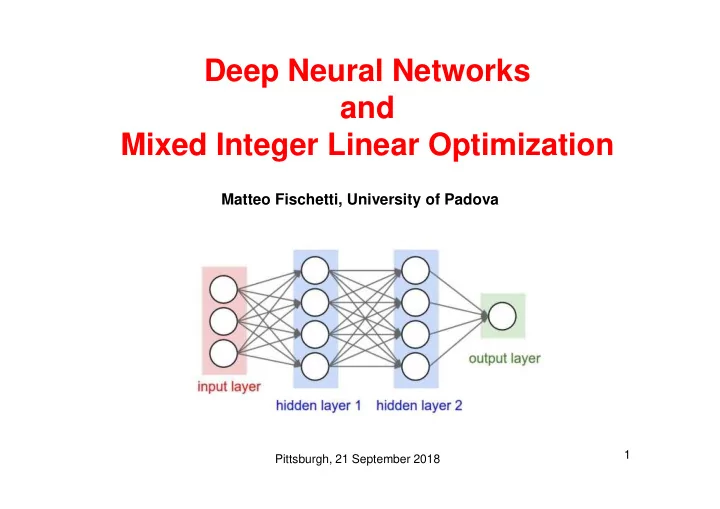
slide-2
SLIDE 2

Machine Learning

  • Example (MIPpers only!): Continuous 0-1 Knapack Problem with a

fixed n. of items

Pittsburgh, 21 September 2018 2

slide-3
SLIDE 3

Implementing the ? in the box

Pittsburgh, 21 September 2018 3

slide-4
SLIDE 4

Implementing the ? in the box

Pittsburgh, 21 September 2018 4

slide-5
SLIDE 5

Deep Neural Networks (DNNs)

  • Parameters w’s are organized in a layered feed-forward network (DAG =

Directed Acyclic Graph)

  • Each node (or “neuron”) makes a weighted sum of the outputs of the

previous layer no “flow splitting/conservation” here!

Pittsburgh, 21 September 2018 5

slide-6
SLIDE 6

The need of nonlinearities

  • We want to be able to play with a huge n. of parameters, but if

everything stays linear we actually have n+1 parameters only we need nonlinearities somewhere!

  • Zooming into neurons we see the nonlinear “activation functions”

Pittsburgh, 21 September 2018 6

  • Each neuron acts as a linear SVM, however …

… its output is not interpreted immediately … … but it becomes a new feature … … to be forwarded to the next layer for further analysis #SVMcascade

slide-7
SLIDE 7

Training

  • For a given DNN, we need to give appropriate values to the (w,b)

parameters to approximate the output function f well

  • Warning: DNNs

are usually highly

  • ver-parametrized!
  • Supervised learning:
  • Supervised learning:

– define an optimization problem where the parameters are the unknowns – (huge) training set of points x for which we know the “true” value f*(x) –

  • bjective function: average loss/error over the training set (+ regularization

terms) to be minimized on the training set (but … not too much!) – validation set: can be used to select “hyperparameters” not directly handled by the optimizer (it plays a crucial role indeed…) – test set: points not seen during training, used to evaluate the actual accuracy of the DNN on (future) unseen data.

Pittsburgh, 21 September 2018 7

slide-8
SLIDE 8

The three pillars of (practical) Deep Learning

Pittsburgh, 21 September 2018 8

2) Backpropagation 1) Stochastic Gradient Descent 3) GPUs (and open-source Python libraries like Keras, pyTorch, TensorFlow etc.)

slide-9
SLIDE 9

Stochastic Gradient Descent (SGD)

  • Objective function to minimize:

average error over a huge training set (hundreds of millions of param.s and training points)

  • SGD is not at all a naïve approach!

– Very well suited here as the objective is an average over the training set, so one can approximate it by selecting a random training point (or a small “mini-batch” of such points) at each iteration (or a small “mini-batch” of such points) at each iteration – Practical experience shows that it often leads to a very good local minimum that “generalizes well” over unseen points – Further regularization by dropout (just an easy way to hurt

  • ptimization!)
  • Question: does it make sense to look for global optimal solutions using

much more sophisticated methods, that are more time consuming and are unlike to generalize equally well?

Pittsburgh, 21 September 2018 9

slide-10
SLIDE 10

Efficient gradient computation

  • We are given a single training point and the current param.s

and we want to compute the gradient of the error function E in

  • Linearize the DNN w.r.t.

Notation: we have a “measure point” xj before and after each activation in the linearization, the slope gives the output change when the input x is increased by 1 w.r.t.

Pittsburgh, 21 September 2018 10

slide-11
SLIDE 11

Backpropagation

  • Let be the increase of E when xj is increased by 1
  • Iteratively compute the δj’s backwards (starting from the final xj )
  • .…
  • .…

Pittsburgh, 21 September 2018 11

slide-12
SLIDE 12

Backpropagation

  • Once all δj’s have been computed (after/before each activation) one

can easily read each gradient component (in the linearized network, this is just the increase of E when a parameter is increased by 1)

Pittsburgh, 21 September 2018 12

slide-13
SLIDE 13

Modeling a DNN with fixed param.s

  • Assume all the parameters (weights/biases) of the DNN are fixed
  • We want to model the computation that produces the output value(s)

as a function of the inputs, using a MINLP #MIPpersToTheBone

  • Each hidden node corresponds to a summation

followed by a nonlinear activation function followed by a nonlinear activation function

Pittsburgh, 21 September 2018 13

slide-14
SLIDE 14

Modeling ReLU activations

  • Recent work on DNNs almost invariably only use ReLU activations
  • Easily modeled as

– plus the bilinear condition – or, alternatively, the indicator constraints

Pittsburgh, 21 September 2018 14

slide-15
SLIDE 15

A complete 0-1 MILP

  • See also: Serra, T., Tjandraatmadja, C., Ramalingam, S. (2017). Bounding and counting linear

regions of deep neural networks. CoRR arXiv:1711.02114. Pittsburgh, 21 September 2018 15

slide-16
SLIDE 16

Convolutional Neural Networks (CNNs)

  • CNNs play a key role, e.g., in image recognition
  • Besides ReLUs, CNNs use
  • Besides ReLUs, CNNs use

pooling operations of the type

  • AvgPool is just linear and can be modeled as a linear constraint
  • MaxPool can easily be

modeled within a 0-1 MILP as

Pittsburgh, 21 September 2018 16

slide-17
SLIDE 17

Adversarial problem: trick the DNN …

Pittsburgh, 21 September 2018 17

slide-18
SLIDE 18

… by changing few well-chosen pixels

Pittsburgh, 21 September 2018 18

slide-19
SLIDE 19

Experiments on small DNNs

  • The MNIST database

(Modified National Institute of Standards and Technology database) is a large database

  • f handwritten digits that is

commonly used for training commonly used for training various image processing systems

  • We considered the following (small) DNNs and trained each of

them to get a fair accuracy (93-96%)

  • n the test-set

Pittsburgh, 21 September 2018 19

slide-20
SLIDE 20

Computational experiments

  • Instances: 100 MNIST training figures (each with its “true” label 0..9)
  • Goal: Change some of the 28x28 input pixels (real values in 0-1) to

convert the true label d into (d + 5) mod 10 (e.g., “0” “5”, “6” “1”)

  • Metric: L1 norm (sum of the abs. differences original-modified pixels)
  • MILP solver: IBM ILOG CPLEX 12.7 (as black box)

– Basic model: only obvious bounds on the continuous var.s – Improved model: apply a MILP-based preprocessing to compute tight lower/upper bounds on all the continuous variables, as in

  • P. Belotti, P. Bonami, M. Fischetti, A. Lodi, M. Monaci, A. Nogales-Gomez, and D. Salvagnin.

On handling indicator constraints in mixed integer programming. Computational Optimization and Applications, (65):545–566, 2016.

Pittsburgh, 21 September 2018 20

slide-21
SLIDE 21

Differences between the two models

Pittsburgh, 21 September 2018 21

slide-22
SLIDE 22

Effect of bound-tightening preproc.

Pittsburgh, 21 September 2018 22

slide-23
SLIDE 23

Reaching 1% optimality

Pittsburgh, 21 September 2018 23

slide-24
SLIDE 24

Thanks for your attention!

Slides available at http://www.dei.unipd.it/~fisch/papers/slides/ Paper:

  • M. Fischetti, J. Jo, "Deep Neural Networks as 0-1 Mixed Integer Linear

Programs: A Feasibility Study", 2017, arXiv preprint arXiv:1712.06174 (accepted in CPAIOR 2018) .

Pittsburgh, 21 September 2018 24