drug holidays ver 7-10 7/13/2018 Long-term Treatment and Drug - - PowerPoint PPT Presentation

drug holidays ver 7 10 7 13 2018
SMART_READER_LITE
LIVE PREVIEW

drug holidays ver 7-10 7/13/2018 Long-term Treatment and Drug - - PowerPoint PPT Presentation

drug holidays ver 7-10 7/13/2018 Long-term Treatment and Drug Financial Disclosures Holidays Include some interesting/surprisingly -Consulting or advisory boards: hot-off-the-press results Radius, Asahi-Kasei Dennis M. Black, PhD Professor


slide-1
SLIDE 1

drug holidays ver 7-10 7/13/2018 1

1

Long-term Treatment and Drug Holidays Include some interesting/surprisingly hot-off-the-press results

Dennis M. Black, PhD Professor Epidemiology and Biostatistics, UCSF

Financial Disclosures

  • Consulting or advisory boards:

Radius, Asahi-Kasei

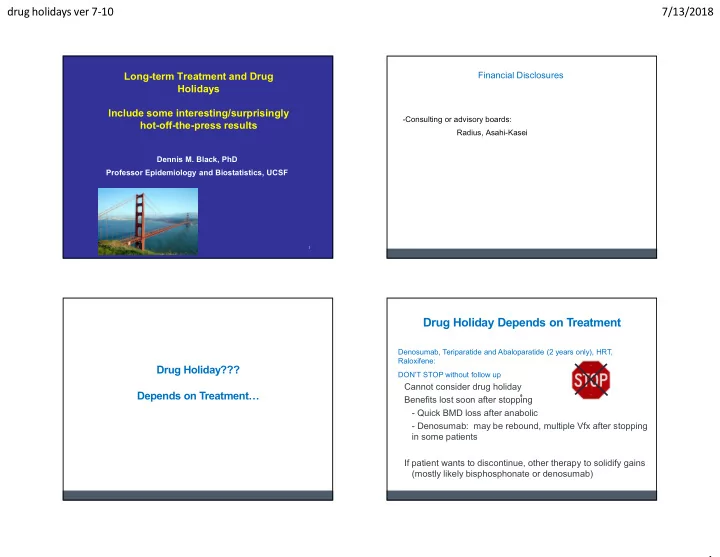
Drug Holiday??? Depends on Treatment…

Drug Holiday Depends on Treatment

Denosumab, Teriparatide and Abaloparatide (2 years only), HRT, Raloxifene: DON’T STOP without follow up

Cannot consider drug holiday Benefits lost soon after stopping

  • Quick BMD loss after anabolic
  • Denosumab: may be rebound, multiple Vfx after stopping

in some patients If patient wants to discontinue, other therapy to solidify gains (mostly likely bisphosphonate or denosumab)

slide-2
SLIDE 2

drug holidays ver 7-10 7/13/2018 2 Drug Holiday For Bisphosphonates

Alendronate or Zoledronic acid (RCT evidence)

  • Residual benefit after stopping
  • Can consider drug holiday (I’ll tell you why)

Risedronate or ibandronate

  • Less evidence about residual benefit
  • More cautious about drug holidays

ASBMR Task Force Guidelines on Long Term Treatment (Adler et al 2015-16)

7

Benefits and Risks for Treatment Beyond 5 Years

  • 1. Benefits/efficacy
  • 2. Risks (AFF)

Benefits of BP Beyond 5 Years….

2 4 6 8 10

Risedronate Alendronate Zoledronic acid

ALN = alendronate; DB = double-blind; EXT 1= extension 1; EXT 2= extension 2; FIT = Fracture Intervention Trial; FLEX = FIT Long-term EXtension; HORIZON-PFT = Health Outcomes and Reduced Incidence with Zoledronic acid Once Yearly Pivotal Fracture Trial; OL, Open-label; PBO = placebo; RCT = randomized controlled trial; RIS = risedronate; VERT-MN = Vertebral Efficacy with Risedronate Therapy MultiNational; Z3P3 = zoledronic acid treatment for 3 years followed by placebo for 3 years; Z6 = zoledronic acid treatment for 6 years; ZOL = zoledronic acid.
  • 1. Black DM, et al. N Engl J Med. 2007;356:1809-1822. 2. Black DM, et al. J Bone Miner Res. 2012; 27:243-254. 3. The Effect of 6 versus 9 Years of Zoledronic Acid Treatment in Osteoporosis:
A Randomized Extension to the HORIZON-Pivotal Fracture Trial (PFT).Presented at ASBMR 2013 (abstract no. SA0389). 4. Black DM, et al. Lancet. 1996;348:1535-1541. 5. Cummings SR, et al. JAMA. 1998;280:2077–2082.
  • 6. Black DM, et al. JAMA. 2006;296:2927-2938. 7. Reginster J-Y, et al. Osteoporos Int. 2000;11:83–91. 8. Sorensen OH, et al. Bone. 2003;32:120-126. 9. Mellström DD, et al. Calif Tissue Int. 2004;75:462-468.

FIT4,5

ALN (n = 3236) PBO (n = 3223)

RCT – FLEX6

ALN 5 mg (n = 329) or 10 mg (n = 333) PBO (n = 437)

HORIZON-PFT1

ZOL (n = 3889) PBO (n = 3876)

RCT – EXT12

Z6 (n = 616) Z3P3 (n = 617)

VERT-MN7

RIS 2.5 mg (n = 408) 5 mg (n = 407) PBO (n = 407)

RCT – EXT8

RIS (n=135) PBO (n=130)

OL-EXT9

RIS 7 yrs (n = 83) PBO 5 yrs/RIS 2yrs (n = 81)

RCT – EXT23

Z9 (n = 95) Z6P3 (n = 95)

Time (Years) 0 2 4 6 8 10

Black JAMA 2006; Black et al. JBMR 2012

Black JAMA 2006; Black et al. JBMR 2012

Years FLEX (Alendronate) HORIZON Ext (Zoledronic acid)

slide-3
SLIDE 3

drug holidays ver 7-10 7/13/2018 3

Total Hip BMD Change in FLEX: Residual Benefit After Stopping

= Placebo = ALN (Pooled 5 mg and 10 mg groups) 1 2 3 4 5 F 0 F 1 F 2 F 3 F 4 FL 0 FL 1 FL 2 FL 3 FL 4 FL 5

Mean Percent Change Year Start of FLEX

P<0.001 ALN vs PBO

FIT FLEX FIT 3 to 4.5 yrs FIT/FLEX Recess 1 to 2 yrs FLEX 5 yrs 2.8% * Black, et. al. JAMA, 12/06 0.1 1 10 Vertebral FX (clinical) Non-vertebral Fracture Alendronate (FLEX: 5 yrs/5 yrs

1.00 (0.8, 1.3) 0.45 (0.2, 0.85) 0.99 (0.7, 1.5) 0.48 (0.3, 0.9)

Vertebral FX (morphometric) Non-vertebral Fracture Zoledronic acid: HORIZON: 3yrs/3 yrs

Reductions (Relative Risks) for Fractures for Continuing vs. Discontinuing Bisphosphonates: Alendronate and ZOL

3 Relative Hazard (± 95% CI) Favors Bisphosphonate Favors Placebo Black JAMA 2006; Black et al. JBMR 2012

Fracture reductions with long-term continuation

  • f bisphosphonates (2 RCTs*)
  • Consistent fracture results for Alendronate and ZOL
  • Continuing for an additional 5 years ...
  • Lowers vertebral fractures risk
  • No evidence for a reduction in non-vertebral

− Confidence intervals are wide and allow for possible benefit

  • There are benefits to continuing > 5 years, but fewer than initiating
  • Continue those at highest risk of vertebral fracture

*Black JAMA 2006; Black et al. JBMR 2012

Black JAMA 2006; Black et al. JBMR 2012

12 FLEX vertebral fracture benefit: Who to continue?

Femoral Neck BMD T- Score (start FLEX) 5 Yr risk (%) Clinical Vert.

  • Fx. In PBO

Number Needed to Treat

All women in study

All BMD values 5.5 34 ≤ -2.5 9.3 21

  • 2.5 to -2

5.8 33 ≥ -2 2.3 81 No prevalent vert. fracture (start of FLEX) ≤ -2.5 8.0 24

  • 2.5 to -2

3.0 63 ≥ -2 1.8 102 Prevalent vertebral fracture (start of FLEX) ≤ -2.5 11.1 17

  • 2.5 to -2

11.1 17 ≥ -2 3.7 51 Black, et al. NEJM. 2012 May 31;366(22):2051-3
slide-4
SLIDE 4

drug holidays ver 7-10 7/13/2018 4

What about long term safety? Does AFF risk increase with longer duration of BP treatment? Several studies treatment duration and AFF risk. 2 examples:

  • 1. 2012 Kaiser Southern Calif. case series of AFF*
  • X-rays evaluations: 142 cases
  • Influential (but some methodologic limitations)
  • 2. Swedish study (2008-2010)

*Dell JBMR 2012; **Schilcher et al 2014

14

Incidence of AFF by Duration of BP Exposure in 142 cases from KP So. Calif (2007-10)*

*Dell et. al. JBMR 2012

Incidence of AFF (100,000 person yrs) Duration of Bisphosphonate Use

Similar results in Swedish study

Note: these results are adjusted for age only…what about other confounders? No ASBMR criteria

High risk may be explained by higher fx risk (lower BMD, higher previous fx)

15

Endocrine Reviews: Review of AFF

  • 6 months of my life (with 4 colleagues*)
  • 20,000 words, on line this week
  • Identify important evidence gaps and suggestions

for improved/perfect studies Kaiser S. Cal new study (first results at ASBMR 2018)

*

Thinking too much about AFF…. (obsessed?)

*Black, Abrahamsen, Bouxsein, Einhorn, Napoli . Endo Reviews. Epub 7/2018

Kaiser Permanente Southern California (KPSC) Osteoporosis Cohort Study (SOCS) 2018 Study (D. Black, Annette Adams, Co-PIs)

  • Population 4.5 million, ~990,000 women > age 50 studied
  • Racially diverse cohort
  • Evaluate all x-rays from subtrochanteric and femoral shaft

fractures (ASBMR criteria) from 2007 to 2015 (being extended thru 2017)

  • Adjust in a prospective analysis (time-dependent covars)
  • Adjust for duration of BP use and many other clinical risk factors
  • Novel: Adjust for pre-treatment BMD
  • Goal: prediction tool for AFF risk
  • Also look at decrease in AFF risk following discontinuation of BP

PRELIMINARY RESULTS to be presented at ASBMR 2018 (Sept)

slide-5
SLIDE 5

drug holidays ver 7-10 7/13/2018 5

Kaiser Permanent Southern California Osteoporosis Cohort (SOCS): AFF Risk Factors

In 990k women> age 50, 233 AFFs

  • 25 (10%) in women with no BP use
  • 206 (90%) in women with some BP use

Limited this analysis to 175,000 women >50 who with BP use >=3 months (2007-2017)

Hypotheses:

  • Adjustment for clinical risk factors will attenuate relationship of

BP duration to AFF

  • Adjustment for BMD will further attenuate BP relationships
  • Several clinical variables will be predictive of AFF risk

18

Black, Rosen. NEJM 1/16

Black et al. Endo Reviews In Press

Kaiser Permanent Southern California Osteoporosis Cohort (SOCS) Predictors of AFF (preliminary)

Risk factor Unadjusted RR (p) Multivariable Adjusted RR (p)

BP duration (vs < 1 year) 1-4 years 6 (<0.001) 4 (0.003) 4-8 years

37 (<.001)

19 (<0.001) > 8 years 80 (<0.001) 42 (<0.001) Black, Adams, Geiger, Dell ASBMR 2018 Relative risks are attenuated after adjustment but still a strong association with longer duration beyond 5 years ABSOLUTE RISKS ARE STILL LOW! Adjust for age, Asian race, GC use > 1 year, any fx history, height Surprise! Adjustment for hip BMD (pretreatment) in a subset (150k) made no difference

20

Digression…BMD and AFF: Some really interesting but preliminary results!

  • Analysis using women with BMD and some BP use (about 150,000)

*Dell et. al. JBMR 2012

slide-6
SLIDE 6

drug holidays ver 7-10 7/13/2018 6

20 2.4

60 2 240 2.2

50 100 150 200 250 300

Hip Fracture Risk AFF Risk

Fracture Risk per 10,000 person years

Approximate Hip Fracture Risk (per 10,000 py) by pre-treatment BMD (analysis among women treated with BP)

T>-1 Normal

  • 1>T >-2.5

Osteopenic T<-2.5 Osteoporotic

Legend: Pre-treatment BMD T-score Category

20 2.4 60 2 240 2.2

50 100 150 200 250 300

Hip Fracture Risk AFF Risk

Fracture Risk per 10,000 person years

Approximate Hip Fracture and AFF Risk (per 10,000 py) by Pre-treatment Total Hip BMD

T>-1 Normal

  • 1>T >-2.5

Osteopenic T<-2.5 Osteoporotic

Legend: Pre-treatment BMD T-score Category

Kaiser Permanent Southern California Osteoporosis Cohort (SOCS) Predictors of AFF (preliminary)

Risk factor Unadjusted RR (p) Multivariable Adjusted RR (p)

Younger Age (-5 yrs) 1.02 (0.42) 1.1 (0.003) Asian race 5.2 (<0.001) 3.8 (<0.001) GC use > 1 year 2.3 (<0.001) 2.3(0.0004) Any fracture hx 1.3 (0.06) 1.6 (0.006) Shorter Height (-2 cm) 1.2(<0.001) 1.1 (0.007) BP duration (vs < 1 year) 1-4 years 6 (<0.001) 4 (0.003) 4-8 years

37 (<.001)

19 (<0.001) > 8 years 80 (<0.001) 42 (<0.001) Black, Adams, Geiger, Dell ASBMR 2018

SOCS (KPSC) Study Preliminary Findings:

Hypotheses:

  • Several clinical variables will be predictive of AFF risk
  • Yes
  • Adjustment for clinical risk factors will attenuate relationship of BP

duration to AFF

  • Yes but duration of use still very strong
  • Adjustment for pre-treatment BMD (and prior fracture) will greatly

attenuate BP duration increase in AFF risk

  • WRONG!
  • These results will be used to build predictive equations for AFF risk for

eventual clinical use

  • Help determine which patients should take drug holiday after 3-5 years of BP.
slide-7
SLIDE 7

drug holidays ver 7-10 7/13/2018 7

High Pretreatment BMD More AFF Risk Some thoughts

  • In 2016, with NEJM paper on PM osteoporosis*, I received

about 30 emails from women with a similar story:

  • “when I was 50-52 years old, I had normal/osteopenic BMD and my

doctor started to treatment just to prevent bone loss. Then 10 years later, (age 60-62), I had a devastating AFF with no trauma”.

  • Possible that those with high total hip BMD might already have too

much mineralization and should not be treated?

  • Is AFF risk increased by greater activity in younger women?
  • Should we be more careful about for continuing > 5 years in women

without hip BMD osteoporosis?

  • Does this give any clues to the pathogenesis of AFF?

*Black, Rosen NEJM 2016

Are Drug Holidays Are Likely to be Effective in Reducing AFF Risk?

Years after Discontinuing Swedish study Black, Adams KPSC 2018 0-1 70% 44% 1-4 NA 80% >4 NA 78%

Reduction in AFF in years after discontinuing BPs (compared to continuing) In another study in KPSC (in press, JBMR), on drug holiday, hip and non-vertebral fracture risk did not increase during a drug holiday These two results together support value of BP drug holiday

ASBMR Task Force Guidelines (Adler et al 2015-16)

Suggests drug holiday in those with Hip BMD T-score > -2.5 or not high fracture risk

ASBMR Task Force Guidelines on Long Term BP Therapy (Adler et al 2016)—Where to Update?

  • Suggests evaluation of patients on oral BP’s after 5

years with possible drug holiday in some patients

  • Based recommendations on fracture efficacy only

What’s new?

  • New results suggest considering the AFF risk part of

equation as well.

  • Drug holidays especially for those at higher AFF risk:
  • Asians
  • Those with >> 5 years of BP use
  • Younger patients (e.g. < age 65)
  • (Glucocorticoid (maybe not..also at high risk of hip and

vertebral fracture))

  • ?Normal hip BMD pretreatment?
slide-8
SLIDE 8

drug holidays ver 7-10 7/13/2018 8

ASBMR Task Force Guidelines (Adler et al 2015-16)

  • MORE!

Emerging evidence supports

  • More sophisticated assessment of

patients for drug holidays using AFF risk info

  • Probably more aggressive use of drug

holidays

  • Reconsideration of these guidelines

Suggests drug holiday in those with Hip BMD T-score > -2.5 and not high fracture risk

What to do after the ‘holiday’

Or Re-entry Dilemma!!!

If your patient is enjoying their “drug holiday”... How to decide when/if to restart?

  • What, if anything, to measure

and when?

  • BMD
  • BTM’s

When to end a drug holiday?

Bauer et al. JAMA IM, May, 2014

FLEX

  • No longer than 5 years after stopping
  • Measure BMD or BTM’s 1-3 years after

discontinuation to decide when to restart?

  • Predictors of clinical fractures in these women
slide-9
SLIDE 9

drug holidays ver 7-10 7/13/2018 9

Total Hip BMD Change in FLEX: Residual Benefit After Stopping

= Placebo = ALN (Pooled 5 mg and 10 mg groups) 1 2 3 4 5 F 0 F 1 F 2 F 3 F 4 FL 0 FL 1 FL 2 FL 3 FL 4 FL 5

Mean Percent Change Year

P<0.001 ALN vs PBO

FIT FLEX FIT 3 to 4.5 yrs FLEX 5 yrs 2.8% * Black, et. al. JAMA, 12/06

Bauer, et al. JAMA IM, May 2014

When to Restart? BMD and Clinical Fracture Risk

Hip BMD at Discontinuation (5 yrs use) Hip BMD change over 1 yr post discon

BMD change useful for restarting decision? Maybe...if you wait 2 or 3 years

Bauer, et al. JAMA IM, May 2014

Does BTM or BTM Change Predict Clinical Fracture Risk after Discontinuing BP?

Bauer, et al. JAMA IM, May 2014

BTM after 5 yrs aln 1 year BTM change after 5 yrs aln

slide-10
SLIDE 10

drug holidays ver 7-10 7/13/2018 10 Some Opinions on Duration of Holidays

  • Drug holidays should be temporary and probably

never last longer than 5 years

  • Evidence suggests AFF risk drops shortly after

discontinuation

  • BMD starts to drop, BTMs start to increase
  • BMD and BTM during holiday of limited value
  • If no information, restart after 3 yrs (high) or 5 years

(lower risk)

  • After 10 years, all women should have drug holiday
  • After holiday, consider lower dose of BP
  • Alendronate: <70 mg/week (35 mg/wk same in FLEX)
  • ZOL: less frequently than annual

Drug Holiday: Summary

  • After 5 years with alendronate (or 3 years with ZOL),

evaluate patients and consider a drug holiday for many (most) patients.

  • Query for thigh/groan pain, consider imaging if pain reported to

look for local thickening and/or “dreaded black line”

  • Consider use of DXA extended femur scans
  • Who to continue?
  • Those with very (very) low BMD (<-2.5 or lower)
  • Those with very high risk of vertebral fracture (inc. GC and AI patients?)
  • Who to give a drug holiday?
  • Women with osteopenic or normal hip BMD (or others who might want)
  • Those with >>5 years of BP
  • Those at high risk of AFF
  • A drug holiday is a not a drug retirement!!! Restart after 3-5 years!

Summary of benefits vs. risks for ALN or ZOL treatment as a function of time

Benefits Hip, non- vertebral and spine reductions Risks Treatment 3-5 years Benefits: Only spine reductions Risks Treatment Beyond 5 yrs Benefits unproven Risks uncertain Treatment Beyond 10 years with ALN (6 years with ZOL)

40

Bisphosphonates and Drug Holidays

  • BP’s are extremely effective drugs in osteoporotic

patients.

  • > 50% reduction vertebral fractures
  • 40 to 60% reduction in hip fractures
  • Compares positively to other preventive therapies (eg. Statins
  • r antihypertensives)
  • The benefit to risk ratio for 3-5 years of treatment is
  • verwhelmingly positive
  • Drug holidays after 3-5 years of BPs for 3 to 5 years will

likely reduce AFF risk

  • Over the next 1-2 years, we can improve risk prediction

for AFF to more precisely target drug holidays

slide-11
SLIDE 11

drug holidays ver 7-10 7/13/2018 11

41

Thanks for your attention and questions!