What to Do after Drug Holidays No Conflicts of Interest Clifford - - PDF document

what to do after drug holidays
SMART_READER_LITE
LIVE PREVIEW

What to Do after Drug Holidays No Conflicts of Interest Clifford - - PDF document

What to Do after Drug Holidays No Conflicts of Interest Clifford Rosen MD rosenc@mmc.org 2 1 Bisphosphonate Scripts in the US What To Do After Drug Holidays Over the last 2 decades Overview of Drug Holidays Who to stop, who to


slide-1
SLIDE 1

1

1

What to Do after Drug Holidays

Clifford Rosen MD rosenc@mmc.org

2

No Conflicts of Interest

3

What To Do After Drug Holidays

 Overview of Drug Holidays

– Who to stop, who to continue, who to send on vacation

 How to Assess Risk after a ‘Holiday’

– Gestalt – DXA – Bone Markers – What the patient wants

 What to do about treatment?

– Anti-resorptive – Anabolic

4

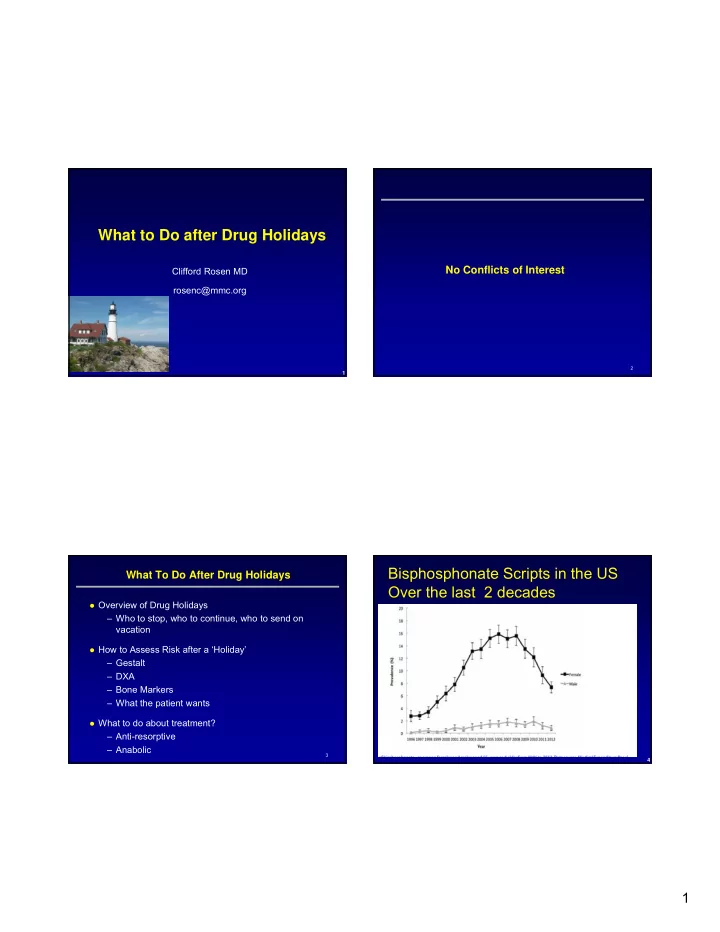
Bisphosphonate Scripts in the US Over the last 2 decades

alendronate AFF first reports

slide-2
SLIDE 2

2

5

A drug holiday (sometimes also called a drug vacation, medication vacation, structured treatment interruption or strategic treatment interruption) is when a patient stops taking a medication(s) for a period of time; anywhere from a few days to many months or even years if they feel it is in their best interests.

Wikipedia- 2016

6

How Do Bisphosphonates Work?

7 8

Studies of Long Term Bisphosphonate Use (BMD primary endpoint)

Study Drug Design N Follow-up years Notes FIT Long- Term Extension (FLEX) Alendronate (5 & 10 mg/day) Randomized , blinded trial 1099 5+5=10 HORIZON- PFT Ext. Zoledronic acid (5 mg/year) Randomized blinded trial 1233 3+3=6 Risedronate Risedronate weekly Observation al study 164 3+3+3=9 Small, non- randomized, adherent

  • nly
slide-3
SLIDE 3

3

9

Design of the FIT Long-Term Extension

  • f Alendronate (FLEX)*

FIT N = 6,459 Placebo N = 3,223 Alendronate N = 3,236 Randomized in FLEX N = 1,099 Alendronate, 5 mg N = 329 Placebo N = 437 Alendronate, 10 mg N = 333

FIT (3 to 4.5 yrs) Post-FIT (1-2 yrs) FLEX (5 yrs)

* Black, et al, JAMA 12/2006

40% 30% 30% Primary endpoint: Change in hip BMD

10

Total Hip BMD: Mean % Change from FIT Baseline

= Placebo = ALN (Pooled 5 mg and 10 mg groups) 1 2 3 4 5 F 0 F 1 F 2 F 3 F 4 FL 0 FL 1 FL 2 FL 3 FL 4 FL 5

Mean Percent Change Year Start of FLEX

P<0.001 ALN vs PBO

FIT FLEX FIT 3 to 4.5 yrs FIT/FLEX Recess 1 to 2 yrs FLEX 5 yrs 2.8%

11

Fracture Incidence (Exploratory Endpoint) In FLEX

ALN (N = 662) RR (95% CI) 3% 19% 21% 1.02 (0.5, 2.3) 1.00 (0.8, 1.4) 0.93 (0.7, 1.2) 3% Hip 20% Non-vertebral 22% Any PBO (N = 437) 9.8% 2% 0.86 (0.6, 1.2) 0.45 (0.2, 0.8) 11.3% Morphometric 5% Clinical

Vertebral Clinical

* Black, et al, JAMA 12/2006

12

Survival Curve for Time to First Nonvertebral Fracture in FLEX

5 10 15 20 1 2 3 4 Cumulative Incidence, % 5 Time to First Fracture, years

Placebo ALN (pooled) RH=1.00 (0.76, 1.32)

F = FIT, FL = FLEX . Black DM et al. JAMA. 2006;296:1–12.
slide-4
SLIDE 4

4

13

13

HORIZON Extension Study Design

 Similar to FLEX extension  3 years of annual ZOL, then randomized to

either:

– 3 more years of ZOL (6 years, Z6) – 3 years of PBO (Z3P3)

14

Fracture Results in HORIZON PFT Extension: 3 more years of ZOL

Z6 (N = 617) RR (95% CI) 1.3% 8.2% 0.90 (0.3, 2.5) 0.99 (0.7, 1.5) 1.4% Hip 7.6% Non-vertebral Z3P3 (N = 616) 3% 1.2% 0.48 (0.3, 0.9) 1.8 (0.5, 6.2) 6% Morphometric 0.7% Clinical

Vertebral Non-vertebral

* Black, et al, JBMR 2012

15

Summary of Vertebral Fracture Reductions for FLEX and HORIZON

Relative Risk (Bis vs. PBO)

Bisphosphonate benefit

16

Efficacy from the 2 long-term randomized extension studies

 Fracture results for both drugs

– Continuing lowers vertebral fractures risk vs discontinuing – Continuing vs. discontinuing  no effect on non-vertebral

  • Confidence intervals are wide and allow for possible benefit

 BMD results for both drugs (ALN and ZOL):

– Continuing long term  retains BMD gains – Discontinuing  BMD loses are modest

 What about long term safety? Does AFF risk increase with

longer duration of treatment?

slide-5
SLIDE 5

5

17

17 FLEX vertebral fracture benefit: Who to continue?

Femoral Neck BMD T- Score (start FLEX) 5 Yr risk (%) Clinical Vert.

  • Fx. In PBO

Number Needed to Treat

All women in study

All BMD values 5.5 34 ≤ -2.5 9.3 21

  • 2.5 to -2

5.8 33 ≥ -2 2.3 81 No prevalent vert. fracture (start of FLEX) ≤ -2.5 8.0 24

  • 2.5 to -2

3.0 63 ≥ -2 1.8 102 Prevalent vertebral fracture (start of FLEX) ≤ -2.5 11.1 17

  • 2.5 to -2

11.1 17 ≥ -2 3.7 51 Black, et al. NEJM 2012 May 31;366(22):2051-3

18

Which patients benefit most from long term ALN (or ZOL) and should therefore be continued?

 Primary benefit is in reduction of vertebral fractures  Therefore, logical to continue those at highest risk of

vertebral fractures

– NEJM; 5/2012

  • Perspective from FDA together with an analysis from FLEX

– Consider femoral neck BMD and vertebral fracture status at the end of the initial treatment period

Black, et al. NEJM 2012 May 31;366(22):2051-3

19

Other clinical factors to assess to decide on discontinuation?

Age (RR=1.5 per 6 years in FLEX) Fracture on initial phase of treatment (some support)* Who to continue: Older patients with low hip BMD, and/or vertebral fractures and/or those who fracture during initial treatment ASBMR committee Fall 2014: Likely to recommend to continue those with hip BMD < -2.5

  • r “high risk of fracture”

* Cosman et al. ASBMR 2012.

20

What to do after the ‘holiday’

Or Re-entry Dilemma!!!

slide-6
SLIDE 6

6

21

When to restart?

  • Discontinue for no more than 5 years
  • Perhaps BMD change after 3 to 5 year holiday

(not 1 or 2 years)

  • No evidence to support bone marker

assessment or change in bone marker

22 23 24

ROC Curves For Fracture Prediction with FRAX

slide-7
SLIDE 7

7

25

One year after Discontinuation of BP

26

Summary of Change in BMD

27

BTMs one year after stopping Aln

28

How About Calcium and Vitamin D After a Drug Holiday?

What To Re-Start or Maintain?

slide-8
SLIDE 8

8

29

Vitamin D and Calcium Reduces Fracture Risk (800IU+1200 mg/d) 2007Tang Lancet 2007

USPSTF: No Risk Reduction for Vitamin D and Hip Fracture- 2014

30

Updated Meta Analysis 2016 Calcium and Vitamin D

31

Risk of Hip Fracture by Age Group in WHI: Age and Fall Interaction

32

A Host of New Drug Treatments!!!

slide-9
SLIDE 9

9

PTH once weekly Fracture Trial-56ug: 1-34

Nakumara, 2012

Summary

  • Drug holidays are a reality even though

efficacy not clear

  • Should be considered in long term

bisphosphonate users

  • Assess after the end of the holiday-

– BMD, bone turnover markers, others

  • Restart Rx or add new drug still

conjecture

slide-10
SLIDE 10

10

37

On Shaky Ground?

Very Little Evidence

“First do no harm”