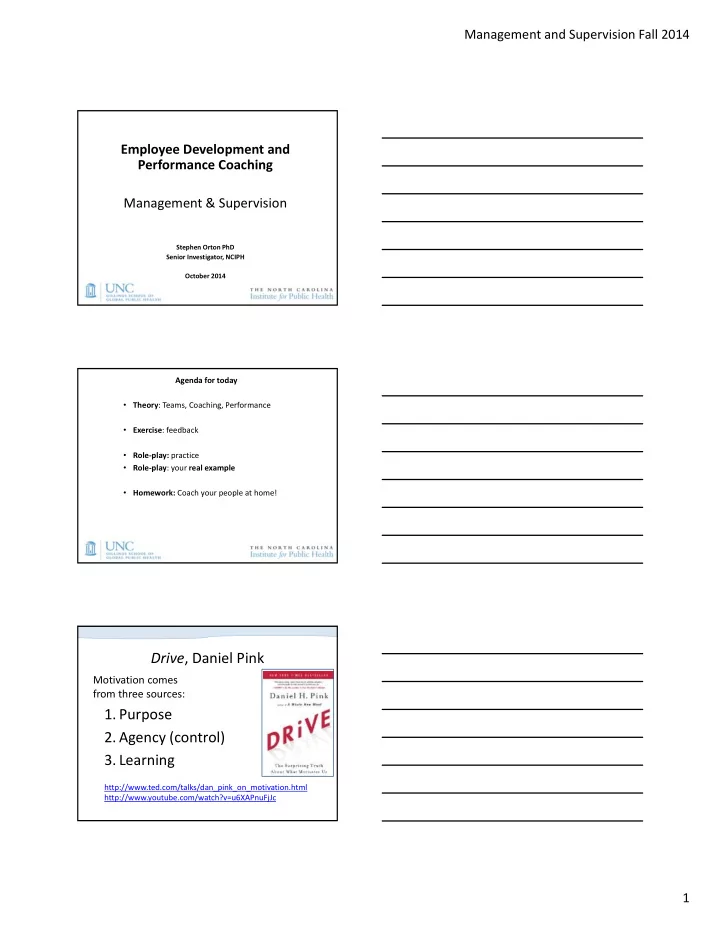
Drive , Daniel Pink Motivation comes from three sources: 1. Purpose - - PDF document

drive daniel pink
SMART_READER_LITE
LIVE PREVIEW

Drive , Daniel Pink Motivation comes from three sources: 1. Purpose - - PDF document

Management and Supervision Fall 2014 Employee Development and Performance Coaching Management & Supervision Stephen Orton PhD Senior Investigator, NCIPH October 2014 Agenda for today Theory : Teams, Coaching, Performance Exercise :


slide-1
SLIDE 1

Management and Supervision Fall 2014 1 Employee Development and Performance Coaching Management & Supervision

Stephen Orton PhD Senior Investigator, NCIPH October 2014

Agenda for today

  • Theory: Teams, Coaching, Performance
  • Exercise: feedback
  • Role‐play: practice
  • Role‐play: your real example
  • Homework: Coach your people at home!

Drive, Daniel Pink

Motivation comes from three sources:

  • 1. Purpose
  • 2. Agency (control)
  • 3. Learning

http://www.ted.com/talks/dan_pink_on_motivation.html http://www.youtube.com/watch?v=u6XAPnuFjJc

slide-2
SLIDE 2

Management and Supervision Fall 2014 2

Jim Collins, Good To Great

  • Humility
  • “Hedgehog Concept”
  • Right people on the bus
  • Know what

turns the flywheel

  • utcomes

drivers

Workforce Deliverables

Workforce structure

Dan Cable, Change to Strange

2‐3 things we’re aiming for;

how we measure success

  • utcomes

drivers

Workforce Deliverables

Workforce structure 2‐3 strategies that drive our success;

valuable, rare and hard to duplicate

Unique, strange things

  • ur employees do

that customers notice

Things the organization does to attract and develop strange employees

Value Chain

slide-3
SLIDE 3

Management and Supervision Fall 2014 3

Measuring

How would you know you were doing a good job

  • f developing people?

Measuring When Teams Work Best

From a huge database of responses to a team survey

  • Team Members
  • Team Relationships
  • Problem‐Solving
  • Leadership and

Org Environment

slide-4
SLIDE 4

Management and Supervision Fall 2014 4

Individual Team Members

Working knowledge

  • Experience
  • Problem‐solving ability

Teamwork

  • Openness
  • Supportiveness
  • Action orientation
  • Positive personal style

Relationships

  • Ability to give and

receive feedback

  • Team focus
  • Team climate

Problem‐solving

Working knowledge

  • Experience
  • Problem‐solving ability

Teamwork

  • Openness
  • Supportiveness
  • Action orientation
  • Positive personal style

Individuals When Teams Work Best

GOAL

ENERGY

slide-5
SLIDE 5

Management and Supervision Fall 2014 5

Energy

GOAL

ENERGY

Improv exercise Discussion Break

  • What is it like to be on this team?
  • Identify coaching / feedback you received
slide-6
SLIDE 6

Management and Supervision Fall 2014 6

When Improvisation Works

  • Say Yes to offers: listen and respond
  • Help each other
  • Jump in
  • Have fun

Your Leverage

  • Set goals, create “focus”
  • Create a positive climate
  • Set norms for team behavior
  • Coach individuals

Coaching Template

SBI Situation – Behavior – Impact (listen)

Situation: when and where, specific Behavior: what, descriptive Impact: “I felt, I thought, I did the following:…” Listen: Feedback is a two‐way street. What is the other person’s perspective?

slide-7
SLIDE 7

Management and Supervision Fall 2014 7

SBI handout

Stop and Listen

Give Some Thanks

  • Situation: where and when
  • Behavior: what the person *did*
  • Impact: how you experienced their behavior:

exactly how it helped you

  • Stop and listen

After‐Action Review

  • How did it feel to deliver that feedback?
  • How did it feel to receive that feedback?

Write down 2 or 3 opportunities to use this skill NEXT WEEK

slide-8
SLIDE 8

Management and Supervision Fall 2014 8

Case

  • Read the case
  • Plan an SBI: write notes on the case sheet

Role‐Play

Raise your hand when you want to jump in

What are we learning?

slide-9
SLIDE 9

Management and Supervision Fall 2014 9

Situation: where and when Behavior: what the person *did* Impact: what happened to you as a result, the specific negative impact on you

Design a Real‐Life SBI

  • Real situation, real person
  • Write SBI notes… share situation in groups
  • Act it out

Role‐Play Groups

  • 1. Coach briefly describes roles
  • 2. Coach picks actor for “other” role
  • 3. Act it out

Debrief: What happened? What worked? What didn’t work? How did it feel?

  • REPEAT CYCLE for all group members

Drive, Daniel Pink

How might coaching motivate your people?

  • 1. Purpose
  • 2. Control
  • 3. Learning
slide-10
SLIDE 10

Management and Supervision Fall 2014 10

NEXT TIME

  • Report out on your SBI results!
  • Get more coaching!
  • Do more experiential learning about change

Stephen Orton

North Carolina Institute for Public Health Gillings School of Global Public Health sorton@unc.edu (919) 966‐8125