Drawing graphs with vertices and edges in convex position and large - - PowerPoint PPT Presentation
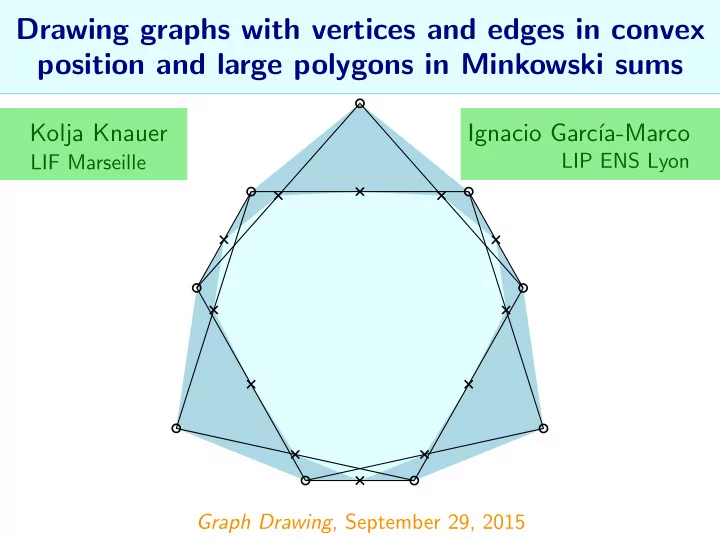
Drawing graphs with vertices and edges in convex position and large polygons in Minkowski sums Kolja Knauer Ignacio Garc a-Marco LIP ENS Lyon LIF Marseille Graph Drawing , September 29, 2015 P R 2 in strictly convex position if P is
P ⊆ R2 in strictly convex position if P is the set of vertices
- f the convex hull of P
P ⊆ R2 in strictly convex position if P is the set of vertices
- f the convex hull of P
P ⊆ R2 in strictly convex position if P is the set of vertices
- f the convex hull of P
P ⊆ R2 in strictly convex position if P is the set of vertices
- f the convex hull of P
P ⊆ R2 in strictly convex position if P is the set of vertices
- f the convex hull of P
P ⊆ R2 in weakly convex position if P on the ”boundary”
- f the convex hull of P
consider graph drawings f : G ֒ → R2 such that:
- edges straight-line segments
- vertices and midpoints of edges on different
points P ⊆ R2 in strictly convex position if P is the set of vertices
- f the convex hull of P
P ⊆ R2 in weakly convex position if P on the ”boundary”
- f the convex hull of P
consider graph drawings f : G ֒ → R2 such that:
- edges straight-line segments
- vertices and midpoints of edges on different
points P ⊆ R2 in strictly convex position if P is the set of vertices
- f the convex hull of P
P ⊆ R2 in weakly convex position if P on the ”boundary”
- f the convex hull of P
- k
consider graph drawings f : G ֒ → R2 such that:
- edges straight-line segments
- vertices and midpoints of edges on different
points P ⊆ R2 in strictly convex position if P is the set of vertices
- f the convex hull of P
P ⊆ R2 in weakly convex position if P on the ”boundary”
- f the convex hull of P
- k
not ok
consider graph drawings f : G ֒ → R2 such that:
- edges straight-line segments
- vertices and midpoints of edges on different
points P ⊆ R2 in strictly convex position if P is the set of vertices
- f the convex hull of P
P ⊆ R2 in weakly convex position if P on the ”boundary”
- f the convex hull of P
- k
not ok for i, j ∈ {s, w, a} define Gj
i
as class of graphs drawable s.th. midpoints position strictly convex if j = s weakly convex if j = w arbitrary if j = a. vertex position strictly convex if i = s weakly convex if i = w arbitrary if i = a.
for i, j ∈ {s, w, a} define Gj
i
as class of graphs drawable s.th. midpoints position strictly convex if j = s weakly convex if j = w arbitrary if j = a. vertex position strictly convex if i = s weakly convex if i = w arbitrary if i = a. Gs
s = Gs w
Gw
s
Gw
w = Gw a = Ga s = Ga w = Ga a
Gs
a
Theorem [G-M,K]:
for i, j ∈ {s, w, a} define Gj
i
as class of graphs drawable s.th. midpoints position strictly convex if j = s weakly convex if j = w arbitrary if j = a. vertex position strictly convex if i = s weakly convex if i = w arbitrary if i = a. Gs
s = Gs w
Gw
s
Gw
w = Gw a = Ga s = Ga w = Ga a
Gs
a
Theorem [G-M,K]:
gj
i (n) max number of edges n-vertex graph in Gj i
Conjecture [Halmann, Onn, Rothblum 07]: All graphs in Gs
s are planar and therefore gs s(n) ≤ 3n − 6.
gj
i (n) max number of edges n-vertex graph in Gj i
Conjecture [Halmann, Onn, Rothblum 07]: All graphs in Gs
s are planar and therefore gs s(n) ≤ 3n − 6.
, . . . ∈ Gs
s
, , ,
gj
i (n) max number of edges n-vertex graph in Gj i
Conjecture [Halmann, Onn, Rothblum 07]: All graphs in Gs
s are planar and therefore gs s(n) ≤ 3n − 6.
, . . . ∈ Gs
s
, , ,
non-planar
gj
i (n) max number of edges n-vertex graph in Gj i
Conjecture [Halmann, Onn, Rothblum 07]: All graphs in Gs
s are planar and therefore gs s(n) ≤ 3n − 6.
, . . . ∈ Gs
s
, , , , , ,
gj
i (n) max number of edges n-vertex graph in Gj i
Conjecture [Halmann, Onn, Rothblum 07]: All graphs in Gs
s are planar and therefore gs s(n) ≤ 3n − 6.
, . . . ∈ Gs
s
, , , , , ,
gj
i (n) max number of edges n-vertex graph in Gj i
Conjecture [Halmann, Onn, Rothblum 07]: All graphs in Gs
s are planar and therefore gs s(n) ≤ 3n − 6.
, . . . ∈ Gs
s
, , , , , ,
gj
i (n) max number of edges n-vertex graph in Gj i
Conjecture [Halmann, Onn, Rothblum 07]: All graphs in Gs
s are planar and therefore gs s(n) ≤ 3n − 6.
, . . . ∈ Gs
s
, , , , , ,
gj
i (n) max number of edges n-vertex graph in Gj i
Conjecture [Halmann, Onn, Rothblum 07]: All graphs in Gs
s are planar and therefore gs s(n) ≤ 3n − 6.
, . . . ∈ Gs
s
, , , , , ,
gj
i (n) max number of edges n-vertex graph in Gj i
Conjecture [Halmann, Onn, Rothblum 07]: All graphs in Gs
s are planar and therefore gs s(n) ≤ 3n − 6.
, . . . ∈ Gs
s
, , , , , ,
gj
i (n) max number of edges n-vertex graph in Gj i
Conjecture [Halmann, Onn, Rothblum 07]: All graphs in Gs
s are planar and therefore gs s(n) ≤ 3n − 6.
, . . . ∈ Gs
s
, , , , , ,
gj
i (n) max number of edges n-vertex graph in Gj i
Conjecture [Halmann, Onn, Rothblum 07]: All graphs in Gs
s are planar and therefore gs s(n) ≤ 3n − 6.
, . . . ∈ Gs
s
, , , , , ,
gj
i (n) max number of edges n-vertex graph in Gj i
Conjecture [Halmann, Onn, Rothblum 07]: All graphs in Gs
s are planar and therefore gs s(n) ≤ 3n − 6.
, . . . ∈ Gs
s
, , , , , ,
gj
i (n) max number of edges n-vertex graph in Gj i
Conjecture [Halmann, Onn, Rothblum 07]: All graphs in Gs
s are planar and therefore gs s(n) ≤ 3n − 6.
, . . . ∈ Gs
s
, , , , , ,
so, this works...and I wont finish these drawings...
gj
i (n) max number of edges n-vertex graph in Gj i
Conjecture [Halmann, Onn, Rothblum 07]: All graphs in Gs
s are planar and therefore gs s(n) ≤ 3n − 6.
gj
i (n) max number of edges n-vertex graph in Gj i
Conjecture [Halmann, Onn, Rothblum 07]: All graphs in Gs
s are planar and therefore gs s(n) ≤ 3n − 6.
Theorem [G-M,K]: We have ⌊ 3
2n − 1⌋ ≤ gs s(n) ≤ gw s (n) = 2n − 3.
gj
i (n) max number of edges n-vertex graph in Gj i
Conjecture [Halmann, Onn, Rothblum 07]: All graphs in Gs
s are planar and therefore gs s(n) ≤ 3n − 6.
Theorem [G-M,K]: We have ⌊ 3
2n − 1⌋ ≤ gs s(n) ≤ gw s (n) = 2n − 3.
gw
s (n) ≤ 2n − 3 :
gj
i (n) max number of edges n-vertex graph in Gj i
Conjecture [Halmann, Onn, Rothblum 07]: All graphs in Gs
s are planar and therefore gs s(n) ≤ 3n − 6.
Theorem [G-M,K]: We have ⌊ 3
2n − 1⌋ ≤ gs s(n) ≤ gw s (n) = 2n − 3.
gw
s (n) ≤ 2n − 3 :
v w v sees vw and w does not
gj
i (n) max number of edges n-vertex graph in Gj i
Conjecture [Halmann, Onn, Rothblum 07]: All graphs in Gs
s are planar and therefore gs s(n) ≤ 3n − 6.
Theorem [G-M,K]: We have ⌊ 3
2n − 1⌋ ≤ gs s(n) ≤ gw s (n) = 2n − 3.
gw
s (n) ≤ 2n − 3 :
v w v sees vw and w does not v v has at most 2 exterior edges
gj
i (n) max number of edges n-vertex graph in Gj i
Conjecture [Halmann, Onn, Rothblum 07]: All graphs in Gs
s are planar and therefore gs s(n) ≤ 3n − 6.
Theorem [G-M,K]: We have ⌊ 3
2n − 1⌋ ≤ gs s(n) ≤ gw s (n) = 2n − 3.
gw
s (n) ≤ 2n − 3 :
v w v sees vw and w does not v v has at most 2 exterior edges v
gj
i (n) max number of edges n-vertex graph in Gj i
Conjecture [Halmann, Onn, Rothblum 07]: All graphs in Gs
s are planar and therefore gs s(n) ≤ 3n − 6.
Theorem [G-M,K]: We have ⌊ 3
2n − 1⌋ ≤ gs s(n) ≤ gw s (n) = 2n − 3.
gw
s (n) ≤ 2n − 3 :
v w v sees vw and w does not v v has at most 2 exterior edges v
gj
i (n) max number of edges n-vertex graph in Gj i
Conjecture [Halmann, Onn, Rothblum 07]: All graphs in Gs
s are planar and therefore gs s(n) ≤ 3n − 6.
Theorem [G-M,K]: We have ⌊ 3
2n − 1⌋ ≤ gs s(n) ≤ gw s (n) = 2n − 3.
gw
s (n) ≤ 2n − 3 :
v w v sees vw and w does not v v has at most 2 exterior edges v v doesn’t see its interior edges
gj
i (n) max number of edges n-vertex graph in Gj i
Conjecture [Halmann, Onn, Rothblum 07]: All graphs in Gs
s are planar and therefore gs s(n) ≤ 3n − 6.
Theorem [G-M,K]: We have ⌊ 3
2n − 1⌋ ≤ gs s(n) ≤ gw s (n) = 2n − 3.
gw
s (n) ≤ 2n − 3 :
v w v sees vw and w does not v v has at most 2 exterior edges v v doesn’t see its interior edges v w every edge is seen at least once
gj
i (n) max number of edges n-vertex graph in Gj i
Conjecture [Halmann, Onn, Rothblum 07]: All graphs in Gs
s are planar and therefore gs s(n) ≤ 3n − 6.
Theorem [G-M,K]: We have ⌊ 3
2n − 1⌋ ≤ gs s(n) ≤ gw s (n) = 2n − 3.
gw
s (n) ≤ 2n − 3 :
v w v sees vw and w does not v v has at most 2 exterior edges v v doesn’t see its interior edges v w every edge is seen at least once = ⇒ every edge is exterior at least once
gj
i (n) max number of edges n-vertex graph in Gj i
Conjecture [Halmann, Onn, Rothblum 07]: All graphs in Gs
s are planar and therefore gs s(n) ≤ 3n − 6.
Theorem [G-M,K]: We have ⌊ 3
2n − 1⌋ ≤ gs s(n) ≤ gw s (n) = 2n − 3.
gw
s (n) ≤ 2n − 3 :
v w v sees vw and w does not v v has at most 2 exterior edges v v doesn’t see its interior edges v w every edge is seen at least once G ∈ Gw
s wlog δ > 1
= ⇒ every edge is exterior at least once
gj
i (n) max number of edges n-vertex graph in Gj i
Conjecture [Halmann, Onn, Rothblum 07]: All graphs in Gs
s are planar and therefore gs s(n) ≤ 3n − 6.
Theorem [G-M,K]: We have ⌊ 3
2n − 1⌋ ≤ gs s(n) ≤ gw s (n) = 2n − 3.
gw
s (n) ≤ 2n − 3 :
v w v sees vw and w does not v v has at most 2 exterior edges v v doesn’t see its interior edges v w every edge is seen at least once G ∈ Gw
s wlog δ > 1
= ⇒ every edge is exterior at least once |E(G)| = 2n−doubly exteriors
gj
i (n) max number of edges n-vertex graph in Gj i
Conjecture [Halmann, Onn, Rothblum 07]: All graphs in Gs
s are planar and therefore gs s(n) ≤ 3n − 6.
Theorem [G-M,K]: We have ⌊ 3
2n − 1⌋ ≤ gs s(n) ≤ gw s (n) = 2n − 3.
gw
s (n) ≤ 2n − 3 :
G ∈ Gw
s wlog δ > 1
|E(G)| = 2n−doubly exteriors how many?
gj
i (n) max number of edges n-vertex graph in Gj i
Conjecture [Halmann, Onn, Rothblum 07]: All graphs in Gs
s are planar and therefore gs s(n) ≤ 3n − 6.
Theorem [G-M,K]: We have ⌊ 3
2n − 1⌋ ≤ gs s(n) ≤ gw s (n) = 2n − 3.
gw
s (n) ≤ 2n − 3 :
G ∈ Gw
s wlog δ > 1
|E(G)| = 2n−doubly exteriors how many? v w if I have an edge vw
gj
i (n) max number of edges n-vertex graph in Gj i
Conjecture [Halmann, Onn, Rothblum 07]: All graphs in Gs
s are planar and therefore gs s(n) ≤ 3n − 6.
Theorem [G-M,K]: We have ⌊ 3
2n − 1⌋ ≤ gs s(n) ≤ gw s (n) = 2n − 3.
gw
s (n) ≤ 2n − 3 :
G ∈ Gw
s wlog δ > 1
|E(G)| = 2n−doubly exteriors how many? v w if I have an edge vw = ⇒ ∃ doubly exterior in v ∪ H+(vw)
gj
i (n) max number of edges n-vertex graph in Gj i
Conjecture [Halmann, Onn, Rothblum 07]: All graphs in Gs
s are planar and therefore gs s(n) ≤ 3n − 6.
Theorem [G-M,K]: We have ⌊ 3
2n − 1⌋ ≤ gs s(n) ≤ gw s (n) = 2n − 3.
gw
s (n) ≤ 2n − 3 :
G ∈ Gw
s wlog δ > 1
|E(G)| = 2n−doubly exteriors how many? v w if I have an edge vw = ⇒ ∃ doubly exterior in v ∪ H+(vw)
gj
i (n) max number of edges n-vertex graph in Gj i
Conjecture [Halmann, Onn, Rothblum 07]: All graphs in Gs
s are planar and therefore gs s(n) ≤ 3n − 6.
Theorem [G-M,K]: We have ⌊ 3
2n − 1⌋ ≤ gs s(n) ≤ gw s (n) = 2n − 3.
gw
s (n) ≤ 2n − 3 :
G ∈ Gw
s wlog δ > 1
|E(G)| = 2n−doubly exteriors how many? if I have an edge vw = ⇒ ∃ doubly exterior in v ∪ H+(vw) = ⇒ ∃ 2 doubly exteriors
gj
i (n) max number of edges n-vertex graph in Gj i
Conjecture [Halmann, Onn, Rothblum 07]: All graphs in Gs
s are planar and therefore gs s(n) ≤ 3n − 6.
Theorem [G-M,K]: We have ⌊ 3
2n − 1⌋ ≤ gs s(n) ≤ gw s (n) = 2n − 3.
gw
s (n) ≤ 2n − 3 :
G ∈ Gw
s wlog δ > 1
|E(G)| = 2n−doubly exteriors how many? if I have an edge vw = ⇒ ∃ doubly exterior in v ∪ H+(vw) = ⇒ ∃ 2 doubly exteriors
gj
i (n) max number of edges n-vertex graph in Gj i
Conjecture [Halmann, Onn, Rothblum 07]: All graphs in Gs
s are planar and therefore gs s(n) ≤ 3n − 6.
Theorem [G-M,K]: We have ⌊ 3
2n − 1⌋ ≤ gs s(n) ≤ gw s (n) = 2n − 3.
gw
s (n) ≤ 2n − 3 :
G ∈ Gw
s wlog δ > 1
|E(G)| = 2n−doubly exteriors how many? if I have an edge vw = ⇒ ∃ doubly exterior in v ∪ H+(vw) = ⇒ ∃ 2 doubly exteriors
gj
i (n) max number of edges n-vertex graph in Gj i
Conjecture [Halmann, Onn, Rothblum 07]: All graphs in Gs
s are planar and therefore gs s(n) ≤ 3n − 6.
Theorem [G-M,K]: We have ⌊ 3
2n − 1⌋ ≤ gs s(n) ≤ gw s (n) = 2n − 3.
gw
s (n) ≤ 2n − 3 :
G ∈ Gw
s wlog δ > 1
|E(G)| = 2n−doubly exteriors how many? if I have an edge vw = ⇒ ∃ doubly exterior in v ∪ H+(vw) = ⇒ ∃ 2 doubly exteriors = ⇒ ∃ 3 doubly exteriors
gj
i (n) max number of edges n-vertex graph in Gj i
Conjecture [Halmann, Onn, Rothblum 07]: All graphs in Gs
s are planar and therefore gs s(n) ≤ 3n − 6.
Theorem [G-M,K]: We have ⌊ 3
2n − 1⌋ ≤ gs s(n) ≤ gw s (n) = 2n − 3.
gw
s (n) ≥ 2n − 3 :
gj
i (n) max number of edges n-vertex graph in Gj i
Conjecture [Halmann, Onn, Rothblum 07]: All graphs in Gs
s are planar and therefore gs s(n) ≤ 3n − 6.
Theorem [G-M,K]: We have ⌊ 3
2n − 1⌋ ≤ gs s(n) ≤ gw s (n) = 2n − 3.
gw
s (n) ≥ 2n − 3 :
gj
i (n) max number of edges n-vertex graph in Gj i
Conjecture [Halmann, Onn, Rothblum 07]: All graphs in Gs
s are planar and therefore gs s(n) ≤ 3n − 6.
Theorem [G-M,K]: We have ⌊ 3
2n − 1⌋ ≤ gs s(n) ≤ gw s (n) = 2n − 3.
gw
s (n) ≥ 2n − 3 :
gj
i (n) max number of edges n-vertex graph in Gj i
Conjecture [Halmann, Onn, Rothblum 07]: All graphs in Gs
s are planar and therefore gs s(n) ≤ 3n − 6.
Theorem [G-M,K]: We have ⌊ 3
2n − 1⌋ ≤ gs s(n) ≤ gw s (n) = 2n − 3.
gw
s (n) ≥ 2n − 3 :
gj
i (n) max number of edges n-vertex graph in Gj i
Conjecture [Halmann, Onn, Rothblum 07]: All graphs in Gs
s are planar and therefore gs s(n) ≤ 3n − 6.
Theorem [G-M,K]: We have ⌊ 3
2n − 1⌋ ≤ gs s(n) ≤ gw s (n) = 2n − 3.
gw
s (n) ≥ 2n − 3 :
gj
i (n) max number of edges n-vertex graph in Gj i
Conjecture [Halmann, Onn, Rothblum 07]: All graphs in Gs
s are planar and therefore gs s(n) ≤ 3n − 6.
Theorem [G-M,K]: We have ⌊ 3
2n − 1⌋ ≤ gs s(n) ≤ gw s (n) = 2n − 3.
gs
s(n) ≥ ⌊ 3 2n − 1⌋ :
gj
i (n) max number of edges n-vertex graph in Gj i
Conjecture [Halmann, Onn, Rothblum 07]: All graphs in Gs
s are planar and therefore gs s(n) ≤ 3n − 6.
Theorem [G-M,K]: We have ⌊ 3
2n − 1⌋ ≤ gs s(n) ≤ gw s (n) = 2n − 3.
gs
s(n) ≥ ⌊ 3 2n − 1⌋ :
Theorem [G-M,K]: We have ⌊ 3
2n − 1⌋ ≤ gs s(n) ≤ gw s (n) = 2n − 3.
Theorem [G-M,K]: We have ⌊ 3
2n − 1⌋ ≤ gs s(n) ≤ gw s (n) = 2n − 3.
what is the truth?
Theorem [G-M,K]: We have ⌊ 3
2n − 1⌋ ≤ gs s(n) ≤ gw s (n) = 2n − 3.
what is the truth? Proposition [G-M,K]: There are cubic graphs in Gw
s .
,
, . . . CkK2
Theorem [G-M,K]: We have ⌊ 3
2n − 1⌋ ≤ gs s(n) ≤ gw s (n) = 2n − 3.
what is the truth? Proposition [G-M,K]: There are cubic graphs in Gw
s .
Conjecture [G-M,K]: Graphs in Gs
s are 2-degenerate.
Theorem [G-M,K]: We have ⌊ 3
2n − 1⌋ ≤ gs s(n) ≤ gw s (n) = 2n − 3.
what is the truth? Proposition [G-M,K]: There are cubic graphs in Gw
s .
Conjecture [G-M,K]: Graphs in Gs
s are 2-degenerate.
Proposition [G-M,K]: Gw
s is not closed under adding leafs.
?
Theorem [G-M,K]: We have ⌊ 3
2n − 1⌋ ≤ gs s(n) ≤ gw s (n) = 2n − 3.
what is the truth? Proposition [G-M,K]: There are cubic graphs in Gw
s .
Conjecture [G-M,K]: Graphs in Gs
s are 2-degenerate.
Proposition [G-M,K]: Gw
s is not closed under adding leafs.
Question: Is Gs
s closed under adding leafs?
Theorem [G-M,K]: We have ⌊ 3
2n − 1⌋ ≤ gs s(n) ≤ gw s (n) = 2n − 3.
what is the truth? Proposition [G-M,K]: There are cubic graphs in Gw
s .
Conjecture [G-M,K]: Graphs in Gs
s are 2-degenerate.
Proposition [G-M,K]: Gw
s is not closed under adding leafs.
Question: Is Gs
s closed under adding leafs?
Conjecture [G-M,K]: Every graph has a (multiple) subdivision in Gs
s.
What has all this to do with Minkowski sums?
A, B ⊆ Rd then A + B := {a + b | a ∈ A, b ∈ B}
What has all this to do with Minkowski sums?
A, B ⊆ Rd then A + B := {a + b | a ∈ A, b ∈ B} if G ⊂ R2 then midpoints ⊆ { 1
2(u + v) | u = v ∈ V } ⊂ 1 2(V + V )
What has all this to do with Minkowski sums?
A, B ⊆ Rd then A + B := {a + b | a ∈ A, b ∈ B} if G ⊂ R2 then midpoints ⊆ { 1
2(u + v) | u = v ∈ V } ⊂ 1 2(V + V )
largest number of convexly independent points in A + A for n-vertex convex set A ⊆ R2 is Θ(gs
s).
because only vertices can be added
What has all this to do with Minkowski sums?
A, B ⊆ Rd then A + B := {a + b | a ∈ A, b ∈ B} if G ⊂ R2 then midpoints ⊆ { 1
2(u + v) | u = v ∈ V } ⊂ 1 2(V + V )
largest number of convexly independent points in A + A for n-vertex convex set A ⊆ R2 is Θ(gs
s).
because only vertices can be added
- gj
i (n) := max n′ + m, such that G ∈ Gj i with |E(G)| = m, |V (G)| = n
and n′ of its vertices can be added to the set of midpoints, such that the resulting set is in strictly convex if j = s weakly convex if j = w arbitrary if j = a. position. fighting for constants
- gj
i (n) := max n′ + m, such that G ∈ Gj i with |E(G)| = m, |V (G)| = n
and n′ of its vertices can be added to the set of midpoints, such that the resulting set is in strictly convex if j = s weakly convex if j = w arbitrary if j = a. position. fighting for constants Theorem [G-M,K]: We have gw
s (n) = 2n.
- gj
i (n) := max n′ + m, such that G ∈ Gj i with |E(G)| = m, |V (G)| = n
and n′ of its vertices can be added to the set of midpoints, such that the resulting set is in strictly convex if j = s weakly convex if j = w arbitrary if j = a. position. fighting for constants Theorem [G-M,K]: We have gw
s (n) = 2n.
Theorem [G-M,K]: We have ⌊ 3
2n⌋ ≤
gs
s(n) ≤ 2n − 2.
- gj
i (n) := max n′ + m, such that G ∈ Gj i with |E(G)| = m, |V (G)| = n
and n′ of its vertices can be added to the set of midpoints, such that the resulting set is in strictly convex if j = s weakly convex if j = w arbitrary if j = a. position. fighting for constants Theorem [G-M,K]: We have gw
s (n) = 2n.
Theorem [G-M,K]: We have ⌊ 3
2n⌋ ≤
gs
s(n) ≤ 2n − 2.
Corollary: largest number of convexly independent points in A + A for n-vertex convex set A ⊆ R2 lies within ⌊ 3
2n⌋ and 2n − 2.
Large convexly independent sets in Minkowski sums
A, B ⊆ R2 or R3, |A| = m, |B| = n. A = B A convex B convex large convex in minkowski sum
R2
O(m
2 3 n 2 3 + m + n)
Ω(m
2 3 n 2 3 + m + n)
Ω(n
4 3 + n)
O((m + n) log(m + n))
2 3n ≤ · ≤ 2n − 2
Eisenbrand, Pach, Rothvoß, Sopher B´ ılka, Buchin, Fulek, Kiyomi, Tanigawa, T´
- th
Swanepoel, Valtr Tiwary
Large convexly independent sets in Minkowski sums
A, B ⊆ R2 or R3, |A| = m, |B| = n. A = B A convex B convex large convex in minkowski sum
R2
O(m
2 3 n 2 3 + m + n)
Ω(m
2 3 n 2 3 + m + n)
Ω(n
4 3 + n)
O((m + n) log(m + n))
2 3n ≤ · ≤ 2n − 2
Eisenbrand, Pach, Rothvoß, Sopher B´ ılka, Buchin, Fulek, Kiyomi, Tanigawa, T´
- th
Swanepoel, Valtr Tiwary linear expected
Large convexly independent sets in Minkowski sums
A, B ⊆ R2 or R3, |A| = m, |B| = n. A = B A convex B convex large convex in minkowski sum
R2 R3
O(m
2 3 n 2 3 + m + n)
Ω(m
2 3 n 2 3 + m + n)
Ω(n
4 3 + n)
O((m + n) log(m + n))
2 3n ≤ · ≤ 2n − 2
· ≤ mn
1 3n2 ≤ · ≤ 3 8n2 + O(n
3 2 )
mn ≤ ·
1 4n2 ≤ ·
Eisenbrand, Pach, Rothvoß, Sopher B´ ılka, Buchin, Fulek, Kiyomi, Tanigawa, T´
- th
Swanepoel, Valtr Tiwary Fukuda, Weibel Halman, Onn, Rothblum linear expected
· ≤ mn
Large convexly independent sets in Minkowski sums
A, B ⊆ R2 or R3, |A| = m, |B| = n. A = B A convex B convex large convex in minkowski sum
R2 R3
O(m
2 3 n 2 3 + m + n)
Ω(m
2 3 n 2 3 + m + n)
Ω(n
4 3 + n)
O((m + n) log(m + n))
2 3n ≤ · ≤ 2n − 2
· ≤ mn
1 3n2 ≤ · ≤ 3 8n2 + O(n
3 2 )
mn ≤ ·
1 4n2 ≤ ·
Eisenbrand, Pach, Rothvoß, Sopher B´ ılka, Buchin, Fulek, Kiyomi, Tanigawa, T´
- th