Drafting Premarital and Postmarital Agreements Strategies for - - PowerPoint PPT Presentation

drafting premarital and postmarital agreements
SMART_READER_LITE
LIVE PREVIEW

Drafting Premarital and Postmarital Agreements Strategies for - - PowerPoint PPT Presentation

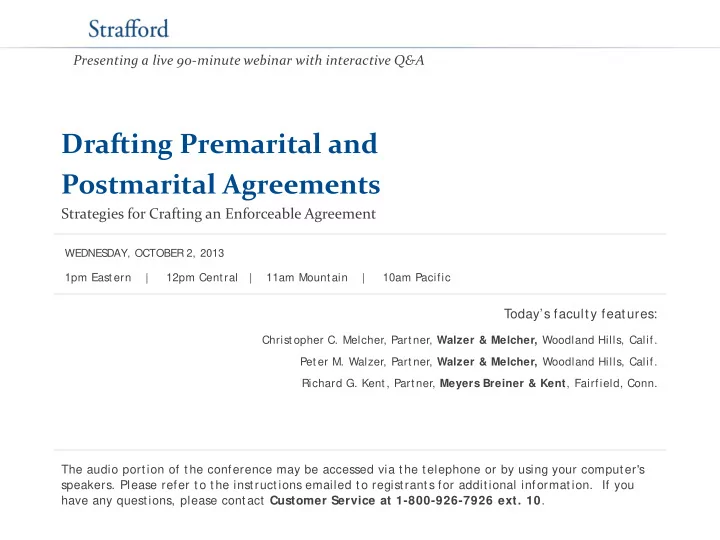
Presenting a live 90-minute webinar with interactive Q&A Drafting Premarital and Postmarital Agreements Strategies for Crafting an Enforceable Agreement WEDNES DAY, OCTOBER 2, 2013 1pm East ern | 12pm Cent ral | 11am Mount ain


slide-1
SLIDE 1

Drafting Premarital and Postmarital Agreements

Strategies for Crafting an Enforceable Agreement

Today’s faculty features:

1pm East ern | 12pm Cent ral | 11am Mount ain | 10am Pacific

The audio portion of the conference may be accessed via the telephone or by using your computer's

  • speakers. Please refer to the instructions emailed to registrants for additional information. If you

have any questions, please contact Customer Service at 1-800-926-7926 ext. 10.

WEDNES DAY, OCTOBER 2, 2013

Presenting a live 90-minute webinar with interactive Q&A

Christ opher C. Melcher, Part ner, Walzer & Melcher, Woodland Hills, Calif. Pet er M. Walzer, Part ner, Walzer & Melcher, Woodland Hills, Calif. Richard G. Kent , Part ner, Meyers Breiner & Kent, Fairfield, Conn.

slide-2
SLIDE 2

Tips for Optimal Quality

S

  • und Qualit y

If you are listening via your computer speakers, please note that the quality

  • f your sound will vary depending on the speed and quality of your internet

connection. If the sound quality is not satisfactory, you may listen via the phone: dial 1-866-927-5568 and enter your PIN when prompted. Otherwise, please send us a chat or e-mail sound@ straffordpub.com immediately so we can address the problem. If you dialed in and have any difficulties during the call, press *0 for assistance. Viewing Qualit y To maximize your screen, press the F11 key on your keyboard. To exit full screen, press the F11 key again.

FOR LIVE EVENT ONLY

slide-3
SLIDE 3

Continuing Education Credits

For CLE purposes, please let us know how many people are listening at your location by completing each of the following steps:

  • In the chat box, type (1) your company name and (2) the number of

attendees at your location

  • Click the S

END button beside the box If you have purchased S trafford CLE processing services, you must confirm your participation by completing and submitting an Official Record of Attendance (CLE Form). Y

  • u may obtain your CLE form by going to the program page and selecting the

appropriate form in the PROGRAM MATERIALS box at the top right corner. If you'd like to purchase CLE credit processing, it is available for a fee. For additional information about CLE credit processing, go to our website or call us at 1-800-926-7926 ext. 35.

FOR LIVE EVENT ONLY

slide-4
SLIDE 4

Program Materials

If you have not printed the conference materials for this program, please complete the following steps:

  • Click on the ^ symbol next to “ Conference Materials” in the middle of the left -

hand column on your screen.

  • Click on the tab labeled “ Handouts” that appears, and there you will see a

PDF of the slides for today's program.

  • Double click on the PDF and a separate page will open.
  • Print the slides by clicking on the printer icon.

FOR LIVE EVENT ONLY

slide-5
SLIDE 5

DRAFTING PREMARITAL AND POSTMARITAL AGREEMENTS

Strategies for Crafting an Enforceable Agreement

5

10/2/13

slide-6
SLIDE 6

PRESENTERS

Richard G. Kent Meyers Breiner & Kent Fairfield, Connecticut 203-255-9410 rkent@mbnllp.com Peter M. Walzer & Christopher C. Melcher Walzer & Melcher LLP Woodland Hills, California 818-591-3700 pmw@walzermelcher.com ccm@walzermelcher.com

6

10/2/13

slide-7
SLIDE 7

OVERVIEW

Differences between premarital

agreements and postmarital agreements.

How to discuss and negotiate these

agreements

Structuring the agreement Choice/conflict of laws for multistate

  • r international couples

Getting retained and paid

7

10/2/13

slide-8
SLIDE 8

WHO NEEDS A PRENUP?

A party who wants to protect

separate assets, such as family wealth from disputes on death or divorce.

A party who has a professional

practice or other service business, and wants to avoid or limit a community interest.

The other party has substantial

debt, or a support obligation from a prior marriage.

8

10/2/13

slide-9
SLIDE 9

BENEFITS OF A PRENUP

Promotes communication about finances

and expectations of each party before marriage.

Provides certainty as to their rights and

  • bligations on divorce.

May increase trust about the other’s

intentions.

May reduce chance of litigation on

divorce.

9

10/2/13

slide-10
SLIDE 10

WHAT A PRENUP CAN DO

Keep premarital property off limits Fundamentally change the default

rules re community property or equitable distribution.

Limit or waive spousal

support/alimony.

Specify rights on death and to life

insurance.

10

10/2/13

slide-11
SLIDE 11

RISKS OF PROPOSING ONE

Neither party appreciates an

attorney’s intrusion into their idyllic expectations of love and marriage.

The subjects of death and divorce

are the antithesis of expectations

  • f love and marriage.

Agreements demonstrate a lack

  • f trust.

Agreements dampen romance.

11

10/2/13

slide-12
SLIDE 12

SOCIETAL VIEWS

Premarital agreements place

emphasis on the individual over the couple.

May hurt women more than men. The wealthy may have an advantage

  • ver the less wealthy.

12

10/2/13

slide-13
SLIDE 13

LEGAL ENVIRONMENT

Marriage is a highly regulated

institution, so there are limits

  • n freedom of contract with

respect to marital agreements.

13

10/2/13

slide-14
SLIDE 14

HOW TO DISCUSS A MARITAL AGREEMENT

Talk to your fiancé Work with a marital counselor Use a mediator Collaborative method Have the lawyers broach the topic

for the first time

14

10/2/13

slide-15
SLIDE 15

3 KEY ELEMENTS TO A PRENUP

Timing Disclosure Independent Counsel

15

10/2/13

slide-16
SLIDE 16

TIMING

How far in advance must the

agreement be presented?

16

10/2/13

slide-17
SLIDE 17

DISCLOSURES

What must be disclosed? Can the right to disclosure be waived? Attach disclosures to the agreement so there is

no question what was disclosed.

The disclosure should give meaningful

information about the party’s income, assets, and obligations.

Serve disclosures while agreement is being

negotiated with sufficient time for review.

17

10/2/13

slide-18
SLIDE 18

INDEPENDENT COUNSEL

Does the attorney have to certify the

agreement?

Is an attorney certification a waiver of the

attorney-client privilege?

Is the attorney “independent” if paid by

the other party?

Can a party waive the right to counsel? What is required to show that an

unrepresented party understood the prenup?

18

10/2/13

slide-19
SLIDE 19

GENERAL LEGAL REQUIREMENTS

Must be in writing and signed by both

parties.

Statute of frauds exception? Consideration not required (but is a good

idea).

May agree on any matter regarding rights

  • n death or divorce, not in violation of

public policy.

19

10/2/13

slide-20
SLIDE 20

PUBLIC POLICY LIMITS

 Child support.  Child custody.  Religious upbringing of children.  Support of a spouse during marriage.  Penalties for spouse not performing marital

duties.

 Unfaithfulness.  Immigration marriage?  Interspousal fiduciary duty?

20

10/2/13

slide-21
SLIDE 21

BUILDING A STRONG AGREEMENT

Avoid last-minute agreements. Allow for changes. Do not include provisions which violate

public policy.

Follow the law in your state (e.g., the

Uniform Premarital Agreement Act).

21

10/2/13

slide-22
SLIDE 22

STRUCTURING THE DEAL

Create a real bargain. Is there incentive to challenge the

agreement because there’s nothing to lose?

No contest clause? Importance of recitals.

22

10/2/13

slide-23
SLIDE 23

PROPERTY ISSUES

No property vs. limited property rights

during marriage.

Lump sum payment? Payment for each year of marriage? Waiver of property rights in loan

proceeds.

Waiver of rights resulting from efforts of

spouse during marriage.

23

10/2/13

slide-24
SLIDE 24

DEATH

 Clients often forget that the property provisions

don’t just apply on divorce – they also apply equally at death.

 Does the client really intend to disinherit the

  • ther spouse if the client dies while the marriage

is intact?

 Life insurance can be provided as a means of

security.

24

10/2/13

slide-25
SLIDE 25

RETIREMENT BENEFITS

Federal law controls Need to have waiver of those

rights executed after marriage.

25

10/2/13

slide-26
SLIDE 26

SPOUSAL SUPPORT/ALIMONY WAIVERS OR LIMITATIONS

 Waiver vs. limitation?  Will the waiver be tested at time of execution of

the agreement or at time of enforcement?

 There may be a greater protection under the law

for spousal support rights than marital property rights.

 Include severability clause.

26

10/2/13

slide-27
SLIDE 27

ALIMONY CHOICES

 Allow court to set amount and duration, subject

to provisions in agreement.

 Limit duration of support payable based on

length of marriage?

 Cap the amount which may be ordered by the

court?

 Requiring a minimum amount is risky because

there may be no ability to pay.

27

10/2/13

slide-28
SLIDE 28

CHOICE OF LAW

Be aware of interstate and

international law issues when parties are living in separate places

  • r where they contemplate moving.

Complex area. Consult with local

counsel as to whether the agreement would be enforceable in that jurisdiction.

28

10/2/13

slide-29
SLIDE 29

ENFORCEMENT IN OTHER JURISDICTIONS

Every state and country different. Some countries do not honor

premarital agreements.

Most countries have premarital

regimes.

Advise client in writing to client you

can only give advice on the law of your state.

29

10/2/13

slide-30
SLIDE 30

DEFENSES

 Unfairness is typically not a defense.  Duress.  Unconsionability  Procedural: The agreement was presented in a one-

sided, take-it-or-leave-it fashion.

 Substantive: The terms are so one-sided as to shock

the conscience of the court.

 Promotive of divorce?  Mistake of fact or law.

30

10/2/13

slide-31
SLIDE 31

RECISSION

Failure to comply with agreement. Does consideration have to be

returned before challenging the agreement?

31

10/2/13

slide-32
SLIDE 32

BURDEN OF PROOF

The burden of proof is typically

  • n the party challenging the

agreement.

California has a presumption of

invalidity if certain preliminary facts are established.

32

10/2/13

slide-33
SLIDE 33

OTHER TRIAL ISSUES

Introducing a copy into evidence

when the original is not available.

What happens when a party claims

that his or her signature was forged?

Requesting a trial on the validity of

the agreement separate from the

  • ther issues in the case.

33

10/2/13

slide-34
SLIDE 34

AMENDING PRENUPS

Not a good idea, especially if your

state recognizes interspousal fiduciary duties.

Better to keep the prenup intact and

do a postnup.

34

10/2/13

slide-35
SLIDE 35

HOW POSTNUPS ARE DIFFERENT

Treated with stricter scrutiny than

prenups.

In some states, any postmarital

agreement in which one party received property without consideration in an interspousal transaction is presumed to be the product of undue influence.

35

10/2/13

slide-36
SLIDE 36

RETAINER AGREEMENT

May include advice to client about

the limits of prenups in the retainer agreement.

Contact Chris Melcher for a sample

prenup CA form and sample retainer agreement at ccm@walzermelcher.com

Contact Richard G. Kent for sample

CT prenup and retainer agreement

36

10/2/13

slide-37
SLIDE 37

HOW MUCH TO CHARGE

These agreements involve a lot

  • f risk.

What is that risk worth to you? Typical fee arrangements.

37

10/2/13

slide-38
SLIDE 38

ETHICAL ISSUES

Representing a party in litigating an

agreement you drafted?

Unconsionable fee for preparing an

agreement.

Conflict of interest. Signing an agreement you feel is a

terrible deal for the client.

38

10/2/13

slide-39
SLIDE 39

THE FUTURE OF PRENUPS & POSTNUPS

 The Uniform Premarital and Marital Agreements

Act (UPMAA)

 Enacted in Colorado and North Dakota  Pending in Nevada and the District of Columbia  Background  All states allow prenups  26 states enacted some version of the UPAA  In those states uniformity has declined  No uniformity in how various states handle

postmarital agreements; some states have no case law or legislation

39

10/2/13

slide-40
SLIDE 40

MORE ON THE UPMAA

 Act Treats Premarital and Marital Agreements

Under the Same Rules

 States can elect an option to refuse enforcement

if there is substantive hardship at the time of enforcement

 There is alternate language regarding who has

the burden of proof to set aside the agreement

 The Act also establishes the for terms waiving or

modifying rights at divorce and for terms waiving

  • r modifying rights at the death of the other

spouse

40

10/2/13

slide-41
SLIDE 41

UPMAA

 The UPMAA does not apply to separation

agreements, nor does it affect the rights of third parties when a spouse is involved in a transfer of property in which the other spouse’s waiver of rights is required

 Choice of law and conflict of laws apply to

premarital agreements and marital agreements. Following the Uniform Commercial Code, choice

  • f law provisions are limited to jurisdictions with

a “significant relationship to the agreement or either party.

41

10/2/13

slide-42
SLIDE 42

UPMAA

 Both premarital agreements and marital

agreements are enforceable without

  • consideration. This may depart from the existing

law for marital agreements in some states, but it reflects the modern approach that the concerns generally policed indirectly by a consideration requirement are better policed directly through procedural requirements and tests of unconscionability

42

10/2/13

slide-43
SLIDE 43

UPMAA

 Unconscionability and failure of disclosure are

alternative grounds for making an agreement unenforceable, each of them adequate on its own.

 Enforcement will be refused if  was entered involuntarily  or as the result of duress,  if the party challenging the agreement did not have

access to independent legal representation, and

 if an unrepresented party did not receive a notice of

waiver of rights or a clear explanation of the effect of the agreement

43

10/2/13

slide-44
SLIDE 44

CONCLUSION

Questions?

44

10/2/13

slide-45
SLIDE 45

45

pmw@walzermelcher.com ccm@walzermelcher.com Peter M. Walzer Christopher C. Melcher Richard G. Kent rkent@mbnllp.com

10/2/13