DRAFT Presentation Outline Part One: Overview/Introduction- - - PowerPoint PPT Presentation

draft presentation outline
SMART_READER_LITE
LIVE PREVIEW

DRAFT Presentation Outline Part One: Overview/Introduction- - - PowerPoint PPT Presentation

DRAFT Presentation Outline Part One: Overview/Introduction- Importance of HCR to the NHAS (ONAP) Part Two: Current Access to Care and Public Health Crisis (HLS/TAEP) Part Three: The Affordable Care Act (ACA) and a Changing


slide-1
SLIDE 1

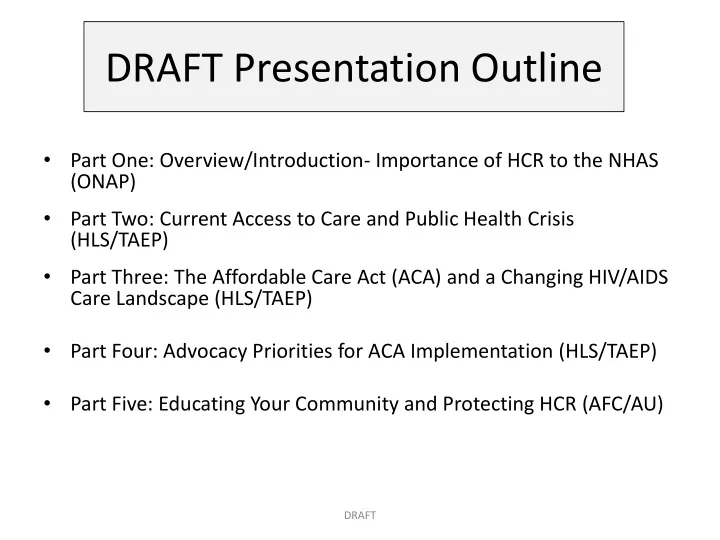
DRAFT Presentation Outline

  • Part One: Overview/Introduction- Importance of HCR to the NHAS

(ONAP)

  • Part Two: Current Access to Care and Public Health Crisis

(HLS/TAEP)

  • Part Three: The Affordable Care Act (ACA) and a Changing HIV/AIDS

Care Landscape (HLS/TAEP)

  • Part Four: Advocacy Priorities for ACA Implementation (HLS/TAEP)
  • Part Five: Educating Your Community and Protecting HCR (AFC/AU)

DRAFT

slide-2
SLIDE 2

Part 2 Current Access to Care and Public Health Crisis

DRAFT

slide-3
SLIDE 3

Context for Reform: The Current System is Not Working…

A Patchwork System with Many Gaps and Holes

  • Even people with

insurance have a hard time meeting cost sharing

  • bligations
  • Safety net programs

(Medicaid and Medicare) have strict eligibility requirements

  • Lack of access to insurance

is a huge problem for millions of Americans, particularly in the South

DRAFT

slide-4
SLIDE 4

Medicaid = a Disability Program for People Living with HIV and AIDS

~ 74% of people living with HIV/AIDS

  • n Medicaid are

eligible because of disability

Spending per Medicaid User with and without HIV by Type of Service (2007)

Source: Jen Kates, Kaiser Family Foundation, Medicaid and HIV: A National Analysis (October 2011)

DRAFT

slide-5
SLIDE 5

We Cannot Fight an Epidemic with a Discretionary Program Alone

Source: Andrea Weddle, HIV Medicine Association, HIV Medical Provider Experiences: Results of a Survey of Ryan White Part C Programs, Institute of Medicine Committee on HIV Screening and Access to Care, September 29, 2010

Ryan White Part C Caseloads Compared to Funding Levels: 2001 to 2009

DRAFT

slide-6
SLIDE 6

Status Quo = Public Health and Access to Care Crisis

The Current Crisis

29% of PWHIV uninsured Thousands

  • n ADAP

waitlists Demand for Ryan White care and services > funding 42-59% of low-income PWHIV not in regular care Disparities in health access, health

  • utcomes

DRAFT

slide-7
SLIDE 7

We Are Not Alone!

Number of Uninsured Americans

Sources: Center on Budget Policies and Priorities, The Number of Uninsured Americans is at an All-Time High (2006), Kaiser Family Foundation, The Uninsured: A Primer (2010).

10 20 30 40 50 60 2001 2005 2009

41.2 Million 46.6 Million 50.9 Million

DRAFT

slide-8
SLIDE 8

Part 3 The Affordable Care Act (ACA) and a Changing HIV/AIDS Care Landscape

DRAFT

slide-9
SLIDE 9
  • 1. Expands and Improves Medicaid
  • Expands Eligibility

– Starting in 2014, disability requirement is eliminated for most people with income up to 133% FPL

(~$14K for an individual/~$29K for family of four)

  • Improves Services

– Medicaid expansion includes Essential Health Benefits (EHB) for the newly-eligible

  • Improves Reimbursement

– Enhances reimbursement for primary care providers in 2013-14

  • Streamlines Application and Enrollment

DRAFT

slide-10
SLIDE 10
  • Gives states the option to provide cost-effective, coordinated

and enhanced care and services to people living with chronic medical conditions*

  • States are eligible for planning grants and increased federal

support – 90% FMAP for first two years of the program

* Successful advocacy led to inclusion of people living with HIV/AIDS

  • 2. Supports Enhanced & Coordinated Care

Through Medicaid Health Home Program

DRAFT

slide-11
SLIDE 11
  • 3. Health Care Reform Increases Access to

Medicare Prescription Drugs

  • 50% discount on all brand-name

prescription drugs

  • AIDS Drug Assistance Program (ADAP)

contributions now count toward copayment obligations

  • Part D “donut hole” phased-out by 2020

DRAFT

slide-12
SLIDE 12
  • Cannot be denied insurance because of

HIV (or other chronic condition) (2014)

  • Health plans cannot drop people from coverage

when they get sick (in effect)

  • No lifetime limits on coverage (in effect)
  • No annual limits on coverage (2014)
  • 4. Reforms Private Insurance and

Reduces Discriminatory Insurance Practices

DRAFT

slide-13
SLIDE 13
  • Starting in 2014, creation of consumer-friendly exchanges to

purchase private insurance

  • Federal subsidies for people with income up to 400% FPL

(~$44K for an individual/~$89K for family of four)

  • Plans cannot charge higher premiums based on gender or

health status

  • Plans must include Essential Health Benefits
  • Plans have to contract with “community providers,”

including Ryan White Programs

Promotes Access to Private Insurance through State-Based Exchanges

DRAFT

slide-14
SLIDE 14

Health Care Reform Invests in Prevention, Access to Care, and Health Workforce

Investments in Prevention and Public Health Fund Investments in Community Health Centers Investments in Health Workforce

DRAFT

slide-15
SLIDE 15

HIV/AIDS Care and Treatment, 2014

Individuals with income up to 133% FPL Eligible for Medicaid based on income alone (Ryan White Program still needed to fill in gaps not covered by Medicaid) Individuals between 133% and 400% FPL Eligible for premium tax credits and cost-sharing subsidies to purchase private insurance (Ryan White Program still needed to fill gaps not covered by private insurance) Individuals with unmet care and treatment needs Ryan White Program still a safety net for: insured people with unmet need and gaps in services legal immigrants not eligible for Medicaid, and undocumented immigrants

The ACA and HIV/AIDS Care: Looking Ahead to 2014

DRAFT

slide-16
SLIDE 16

Part 4 Advocacy Priorities for ACA Implementation

DRAFT

slide-17
SLIDE 17

ACA Essential Health Benefits

  • Ambulatory services
  • Emergency services
  • Hospitalization
  • Maternity/newborn care
  • Mental health and substance use

disorder services

  • Prescription drugs
  • Rehabilitative and habilitative

services

  • Laboratory services
  • Preventive and wellness services and

chronic disease management

  • Pediatric services

Federal Guidance/Regulations State Implementation Decisions

  • 1. Ensuring a Comprehensive Essential

Health Benefits Package

DRAFT

slide-18
SLIDE 18
  • 2. Ensuring Access to Essential Services:

Covering the Gaps

  • Essential services needed by people living with

HIV/AIDS NOT fully covered by Medicaid:

– Dental services – Nonmedical case management – Nutrition services – Transportation – Mental health services – Peer support services – Insurance assistance

  • Medicaid will NOT be available for:

– Undocumented immigrants – Legal immigrants within the 5 year ban

Ryan White HIV/AIDS Program

DRAFT

slide-19
SLIDE 19
  • Work with all relevant agencies, including Medicaid,

departments of insurance, and state health departments – Data requests – Coordinated plans/strategy – Public hearings

  • 3. Be at the Table

DRAFT