
SLIDE 1
Draft
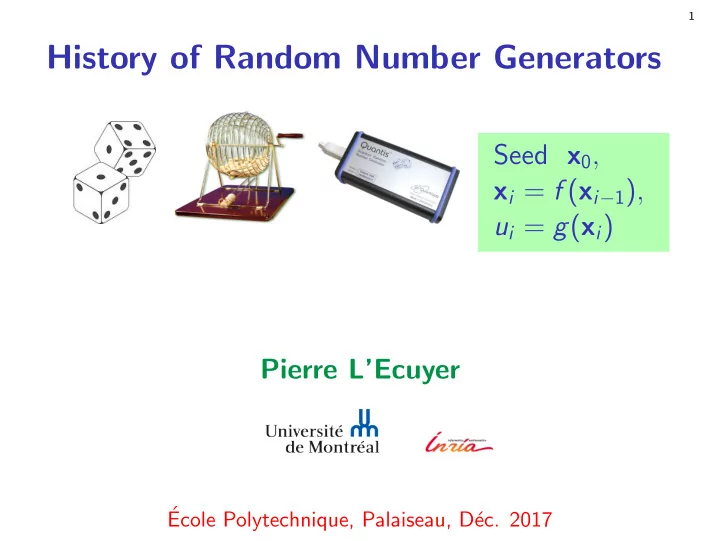
1History of Random Number Generators
Seed x0, xi = f (xi−1), ui = g(xi) Pierre L’Ecuyer
´ Ecole Polytechnique, Palaiseau, D´
- ec. 2017
Draft History of Random Number Generators Seed x 0 , x i = f ( x i - - PowerPoint PPT Presentation
1 Draft History of Random Number Generators Seed x 0 , x i = f ( x i 1 ) , u i = g ( x i ) Pierre LEcuyer Ecole Polytechnique, Palaiseau, D ec. 2017 2 Draft Once upon a time, ... 5000 years ago Dice, coins, and other devices
History of Random Number Generators
Seed x0, xi = f (xi−1), ui = g(xi) Pierre L’Ecuyer
´ Ecole Polytechnique, Palaiseau, D´
Once upon a time, ... 5000 years ago
Dice, coins, and other devices were used long ago to make “random” selections and produce random numbers in games of chance. 5000-year old dice have been found in Iran and Irak. Dice were popular in India, China, Egypt, ..., some 4000 years ago.
Source: quatr.us/west-asia/dice-invented-history-dice.htm, awesomedice.com/blog/551/new-candidate-for-oldest-dice/People believed the outcomes were not truly random, but decided by god!
2000 years ago in the Roman Empire
Only need one bit to decide between life and death!
Tables of random sampling numbers
For statisticians, throwing dice to take random samples was inconvenient. Following a suggestion of Karl Pearson, Tippett (1927) published a table of 41,600 random digits taken from a 1925 census report. Fisher and Yates (1928): table with digits picked from a table of logarithms. Kermack and Kendrick (1937): table of digits taken from a telephone directory. Proposed run tests and gap tests to detect periodic behavior. Kendall and Babington-Smith (1938): first “machine” to produce the numbers. Cardboard disk divided in 10 sectors, rotating at about 250 turns per minute. Light beam flashed at random time, about every 2 seconds. Flashed sector number was recorded by a human. They made a table of 100,000 sampling numbers. First page of table from Kendall and Babington-Smith (1938)
How to measure the quality of a table?
Probability theory: for independent random digits, any possible table of n digits has the same probability, so no table is better than another!
How to measure the quality of a table?
Probability theory: for independent random digits, any possible table of n digits has the same probability, so no table is better than another! KBS introduced a notion of locally random sequence: every reasonably long subsequence should appear random and pass simple statistical tests. They proposed a small set of tests that measure: (1) the frequency of each digit; (2) the frequency of each pair in successive values (serial test); (3) the frequency of certain blocks of five digits (poker); (4) lengths of gaps between the occurrences of a given digit. Frequencies are compared with expectations via a chi-square. They replicated the tests with disjoint parts of their table. Their table passed the tests.
1947: RAND Corporation project
Tables in books were not convenient for random sampling with computers. Project: produce a million random digits in a fully automated way. An electronic device emits pulses randomly, about 100,000 per second. Every second, we count how many pulses, modulo 32. 20 of the 32 possible values are mapped to decimal digits, the others are discarded. The digits were saved on 20,000 punched cards, 50 per card.
1947: RAND Corporation project
Tables in books were not convenient for random sampling with computers. Project: produce a million random digits in a fully automated way. An electronic device emits pulses randomly, about 100,000 per second. Every second, we count how many pulses, modulo 32. 20 of the 32 possible values are mapped to decimal digits, the others are discarded. The digits were saved on 20,000 punched cards, 50 per card. Odd digits were slightly more frequent! Then each digit was transformed by adding the corresponding digit of the previous card, mod 10. The transformed digits passed statistical tests. Horton and Smith III (1949) proved that adding mod b random digits in base b reduces the bias. A copy of the punched cards (large box) could be purchased in 1950.
1955: The million-digit book
Book with 50 rows of 50 digits per page for 400 pages. Reissued in paperback in 2001. Available at Amazon. This book has maximum suspense: when reading digits in succession, at any step, one has no clue of what comes after!!!
Generating random numbers on the fly
For physicists doing Monte Carlo simulation, reading random digits from punched cards or tables was too slow and memory was also limited. Two main approaches:
At the end of the RAND report of Brown (1949): “... for the future ... it may not be asking too much to hope that ... some numerical process will permit us to produce our random numbers as we need them. The advantages of such a method are fairly obvious in large-scale computation where extensive tabling operations are relatively clumsy.”
Physical devices
Coins, dice, roulette, picking balls from an urn, shuffling cards, etc., have been used for centuries. With computers, electronic devices such as counters of random events and periodic sampling of electric noise, are faster and more convenient. An early example: Cobine and Curry (1947): electric noise in a gas tube in a magnetic field is amplified and sampled to produce random bits. Thousands of articles and around 2000 patents for physical RNGs in the last 70 years! Thermal and electric noise, photoelectric effect, devices based on quantum physics phenomena such as light beam splitters, shot noise in electronic circuits, radioactive decay detected by a Geiger counter, etc. Transformation techniques to reduce biais and correlations. Fastest commercial devices today produce about 3 Gbits per second.
1957: ERNIE
The Electronic Random Number Indicator Equipment (ERNIE) could produce 50 random digits per second, used to determine winning numbers in the British Savings Bonds Lottery. High voltage applied at each end of glass tubes filled with neon gas, produces current inside the tube, creating noise, which was amplified and collected.
ERNIE 4
Original ERNIE was used until 1972, then upgraded. ERNIE 4, still in use since 2004, extracts random bits from thermal noise in transistors.
Algorithmic generators
S, finite state space; s0, seed (initial state); f : S → S, transition function; g : S → [0, 1], output function. s0
Algorithmic generators
S, finite state space; s0, seed (initial state); f : S → S, transition function; g : S → [0, 1], output function. s0
g
Algorithmic generators
S, finite state space; s0, seed (initial state); f : S → S, transition function; g : S → [0, 1], output function. s0
f− − − − → s1
g
Algorithmic generators
S, finite state space; s0, seed (initial state); f : S → S, transition function; g : S → [0, 1], output function. s0
f− − − − → s1
g
u1
Algorithmic generators
S, finite state space; s0, seed (initial state); f : S → S, transition function; g : S → [0, 1], output function. s0
f− − − − → s1
f− − − − → · · ·
f− − − − → sn
f− − − − → sn+1
g
u1 · · · un un+1
Algorithmic generators
S, finite state space; s0, seed (initial state); f : S → S, transition function; g : S → [0, 1], output function. · · ·
f− − − − → sρ−1
f− − − − → s0
f− − − − → s1
f− − − − → · · ·
f− − − − → sn
f− − − − → sn+1
g
uρ−1 u0 u1 · · · un un+1 Period of {sn, n ≥ 0}: ρ ≤ cardinality of S. Key feature: Can reproduce exactly the same sequence at will, without storing it.
1946: von Neumann Middle-square method
Paper published in 1951. Start with 2a-digit number, square it to get 4a digits and take the middle 2a digits. Repeat.
Source: WikipediaWith most seeds, ends in a very short cycle. Many heuristic “improvements” have been proposed, even recently. Not much theoretical support.
Two-digit numbers in base 10
(Source: Wikipedia) 1950 or earlier: Decimals of π and e
Using successive decimals of π, e, etc., to imitate a random sequence was suggested long ago. Metropolis et al. (1950) computed 2,000 decimals of π and e for this purpose and the sequences passed statistical tests. Pathria (1962) did it for 10,000 decimals of π, then Esmenjaud-Bonnardel (1965) for 100,000 decimals. No statistical problem was found. The world record in 2016 was 22,459,157,718,361 decimal digits of π. But using these digits is much too slow, and it takes too much space to store them.
Notions of uniformly distributed infinite sequence
A more fundamental question: what can we prove about the uniformity and independence of these successive digits, in the long run? Borel (1909): A sequence of digits in base b is k-distributed if any of the bk possible blocks of k successive digits appears with the same frequency in the long run. It is ∞-distributed if this holds for any k ≥ 1.
Notions of uniformly distributed infinite sequence
A more fundamental question: what can we prove about the uniformity and independence of these successive digits, in the long run? Borel (1909): A sequence of digits in base b is k-distributed if any of the bk possible blocks of k successive digits appears with the same frequency in the long run. It is ∞-distributed if this holds for any k ≥ 1. Borel proved that almost all real numbers (w.r.t. uniform measure) have an ∞-distributed digital expansion in base b for any b (i.e., they are normal numbers). We do not know if π or e is a normal number.
Notions of uniformly distributed infinite sequence
A more fundamental question: what can we prove about the uniformity and independence of these successive digits, in the long run? Borel (1909): A sequence of digits in base b is k-distributed if any of the bk possible blocks of k successive digits appears with the same frequency in the long run. It is ∞-distributed if this holds for any k ≥ 1. Borel proved that almost all real numbers (w.r.t. uniform measure) have an ∞-distributed digital expansion in base b for any b (i.e., they are normal numbers). We do not know if π or e is a normal number. Similar notions of uniformity for sequences of real numbers in [0, 1) were studied by Weyl (1916), Korobov (1948), Franklin (1963, 1965), etc. See Kuipers and Niederreiter (1974). Sequences that provably satisfy these definitions can be constructed, but they are impractical for simulation, and often do not look random.
RNGs with long known finite period
1945: Mathematician Derrick Lehmer started using ENIAC computers for his research in number theory. He developed the vision that abstract mathematics could contribute to this new emerging field named “large-scale computing” (and vice-versa).
RNGs with long known finite period
1945: Mathematician Derrick Lehmer started using ENIAC computers for his research in number theory. He developed the vision that abstract mathematics could contribute to this new emerging field named “large-scale computing” (and vice-versa). Number theory to the rescue: In 1949, at a symposium at Harvard, Lehmer suggested the idea of an algorithmic RNG with finite state space, based on a recurrence with long and known period. To realize this, he proposed the linear congruential generator (LCG): state xi = axi−1 mod m and output ui = xi/m, for 0 < a < m.
RNGs with long known finite period
1945: Mathematician Derrick Lehmer started using ENIAC computers for his research in number theory. He developed the vision that abstract mathematics could contribute to this new emerging field named “large-scale computing” (and vice-versa). Number theory to the rescue: In 1949, at a symposium at Harvard, Lehmer suggested the idea of an algorithmic RNG with finite state space, based on a recurrence with long and known period. To realize this, he proposed the linear congruential generator (LCG): state xi = axi−1 mod m and output ui = xi/m, for 0 < a < m. He suggested two specific ones: For decimal arithmetic: m = 108 + 1. Generated 1,250 8-digit numbers per hour on an IBM calculating punch 602A. For binary arithmetic: m = 231 − 1 and a = 23, with period 231 − 2. Could generate 625 8-digit numbers per second on the ENIAC.
Many more LCGs
Already in 1950, people started to use multiplicative LCGs with m = 2e (for binary computers) or m = 10e (for decimal computers), with e equal to the computer word length, to gain speed. This limited the period to ρ = m/4 and ρ = m/200, respectively. They also started to take a as a sum of 2 or 3 powers of 2 or 10, e.g., a = 2d + 1, 2d + 2 + 1, 2d + 4 + 1, etc., so the product ax mod m could be computed by just a few shifts and adds.
Many more LCGs
Already in 1950, people started to use multiplicative LCGs with m = 2e (for binary computers) or m = 10e (for decimal computers), with e equal to the computer word length, to gain speed. This limited the period to ρ = m/4 and ρ = m/200, respectively. They also started to take a as a sum of 2 or 3 powers of 2 or 10, e.g., a = 2d + 1, 2d + 2 + 1, 2d + 4 + 1, etc., so the product ax mod m could be computed by just a few shifts and adds. Taussky and Todd (1954) report instances with m = 243, 242, 239, 236, 1011, 1010. They also pointed out that with m = 2e, the period of the jth least significant bit cannot exceed max(0, 2j−2), so one should not rely on the least significant bits.
Adding a constant term
Rothenberg (1960) proposed adding a constant c: xi = (axi−1 + c) mod m and proved that with m = 235, a = 2d + 1, and c odd, the period is 235. He also suggested m = 235, a = 7, c = 1 for the IBM 704 35-bit computer. Hull and Dobell (1962) proved sufficient conditions for maximal period for general m, a, and c > 0. In some cases, they were already known.
Empirical statistical Tests
Hypothesis H0: “{u0, u1, u2, . . . } are i.i.d. U(0, 1) r.v.’s”. We know that H0 is false, but can we detect it ?
Empirical statistical Tests
Hypothesis H0: “{u0, u1, u2, . . . } are i.i.d. U(0, 1) r.v.’s”. We know that H0 is false, but can we detect it ? Test: — Define a statistic T, function of the ui, whose distribution under H0 is known (or approx.). — Reject H0 if value of T is too extreme. If suspect, can repeat. Different tests detect different deficiencies.
Empirical statistical Tests
Hypothesis H0: “{u0, u1, u2, . . . } are i.i.d. U(0, 1) r.v.’s”. We know that H0 is false, but can we detect it ? Test: — Define a statistic T, function of the ui, whose distribution under H0 is known (or approx.). — Reject H0 if value of T is too extreme. If suspect, can repeat. Different tests detect different deficiencies. Utopian ideal: T mimics the r.v. of practical interest. Not easy. Ultimate dream: Build an RNG that passes all the tests? Formally impossible.
Empirical statistical Tests
Hypothesis H0: “{u0, u1, u2, . . . } are i.i.d. U(0, 1) r.v.’s”. We know that H0 is false, but can we detect it ? Test: — Define a statistic T, function of the ui, whose distribution under H0 is known (or approx.). — Reject H0 if value of T is too extreme. If suspect, can repeat. Different tests detect different deficiencies. Utopian ideal: T mimics the r.v. of practical interest. Not easy. Ultimate dream: Build an RNG that passes all the tests? Formally impossible. Compromise: Build an RNG that passes most reasonable tests. Tests that fail are hard to find. Formalization: computational complexity framework.
Statistical testing
Large collection of empirical statistical tests developed over the years, since around 1940 and even earlier. Frequency, disjoint serial, overlapping serial, gap tests, runs up and down, runs of given digit, poker, coupons collector, collisions, nearest points, birthday spacings, iterated spacings, random walks, binary matrix rank, linear complexity, . . . In many cases, the theoretical distribution used initially for the test statistic was incorrect! Examples: overlapping serial tests and run tests.
Statistical testing
Large collection of empirical statistical tests developed over the years, since around 1940 and even earlier. Frequency, disjoint serial, overlapping serial, gap tests, runs up and down, runs of given digit, poker, coupons collector, collisions, nearest points, birthday spacings, iterated spacings, random walks, binary matrix rank, linear complexity, . . . In many cases, the theoretical distribution used initially for the test statistic was incorrect! Examples: overlapping serial tests and run tests. Knuth (1969, 1981). Dudewicz and Ralley (1981): TESTRAND (in FORTRAN). Marsaglia (1996): DIEHARD. L’Ecuyer and Simard (2007): TestU01 (early versions since before 1990.) NIST suites (2001, 2010).
Examples: Serial and collision tests
1 1 ui+1 ui Throw n = 10 points in k = 100 boxes.
Examples: Serial and collision tests
1 1 ui+1 ui
Examples: Serial and collision tests
1 1 ui+1 ui
Examples: Serial and collision tests
1 1 ui+1 ui
Examples: Serial and collision tests
1 1 ui+1 ui
Examples: Serial and collision tests
1 1 ui+1 ui
Examples: Serial and collision tests
1 1 ui+1 ui
Examples: Serial and collision tests
1 1 ui+1 ui
Examples: Serial and collision tests
1 1 ui+1 ui
Examples: Serial and collision tests
1 1 ui+1 ui
Examples: Serial and collision tests
1 1 ui+1 ui
Examples: Serial and collision tests
1 1 ui+1 ui
Here we observe 3 collisions. P[C ≥ 3 | H0] ≈ 0.144.
Collision test
Partition [0, 1)s in k = ds cubic boxes of equal size. Generate n points (uis, . . . , uis+s−1) in [0, 1)s. C = number of collisions.
Collision test
Partition [0, 1)s in k = ds cubic boxes of equal size. Generate n points (uis, . . . , uis+s−1) in [0, 1)s. C = number of collisions. Under H0, C ≈ Poisson of mean λ = n2/(2k), if k is large and λ is small. If we observe c collisions, we compute the p-values: p+(c) = P[X ≥ c | X ∼ Poisson(λ)], p−(c) = P[X ≤ c | X ∼ Poisson(λ)], We reject H0 if p+(c) is too close to 0 (too many collisions)
Example: LCG with m = 101 and a = 12: 1 1 ui+1 ui
n λ C p−(C) 10 1/2 0.6281 Example: LCG with m = 101 and a = 12: 1 1 ui+1 ui
n λ C p−(C) 10 1/2 0.6281 20 2 0.1304 Example: LCG with m = 101 and a = 12: 1 1 ui+1 ui
LCG with m = 101 and a = 51: 1 1 ui+1 ui
LCG with m = 101 and a = 51: 1 1 ui+1 ui
LCG with m = 101 and a = 51: 1 1 ui+1 ui
n λ C p+(C) 10 1/2 1 0.3718 20 2 5 0.0177 40 8 20 2.2 × 10⁻⁹ The spectral test
Coveyou and MacPherson (1967) (ORNL report in 1965) exposed the lattice structure of LCGs and proposed the spectral test to measure their multivariate uniformity. They showed that all vectors u = (ui, . . . , ui+s−1) belongs to a lattice; all lie in equidistant parallel hyperplanes with wavelength ds = 1/ℓs where ℓs (the frequency) is the length of the shortest nonzero vector in the dual
any given m.
The spectral test
Coveyou and MacPherson (1967) (ORNL report in 1965) exposed the lattice structure of LCGs and proposed the spectral test to measure their multivariate uniformity. They showed that all vectors u = (ui, . . . , ui+s−1) belongs to a lattice; all lie in equidistant parallel hyperplanes with wavelength ds = 1/ℓs where ℓs (the frequency) is the length of the shortest nonzero vector in the dual
any given m. They proposed an algorithm to compute ℓs and gave several examples for s up to 10 and m near 1010, 231, 235, and 247. They showed for example that ds is always large when a is small or when a = 2d + 3 and m = 2e. Examples: RANDU, with m = 231 and a = 216 + 3; RANNO, with m = 235 and a = 218 + 3; Lehmer’s LCG with m = 231 − 1 and a = 23, etc.
1 1 ui ui−1 xi = 12 xi−1 mod 101; ui = xi/101
Marsaglia (1968) examined the lattice structure in terms of the minimal number of hyperplanes points that contain all the points. Spectral test algorithm was improved by Knuth (1969), Dieter (1975), Fincke and Pohst (1985), etc. Should we discard LCGs altogether because of their lattice structure?
Marsaglia (1968) examined the lattice structure in terms of the minimal number of hyperplanes points that contain all the points. Spectral test algorithm was improved by Knuth (1969), Dieter (1975), Fincke and Pohst (1985), etc. Should we discard LCGs altogether because of their lattice structure?
Multiple recursive generator (MRG)
Duparc et al. (1953): Fibonacci recurrence xi = (xi−1 + xi−2) mod m. Mitchell and Moore (1958): Lagged-Fibonacci, xi = (xi−r + xi−k) mod m. Bad structure: All points (un−k, un−r, un) belong to only two parallel planes in [0, 1)3. But still several versions in C and C++ libraries. Zierler (1959) studied the general case: xi = (a1xi−1 + · · · + akxi−k) mod m. Max period mk − 1, possible only if m is prime. Alanen and Knuth (1964): Algorithm to verify max period conditions. Good parameters based on spectral test: Grube (1973), L’Ecuyer, Blouin, Couture (1988). Deng and co-authors (2000 to 2012): very large order k. Bad structures. Marsaglia and Zaman (1991): Add-with-carry and Subtract-with-borrow. Modulo m = 2e, huge period, near mk.
Example: subtract-with-borrow (SWB)
State (xn−48, . . . , xn−1, cn−1) where xn ∈ {0, . . . , 231 − 1} and cn ∈ {0, 1}: xn = (xn−8 − xn−48 − cn−1) mod 231, cn = 1 if xn−8 − xn−48 − cn−1 < 0, cn = 0 otherwise, un = xn/231, Period ρ ≈ 21479 ≈ 1.67 × 10445.
Example: subtract-with-borrow (SWB)
State (xn−48, . . . , xn−1, cn−1) where xn ∈ {0, . . . , 231 − 1} and cn ∈ {0, 1}: xn = (xn−8 − xn−48 − cn−1) mod 231, cn = 1 if xn−8 − xn−48 − cn−1 < 0, cn = 0 otherwise, un = xn/231, Period ρ ≈ 21479 ≈ 1.67 × 10445. In Mathematica versions ≤ 5.2: modified SWB with output ˜ un = x2n/262 + x2n+1/231. Great generator?
All points (un, un+40, un+48) belong to only two parallel planes in [0, 1)3. Ferrenberg et Landau (1991). “Critical behavior of the three-dimensional Ising model: A high-resolution Monte Carlo study.” Ferrenberg, Landau et Wong (1992). “Monte Carlo simulations: Hidden errors from “good” random number generators.”
All points (un, un+40, un+48) belong to only two parallel planes in [0, 1)3. Ferrenberg et Landau (1991). “Critical behavior of the three-dimensional Ising model: A high-resolution Monte Carlo study.” Ferrenberg, Landau et Wong (1992). “Monte Carlo simulations: Hidden errors from “good” random number generators.” Tezuka, L’Ecuyer, and Couture (1993). “On the Add-with-Carry and Subtract-with-Borrow Random Number Generators.” Couture and L’Ecuyer (1994) “On the Lattice Structure of Certain Linear Congruential Sequences Related to AWC/SWB Generators.”
Collision test of Subtract-with-Borrow in (old) Mathematica 5.2 For the unit cube [0, 1)3, divide each axis in d = 100 equal intervals. This gives k = 1003 = 1 million boxes. Generate n = 10 000 vectors in 25 dimensions: (U0, . . . , U24). For each, note the box where (U0, U20, U24) falls. Here, expected number of collisions under H0 is λ = 50.
Collision test of Subtract-with-Borrow in (old) Mathematica 5.2 For the unit cube [0, 1)3, divide each axis in d = 100 equal intervals. This gives k = 1003 = 1 million boxes. Generate n = 10 000 vectors in 25 dimensions: (U0, . . . , U24). For each, note the box where (U0, U20, U24) falls. Here, expected number of collisions under H0 is λ = 50. Results: C = 2070, 2137, 2100, 2104, 2127, ....
Collision test of Subtract-with-Borrow in (old) Mathematica 5.2 For the unit cube [0, 1)3, divide each axis in d = 100 equal intervals. This gives k = 1003 = 1 million boxes. Generate n = 10 000 vectors in 25 dimensions: (U0, . . . , U24). For each, note the box where (U0, U20, U24) falls. Here, expected number of collisions under H0 is λ = 50. Results: C = 2070, 2137, 2100, 2104, 2127, .... With MRG32k3a: C = 41, 66, 53, 50, 54, ....
Combined recurrences
Forsythe (1951): described an early method to construct an RNG with long known period: Take several short sequences with relatively prime (known) periods, run them in parallel, and combine their states to produce the output at each step. For example, with sequences of periods 31, 33, 34, and 35, we can obtain a period of 1,217,370.
Combined LCGs and MRGs
Whichmann and Hill (1982) proposed an RNG that combines three 16-bit LCGs of prime periods near 215. Still used in Excel! Zeisel (1986) pointed out that their RNG is equivalent to another LCG, with period near 243. L’Ecuyer (WSC 1986, 1988): Combined LCGs. L’Ecuyer (1996, 1999): Combined MRG. They are equivalent to an LCG or MRG with large modulus, equal to the product of moduli of the components. Was proved by L’Ecuyer and Tezuka (1991) for LCGs, and by L’Ecuyer (1996) for MRGs. Popular examples: MRG32k3a, MRG31k3p.
Combined MRGs.
Two [or more] MRGs in parallel: x1,n = (a1,1x1,n−1 + · · · + a1,kx1,n−k) mod m1, x2,n = (a2,1x2,n−1 + · · · + a2,kx2,n−k) mod m2. One possible combinaison: zn := (x1,n − x2,n) mod m1; un := zn/m1; L’Ecuyer (1996): the sequence {un, n ≥ 0} is also the output of an MRG
(mk
1 − 1)(mk 2 − 1)/2.Permits one to implement efficiently an MRG with large m and several large nonzero coefficients. Parameters: L’Ecuyer (1999); L’Ecuyer et Touzin (2000). Implementations with multiple streams.
A recommendable generator: MRG32k3a
Choose six 32-bit integers: x−2, x−1, x0 in {0, 1, . . . , 4294967086} (not all 0) and y−2, y−1, y0 in {0, 1, . . . , 4294944442} (not all 0). For n = 1, 2, . . . , let xn = (1403580xn−2 − 810728xn−3) mod 4294967087, yn = (527612yn−1 − 1370589yn−3) mod 4294944443, un = [(xn − yn) mod 4294967087]/4294967087.
A recommendable generator: MRG32k3a
Choose six 32-bit integers: x−2, x−1, x0 in {0, 1, . . . , 4294967086} (not all 0) and y−2, y−1, y0 in {0, 1, . . . , 4294944442} (not all 0). For n = 1, 2, . . . , let xn = (1403580xn−2 − 810728xn−3) mod 4294967087, yn = (527612yn−1 − 1370589yn−3) mod 4294944443, un = [(xn − yn) mod 4294967087]/4294967087. (xn−2, xn−1, xn) visits each of the 42949670873 − 1 possible values. (yn−2, yn−1, yn) visits each of the 42949444433 − 1 possible values. The sequence u0, u1, u2, . . . is periodic, with 2 cycles of period ρ ≈ 2191 ≈ 3.1 × 1057.
A recommendable generator: MRG32k3a
Choose six 32-bit integers: x−2, x−1, x0 in {0, 1, . . . , 4294967086} (not all 0) and y−2, y−1, y0 in {0, 1, . . . , 4294944442} (not all 0). For n = 1, 2, . . . , let xn = (1403580xn−2 − 810728xn−3) mod 4294967087, yn = (527612yn−1 − 1370589yn−3) mod 4294944443, un = [(xn − yn) mod 4294967087]/4294967087. (xn−2, xn−1, xn) visits each of the 42949670873 − 1 possible values. (yn−2, yn−1, yn) visits each of the 42949444433 − 1 possible values. The sequence u0, u1, u2, . . . is periodic, with 2 cycles of period ρ ≈ 2191 ≈ 3.1 × 1057.
Robust and reliable for simulation.
Used by SAS, R, MATLAB, Arena, Automod, Witness, Spielo gaming, ...
Linear recurrences modulo 2
Tausworthe (1965): linear feedback shift register (LFSR): xi = (a1xi−1 + · · · + akxi−k) mod 2, ui =
wxis+ℓ−12−ℓ. Takes a block of w bits starting at every multiple of s. Fast implementation in hardware via a shift register. With primitive polynomial, it is t-distributed to ℓ bits of accuracy for all ℓ ≤ s and t ≤ ⌊k/s⌋. Tootill et al. (1973): introduced stronger property of asymptotically random (to w bits), also called maximally equidistributed (ME). Means t-distributed to ℓ bits of accuracy whenever ℓ ≤ w and t ≤ ⌊k/ℓ⌋. They found a specific ME Tausworthe generator with xi = (xi−607 + xi−273) mod 2, s = 512, and w = 23. Lewis et al. (1973): generalized feedback shift register (GFSR): yi = (yi−r ⊕ yi−q), with qw-bit state. w copies of same recurrence. Period limited to 2q − 1 despite qw-bit state.
These RNGs are special cases of the general F2-linear family: xi = Axi−1, yi = Bxi, ui =
wyi,ℓ−12−ℓ = .yi,0 yi,1 yi,2 · · · , Matsumoto and Kurita (1992): Twisted GFSR, with period 2k − 1 for k-bit state. Matsumoto and Kurita (1994): tempered TGFSR. Matsumoto and Nishimura (1998): Mersenne Twister. MT19937. Panneton, L’Ecuyer, and Matsumoto (2006): The WELL generator, nearly as fast as MT19937, but they are ME, and mix the bits much better at each step. Period lengths: 2512 − 1 to 244497 − 1.
Impact of a matrix A that changes the state too slowly. Experiment: take an initial state with a single bit at 1. Try all k possibilities and take the average of the k values of un obtained for each n. WELL19937 vs MT19937; moving average over 1000 iterations. 200 000 400 000 600 000 800 000 0.1 0.2 0.3 0.4 0.5
Combined linear recurrences modulo 2
Lindholm (1968): a primitive polynomial of A with few nonzero coefficients always leads to bad statistical behavior. There should be nearly 50% 0 and 50% 1 in the characteristic polynomial. Tezuka and L’Ecuyer (1991) and Wang and Compagner (1993) proposed combined Tausworthe generators to achieve this. Period is the product of the periods of components. L’Ecuyer (1996, 1999) showed how to construct maximally equidistributed combined Tausworthe generators and provided several specific implementations. Note: All F2-linear RNGs fail statistical tests on the linear complexity of the binary sequence of any given bit.
Nonlinear generators
Linear RNGs are not cryptographically secure and most fail some tests that exploit their linearity. This can motivate nonlinear RNGs. Coveyou (1969): studied polynomial recurrence xi = p(xi−1) mod m. Knuth (1981): quadratic recurrence modulo m. Marsaglia (1985): multiplicative Lagged Fibonacci. L’Ecuyer and Granger-Pich´ e (2003): combination of MRG with F2-linear. Proof of multivariate uniformity. RNGs coming from cryptology: Blum, Blum, and Schub (1986): BBS generator. NIST (2001): AES generator. Then SHA, TEA, ChaCha, Threefish, etc.
Multiple streams and substreams
Bratley, Fox, and Shrage (1983): Table of seeds spaced 100,000 steps apart for LCG with m = 231 − 1 and a = 16807. L’Ecuyer and Cot´ e (1991) introduced facilities with multiple disjoint streams of length 250 partitioned into substreams of length 230, based on a combined LCG of period near 261. L’Ecuyer, Simard, Chan, Kelton (2002) proposed RngStreams, which
period near 2191. Available in many programming languages, and now used in various software environments such as MATLAB, SAS, Arena, R, SSJ, etc.
Some key references
Main paper: L’Ecuyer, P. 2017. “History of Uniform Random Number Generation”. In Proceedings of the 2017 Winter Simulation Conference: IEEE Press. Coveyou, R. R., and R. D. MacPherson. 1967. “Fourier Analysis of Uniform Random Number Generators”. Journal of the ACM 14:100–119. Knuth, D. E. 1998. The Art of Computer Programming, Volume 2: Seminumerical Algorithms. Third ed. Reading, MA: Addison-Wesley. L’Ecuyer, P. 2012. “Random Number Generation”. In Handbook of Computational Statistics (second ed.)., edited by J. E. Gentle,