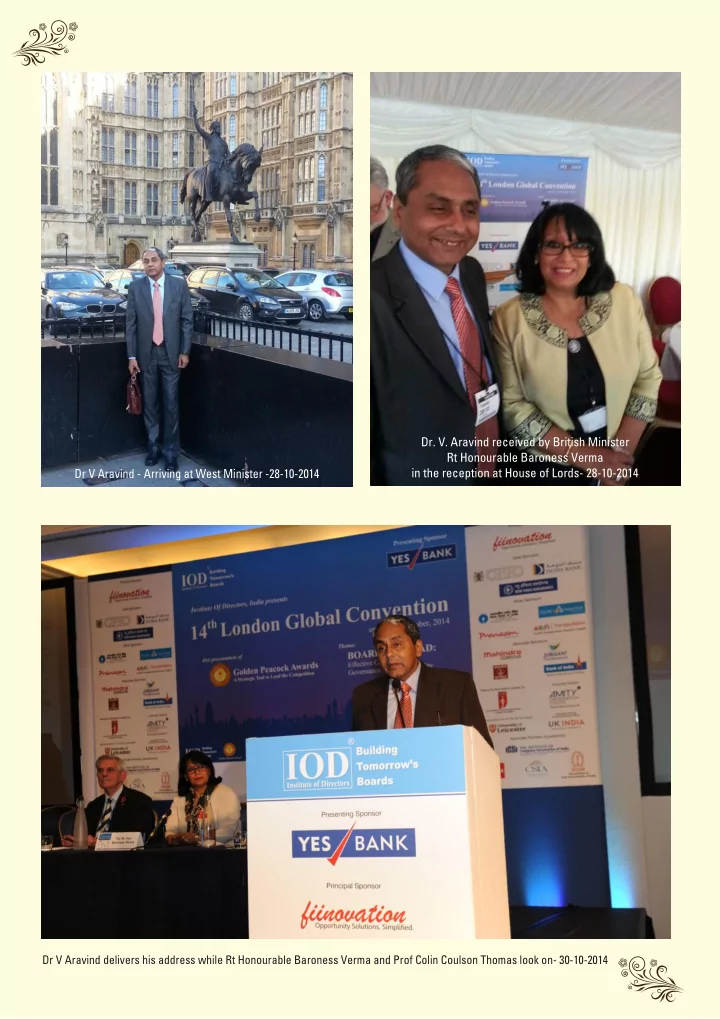
SLIDE 1 Dr V Aravind - Arriving at West Minister -28-10-2014
- Dr. V. Aravind received by British Minister
Rt Honourable Baroness Verma in the reception at House of Lords- 28-10-2014
Dr V Aravind delivers his address while Rt Honourable Baroness Verma and Prof Colin Coulson Thomas look on- 30-10-2014
SLIDE 2 With Lord Swarajpal in the lunch at House of Lords - 28-10-2014 With Lord Swarajpal in the lunch at House of Lords - 28-10-2014 Former British Minister Rt.Hon’ble Patresia looks on Former British Minister Rt.Hon’ble Patresia looks on With Lord Swarajpal in the lunch at House of Lords - 28-10-2014 Former British Minister Rt.Hon’ble Patresia looks on
- Dr. V. Aravind with Prof Colin Coulson Thomas of Camebridge
University in the reception at House of Lords - 28-10-2014 Lord Swarajpal falicitates Dr V Aravind in the convention on 29-10-2014 Dr.V. Aravind Greeted by Lord Swarajpal in receiption Dr.V. Aravind Greeted by Lord Swarajpal in receiption at the Convention venue -Hotel Milenium Mayfair - 29-10-2014 at the Convention venue -Hotel Milenium Mayfair - 29-10-2014 Dr.V. Aravind Greeted by Lord Swarajpal in receiption at the Convention venue -Hotel Milenium Mayfair - 29-10-2014
Dr V Aravind (Centre) on the dias in one of the sessions- Chairman Financial Conduct Authority UK Mr John Griffith Jones on his right - Prof Sir Andrew Likierman Dean London Business School on his Left (30-10-2014)
Dr V Aravind on the dias and British Minister Rt Honourable Baroness Verma delivers her speech - 30-10-2014
SLIDE 3
- Dr. V. Aravind with Prof David Maguire the
- Dr. V. Aravind with Prof David Maguire the
Vice Chancellor of Green Wich University - 30-10-2014 Vice Chancellor of Green Wich University - 30-10-2014
- Dr. V. Aravind with Prof David Maguire the
Vice Chancellor of Green Wich University - 30-10-2014
- Dr. V. Aravind with Prof Dame Julia King
- Dr. V. Aravind with Prof Dame Julia King
Vice Chancellor of Aston University- 30-10-2014 Vice Chancellor of Aston University- 30-10-2014
- Dr. V. Aravind with Prof Dame Julia King
Vice Chancellor of Aston University- 30-10-2014 Dr V Aravind with the Mayor of Southwark Councillor Dr V Aravind with the Mayor of Southwark Councillor Sunil Chopra at a receiption at his office - 03-11-2014 Sunil Chopra at a receiption at his office - 03-11-2014 Dr V Aravind with the Mayor of Southwark Councillor Sunil Chopra at a receiption at his office - 03-11-2014
- Dr. V. Aravind with Prof Martin Halliwell Vice Chancellor and
- Dr. V. Aravind with Prof Martin Halliwell Vice Chancellor and
Professors at LeicesterUniversity- 31-10-2014 Professors at LeicesterUniversity- 31-10-2014
- Dr. V. Aravind with Prof Martin Halliwell Vice Chancellor and
Professors at LeicesterUniversity- 31-10-2014
SLIDE 4 Courtesy : Aravind Group Companies and Aravind Foundation Vriddachalam - 606 001
Dr V Aravind's oration in the convention - 30-10-2014
SLIDE 5 LONDON GLOBAL CONVENTION ON CORPORATE GOVERNANCE AND SUSTAINABILITY
From -28/10/2014 to 31/10/2014
SUSTAINABLE CSR – NO MORE PLEASURE TIME PHILANTHROPY
Paper presented by
697 Junction Road, Vriddhachalam – 606 001. Tamil Nadu. India. Tel: +91 4143 260506 / Fax: +91 4143 262296 / Hand Phone: +91 9443378507 Email – vtradevind@yahoo.co.uk / vtradevind@gmail.com
Fellow Member of Institute Of Directors
Fellow Member of American Academy of Financial Management –USA
Fellow Member of United Writers Association
Member of All India Management Association
Co Convener – CSR Panel, FICCI, Tamil Nadu
Member – Advisory Committee of Prince Institute of Innovative Technology (PIIT), Noida, UP, India
Member – Advisory Committee – Shastri Institute of Learning, Jaipur, India Affiliations Chairman Aravind Group Companies (Claywares, Hoist Ventures (P) Ltd, Racemouse Exports, Aravind Associates, Gaanarasa Audio) Aravind Foundation Industry Partner & Chairman : Institute Management Committee of Government Industrial Training Institutes, Sankarapuram and Pullambadi, Tamil Nadu, India.
SLIDE 6 SUSTAINABLE CSR – NO MORE PLEASURE TIME PHILANTHROPY
CHANGING PARADIGM OF CSR
CSR has now moved in to a more constructive and productive phase from the ambit of pleasure time
- philanthropies. It is a continuous process with sustainable action which should promote nancial support
from within, as a means of enhancing reputation and credibility among stakeholders and more towards the society at large on which success or even survival of any industry may depend in today's interdependent
- world. Business Policies, however well intentioned, without fostering partnerships and local involvement in
communities in which companies do business, are likely to fuel feelings of alienation and suspicion, which companies simply cannot afford. Communities are vital and companies need a stable social environment that provides a predictable climate for investment and trade for continued commercial success. "One size ts all" –approach will never suit. The responsibility of Industries thriving on natural capital by squandering the common wealth the natural capital, hazardous & extractive type of industries, industries causing multiple damage to the common infrastructure, environment and peace of the society have to attach more values to transparent dialogue with stake holders and with those affected by their operations. They may be Governments, IGOs, NGOs or the community around interrelated in a macro environment. CSR includes supplementing the Governmental actions. EXAMPLE: 1 - In the construction sector, Cement Manufacture is a hazardous one and the emissions and dust created pollutes the atmosphere to several kilometers radius. The populace in the region is vulnerable for heart problems, lung dieses, cancer, ulcer and other health complications. The employees are the most prone for such ailments. The quality of water in the area gets spoiled besides making the water table going further down. If the cement plants own their own Lime Stone Mines in the same area/region or otherwise, the hazards of mining adds to the negatives. The Respirable Suspended Particulate Matter (RSPM) in the ambient air will cross the danger level of 100 micrograms per cubic meter of air. How many schools & institutions will get affected by their operations? The company might be paying a negligible royalty to the Government for the lime stones extracted. Frequently plying heavy trucks create further pollution, besides spoiling the public infrastructure, the roads. Frequent road damages will make things impossible for any Government to relay the roads frequently.Though Cement is vital for infrastructural development, the menace will never be tolerated by the society. The company`s Responsibility is most and has to perform a responsible CSR to a great deal in the region, in addition to ensuring pollution control and other safety measures. Government Regulations or the General Code for CSR can only be broad based to give an overall outline. The subject CSR has to be approached with insight, innovative thinking, due consideration of the local issues, attaching importance for social values with practical wisdom pertinent to the geographic, demographic aspects and the requirements of the targeted community/society/stakeholders. Legal Compliance merely gives the right to stay in business. A company that is acting responsibly is the
- ne that is not only complying with the law but going beyond it.
CSR DYNAMICS - CORPORATIONS IN SOCIETY TO BE HUMANE
2
SLIDE 7 Responsible Company requires concentration in at least 4 segments in which the societycan be covered in the Macro Environment.
Social environment focusing on demographics, lifestyles and social values
Economic environment focusing on the economy
Political environment focusing on the legislative process, election process and the interaction between rms, politics and government
Technological environment focusing on the changes in technological advancement TRIPPLE BOTTOM LINE IN CSR - ECONOMIC, SOCIAL AND ENVIRONMENT What CSR should mean to business and governance is the concept of triple bottom line. The economic bottom line has been with each company since birth. The environmental bottom line is becoming a necessity with Environmental Annual Reports becoming the rule rather than the exception, and the investors are quick to check on this as well as the rst bottom line. The third bottom line is the socio economic one. The main motivation behind this paper is a conviction that CSR gives way to a remarkable strength and topicality and those investors get convincing bottom lines on all the three
- counts. Socio Economic Development and the Environmental Security / sustainability are two sides of
the same coin, the Sustainable CSR. FINANCE VERSUS SOCIAL PERFORMANCE - IT PAYS FOR CSR Social obligations should not be seen as just another cost. On the contrary a clear CSR strategy could improve protability by reducing costs by helping to enhance positive social effects and avoiding the
- negatives. The CSR strategy should help align corporate and social values, identifying new commercial
- pportunities. Integrating CSR into the corporate strategy warrants the inclusion of stakeholder input.
Company - Society conict is thus avoided. Close cooperation with local communities, governments and other interested parties, including NGOs and research organizations will bestow on the company reputation and the license to operate. Sustainable CSR is the one that is developed as a Self Sustaining
A professional approach is required to make CSR Self Sustaining. SUSTAINABLE CSR NEEDS PROFESSIONAL APPROACH CSR does not merely mean to give away something by way of charity and forgetting it altogether. It requires persistent and continued attention, efforts and exercise of managerial functions to see that the CSR activity has the inbuilt mechanism of nancial/resource generation for continued support from within and to ensure that the targeted community stands on its own legs though in due course for maintaining themselves in proper lifestyle backed bysustainable lively hood as well.
Community Government Employee Consumer Owners
3
SLIDE 8 Companies can strategize CSR to generate nance /resource in itself for CSR sustainability making the investment / expenditure minimal in one project to facilitate further CSR activities / voluntary actions. Joining hands with the Government to supplement the Governmental actions towards a popularscheme/project in the locality/ region or an infrastructure creation will be a worthwhile strategy. In case of capability building or skill training and organizing placements for successful trainees, the industry gets the trained work force besides helping the society and the youth. In India Government pays for the skill training. The triple bottom line approach can only create values. Larger corporates can implement CSR with the support, without the support and inspite of the support from the Government. EXAMPLE: 2 - Government of India brought out a scheme to upgrade the Industrial Training Institutes and impart Quality Training with modernity in the country under Public Private Partnership model. Each industry took up one institute or two for up gradation of the existing courses in the institute alongside to introduce new courses popular with the nature of the institute, its location and the employment potential for the trained youth, after skilling. The Government supported the scheme with an interest free loan of INR 2.5 crores to each Institute Management Committee (A Society) headed by the industry partner, with a moratorium of 10 years for repayment and the payment to be made in 20 years from the eleventh year in equal installments. By way of reserves / seed capital was allowed to be maintained in deposit which can earn interest from the banks. The institutes are allowed to generate funds out of job orders done or by selling the materials produced while imparting training, which fund generation can be used for further development and for the repayment of the loan. Aravind Group Companies joined the scheme by becoming industry partners for two Government Industrial Training Institutes, one at Sankarapuram, Villuppuram District and another at Pullambadi in Tiruchirappalli (Trichy) District, in Tamil Nadu State, India. Both are RURAL INSTITUTES in the interior
- areas. In both the Institutes the planned infrastructure was created in a short time, otherwise which was
poor.Latest Training Techniques are in place to bring out the subtle and dormant talent. The new courses were started in the Institute at Sankarapuram and have recorded 100% admissions. The area of 3 hectares will be for developing green cover and carbon credit. Solar panels are planned. The Institute is exclusive for marginalized sections of the society. Placements are ne for the successful
- trainees. Short time courses in 19 modules are run for which the Government pays.
The Institute at Pullambadi is exclusive for women and two new courses (1) Multimedia Animation and (2) Surface Ornamentation are started with modern tools, latest systems and equipment. The broad band connection for the internet facility was established by laying the cables for 1.2 kilometers to
- perate nearly 60 systems in the campus. The new buildings are provided with Roof Top Solar Panels
for power generation for total illumination and for the purpose of fans. Short term courses in nearly 20 modules are planned including Solar Energy. Campus interviews are organized for placement of successful trainees. In addition Women Self Help Groups (SHGs) are planned for the trainees for self- employment for sustainable lively hood, thereby ensuring Empowerment of Women. Periodical medical camps are in the ofng for hygiene and health considerations. The institute campus is a deep water logging area and the road side channel is cleared to the extent of 400 meters to take the water for storage in the adjacent tank. The rain water harvesting is being planned and will be done in the campus to store the rain water in a small pond at the back side of the institute. The rest area in the campus to the tune of 3.5 hectares is marked for the development of green cover and carbon credit. Thus the triple bottom line concept is met on all the three lines more than the desired levels. The Economic, Social and Environmental aspects are fully met. PRIORITY AREAS FOR SUSTAINABLE CSR:
- 1. HUMAN RIGHTS: Human Rights are the universal rights that every person is entitled to enjoy and
to get protected. Human rights are to be seen as an umbrella to cover almost all social and environmental issues starting with the right to breathe clean air and drink clean water. CSR implies aspects beyond these rights in more stringent interpretations.
4
SLIDE 9
- 2. EMPLOYEE RIGHTS: Among other aspects, Company must respect local customs and adjust
practices, accordingly respecting diversity (cultural and gender) in the workplace. Employee rights should include the rights to enhanced skills and capacity and companies have an obligation to provide training to help ensure future employment be it with that company, another or of the society.
- 3. ENVIRONMENTAL PROTECTION: Protecting the physical environment from the impact of
- perations is a core responsibility. Besides their legal obligations, corporations have a broad
responsibility to protect the physical environment throughout their supply chains. They should commit to continuous improvements in eco-efciency (doing more with less) and managing the full lifecycle of their product or service. The core of the environmental policy can be, seeking solutions that can lead to competitive advantage and interlinking environmental issues with most aspects of CSR.
- 4. COMMUNITY INVOLVEMENT: The importance of company involvement and investment in the
local community is an important component of CSR. This involvement has been further dened to include such things as responsibility for skills training, placements and ensuring that proper health and safety systems are in place to protect the community. Partnerships are important parts of CSR, particularly partnerships involving the local community for collaborative projects and with greater stress on mutuality than on simply giving.
- 5. SUPPLIER RELATIONS: Company relations with suppliers and contractors are always deemed a
priority.
- 6. STAKEHOLDER`S RIGHTS:Stakeholdershave both inuence and rights, which should be
respected and protected. This aspect will go in line with Community Involvement. Beyond the above mentioned concepts additional actions on the following are necessary.
- 1. Reporting / disclosure/transparencyshould grow in importance.
- 2. Principles/codes need to be adapted to local cultural situations to eliminate corruption.
- 3. Consumer education regards product usage, stewardship on contents, use, disposal and the
environmental impacts of their complete product life cycle.
- 4. Communication should be effective and louder in a fashion while addressing the community.
- 5. Corruption is detrimental to investment, well being of the society, distorts the marketplace if within
government and problematic for business with resistance being remote. Corruption should be fought at all levels and tiers. SUSTAINABLE AND RELIABILITY CENTERED CSR STRATEGY The following principles are integral. 1. Capacity Building: as corporate handout and an essential component of local partnership for formulation of social capital in communities - a qualifying criterion of any social investment. 2. Taking the long-term view : Social relationships are built on long-term commitment. Sustainable development depends on the long term view. 3. Building partnership : Building partnerships between business and other groups in society, a better platform for success. 4. Cooperation on technology is an integral part of capacity building and partnership. 5. Transparency and Openness as an evidence of responsible corporate behavior. 6. Integrating the approach must be a management objective ingrained in the corporate culture and reporting systems, integral to the company.
5
SLIDE 10
7. Sustainable CSR includes a strategy for nancial sustainability / nancially self-sustaining aspects with desired strategic autonomy, though in due course of a specic CSR activity. PRACTICAL STEPS AND HANDS-ON TOOLS 1. Building a CSR Strategy is vital as Sustainable CSR is incorporated as crucially strategic that a company's over-arching developmental strategy must address. 2. Honing the Issues is important. NGOs, media, modern technology including the inter-net strive to ensure more a robust basis for ethical or socially responsible selection of consumables. Consumer's concern for the quality of food and the power of the conscious consumer action are rapidly increasing. The impact of communication should be paid particular attention. SUSTAINABLE CSR – ADDRESSING BUSINESS SUSTAINABILITY CSR provides highly interesting business opportunities for existing and new consultancies, accountancy rms, certication specialists and the like. As such, these corporate actors become a driving force for CSR in themselves. New government regulations may contribute to expand the market for CSR services. 1. CSR can be a powerful motivating force in itself. In a corporation where the staffs are part of making a positive difference in the society - by protecting the rights of stakeholders and owners, will be ready to make that extra effort which every business could use. 2. Business is an inseparable part of the society, contributing to and beneting from it. Companies by accommodating changes in the public expectations of business can enlarge their market potential. 3. To optimize the long-term value of the company to its shareholders business needs to ensure that its values are aligned with the consensus in society. This way it can avoid conicts and reaps tangible benets. To do this, it has to balance the needs of a range of stakeholders. 4. Businesses must aim for a more inclusive approach to commercial life, where business values are neither different nor fenced off from those of the society. CSR can make the society prosper in stable market conditions with effective legal systems, well-dened property and nancial rights rendering the consumers with the power of spending and freedom of choice out of which the business benets. 5. Social responsibility is, consequently, essential for the creation of long-term value for shareholders and stake holders. Managers must consider and satisfy the needs of a much broader range of people (the stakeholders) in their specic quest to deliver value to the shareholders. Shareholder value creation will sustain the company and the market. 6. Inclusive approach to commercial life also reveals more business opportunities by exposing companies to information and inuences that they would otherwise miss. A narrow perspective action restricts opportunity, the ability to create value for the shareholders and the stake holders and the society at large. The business can reap the benets only by continuing CSR process, not out of one time charity. TOOLS FOR ASSISTANCE As one progresses from one phase to the next, there are many tools available to assist. They vary from policy reports and decision making, trees to computer software. 1. Introduce CSR in organizations with little or no experience in addressing CSR, these are the tools used to brief senior management and stress the seriousness of CSR. 2. Identifying the tools designed for organizations to explore own CSR's Implications. 3. Positioning the organizations which are ready to establish their position on CSR issues and assess their status with respect to others in the eld. 4. Developing the tools useful in the process of planning and development of a CSR strategy, for setting priorities, goals and in building internal capacity for tackling CSR issues. 5. Implementation by putting CSR strategies into practice.
6
SLIDE 11 6. Monitoring by measuring performance, as an input to reporting and strategy review with emphasis
- n continuous improvement.
STAKE HOLDER FOOT PRINTS The essence of corporate social responsibility is to recognize the value of external stakeholder dialogue with stakeholder engagement placed at the Centre of CSR activity, more than promulgating own values and principles, but understanding the values and principles of those who have a stakes in its entire
- perations and the society around. Generally CSR has to improve.
MANAGING, MEASURING, MONITORING AND ASSESSING CSR AND IT`s SUSTAINABILITY New ways/methods to quantify corporate performance and the sustainable CSR have to be designed by the company to suit their business and CSR activities. Quantifying social and environmental performance in the social area is more difcult to quantify than commercial or environmental
- performance. There are three main areas.
Adequate nancial measurement methods should be in place to measure performance with concentration on social and environmental factors. Historic performance method cannot reect changing expectations fully and are not useful to determine long-term viability. A method could be adopted to combine the nancial, social and environmental elements of a company's performance in a single performance picture, instead of keeping them separate. The Company should put in place proper social responsibility management guidelines and reporting systems with clear cut objectives. Tried and tested tools to make these measurements are not readily available. Efforts should be on to develop various approaches, including the following depending on the nature and operations of the company and its CSR activity.
- 1. ESTABLISHMENT OF GOOD PRACTICE NET WORKS: These are formal and informal networks
within the business community that ensure good practices on non-competitive issues.
- 2. SURVEYS: These range from internal and external opinion surveys to take stock of stakeholder
reviews and peer group analysis.
- 3. BENCH MARKING: Areas include: past performance; company goals and targets; industry
standards: best practice in the industry; best practice from other sectors and records of fulllment of triple bottom lines.
7
SLIDE 12
- 4. ACCREDITION: Companies should develop and rene internal codes of conduct, as well as
subject themselves to independent judgment of certication agency. Preparation of regular CSR reports, business unit analysis for the fundamental principles of corporate responsibility and for the framework of reputation assurance with key questions to reveal the quality of management processes can be done. Further action plans can be developed to improve the company's comparative position and the framework created allows to link management processes directly to business results and key performance measures. Image audit, Social audit and Self-imposed accountability are open. Socially responsible businesses would attempt to maximize the positive impacts on the disadvantaged stakeholders, beyond what is required by law and support sustainable community development efforts to the extent it has the resources to do so, simultaneously creating fresh resource for its continuity. EMERGING CSR AGENDA : ISSUES IN THE REALM OF BUSINESS IN SOCIETY Formulation of Regulations and Public Policy : In the present day global economy the side effects of public policies and regulations are adversely affecting poor communities, which can be avoided. While developing product standards, expert panel shall not consist manufacturers of the products. Laws relating to displacement of people due to setting up of new companies / projects are not fully helpful to the displaced, mostly poor illiterates who will stand to lose the only resource available for their lively
- hood. The small monetary compensation will result in consumption further deepening and feminizing
- poverty. A socially responsible company should seek to inuence such policies and regulations in a
manner that benets both business and the larger society. Combating Corruption and restoring recognition for the knowledge base: Present day politics leaves most in despair and academics getting marginalized in a world that has no time to read and think. Cricketers and lm stars tend to be more admired for their wealth than thought leaders. There is need for recognition of merit, talent and a commitment to give back to society. Industry leaders have the potential to play the role more effectively.
8