Dr. Tony Bates Research Associate Contact North www.contactnord.ca - - PowerPoint PPT Presentation

dr tony bates
SMART_READER_LITE
LIVE PREVIEW

Dr. Tony Bates Research Associate Contact North www.contactnord.ca - - PowerPoint PPT Presentation

Leveraging t the O Opportunities a and Addressing t the C Challenges o of f Immersive T Technologies The Pr Promise o of " "Reality-Like" E Experiences Dr. Tony Bates Research Associate Contact North


slide-1
SLIDE 1

Leveraging t the O Opportunities a and Addressing t the C Challenges o

  • f

f Immersive T Technologies

The Pr Promise o

  • f "

"Reality-Like" E Experiences

  • Dr. Tony Bates

Research Associate Contact North

www.contactnord.ca

slide-2
SLIDE 2

Webinar F Format

Aim of series:

  • Discuss issues raised in

Teaching in a Digital Age

  • Draw on your experiences in

addressing these and related issues This webinar:

  • Immersive technologies

(Chapters 8.7a and 8.7.b)

slide-3
SLIDE 3

To Topics

The hype cycle Serious games Virtual and augmented reality

  • Definitions
  • Examples
  • Design
  • Strengths and weaknesses
slide-4
SLIDE 4

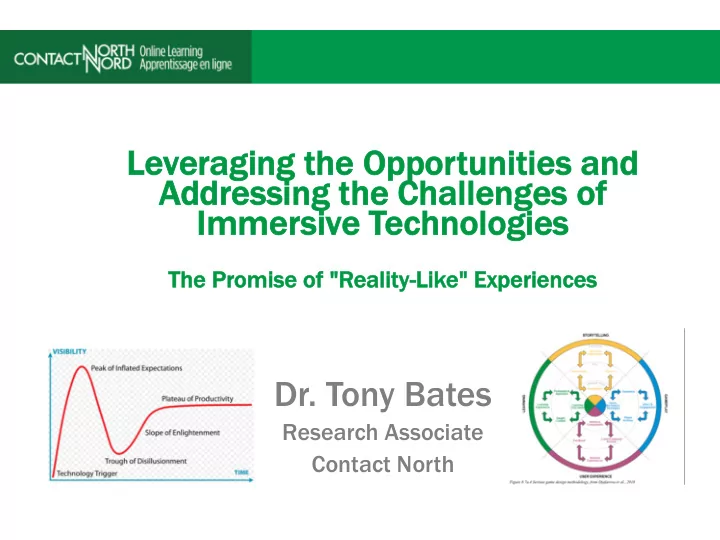
Ga Gartner’s H Hype C Cycle

slide-5
SLIDE 5

Questions a and C Comments

  • Which technology is currently at the top of the hype

cycle in education?

  • How accurate or useful is the Gartner hype cycle?
  • Any other comments on hype in ed tech?
slide-6
SLIDE 6

Se Serious Ga Games

Definition:

  • Serious g

games are… where players cultivate their knowledge and practice their skills through

  • vercoming numerous

hindrances during gaming (Zhonggen, 2019). Not necessarily electronic: e.g. cards

  • r board games
slide-7
SLIDE 7

Se Serious Ga Games

Examples:

  • Academic integrity (Ryerson Univ.)
  • Home visit: branching video (Ryerson Univ.)
  • Web design (Red River College): gamification
slide-8
SLIDE 8

Se Serious Ga Games

Design (Ryerson: Djafarova+):

  • Learning (content; skills)
  • Storytelling (narrative)
  • Game play (puzzle, trivia)
  • User experience
slide-9
SLIDE 9

Se Serious Ga Games

Strengths:

  • Motivational: ‘stretch’ students
  • Skills development: problem solving;

collaboration; correct processes

  • Can be low cost; templates to follow

Weaknesses

  • Needs specialist knowledge
  • High risk – but high return
slide-10
SLIDE 10

Questions a and C Comments

  • Anyone used serious games?

Examples? Experience?

  • Where would you place serious games

in the SAMR model?

  • Using the SECTIONS model, what are (a)

benefits (b) limits of serious games?

  • Other questions/comments about

serious games?

slide-11
SLIDE 11

Virtual a and A Augmented R Reality

  • Augmented reality: digital ‘layer’

added to real world (Pokémon Go)

  • Virtual reality: fully immersive, 3D,

real time; interactive

  • Low cost headsets, and apps (e.g.

MathWorld) for learners;

  • Powerful cloud computing enabling

complex interactions in real time

slide-12
SLIDE 12

Virtual a and A Augmented R Reality

Examples: VR:

  • Interactive chemical compounds
  • Conducting an orchestra

AR:

  • Soil sciences
  • MathWorld
slide-13
SLIDE 13

Virtual a and A Augmented R Reality

Affordances:

  • Deep, intuitive understanding
  • Modelling dangerous or

inaccessible environments

  • Avoid mistakes that affect real

people (e.g. nursing)

  • Shorten training time in real

contexts (e.g. flight simulators)

slide-14
SLIDE 14

Virtual a and A Augmented R Reality

Strength:

  • Costs are dropping; OER
  • Adds emotional context
  • Unique educational affordances

Weakness:

  • High cost
  • Specialist knowledge

Deep but not wide

slide-15
SLIDE 15

Questions a and C Comments

  • Anyone used VR or AR? Examples?

Experience?

  • Where would you place (a) VR (b) AR

in the SAMR model?

  • Using the SECTIONS model, what

are (a) benefits (b) limits of (i) virtual reality (ii) augmented reality?

  • Other questions/comments about

games, VR or AR?

slide-16
SLIDE 16

General D Discussion: Questions/Comments a about Emerging T Technologies

  • What other technologies are emerging

(besides Games/VR/AR/AI) that may be useful for education?

  • How can institutions best encourage

innovation/experimentation with new technologies?

  • ………………………?