Dr. David Igoe PhD in Offshore Pile Design (UCD 2009) Delivering - - PowerPoint PPT Presentation

dr david igoe
SMART_READER_LITE
LIVE PREVIEW

Dr. David Igoe PhD in Offshore Pile Design (UCD 2009) Delivering - - PowerPoint PPT Presentation

Geotechnical Challenges in Offshore Engineering BE in Civil Engineering (UCD 2005) Dr. David Igoe PhD in Offshore Pile Design (UCD 2009) Delivering the most progressive, reliable, and efficient Postdoctoral Researcher (UCD 2010


slide-1
SLIDE 1

Engineers Ireland / ICE Presentation 2017 – David Igoe

Delivering the most progressive, reliable, and efficient geotechnical designs across a wide variety of situations.

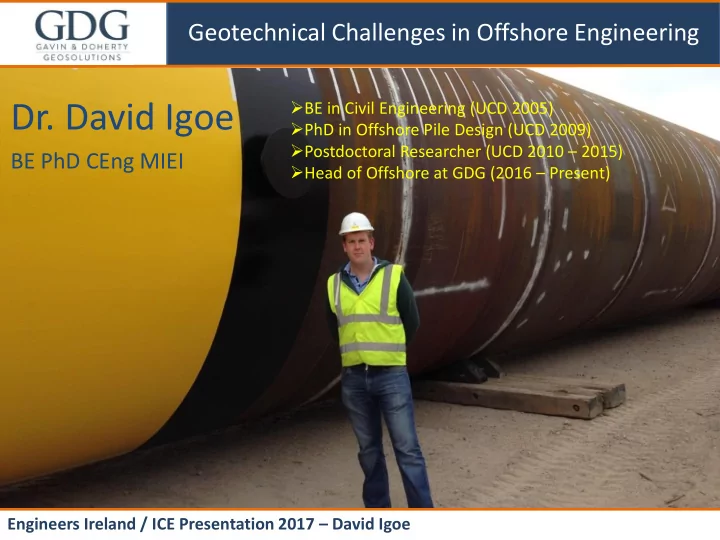
Geotechnical Challenges in Offshore Engineering

  • Dr. David Igoe

BE PhD CEng MIEI

  • BE in Civil Engineering (UCD 2005)
  • PhD in Offshore Pile Design (UCD 2009)
  • Postdoctoral Researcher (UCD 2010 – 2015)
  • Head of Offshore at GDG (2016 – Present)
slide-2
SLIDE 2

Engineers Ireland / ICE Presentation 2017 – David Igoe

  • Introduction
  • Key Geotechnical Challenges
  • Monopiles
  • Jacket Structures
  • Gravity Base Foundations
  • Research Projects
  • PISA (Pile Stability Analysis)
  • Pile Ageing
  • DemoGravi3
  • Other Projects
  • Conclusions

Overview

slide-3
SLIDE 3

Engineers Ireland / ICE Presentation 2017 – David Igoe

Introduction

slide-4
SLIDE 4

Engineers Ireland / ICE Presentation 2017 – David Igoe

Offshore Wind

slide-5
SLIDE 5

Engineers Ireland / ICE Presentation 2017 – David Igoe

Offshore Wind

European Offshore Wind Installations up to 2015 (EWEA)

slide-6
SLIDE 6

Engineers Ireland / ICE Presentation 2017 – David Igoe

Offshore Wind

Economics

  • Pre 2015, average price >€100 /

MWh

  • July 2016 - Borssele 1&2 wind won at

€72 per MWh (Dong Energy)

  • Oct 2016 - Kriegers Flak won at €60

per MWh (Vattenfall)

  • Dec 2016 – Borssele 3&4 won at

€54.5 / MWh (Van Oord / Shell)

  • March 2017 -
slide-7
SLIDE 7

Engineers Ireland / ICE Presentation 2017 – David Igoe

Offshore Wind

Economics

  • Pre 2015, average price >€100 /

MWh

  • July 2016 - Borssele 1&2 wind won at

€72 per MWh (Dong Energy)

  • Oct 2016 - Kriegers Flak won at €60

per MWh (Vattenfall)

  • Dec 2016 – Borssele 3&4 won at

€54.5 / MWh

  • March 2017 – First Subsidy-free
  • ffshore wind bid – Dong Energy
slide-8
SLIDE 8

Engineers Ireland / ICE Presentation 2017 – David Igoe

Offshore Wind – Geotechnical Engineering Challenges

Foundation Design

  • Monopiles
  • Lateral Loading
  • Cyclic Loading
  • Tripods / Jacket Structures
  • Pile Axial Loading
  • Ageing
  • Cyclic Loading
  • Gravity Base
  • Shallow Foundations
  • Cyclic Loading
slide-9
SLIDE 9

Engineers Ireland / ICE Presentation 2017 – David Igoe

Offshore Wind – Geotechnical Engineering Challenges

Foundation Design

  • Monopiles
  • Lateral Loading
  • Cyclic Loading
  • Tripods / Jacket Structures
  • Pile Axial Loading
  • Ageing
  • Cyclic Loading
  • Gravity Base
  • Shallow Foundations
  • Cyclic Loading
slide-10
SLIDE 10

Engineers Ireland / ICE Presentation 2017 – David Igoe

Monopile Design

Traditional Monopile Design

  • Lateral Pile Response typically

using 1D FE ‘p-y’ approach

slide-11
SLIDE 11

Engineers Ireland / ICE Presentation 2017 – David Igoe

Monopile Design

Traditional Monopile Design

  • Lateral Pile Response typically

using 1D FE ‘p-y’ approach

  • API ‘p-y’ curves derived from

small diameter (0.6m diameter), slender pile tests – Not suitable for monopiles typically >4m

  • API approach thought to be

conservative for monopiles

  • Implemented in 1D FE model

software (e.g. LPile / Oasys ALP)

slide-12
SLIDE 12

Engineers Ireland / ICE Presentation 2017 – David Igoe

Offshore Wind – Geotechnical Engineering Challenges

slide-13
SLIDE 13

Engineers Ireland / ICE Presentation 2017 – David Igoe

Monopile Design - ULS

Monopile Design – ULS case

  • When large extreme load hits structure - Structural and Soil Integrity
  • Checks. Including scour corrosion and cyclic degradation due the

environmental and turbine loading.

  • Ensure deflection/rotation does not become excessive (<2 degrees)
  • Pile Length Check – Change in length should not significantly effect

mudline rotation – 10% criteria

slide-14
SLIDE 14

Engineers Ireland / ICE Presentation 2017 – David Igoe

Monopile Design - SLS

Monopile Design – SLS case

  • Ensure permanent accumulated rotation due to cyclic loading does

not exceed specified tolerance – typically 0.5 degrees

  • Hettler approach
  • Values of t and Neq are

calculated from rainflow counting of a BSH storm event

  • 0.16 < t < 0.22 (Seed et al.)
  • Neq typically <15
slide-15
SLIDE 15

Engineers Ireland / ICE Presentation 2017 – David Igoe

Monopile Design – FLS & DLS

Monopile Design – FLS & DLS case

  • Structural fatigue checks - Materials within structure to last

beyond specified design life.

  • Fatigue check performed using linearized ‘p-y’ springs
  • Should include driveability analysis – Stresses and blowcounts from

driveability analysis used in structural fatigue checks

  • Dynamic check to ensure natural frequency of structure lies
  • utside excitation frequency bands to avoid resonance.
slide-16
SLIDE 16

Engineers Ireland / ICE Presentation 2017 – David Igoe

Monopile Research – PISA project

PISA Overview

  • Led by Dong Energy and funded through the Carbon

Trust Offshore Wind Accelerator program

  • Academic Work Group involving Oxford, Imperial

College and UCD

  • Total Budget ≈ £3m over 2.5 years. Started in August

2013

  • Project aim was to develop a new design methodology

for laterally loaded piles for the offshore wind industry

  • Two Pronged Approach
  • Campaign of Monopile field tests
  • 3D FE modelling of field tests and parametric study
slide-17
SLIDE 17

Engineers Ireland / ICE Presentation 2017 – David Igoe

Monopile Research – PISA project

DL1 DL2 DM1 DM2 DM3 DM4 DM5 DM6 DM7 DM9 DR1 DS1-4 21m 12m

PISA Overview

  • Field testing began with pile installation in

October 2014. Final load testing completed 24th July 2015.

  • Two test sites with 14 pile tests performed at

each site

slide-18
SLIDE 18

Engineers Ireland / ICE Presentation 2017 – David Igoe

Monopile Research – PISA project

z

PL PH AL AH STICK UP INCLINOMETERS - SUI LOAD CELL - LCL RAMSTROKE DISPLACEMENT TRANSDUCERS - LVDT FIBRE OPTICS - FOS INCLINOMETERS - IPI EXTENSOMETERS - IPE PIEZOMETERS - PZT

M/H D L

slide-19
SLIDE 19

Engineers Ireland / ICE Presentation 2017 – David Igoe

Monopile Research – PISA project

slide-20
SLIDE 20

Engineers Ireland / ICE Presentation 2017 – David Igoe

Monopile Research – PISA project

slide-21
SLIDE 21

Engineers Ireland / ICE Presentation 2017 – David Igoe

Monopile Research – Blessington Tests

Blessington Monopile Research

  • 15 Piles - Lateral Static Load Tests
  • 3 Piles - Lateral Cyclic Tests
slide-22
SLIDE 22

Engineers Ireland / ICE Presentation 2017 – David Igoe

Monopile Research – RWE Vibro Tests

Other Monopile Research

  • RWE Vibro Project
  • 5 x 4.5m Diameter Pile Tests
  • Comparison between vibrated and impact driven

installation

  • Vibrated Installation can:
  • Reduce time of installation
  • Reduce noise and environmental impact to sealife
  • Reduce Cost
slide-23
SLIDE 23

Engineers Ireland / ICE Presentation 2017 – David Igoe

Monopile Design Optimisation - GDG

slide-24
SLIDE 24

Engineers Ireland / ICE Presentation 2017 – David Igoe

Offshore Wind – Geotechnical Engineering Challenges

Foundation Design

  • Monopiles
  • Lateral Loading
  • Cyclic Loading
  • Tripods / Jacket Structures
  • Pile Axial Loading
  • Pile Ageing
  • Gravity Base
  • Shallow Foundations
  • Cyclic Loading
slide-25
SLIDE 25

Engineers Ireland / ICE Presentation 2017 – David Igoe

Tripods / Jacket structures – Pile Axial Loading and Ageing

Axial Pile Design

  • Jacket structures reasonably well known – challenge

for design optimisation

  • Jackets piles primarily resist overturning moments

through ‘push-pull’ (tension and compression) axial loading

  • API main text approach uses traditional earth pressure

(Beta) approach in sands and total stress (alpha) approach in clays for estimating shaft friction.

  • Database research indicate CPT based method

preferable (ICP, UWA, NGI, Fugro) – offer better reliability and more optimised design

  • ICP, UWA, NGI, Fugro methods included in API design

guide commentary section and are in theory preferred method

  • ICP method has been used by shell UK for the past 10

years

slide-26
SLIDE 26

Engineers Ireland / ICE Presentation 2017 – David Igoe

Tripods / Jacket structures – Pile Axial Loading and Ageing

Pile Ageing

  • Primary item of debate in various parts of the
  • ffshore engineering community (OTC, API/ISO

meetings, ISFOG 2015)

  • Shaft capacity of piles seen to increase by up to

250% over 120 days after installation

  • Initial testing performed by Imperial College. Later

tests by UWA, UCD and Norwegian Geotechnical Institute (NGI) show similar findings.

0.5 1 1.5 2 2.5 3 1 10 100 1000

Normalised Capacity, Q/QICP Time after Driving (Days)

Blessington Dunkirk EURIPIDES Hound Point Padre Island I-880

ICP Intact Ageing Characteristic

slide-27
SLIDE 27

Engineers Ireland / ICE Presentation 2017 – David Igoe

Tripods / Jacket structures – Pile Axial Loading and Ageing

Pile Ageing

  • In theory, up to 50% on pile length can

be saved allowing for 90 days ageing

  • Typically piles are driven first
  • After >30 days jacket structures / Tripods

are installed

  • After >90 days Turbines are installed
  • Max loading will occur a minimum of 90

days after pile installation

  • Huge potential for cost and steel savings
  • Further Research required for savings to

be realised

10 20 30 40 50 60 1 2 3 4 5 6 7 8 9 10 11 12 13 14 15 16 17 18 19 20

Required Pile Length (m) Location No.

Pile Required Length (10-days) Pile Required Length (90-days) 0% 10% 20% 30% 40% 50% 60% 70% 1 2 3 4 5 6 7 8 9 10 11 12 13 14 15 16 17 18 19 20

Percentage Saving Location No.

slide-28
SLIDE 28

Engineers Ireland / ICE Presentation 2017 – David Igoe

Tripods / Jacket structures – Pile Axial Loading and Ageing

slide-29
SLIDE 29

Engineers Ireland / ICE Presentation 2017 – David Igoe

Offshore Wind – Geotechnical Engineering Challenges

Foundation Design

  • Monopiles
  • Lateral Loading
  • Cyclic Loading
  • Tripods / Jacket Structures
  • Pile Axial Loading
  • Ageing
  • Cyclic Loading
  • Gravity Base
  • Shallow Foundations
  • Cyclic Loading
slide-30
SLIDE 30

Engineers Ireland / ICE Presentation 2017 – David Igoe

Gravity Bases – GDG

DemoGravi3

  • H2020 Full Scale Demonstrator Project
  • Novel Tripod Gravity Base Structure
  • Self-Buoyant during transport
  • Ballasted during installation
  • Relies on Ballasted Weight to prevent

sliding and overturning

  • Currently under fabrication
  • To be installed – Sep / Oct 2017
slide-31
SLIDE 31

Engineers Ireland / ICE Presentation 2017 – David Igoe

Gravity Bases – GDG research

DemoGravi3

  • GDG responsible for Geotechnical Design
  • Detailed analysis of cyclic pore pressure response
  • Advanced 3D FE analysis and analytical checks
slide-32
SLIDE 32

Engineers Ireland / ICE Presentation 2017 – David Igoe

Gravity Bases – GDG research

Gravity Base Design

  • Bearing Capacity
  • Settlement / Differential
  • Sliding
  • Change in design guidance DNV (2014)
  • Pre 2014 – Hd < Vd . tan(phi) < 0.4
  • Post 2014 - Hd < r. Vd . tan(phi)
  • R is roughness parameter which is 1.0 for soil

– soil or <1 for soil structure

slide-33
SLIDE 33

Engineers Ireland / ICE Presentation 2017 – David Igoe

Gravity Bases – GDG research

Conclusions

  • Offshore Wind Industry undergoing

significant expansion over the comes decade

  • Costs related to offshore wind have reduced

dramatically over the past 12 months

  • Ongoing research into offshore foundations

starting to be realised by industry – design

  • ptimisation
  • Significant growth expected in offshore

renewables and need for talented engineers across Europe

  • Interesting, Innovative and Exciting area for

Engineers

slide-34
SLIDE 34

Engineers Ireland / ICE Presentation 2017 – David Igoe

Engineering a sustainable future The End – Thanks For Listening!