Dover Township Annual Municipal Separate Storm Sewer System Public - - PowerPoint PPT Presentation

dover township
SMART_READER_LITE
LIVE PREVIEW

Dover Township Annual Municipal Separate Storm Sewer System Public - - PowerPoint PPT Presentation

Dover Township Annual Municipal Separate Storm Sewer System Public Presentation By: Laurel Oswalt, Township Manager Michael Fleming, Public Works Director What is the Municipal Separate Storm Sewer System (MS4) Program? A program under


slide-1
SLIDE 1

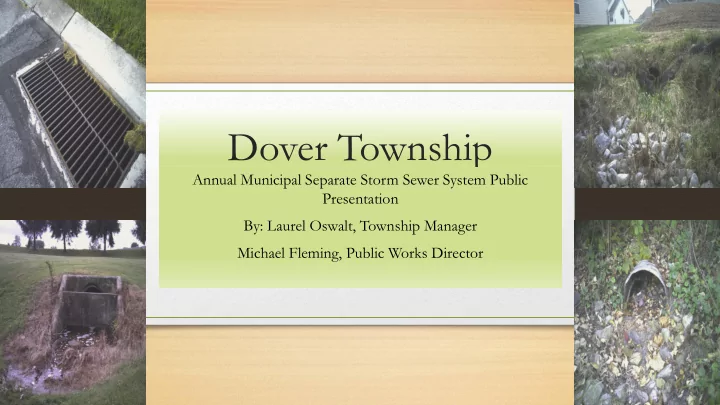
Dover Township

Annual Municipal Separate Storm Sewer System Public Presentation By: Laurel Oswalt, Township Manager Michael Fleming, Public Works Director
slide-2
SLIDE 2

What is the Municipal Separate Storm Sewer System (MS4) Program?

  • A program under which a municipality is issued a

permit to discharge stormwater into the creeks, streams, rivers and ultimately for Dover Township, the Chesapeake Bay. The intent of the MS4 Program is to reduce pollutants. It is regulated by both the United States Department of Environmental Protection Agency (EPA) and the Pennsylvania Department of Environmental Protection (DEP).

slide-3
SLIDE 3

How does the Municipal Separate Storm Sewer System Permit work?

  • The Township’s permit covers a 5 year period, during which, we must

measure our efforts in 6 different areas. These areas are referred to in the permit as Minimum Control Measures (MCMs). Annually, the Township must report to the Pennsylvania DEP on how it has improved, changed, and managed these areas in order to stay in compliance with the permit. Each Minimum Control Measure Area must be re-evaluated annually and the Township must report to the public on their efforts on an annual basis as well.

slide-4
SLIDE 4

Program #1: Public Education and Outreach

  • Develop and implement a written plan

to achieve measurable improvements to the following target audiences:

  • Residents
  • Businesses
  • Developers
  • Schools
  • Municipal Employees
  • Establish lists of target groups in order

to conduct the outreach.

  • Publish educational materials including

articles in the newsletter, pamphlets, and flyers.

  • Place educational materials and links on

the Township Website.

  • Utilize a minimum of 2 other

distribution methods to distribute materials.

slide-5
SLIDE 5

How is Dover Township Providing Education and Outreach?

  • Developed lists through resources available.
  • Provide pamphlets in the entry way to the Township Building and
  • n the Township website with the required links to the regulatory

agencies.

  • Additional distribution methods:
  • Township events
  • Joint Public Education Sessions
  • Mailings
  • Bulletin Boards
  • Educational Video
  • Door hangers
  • Education Station at Rain Garden in Brookside Park
  • Work with the School District on curriculum
slide-6
SLIDE 6

Joint Public Education Sessions with West Manchester and Manchester Townships

slide-7
SLIDE 7

Program #2: Public Involvement and Participation Program

  • Provide opportunities for the public to

participate in public meetings. At least

  • ne meeting annually.
  • Provide information to the public on

community organizations like watershed and environmental groups.

  • Post the annual report on the website.
  • Advertise in the newspaper any changes

in the ordinance, allowing for public comment.

  • Provide methods for the community to

report suspected illicit discharges or pollution events to the Township that would affect waterways.

slide-8
SLIDE 8

How does Dover Township Involve the Community in the Process?

  • Tonight’s meeting is our required annual meeting.
  • We utilize our website and newsletter as a tool to

inform the public about watershed group events.

  • Advertisement of changes to ordinances are a legal

requirement of any ordinance revision.

  • Illicit discharge reporting can be done through our

website contact or by telephone.

NOTICE OF MUNICIPAL SEPARATE STORM SEWER SYSTEM PUBLIC EDUCATION WORK MEETING The Dover Township Board of Supervisors will be holding a Municipal Separate Storm Sewer System Public Education Work Meeting prior to the Dover Township Board of Supervisors regularly scheduled meeting on Monday, April 25, 2016. The educational meeting will begin at 6:00 PM in the Meeting Room of the Dover Township Municipal Building, 2480 West Canal Road, Dover, PA 17315. This meeting is

  • pen for public attendance.

Dover Township Tiffany Strine, Dover Township Secretary

slide-9
SLIDE 9

Program #3: Illicit Discharge Detection and Elimination

  • Identify and map the entire stormwater

sewer system including the MS4 area and areas that are considered high priority for possible illegal discharges.

  • Screen outfalls during various seasonal

conditions at least once during the permit term (5 years).

  • Develop procedures to detect and

eliminate illicit discharges in the field.

  • Evaluate educational or inspection based

programs to prevent on lot septic systems failures.

  • Develop methods for obtaining access

to properties through agreements with property owners.

  • Develop, pass and implement a

stormwater management ordinance to enforce this program and prohibit non- stormwater discharges into the stormwater system.

  • Provide an Educational Program to

target audiences regarding illicit discharges.

slide-10
SLIDE 10

How does Dover Township Manage Illicit Discharges?

  • Dover Township has mapped the

system and divided it into 4 quadrants.

  • Crews inspect an area annually and

look to address:

  • Maintenance issues
  • Cleaning Inlets
  • Illicit discharges
  • Investigate and take samples
  • Use the ordinances to enforce a remedy
slide-11
SLIDE 11

How does Dover Township Manage Illicit Discharges?

  • On lot septic systems are required to

be pumped and inspected every 4

  • years. Permits are required to bring

the system into compliance.

  • Stormwater Operations and

Maintenance agreements are obtained through the building permit process.

  • An ordinance is in place to aid in

enforcement actions. It is periodically reviewed and amended.

slide-12
SLIDE 12

Program #4: Construction Site Stormwater Runoff Control

  • Dover Township relies on the

Pennsylvania Department of Environmental Protection’s National Pollutant Discharge Elimination System Permits which are administered by the York County Conservation District.

  • Under an agreement with the County

regular inspections of construction activities are performed and enforcement procedures are enlisted to bring compliance. Dover Township is informed of all inspections and their outcomes via letter.

slide-13
SLIDE 13

Program #5: Post Construction Stormwater Management in New and Re-Development Activity

  • Develop a program to require the use,

proper selection and inspection of stormwater infrastructure to minimize water quality issues through the development process. Track these new systems.

  • Adopt an ordinance that establishes

the procedure for review, approval, permitting, financial security and inspections of the facilities.

  • Develop and implement measures to

encourage low impact development

  • techniques. Track them.
  • Establish a written program to inspect

these facilities. The program must have enforcement authority to mandate corrections to deficiencies.

  • Determine the inventory of stormwater

facilities and whether they are public or private facilities.

slide-14
SLIDE 14

How does Dover Township Promote the Stormwater Management in the Development Process?

  • Through Ordinances and guidance from

state agencies regarding best management practices, water quality improvements are required.

  • Stormwater Ordinance
  • Subdivision and Land Development Ordinance
  • Zoning Ordinance
  • A list of all the developments with

stormwater management facilities has been

  • developed. Ownership is determined and

responsible parties are identified.

slide-15
SLIDE 15

How does Dover Township Promote the Stormwater Management in the Development Process?

  • Crews inspect the facility with our Trimble

units to determine proper maintenance is

  • ccurring, GPS the location and get

pictures of the facility. They are plotted with our mapping software.

  • If privately owned, letters are generated

and reports provided to the owner for maintenance and repairs to be completed.

  • Enforcement action would need to be

taken if the matters are not addressed.

slide-16
SLIDE 16

Program #6: Pollution Prevention/Good Housekeeping for Municipal Operations

  • Identify and document municipal operations

listing all facilities owned and operated, the activities performed there, including development

  • f a written plan to track these activities and

education of the employees. Some activities include:

  • Street sweeping
  • Snow removal/Deicing
  • Inlet/Outfall cleaning
  • Lawn/Grounds care
  • General Stormwater
  • Maintenance/Repairs
  • General Stormwater Maintenance/Repair
  • Park and Open Space Maintenance
  • Municipal Building Maintenance
  • New Construction and Land Disturbances
  • Right-of-Way Maintenance
  • Vehicle Operation
  • Vehicle Fueling
  • Vehicle Maintenance
  • Leaf/Yard Debris Disposal, etc.
slide-17
SLIDE 17

Program #6: Pollution Prevention/Good Housekeeping & Salt Use

  • Changes to winter operation

activities included salt spreader calibration.

  • “Sensible Salting” to prevent bonding
  • f snow & ice to pavements.
  • Materials are used most efficiently

with minimal damage to environment.

  • Reduction in street sweeping
slide-18
SLIDE 18

Program #6: Pollution Prevention/Good Housekeeping & Salt Use

ROADWATCH Temperature Indicating System

slide-19
SLIDE 19

Questions or Comments?